
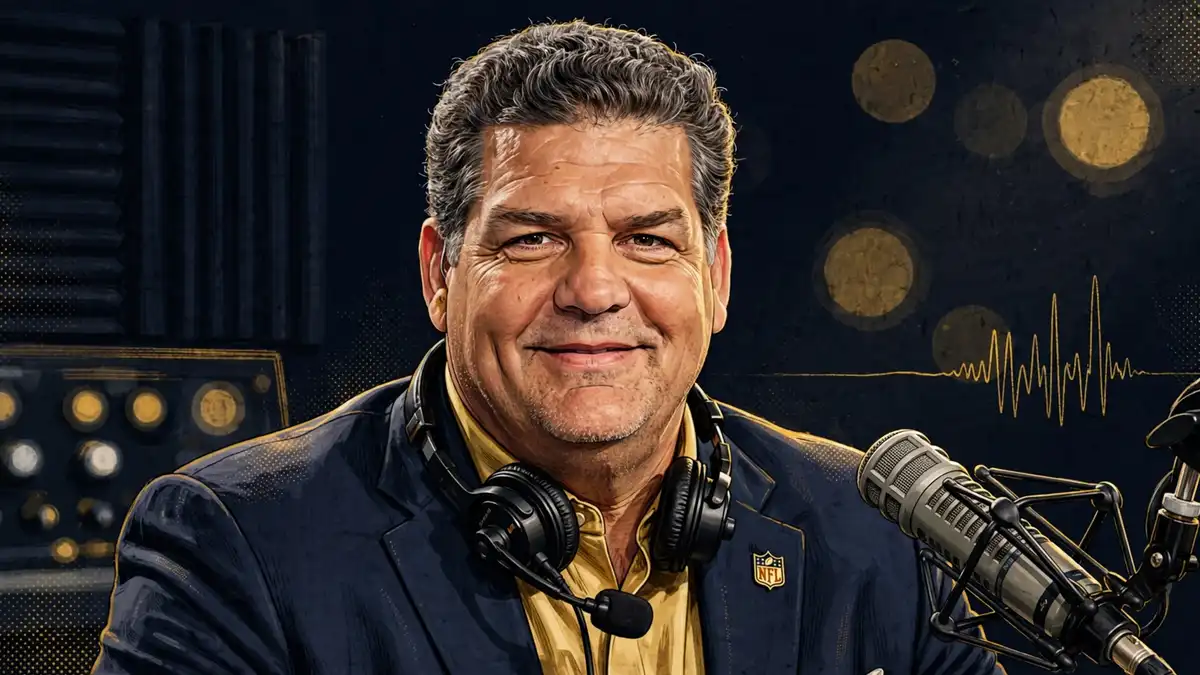
Mike Golic‘s net worth is estimated at $20 million to $25 million as of November 2026. The former NFL defensive lineman turned morning-radio fixture built the fortune the slow way: eight seasons in the NFL, then 25 years at ESPN, where his salary climbed to a reported $6 million a year — and, six years after the network let him go, an August 2026 return to ESPN Radio alongside his son, Mike Golic Jr.
Mike Golic: Quick Facts
| Estimated net worth | $25 million (range: $20 million to $25 million) |
|---|---|
| Profession | Former NFL defensive lineman; sports radio and television host |
| Nationality | American |
| Born | December 12, 1962 (age 63) |
| Height | 6 feet 5 inches (1.96 m) |
| Primary income sources | ESPN broadcasting salary, NFL pension, radio and streaming deals, book royalties, speaking engagements, diabetes-awareness partnerships |
| Active years | 1985–present (NFL 1985–1993; broadcasting 1995–present) |
| Last reviewed | November 2026 |
- Early Life and Background
- Education
- Career Journey
- Rise to Fame
- Main Sources of Income
- Salary and Earnings
- Businesses and Investments
- Brand Deals and Sponsorships
- Houses, Cars and Other Assets
- Awards and Achievements
- Net Worth Growth Over the Years
- Social Media Presence
- Personal Life
- Sources & Reporting
- Frequently Asked Questions
Early Life and Background
Michael Louis Golic Sr. was born on December 12, 1962, in Willowick, Ohio, a small city on Lake Erie about 20 miles northeast of Cleveland. He was the youngest of three brothers in a family where football was less a pastime than a trade. His father, Bob Golic Sr., played seven seasons of professional football in the Canadian Football League for the Hamilton Tiger-Cats, Montreal Alouettes and Saskatchewan Roughriders. His oldest brother, Bob Golic, went further: three Pro Bowl selections across a 14-season NFL career with the New England Patriots, Cleveland Browns and Los Angeles Raiders. The middle brother, Greg, also played. The Golics are of Slovenian descent, and the dinner-table talk in Willowick ran to blocking schemes and training camp.
Golic has said the brothers became competitive swimmers when they were around six or seven years old, a detail that says plenty about the household. Everything was a contest, and losing carried a price at home. That edge stayed with him. At St. Joseph High School in Cleveland, he played football for the Vikings and drew the attention of college recruiters who saw a 6-foot-5 lineman with a motor that never idled. Notre Dame won the race, and the choice shaped the rest of his life: the school became his college, his employer-adjacent home for decades through his children, and the place his whole family kept returning to.
The Willowick years also explain the money story that followed. Golic was not a first-round pick with a signing bonus that set him up for life. He was a 10th-round pick who had to make a roster, then make another one, then find a second career when the first ended at 31. The $25 million estimate is a story of duration, not a single payday: eight NFL seasons at 1980s salaries, then a broadcasting run that lasted three times as long as his playing career and paid several times more per year at its peak.
Education
Golic attended the University of Notre Dame from 1981 to 1984, majoring in finance and management, and graduated in 1985. The degree matters more than it looks on a bio page. He spent his working life around contracts, salaries and negotiations, and he has said the finance grounding helped him read his own deals with clear eyes — including the moment in 2020 when ESPN decided his contract was not worth renewing, a decision he discussed publicly and without bitterness in interviews afterward.
On the field, he played outside linebacker for the Fighting Irish and served as team captain during his senior season. He wore No. 55 in honor of his brother Bob, who had worn the number at Notre Dame before him. The Gerry Faust era at Notre Dame was not a golden age — the Irish averaged about six wins a season from 1981 to 1984 and reached two bowl games — but Golic’s 1983 team beat 13th-ranked Boston College 19-18 in the Fiesta Bowl, a result he still counts among his college highlights.
Football was only half his Notre Dame athletic life. Golic also wrestled for the Fighting Irish and compiled a 24-4-1 career record on the mat. Wrestling gave him something football did not: a solo discipline where conditioning and balance decided everything, and where there was nobody to blame. Three decades later, in 2015, the National Wrestling Hall of Fame inducted him in its Outstanding American category, reserved for people who used wrestling as a springboard to success in another field. It remains one of the honors he talks about most, ahead of anything he won in broadcasting.
Notre Dame also gave him his family network. All three of his children later attended the university. His sons played football there, his daughter swam there, and the family foundation he and his wife later set up directs its giving toward the South Bend community. For a man who has lived most of his adult life in Connecticut, South Bend has stayed home in a way few other places have.
Career Journey
The 1985 NFL Draft picked 330 players. Golic was No. 255, a 10th-round selection of the Houston Oilers, the kind of pick that arrives at camp with no guarantees and a playbook to learn overnight. He made the team. Over eight NFL seasons he played in 115 games and started 49, recording 11.5 sacks, three interceptions and three fumble recoveries, and appearing in five playoff games. The raw numbers place him exactly where he was: a reliable interior lineman, a rotation player who became a starter, never a star, never a Pro Bowler, and valued by coaches who knew what they had.
His tour ran through three franchises. Houston kept him for two-plus seasons, 1985 to 1987. The Philadelphia Eagles claimed him during the 1987 season, and Philadelphia became the defining stop: six seasons, 1987 to 1992, on defenses that terrorized quarterbacks in the late 1980s and early 1990s. He lined up alongside Reggie White, Jerome Brown, Seth Joyner, Wes Hopkins and Andre Waters, with Randall Cunningham running the offense and Cris Carter catching passes. Those Eagles teams won with a ferocious front, and Golic’s job was the unglamorous part — hold the point of attack, eat blocks, let the playmakers hunt. He finished with the Miami Dolphins in 1993, his eighth and final season, and retired at 31.
The money from those eight seasons looks small beside modern contracts, and that gap is the first thing to understand about his fortune. NFL salaries in the late 1980s and early 1990s were a fraction of today’s figures, and a 10th-round defensive tackle was not collecting quarterback money. One tracker puts his total NFL earnings at roughly $5 million across his playing years, a figure we repeat only as a reported estimate — no contract database publishes a verified career total for Golic, and the number should be read as an informed approximation rather than a filing. What the playing years did give him was a vested NFL pension, eight credited seasons toward retirement benefits, and a name that meant something in Philadelphia, where his television career had already started while he was still playing.
That television start is the hinge of the whole story. While with the Eagles, Golic began a weekly segment called “Golic’s Got It” on The Randall Cunningham Show. The segment worked, and a feature he did won a Mid-Atlantic Region Emmy Award. Most players wait until retirement to think about what comes next. Golic was already building the second career in his spare time, learning to talk on camera while he still had a locker. When the Dolphins let him go after 1993, he did not need to start from zero.
He has also been candid about one part of his playing career that other players hide. Golic has admitted he took corticosteroids briefly while recovering from an injury — not anabolic steroids, as he has stressed, but a short course to get back on the field. The admission cost him nothing professionally and fits the pattern of his public life since: he talks about his mistakes and his health in the open, where other broadcasters stay silent.
Rise to Fame
ESPN hired Golic in 1995 as a reporter and analyst for Sunday NFL Countdown, and as an original analyst for NFL 2Night, the five-night-a-week news program on ESPN2 now known as NFL Live. He also worked Arena Football League games as a color commentator from 1996 to 1998 and again from 2007 to 2008, and served as a college football analyst for ESPN and ABC Sports from 1997 to 2004. The resume reads like a utility player filling every gap on the depth chart, and that was the point: Golic would do any assignment, on any platform, and the network kept finding new ones for him.
Radio changed everything. In 1998 he co-hosted the first morning show on ESPN Radio, The Bruno-Golic Morning Show, with Tony Bruno. The pairing lasted about a year before Bruno resigned and left ESPN Radio, and Golic worked through a series of co-hosts for the rest of 1999. Then, in 2000, the network paired him with Mike Greenberg, a New York sportswriter-turned-broadcaster whose style was the opposite of Golic’s in almost every way: Greenberg the careful, germaphobic wordsmith; Golic the ex-jock who ate on air and laughed at himself. Mike & Mike in the Morning — later just Mike & Mike — ran from 2000 to 2017, simulcast first on ESPNews and then on ESPN2 from 2006, and became the centerpiece of ESPN Radio and one of the longest-running morning shows in sports radio history.
The show’s signature bits entered the culture of sports mornings. The annual “Sheet of Integrity” bracket wager — born when Golic said he planned to enter a huge number of NCAA tournament sheets into different pools while Greenberg insisted on picking with integrity — ended with the loser performing an embarrassing stunt on air. In the first year Greenberg won, and Golic had an eyebrow waxed live. In 2010 the pair co-wrote the book Mike and Mike’s Rules for Sports and Life. The honors followed the run: induction into the NAB Broadcasting Hall of Fame in April 2016, then the National Radio Hall of Fame in November 2018, voted in by a panel of nearly 1,000 radio industry professionals. Few sports radio shows have collected both.
When Greenberg left in November 2017 to host the television morning show Get Up!, Golic stayed on radio. On November 27, 2017, he launched Golic and Wingo with Trey Wingo, featuring his son Mike Golic Jr. as a regular presence. The show ran until July 31, 2020, when ESPN canceled it. Golic’s radio run — 22 years on ESPN Radio mornings — ended not with a farewell tour but with a corporate programming decision, and the way it ended still rankles listeners who grew up with the show. His ESPN colleague Chris Berman, another long-tenured voice who became the sound of the network itself, offers the closest parallel for what Golic meant to ESPN’s identity.
The post-ESPN years tested whether the fame would hold without the platform. Golic returned to calling college football games for ESPN and ABC in the fall of 2020, working the Alamo Bowl and Fiesta Bowl, and posted a farewell note on December 22, 2020, after his last day on the ESPN campus. His contract expired at the end of 2020, and ESPN did not re-sign him. In a 2021 interview with The Athletic’s Richard Deitsch, he said the network’s message was blunt: after more than two decades, “they just felt there wasn’t any more worth.” He added that ESPN never even discussed a pay cut. The quote traveled widely because it was so rare — a broadcaster saying out loud what networks usually leave unsaid.
The comeback took six years and ran through three more employers. In 2021 he joined Learfield as co-host and analyst of College Football Saturday Night, a streaming radio broadcast. He worked as an analyst for Pro Football Talk and for Westwood One’s Thursday Night Football broadcasts. In 2022 he and his son launched GoJo and Golic on DraftKings, a streaming show that ran until 2025, when the pair moved to FanDuel Sports Network to host Golic/Golic — a move that also reunited them with former ESPN producer Norby Williamson. That show was canceled in March 2026 amid the network’s financial problems. Then, in June 2026, ESPN announced the move nobody had predicted: Golic and Golic Jr. had signed a multi-year agreement to return to ESPN Radio, and their mid-morning show The Golics debuted on August 3, 2026, airing weekdays from 10 a.m. to noon ET. In August 2026, Notre Dame Athletics also named Golic the color analyst for the SoFi Notre Dame Radio Network for the 2026 season — a homecoming to the school where his career began.
Main Sources of Income
Golic’s money comes from four streams, and their proportions flipped completely between his two careers. The NFL paid him a workingman’s wage for eight seasons. Broadcasting paid him a star’s wage for 25 years. The post-ESPN years added streaming and radio deals, and a set of smaller streams — a book, speaking engagements, diabetes-awareness partnerships — rounded out the total. No single deal made the fortune. The fortune is the sum of a very long run at the top of one network’s pay scale.
ESPN broadcasting is the largest stream by a wide margin. From 1995 to 2020 he drew a network salary that rose with the success of Mike & Mike, reaching a reported $4 million a year under the five-year contract he signed in 2015 and $6 million a year after a raise in 2019. Spread across the final decade of his first ESPN run, that salary alone accounts for tens of millions in gross earnings before tax, agent fees and living costs — the core of the $25 million estimate.
The NFL pension is the quiet second stream. Eight credited seasons vest a player in the NFL’s pension and benefits system, paying a monthly benefit in retirement that grows with credited seasons and age at retirement. The exact figure is private, and the pension is modest beside a $6 million broadcasting salary, but it is guaranteed income that started decades ago and runs for life — the kind of floor that lets a broadcaster take risks on streaming startups and short-term radio deals in his sixties.
Post-ESPN media work is the third stream. Learfield, Westwood One and Pro Football Talk paid for his analysis from 2021 onward, and the DraftKings and FanDuel shows from 2022 to 2026 carried their own deals, none of which were disclosed publicly. The August 2026 return to ESPN Radio under a multi-year agreement restores a network salary as his primary income again, and at 63 he is earning from the same chair he left in 2020 — a rare second act in a business that rarely offers them.
The fourth stream is the smallest and the most personal: the 2010 book Mike and Mike’s Rules for Sports and Life, co-written with Greenberg; paid speaking engagements through agencies that list him for corporate and sports events; and diabetes-awareness partnerships with pharmaceutical and device companies, including Janssen, the maker of the Invokana medication he takes, and LifeScan’s Diabetes Way platform. These deals pay in the low-to-mid five figures per engagement by industry norms, and we do not inflate them into a business empire. They are real, documented income — and they keep his name in front of audiences that never listened to sports radio.
Salary and Earnings
The salary record is the best-documented part of Golic’s finances, and it is also where the numbers split into two eras. Celebrity Net Worth, the tracker with the freshest update on Golic, reports that he signed a five-year ESPN contract in 2015 paying $4 million a year, and that his salary rose to $6 million a year in 2019. Those two figures anchor the whole estimate. A broadcaster earning $4 million to $6 million a year across the back half of a 25-year network run, with no public record of lavish spending or business losses, lands in the $20 million to $25 million range once tax, fees and two decades of living costs are allowed for. The math is not precise, and no honest estimate pretends otherwise — but it is the only math that fits the public record.
Earlier salary figures tell the growth story. Reports from the early 2020s put his ESPN pay at roughly $2 million a year before the 2015 deal, and some trackers still list a $5 million figure as a blended average across his later years — a number that appears in analyst-salary roundups and sits between the $4 million and $6 million contract figures. The spread is not a contradiction. It is what happens when different outlets capture different years of the same rising pay curve. We use the contract figures because they are tied to specific years and a named structure: a five-year deal, then a raise.
The NFL years, by contrast, paid a fraction of the broadcasting money. Drafted in the 10th round in 1985, Golic entered a league where even starters earned mid-six-figure salaries at best, and where a defensive tackle’s pay rose slowly. The reported estimate of roughly $5 million in total career playing earnings — repeated by Readesh and other trackers — is plausible for an eight-year lineman of that era, but it is not verified against a contract database, and Spotrac publishes no career-earnings page for Golic Sr. (its records cover his son’s short NFL stint instead). Treat the $5 million as a guide, not a filing.
The year-by-year picture shows why the net worth estimate holds up. In 2015, the $4 million ESPN deal began. In 2019, the raise to $6 million took effect. In 2020, Golic and Wingo ended on July 31, and his contract ran to December 31, 2020; he collected pay through the end of that deal while calling college games in the fall. From 2021 to 2022, his income dropped to whatever Learfield, Westwood One and Pro Football Talk paid — undisclosed, and certainly below $6 million a year. From 2022 to 2025, the DraftKings show GoJo and Golic paid a streaming-era salary, also undisclosed. The 2025 move to FanDuel Sports Network lasted about a year before the March 2026 cancellation. The August 2026 ESPN return restores network pay under a multi-year deal whose terms ESPN has not disclosed. The shape is a plateau, a dip, and a second plateau — and the second plateau is still running.
Peer comparison sharpens the picture. Pat McAfee, another former NFL player who built a broadcasting fortune, earns far more today under his ESPN deal — but McAfee’s deal came in the 2020s, when sports-media money had grown again. Golic’s $6 million peak, set in 2019, was top-of-market for radio at the time. Troy Aikman, who moved from the field to the booth a generation earlier, shows the same pattern on a bigger scale: the playing career opens the door, and the broadcasting career pays for the house. Golic’s version of that pattern ran through radio rather than the Sunday booth, and radio’s pay ceiling was lower — which is why his estimate sits at $25 million rather than the nine-figure sums attached to the biggest television voices.
One more number deserves a clear answer because readers ask it constantly: no, Golic has never disclosed his net worth, his bank balance, or his current ESPN salary. Every figure in this article is an estimate built from the contract reports above and the trackers that cite them. The $30 million to $50 million range that appears on some low-quality sites has no sourcing behind it — no contract, no filing, no named outlet — and we do not use it. The honest range is $20 million to $25 million, anchored at $25 million because the freshest trackers converge there.

Businesses and Investments
Here is where an honest article parts company with the low-quality net worth sites. Golic has no public business empire. He has never announced a startup, a restaurant chain, a clothing line, a production company or a venture fund, and no filing ties him to one. Some AI-written pages credit him with a production company called Golic Media and a portfolio of properties in Florida and Michigan. Neither claim traces to a named source, a filing or an interview, and both read like the kind of invented detail that fills pages when a writer has run out of facts. We do not repeat them as fact.
What he does have is the portfolio of a man with a finance degree who spent 25 years earning a large salary. He holds a vested NFL pension from eight credited seasons. He owns the family home in Avon, Connecticut, where he has lived with his wife Christine for years. He has spoken publicly about managing his money conservatively and about the discipline his Notre Dame finance training gave him. Beyond that, the record is private, and private is the right word: Golic has never been the subject of a bankruptcy filing, a lawsuit over money, a failed venture or a public investment loss, and the absence of that kind of story is itself a data point. Fortunes built on one salary and held for decades look boring from the outside. Boring is usually what survival looks like.
The investment story that is documented is his health. Diagnosed with type 2 diabetes at 42 in 2005 — the same age his father received the same diagnosis — Golic rebuilt his daily routine around the disease: portion control, regular workouts, medication, and technology to track blood sugar. He has said he weighed about 280 pounds during his playing career and heavier after retirement, and that the diagnosis forced a change. He worked with NutriSystem for Men and has spoken about losing more than 50 pounds through diet and exercise. The payoff is not measured in dollars, but it is the reason he is still on the radio at 63, six years after ESPN first let him go, while many of his contemporaries have retired.
For readers weighing the $25 million figure, the investment section carries a simple test. Add a $4 million to $6 million salary across the last six years of his first ESPN run, subtract federal and Connecticut taxes, agent fees and living costs, add eight NFL seasons, a pension, a book and two decades of speaking and partnership income, and allow for investment growth on the savings. The result lands in the low-to-mid eight figures. It does not land at $50 million, and it does not land at $9 million — the stale figure one tracker still shows from years ago. The range we publish, $20 million to $25 million, is the range the arithmetic supports.
Brand Deals and Sponsorships
Golic’s endorsement life is smaller than a star athlete’s and more focused than a television host’s: almost everything traces to the diabetes diagnosis he received in 2005. He has partnered with Janssen, the pharmaceutical company that makes Invokana, the medication he takes, to raise awareness about living with type 2 diabetes. He worked with the American College of Endocrinology’s “Game Plan” initiative, alongside an endocrinologist and a dietitian, teaching patients to treat their doctor as a coach and their family as teammates — his own words, borrowed from football, and the reason the campaign worked. He has appeared for LifeScan’s Diabetes Way platform and its “Talking Type You” campaign, urging people with diabetes to talk openly about managing the condition instead of hiding it the way his father did.
The deals fit because they are not performances. His father had type 2 diabetes in his forties and never talked about it. Golic decided to do the opposite, telling interviewers that his children needed to know the disease runs in the family and that silence was the real risk. Men’s Journal quoted him at length on the choice, and the candor turned a private health matter into the most consistent commercial thread of his post-ESPN career. These partnerships pay — pharmaceutical awareness campaigns are real, contracted work — but they are not the engine of the fortune. They are the work he does because it matters to him, and the pay follows the work.
Speaking engagements form the second strand. Agencies including All American Speakers and PDA Speakers list Golic for corporate events, sports banquets and diabetes-awareness appearances, trading on two assets no younger speaker has: 25 years on the most listened-to morning show in sports radio, and a playing career at Notre Dame and in the NFL. Speaking fees for a broadcaster of his standing typically run into five figures per event, though no agency publishes his rate. He also earned from the book Mike and Mike’s Rules for Sports and Life, published in 2010 with Greenberg, and from cameo appearances as himself — on ESPN’s Tilt, on Guiding Light in 2008, and as a playable legend in the video game All-Pro Football 2K8 the same year.
What he has not done is lend his name to the product lines that fill other broadcasters’ endorsement pages. There is no Golic-branded apparel, no supplement line, no crypto deal, no sportsbook ambassadorship on the public record, even as sports betting sponsors flooded the industry he works in. The absence is notable, and it is consistent with the rest of the profile: a broadcaster who kept his commercial life narrow, his name attached to a health cause he lives with, and his income tied to the microphone.
Houses, Cars and Other Assets
Golic lives in Avon, Connecticut, with his wife Christine, in the home the family has kept through his ESPN years. Avon sits about 10 miles west of Hartford, close enough to ESPN’s Bristol campus for a daily commute and far enough into the Farmington Valley for the privacy a broadcaster wants. No public record states the home’s value, and we do not guess one. Property records for the house are not part of the public reporting on Golic, and the low-quality sites that attach a dollar figure to the address are inventing it.
The family also spends time in South Bend, Indiana, and Scottsdale, Arizona, according to reporting by The Spun — South Bend for the Notre Dame ties and the family foundation’s work, Scottsdale as a warm-weather base. Whether those are second homes, rentals or extended stays is not documented, and we do not present them as a property portfolio. The honest statement is that Golic owns at least one long-term family home in Connecticut and keeps roots in the two other cities that matter to his family.
Cars are where the reporting gets specific, and charming. Golic’s pride and joy, by multiple accounts, is a Toyota 4Runner in a cement color — and the family collectively owns three identical ones, one for each branch of the household, a detail reported by The Sports Lite that fits everything else known about the man. There is no public record of a luxury car collection, no Ferrari or Bentley on the bio pages, and no dealership partnership. A broadcaster who made $6 million a year and drives a Toyota truck is either modest or unbothered by status symbols, and the evidence points to both.
The remaining assets are the ones that do not photograph well: the NFL pension, the savings accumulated across 25 years of network pay, the book royalties that still trickle in, and the new multi-year ESPN Radio agreement signed in June 2026. None of them has a public valuation. Taken together they are the balance sheet behind the $25 million estimate — a balance sheet built on salary rather than speculation, which is why it has survived six years without a network job and a full career change in the streaming era.
Awards and Achievements
Golic’s trophy case splits into two halves, and the split tells the story of the career. The playing half is thin: no Pro Bowl, no All-Pro selection, no Super Bowl ring. He was a good professional lineman on good teams, and the record reflects that without apology. The broadcasting half is heavy, and it is where the honors cluster.
The first award came while he was still playing. His weekly segment “Golic’s Got It” on The Randall Cunningham Show won a Mid-Atlantic Region Emmy Award — a local Emmy, but a real one, and the first proof that the lineman could hold a television audience. The second wave came with Mike & Mike: induction into the NAB Broadcasting Hall of Fame in April 2016, in a ceremony in Las Vegas alongside names like Bob Uecker, Vin Scully and Harry Caray, and induction into the National Radio Hall of Fame in November 2018, voted in by a panel of nearly 1,000 radio industry professionals. The show ran from 2000 to 2017, and the two hall inductions are the industry’s verdict on what those 17 years meant.
The third honor is the one he seems proudest of. In 2015, the National Wrestling Hall of Fame inducted him in its Outstanding American category, honoring people who used wrestling as a stepping stone to success elsewhere. His 24-4-1 college wrestling record at Notre Dame was three decades old by then, and the induction recognized the discipline rather than the record. In 2018, the Walter Camp Football Foundation named him its Man of the Year, an award that honors leadership and service alongside football achievement — a fitting cap to a year that also brought the Radio Hall of Fame induction.
Measured against his peers, the honors place Golic in a small group: broadcasters who reached two halls of fame without ever being the biggest television star of their era. Boomer Esiason, another former NFL player who built a long radio career after retirement, followed a similar path from the field to the morning microphone. Phil Simms, who moved from quarterback to the broadcast booth, shows the television version of the same second act. Golic’s version ran through radio, lasted longer than either man’s playing career, and ended — twice — with a hall induction and a network comeback.
Net Worth Growth Over the Years
No year-by-year net worth record exists for Golic, so the table below is our reconstruction from the documented salary milestones, not a filing. It shows the shape of the fortune: slow growth through the playing years, steady accumulation through the radio years, a jump when the ESPN contracts grew, a plateau after the 2020 exit, and a second act from 2026.
| Period | What happened | Estimated net worth |
|---|---|---|
| 1985–1993 | Eight NFL seasons; Oilers, Eagles, Dolphins; modest 1980s salaries | Under $1 million |
| 1995–1999 | Joins ESPN; Sunday NFL Countdown, NFL 2Night; first radio show | $1 million – $2 million |
| 2000–2010 | Mike & Mike launches; simulcast on ESPN2; book published 2010 | $3 million – $6 million |
| 2011–2014 | Peak Mike & Mike years; salary rising toward $2 million a year | $6 million – $10 million |
| 2015–2019 | Five-year ESPN deal at $4 million a year; raise to $6 million in 2019 | $12 million – $20 million |
| 2020–2021 | Golic and Wingo ends; contract expires; college-game work; Learfield | $20 million – $22 million |
| 2022–2025 | DraftKings show GoJo and Golic; move to FanDuel Sports Network | $22 million – $24 million |
| 2026 | FanDuel show canceled March 2026; ESPN Radio return August 2026; Notre Dame radio role | $20 million – $25 million |
Two things stand out in that table. First, the fortune was made late: Golic was 53 when he signed the $4 million deal in 2015, and 57 when the raise to $6 million arrived. Most athletes make their money in their twenties. Golic made his in his fifties, because radio pays for longevity and he had more of it than almost anyone in the business. Second, the 2020 exit did not shrink the estimate. A broadcaster who has banked a decade of multi-million-dollar salaries does not lose the fortune when the job ends; he loses the income, and the savings stay. The 2026 return adds income again, which is why the range holds at $20 million to $25 million rather than drifting down.
Peer comparison puts the number in context. Aaron Rodgers, whose playing contracts dwarf anything Golic earned on the field, shows what the first career can pay at the very top. Golic’s story is the inverse: a modest playing career, then a broadcasting career that paid many times more than the playing one ever could. Among the broadcasters who followed that path, $25 million is a strong outcome — ahead of most former players who tried radio and left, and behind only the television booth stars whose contracts run into eight figures a year.
Social Media Presence
Golic’s social media presence is an extension of the radio show rather than a brand of its own. He is active on X, formerly Twitter, under the handle @espngolic, where he posts show clips, Notre Dame football notes, family moments and the occasional sharp opinion on a game. His December 22, 2020 farewell post from the ESPN campus — “Weird day this Dec. 22nd. While I still have Alamo bowl and Fiesta bowl on my ESPN schedule, I was at ESPN today for the last time” — was shared widely enough to become part of the story of his departure, and it remains the most quoted thing he has written online.
He also posts on Instagram, where the feed leans toward family, golf and behind-the-scenes shots from the studio, and he appears regularly in clips posted by ESPN Radio and by his son’s accounts. We do not publish follower counts here: they change daily, and no verified count was available at the time of writing. The useful fact is the shape of the audience. Golic’s following is older, sports-radio loyal and Notre Dame connected — the audience that listened to Mike & Mike on the drive to work for 17 years and followed him to DraftKings, FanDuel and back to ESPN. That loyalty is why a 63-year-old broadcaster could sign a new multi-year radio deal in 2026, six years after his network decided he had no worth left to offer.
His daughter Sydney has built her own social following, and his son Mike Jr. is active across platforms as a broadcaster in his own right. The family’s online presence is a group project as much as an individual one, and the August 2026 return of The Golics gave all three generations of it a new center: a father-and-son show on the network where the father spent a quarter-century.
Personal Life
Golic married Christine Golic on May 30, 1987, and the marriage has lasted nearly four decades — through the NFL years, the ESPN years, the 2020 exit and the 2026 return. Christine, herself a Notre Dame graduate, has been the steady center of the household: the person who, by Golic’s own account, made him work out, put vegetables on the table and kept him honest about his health after the diabetes diagnosis. When her father died, Golic once walked off his show mid-broadcast to be with her. The marriage is the least dramatic part of his public life, and that is the point: no divorce, no scandal, no tabloid cycle, in a business where all three are common.
The couple has three children, and all three attended Notre Dame. Mike Golic Jr., born September 28, 1989, played football at Notre Dame, signed with the Pittsburgh Steelers as an undrafted free agent in 2013, spent time with the New Orleans Saints and the Montreal Alouettes, and then followed his father into broadcasting — co-hosting Chiney & Golic Jr. at ESPN, then GoJo and Golic on DraftKings, Golic/Golic on FanDuel, and now The Golics on ESPN Radio. Jake Golic, born December 25, 1990, played football at Notre Dame and then for the University of Cincinnati in the 2014–15 season. Sydney Golic, born December 21, 1994, swam for the Fighting Irish and married Ben Braunecker on April 17, 2022.
The family set up the Golic Family Foundation to give back to the South Bend community, the city that shaped the family across two generations. The foundation’s work is local and low-profile — the opposite of a gala-circuit charity — and it fits the pattern of a family that treats Notre Dame as a home rather than a credential. Golic has also been open about the diabetes that runs in the family: diagnosed at 42, the same age as his father, he told his children they would need to take precautions, and he built his public health work around the refusal to hide the disease the way his parents’ generation did.
He is 63, back on ESPN Radio, calling Notre Dame games, and working beside his son. The personal life section of a net worth article usually reads like an afterthought. In Golic’s case it reads like the explanation: the fortune was built by a man who stayed married, stayed healthy enough to keep working, stayed loyal to one school and one network, and got a second chance at the job he loved because the audience never left.
Sources & Reporting
Celebrity Net Worth — the $25 million estimate, the 2015 five-year ESPN contract at $4 million a year, the 2019 raise to $6 million a year, the July 2020 Golic and Wingo cancellation, the 2021 Learfield move, the DraftKings and FanDuel shows, and the June 2026 ESPN return; page updated November 21, 2026.
ESPN Press Room — the NAB Broadcasting Hall of Fame induction in April 2016 and the National Radio Hall of Fame induction announcement in June 2018 for Mike & Mike.
Awful Announcing — the August 2026 return to ESPN Radio with The Golics, six years after the 2020 departure, and Golic’s account of ESPN’s decision not to re-sign him.
Front Office Sports — the November 2020 interview as Golic entered free agency after 25 years at ESPN, including the end of Golic and Wingo and the move to college-game work.
Sportscasting — Golic’s 2021 interview with The Athletic’s Richard Deitsch on his ESPN departure, including the “they just felt there wasn’t any more worth” account and the December 22, 2020 farewell.
Wikipedia — biographical cross-check: December 12, 1962 birth in Willowick, Ohio; 1985 draft, 255th overall; 115 games, 49 starts, 11.5 sacks, three interceptions; Notre Dame degree, captaincy and wrestling record; family details.
Pro Football History — the life-and-career account: Willowick upbringing, Slovenian descent, competitive swimming as a child, the Gerry Faust Notre Dame years, the Philadelphia Eagles tenure, and the 2005 type 2 diabetes diagnosis at age 42.
Men’s Journal — the interview on living with type 2 diabetes, the Janssen/Invokana partnership, and treating his doctor as a coach and his family as teammates.
Diabetes Self-Management — the American College of Endocrinology “Game Plan” initiative with Golic as a coach for patients with type 2 diabetes.
The Spun — the family profile: marriage to Christine since 1987, three children at Notre Dame, and time spent in South Bend and Scottsdale as well as Avon, Connecticut.
National Wrestling Hall of Fame — the 2015 Outstanding American induction and the 24-4-1 college wrestling record at Notre Dame.
Reporting window: November 2026, with the freshest tracker update dated November 21, 2026. Salary figures are reported contract terms from Celebrity Net Worth; the $5 million total NFL earnings figure is a tracker estimate and is labeled as such. No figure in this article comes from an unaudited or anonymous source without that label attached.
Frequently Asked Questions
What is Mike Golic’s net worth in 2026?
Mike Golic’s net worth is estimated at $25 million in 2026, within a range of $20 million to $25 million. Celebrity Net Worth puts the figure at $25 million in an update dated November 21, 2026, and other 2026 trackers agree. The estimate rests on his long ESPN career, where his salary peaked at a reported $6 million a year, rather than on his eight NFL seasons, which paid far less.
What was Mike Golic’s salary at ESPN?
At his peak, Mike Golic earned a reported $6 million a year at ESPN. He signed a five-year contract in 2015 paying $4 million a year, and his salary was raised to $6 million a year in 2019, according to Celebrity Net Worth. Earlier in his ESPN run he earned roughly $2 million a year, so the $6 million figure reflects the final years of his first stint at the network.
Is Mike Golic still at ESPN in 2026?
Yes. After six years away, Mike Golic returned to ESPN Radio in August 2026. He and his son Mike Golic Jr. signed a multi-year agreement, and their mid-morning show The Golics debuted on August 3, 2026, airing weekdays from 10 a.m. to noon ET. Golic had left ESPN at the end of 2020 when the network did not renew his contract.
What is Mike Golic doing now?
As of November 2026, Mike Golic co-hosts The Golics on ESPN Radio with his son Mike Golic Jr., weekdays from 10 a.m. to noon ET. He is also the color analyst for the SoFi Notre Dame Radio Network for the 2026 season, a role Notre Dame Athletics announced in August 2026. Before the ESPN return he hosted shows on DraftKings and FanDuel Sports Network with his son.
How old is Mike Golic?
Mike Golic is 63 years old. He was born on December 12, 1962, in Willowick, Ohio, so he turns 64 in December 2026. He was 22 when the Houston Oilers drafted him in 1985, 37 when Mike & Mike began in 2000, and 63 when he returned to ESPN Radio in August 2026.
How tall is Mike Golic?
Mike Golic is 6 feet 5 inches tall (1.96 m). He played at about 265 pounds during his NFL career as a defensive tackle, and has said he weighed around 280 pounds at his heaviest before changing his diet and exercise routine after his type 2 diabetes diagnosis in 2005.
Who is Mike Golic’s wife?
Mike Golic’s wife is Christine Golic, whom he married on May 30, 1987. Christine is a Notre Dame graduate, and the couple has three children — Mike Golic Jr., Jake Golic and Sydney Golic — all of whom attended Notre Dame. The family lives in Avon, Connecticut.
Did Mike Golic play in the NFL?
Yes. Mike Golic played eight seasons in the NFL as a defensive tackle after the Houston Oilers drafted him 255th overall in the 10th round of the 1985 NFL Draft. He played for the Oilers (1985–1987), the Philadelphia Eagles (1987–1992) and the Miami Dolphins (1993), appearing in 115 games with 49 starts, 11.5 sacks and three interceptions.
Final Thoughts
Mike Golic’s $25 million net worth is a reward for staying power. He was never the highest-paid player on his team, never the biggest television star at his network, and never the broadcaster with the flashiest deal. He was the one who showed up: eight NFL seasons as a 10th-round pick who refused to wash out, then 25 years at ESPN, 17 of them on the morning show that defined sports radio for a generation, at a salary that climbed to $6 million a year because the audience kept coming back.
The 2020 exit could have been the end of the story. ESPN told him, in effect, that his worth to the network had run out, and he spent the next six years proving otherwise — on Learfield, on Westwood One, on DraftKings, on FanDuel — until the network that let him go signed him to a new multi-year deal and put him back on the radio beside his son. At 63, with a pension, a house in Avon, a foundation in South Bend and a morning show again, the fortune is secure and the second act is still running. The range is $20 million to $25 million, anchored at $25 million, and the next chapter — The Golics, Notre Dame radio, and whatever comes after — will decide whether it grows from here.
Published on November 22, 2026. Last reviewed November 2026. Found an error? See our corrections policy.