
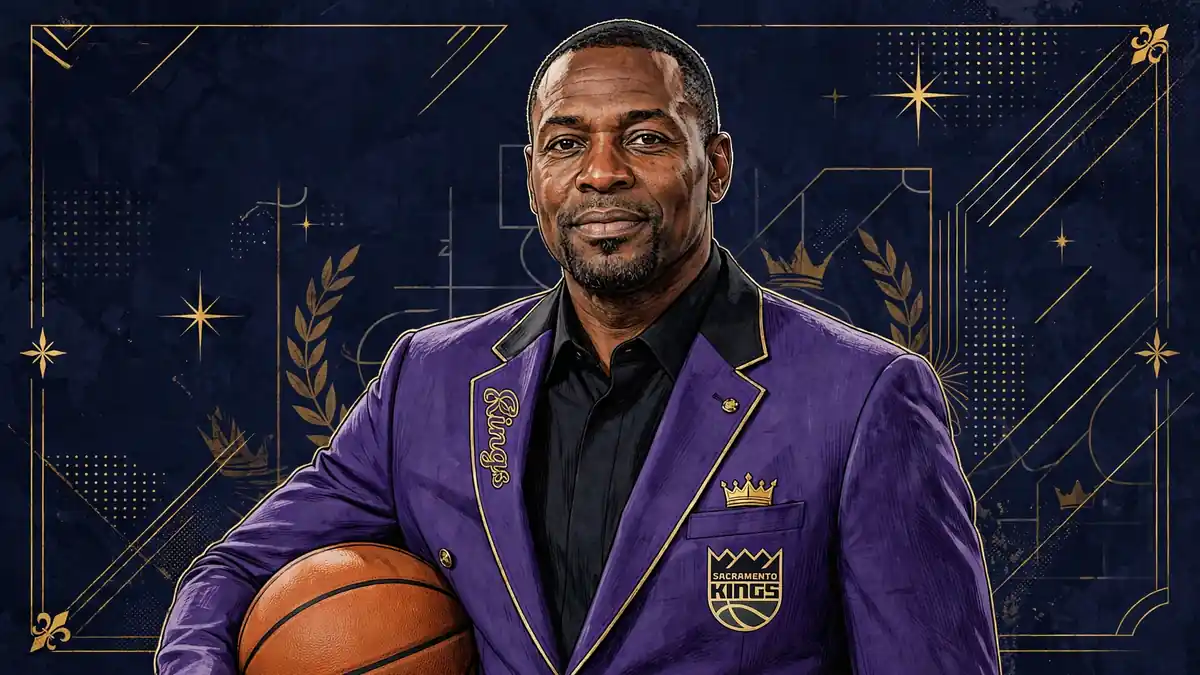
Doug Christie‘s net worth is estimated at $20 million to $25 million as of November 2026. The former NBA shooting guard banked $51.6 million in playing salary across 15 seasons, then came back to the franchise where he made his name — the Sacramento Kings — as head coach, a job that pays him about $2 million a year, reportedly the lowest head-coaching salary in the league. The gap between what he earned and what he kept is the story of this estimate, and it starts with a number many sites get wrong.
Doug Christie: Quick Facts
| Estimated net worth | $20 million (range: $20 million to $25 million) |
|---|---|
| Profession | NBA head coach and former professional basketball player |
| Nationality | American |
| Born | May 9, 1970 (age 56) |
| Height | 6 ft 6 in (1.98 m) |
| Primary income sources | NBA playing salary, Sacramento Kings head-coaching salary, broadcasting, reality television |
| Active years | Playing career 1992–2007; coaching career 2021–present |
| Last reviewed | November 2026 |
- Early Life and Background
- Education
- Career Journey
- Rise to Fame
- Main Sources of Income
- Salary and Earnings
- Businesses and Investments
- Brand Deals and Sponsorships
- Houses, Cars and Other Assets
- Awards and Achievements
- Net Worth Growth Over the Years
- Social Media Presence
- Personal Life
- Sources & Reporting
- Frequently Asked Questions
Early Life and Background
Douglas Dale Christie was born on May 9, 1970, in Seattle, Washington, to Norma and John Christie. His mother is white and his father is Black, and Christie has spoken openly about growing up biracial in Seattle during the 1970s and 1980s. Basketball was the constant. He attended Cascade Middle School and Mark Morris High School before transferring to Rainier Beach High School, where his game took off. As a senior in 1988, Christie led Rainier Beach’s varsity boys’ team to its first-ever state championship, a result that still sits in the school’s record books and put the 6-foot-6 guard on every West Coast college recruiter’s list.
Seattle shaped more than his jump shot. Rainier Beach sits in one of the city’s toughest neighborhoods, and Christie has described the discipline of those years — early gym sessions, long bus rides, a mother who kept him on a short leash — as the foundation for a 15-year professional career built less on raw talent than on work and defense. He was never the most gifted scorer on any roster he joined. He became the player coaches trusted to guard the other team’s best scorer, and that reputation, formed on Seattle playgrounds and high-school gyms, paid him for a decade and a half.
By the time he graduated from Rainier Beach in 1988, Christie had a clear profile: long, quick, unselfish, and already a better defender than most college guards. Pepperdine University, a small West Coast Conference school in Malibu, won the recruiting race — a choice that looks modest on paper and turned out to be the best basketball decision of his young life, because at Pepperdine he got the minutes and the freedom that a bigger program might never have given him.
Education
Christie enrolled at Pepperdine University in 1988 as a sociology major and spent four seasons with the Waves. The program was a strong fit. Pepperdine reached the NCAA tournament in 1991 and again in 1992, and Christie was named West Coast Conference Men’s Basketball Player of the Year in both seasons — a rare back-to-back honor that marked him as the best player in his conference two years running. He left Pepperdine as one of the most decorated players in school history, with a degree path in sociology and a draft stock that had climbed steadily through his senior year.
The college numbers matter for the money story because they explain his draft position. Christie was not a lottery pick and never carried a max-contract profile. He was a mid-first-round pick whose value came from defense, versatility, and durability — the kind of player who earns steadily for a long time rather than landing one enormous payday. That pattern held for his whole career: no single contract ever made him rich, but 15 seasons of them added up to more than $51 million in salary.
Pepperdine also gave him something less measurable. The Waves’ program under coach Tom Asbury ran a disciplined, defense-first system, and Christie arrived in the NBA already fluent in the habits — film study, positional defense, moving without the ball — that kept role players employed. His sociology degree, meanwhile, is a footnote that says something about the man: even as a teenager, Christie was interested in how people and groups work, an interest that later showed up in his broadcasting and coaching.
Career Journey
Christie’s professional career ran from 1993 to 2007 and took him through seven NBA organizations. The through-line is not stardom but survival and reinvention: a player who started as an afterthought in Los Angeles, found his game in Toronto, became a defensive anchor in Sacramento, and then watched his body give out in his mid-30s. The salary table in the earnings section below tracks that arc season by season.
The draft and the Los Angeles Lakers
The Seattle SuperSonics selected Christie with the 17th overall pick in the 1992 NBA draft. He never played a game for them. Unable to agree on a contract with Seattle, Christie sat out the start of the season until the Sonics traded him to the Los Angeles Lakers in early 1993. He made his NBA debut that March — wearing a jersey that bore the misspelled name “Chrisite,” a small indignity that has followed him through every career retrospective since. The Lakers used him sparingly: 23 games to close out the 1992-93 season and 65 games in 1993-94. His rookie-scale pay was $1,445,000 for the 1993-94 season, according to Basketball-Reference’s salary records.
Those two seasons in Los Angeles taught Christie the economics of the league’s middle class. He was a first-round pick on a glamour franchise, and still a bit player. The Lakers traded him to the New York Knicks in 1994, and the pattern repeated: 12 games in 1994-95 and 23 games in 1995-96. Three seasons in, Christie had played for two of the league’s biggest-market teams and had almost nothing to show for it — no starting role, no signature moment, and a career that looked headed for the end of the bench.
Toronto Raptors: the breakout
Midway through the 1995-96 season, the Knicks traded Christie to the Toronto Raptors, then a young expansion franchise with minutes to give. The change of scenery changed his career. He appeared in 32 games for Toronto that season, averaging 10.1 points per game. In 1996-97 he played 81 games and averaged 14.5 points; the next season he recorded a career-high 16.5 points per game in 78 games. Toronto gave him the one thing Los Angeles and New York never had: a starting job and the freedom to fail.
Christie played two more seasons with the Raptors and in 2000 helped the team reach the first round of the playoffs — the franchise’s first postseason appearance. His salary climbed with his role, from $1,355,000 in 1996-97 to $2,742,600 in 1999-00. By the end of his Toronto run he was a proven two-way starter, a 6-foot-6 guard who could defend three positions, hit the open three, and run an offense in stretches. That is the profile Sacramento paid for in the summer of 2000.
Sacramento Kings: the peak years
In August 2000, the Kings traded forward Corliss Williamson to Toronto for Christie. The deal is now remembered as one of the best trades in Kings history. Christie became Sacramento’s starting shooting guard and one of the best perimeter defenders in the league. His defense was credited with pushing the Kings toward the top of the NBA, and he helped lead the team to four consecutive playoff appearances from 2001 to 2004. In the 2001-02 season the Kings led the league in wins and reached the Western Conference Finals, falling to the Los Angeles Lakers in a seven-game series that remains one of the most argued-over results in modern NBA history.
Those five Sacramento seasons were also his best-paid. His Kings salary rose from $3,140,000 in 2000-01 to $5,200,000, then $6,250,000, $6,900,000 and $7,550,000 in 2004-05. He played 355 games for Sacramento — more than for any of his other six organizations — and the city adopted him. Kings fans still rank him among the most popular players of the franchise’s Sacramento era, and that popularity later became the foundation of his second career in broadcasting and coaching.
Orlando, Dallas, and the Los Angeles Clippers
The end came fast. In January 2005 the Kings traded Christie to the Orlando Magic. Unhappy about the trade, he played only a few games before bone spurs in his ankle forced surgery; the Magic released him on August 11, 2005. His 2005-06 Orlando salary of $8,200,000 was the largest single-season paycheck of his career, but he barely played for it — a reminder that NBA contracts pay for the season, not for the games played.
After his release, Christie signed a one-year contract with the Dallas Mavericks, but persistent ankle problems limited him to seven games before he was waived in late 2005. He sat out all of 2006, then attempted a comeback in early 2007 by signing a 10-day contract with the Los Angeles Clippers. He played seven games, decided his body was done, and walked away. His final NBA paycheck was $158,071 from the Clippers. He retired at 36, after 15 seasons, 9,301 career points, 3,382 rebounds and 1,555 steals.
That ending shapes the net worth picture in two ways. First, Christie never had a late-career veteran payday of the kind modern role players collect — his last big contract was the Orlando deal, and it ended in surgery. Second, he retired before the NBA’s salary explosion. His $51.6 million career total, earned between 1993 and 2007, would look modest next to a single modern contract: today’s mid-level players sign deals worth more than Christie’s entire career. His wealth was built in a cheaper era, and it shows in the estimate.
Rise to Fame
Christie never became famous the way scorers do. He became famous the way defenders do: slowly, then all at once, when the team around him started winning. The rise had three stages. First, Toronto, where he went from bench player to 16-point-a-game starter. Second, Sacramento, where his defense turned a fun offensive team into a genuine contender. Third, the 2002 Western Conference Finals, where the Kings pushed a Lakers dynasty to seven games and Christie guarded Kobe Bryant in stretches — the kind of assignment that makes a player’s reputation, win or lose.
The honors followed the winning. Christie was named to the NBA All-Defensive First Team in 2003 and to the All-Defensive Second Team in 2001, 2002 and 2004 — four All-Defensive selections in four seasons, a run matched by very few guards of his era. He was also recognized as one of the league’s best three-point shooters during the Sacramento years, a combination — lockdown defense plus reliable outside shooting — that every contender wants and few players provide. Coaches voted for those teams, not fans, which says something about how the league itself valued him.
Fame also came from the other half of his public life. By the early 2000s, Christie and his wife Jackie were among the most talked-about couples in the NBA, thanks to a New York Times feature in 2002 about their marriage and their habit of renewing their wedding vows every year. The 2006 BET reality series “The Christies Committed” and Jackie’s long run on VH1’s “Basketball Wives” kept the family in the public eye long after his playing days ended. That visibility never translated into the endorsement money a star would command, but it kept his name in circulation — and it is part of why Sacramento welcomed him back as a broadcaster in 2018 and as a coach in 2021.
His second rise, the coaching one, began quietly. Christie joined NBC Sports California as a color commentator for Kings games in the 2018-19 season, spending three seasons in the booth learning the franchise from the outside. In August 2021 he left broadcasting to become an assistant coach under Luke Walton, then Alvin Gentry, then Mike Brown. When Brown was fired on December 27, 2024, Christie was named interim head coach. He steadied a listing team, going 27-24 the rest of the way, and on May 1, 2025, the interim tag was removed. He was the Kings’ head coach — the same franchise, the same building, the same fans who had cheered him as a player two decades earlier.
Main Sources of Income
Christie’s money comes from four places, and the first dwarfs the other three. Understanding the split is the key to the whole estimate.
NBA playing salary — about $51.6 million. This is the foundation of his wealth and the only income stream with a public paper trail. Basketball-Reference’s salary database puts his career total at $51,591,438 across 15 seasons, with the biggest single-season paychecks coming late: $7,550,000 from Sacramento in 2004-05 and $8,200,000 from Orlando in 2005-06. Those are gross figures. After federal and state taxes, agent fees of roughly 3 to 4 percent, and 15 years of living costs, the amount that could have been saved and invested is far smaller — which is exactly why his net worth sits near $20 million rather than $50 million. Anyone quoting $50 million as his net worth is repeating his gross earnings, not his wealth.
Head-coaching salary — about $2 million a year. When Christie signed his three-year deal as the Kings’ permanent head coach in May 2025, The Athletic’s Sam Amick reported the terms: two guaranteed seasons at approximately $2 million annually, with a team option for 2027-28 that carries what Amick called a significant raise. Hoops Rumors and Field Level Media confirmed the same structure. That makes Christie one of the lowest-paid head coaches in the NBA — his predecessor Mike Brown had been on an extension worth $8.5 million a year, per The SportsGrail — and the Kings’ decision to keep him after a 22-59 season in 2025-26 was reported in April 2026 by multiple outlets, with Amick noting the below-market contract likely played a role. Two guaranteed years at $2 million adds roughly $4 million in gross coaching pay, before tax.
Broadcasting — undisclosed. Christie spent three seasons, 2018-19 through 2020-21, as a color commentator for Kings games on NBC Sports California. Regional sports network analyst pay is not public, and no outlet has reported his figure. It was a real income stream — former players in that chair typically earn a solid six-figure salary — but it was a bridge between careers, not a fortune. He gave it up in August 2021 to join the coaching staff, trading the booth for the bench and a longer runway.
Reality television and media projects — modest. Christie and Jackie starred in the 2006 BET J reality series “The Christies Committed,” and Doug has appeared alongside Jackie on VH1’s “Basketball Wives” over the years. Reality pay for a supporting cast member is a fraction of what a lead earns — reporting on the genre has put Jackie’s per-episode figure at up to $20,000, and Doug’s appearances have been fewer and smaller. In 2007 the couple self-released “The Christie’s Un-Cut,” a sketch-comedy DVD; Wikipedia’s account of his career notes it sold 1,800 copies. These projects kept the Christie name in the entertainment press, but they were never a major income line. They matter more to the story of his fame than to the story of his money.
What is missing from the list is just as telling. There is no public record of a major endorsement portfolio, no signature shoe, no national ad campaign, and no verified business empire. Christie was a defense-first role player in an era before role players got rich off endorsements, and his post-playing income has come from jobs — broadcasting, coaching — rather than from equity or licensing. That is a normal financial profile for a player of his tier, and it is why the estimate range stays tight.

Salary and Earnings
The table below lists Christie’s NBA salary season by season, drawn from Basketball-Reference’s salary records. It is the single most reliable document in this whole article, because NBA salaries are public by design. Read it as the spine of his fortune — and notice where the money concentrates. More than half of his career total arrived in his final six seasons, and his two biggest paydays came in the last three years of his career.
| Season | Team | Salary |
|---|---|---|
| 1993-94 | Los Angeles Lakers | $1,445,000 |
| 1994-95 | New York Knicks | $1,244,000 |
| 1995-96 | New York Knicks | $1,466,000 |
| 1996-97 | Toronto Raptors | $1,355,000 |
| 1997-98 | Toronto Raptors | $2,012,767 |
| 1998-99 | Toronto Raptors | $2,353,000 |
| 1999-00 | Toronto Raptors | $2,742,600 |
| 2000-01 | Sacramento Kings | $3,140,000 |
| 2001-02 | Sacramento Kings | $5,200,000 |
| 2002-03 | Sacramento Kings | $6,250,000 |
| 2003-04 | Sacramento Kings | $6,900,000 |
| 2004-05 | Sacramento Kings | $7,550,000 |
| 2005-06 | Orlando Magic | $8,200,000 |
| 2005-06 | Dallas Mavericks | $1,575,000 |
| 2006-07 | Los Angeles Clippers | $158,071 |
| Career total | 7 teams, 15 seasons | $51,591,438 |
Two notes on the numbers. First, Celebrity Net Worth gives a slightly different peak-season figure — $7,821,000 for 2004-05 — against Basketball-Reference’s $7,550,000 for the same season. The difference is small and likely comes from how incentives and contract structure are counted; it does not change the picture. Second, Celebrity Net Worth translates that 2004-05 salary into about $13.2 million in today’s dollars, which shows how much the purchasing power of his peak earnings has grown since. His whole career total, adjusted the same way, would be worth far more than $51.6 million in 2026 dollars — but net worth is measured in the dollars he kept, not the dollars he earned.
How does his pay compare with the players around him? The gap is the point. Michael Jordan earned about $94 million in NBA salary in an era with a much smaller salary cap, then built a fortune worth billions off the court. LeBron James has earned more than $500 million in playing salary alone. James Harden, a guard of Christie’s generation’s next wave, has earned more than $300 million. Christie sits in a different tier: a well-paid starter whose career total would not cover two seasons of a modern max contract. The comparison is not a knock. It explains why his net worth is measured in tens of millions while the superstars’ are measured in hundreds of millions and billions.
His coaching pay adds a modest second act. Two guaranteed years at roughly $2 million is about $4 million gross, and the team option for 2027-28 would pay significantly more if exercised, per The Athletic. If the Kings pick up that option after a better season, his coaching earnings could approach $8 million to $10 million across the deal. If they do not, his coaching total stays near $4 million plus whatever assistant-coach salary he earned from 2021 to 2024, which was never reported. Either way, coaching is a comfortable living, not a second fortune.
Businesses and Investments
Here is where an honest article has to say what it does not know. There is no public record of Doug Christie running a business empire, holding a portfolio of startups, or owning a chain of anything. No SEC filing, no company announcement, and no profile in the business press ties him to a major venture. That absence is normal for a player of his profile — most of his earnings arrived as salary, and most of his post-playing income has arrived as wages — but it is worth stating plainly, because other net worth sites fill this section with invented ventures. We will not.
What is documented is smaller and more personal. The Christies have treated their family life as a media project for two decades: the 2006 BET J series, the self-produced “The Christie’s Un-Cut” DVD in 2007, and Jackie’s long-running presence on “Basketball Wives.” Jackie has built the more visible business profile of the two — Celebrity Net Worth puts her own net worth at $10 million and credits her with books, fashion design, and clothing ventures alongside reality television. The couple’s finances are intertwined in the public record, and some estimates of “Doug and Jackie Christie” wealth fold her earnings in. We keep them separate: her $10 million is hers, and our $20 million to $25 million range is his.
On investments, the record is silent. No property portfolio has been reported, no stock holdings disclosed, no venture fund announced. That does not mean Christie has no investments — most retired athletes hold retirement accounts, index funds, and real estate that never makes the news. It means no reliable source has documented them, and an estimate built on invented holdings would be fiction. The range we publish reflects that uncertainty: $20 million at the low end, where Celebrity Net Worth lands, and $25 million at the top, where 2025 estimates from other outlets cluster. If Christie holds a quiet portfolio of property or equities, the top of the range is where it would show up.
The one investment that is documented is the least financial and the most valuable: his relationship with Sacramento. Christie spent his best years with the Kings, stayed in the city’s orbit after retirement, took the broadcasting job, then the assistant-coaching job, then the head-coaching job. That loyalty is what turned a retired role player into a head coach at 54. It does not appear on a balance sheet, but it is the reason his income did not stop when his playing career did — and it is the reason he still draws a salary from the NBA nearly twenty years after his last game.
Brand Deals and Sponsorships
Christie never had a signature shoe, a national commercial, or a licensing deal of the kind that defines a star’s off-court income. That is not a criticism; it is the market. Endorsement money in the NBA flows to scorers, highlight makers, and global brands. Christie was a defensive specialist on teams built around Chris Webber, Vlade Divac, and Peja Stojakovic — the Kings’ stars got the campaigns, and Christie got the defensive assignment. No major endorsement deal from his playing career has ever been reported in the press.
What he did have was local value. In Sacramento during the early 2000s, Christie was one of the most popular players on the most popular team the city had ever had. Local appearances, car-dealer spots, and community events are the standard fare for a player in that position, and Christie did his share of them — but those pay in the thousands, not the millions, and none of them were reported with figures. We do not inflate them into a “brand empire.”
The contrast with his peers is instructive. Jaylen Brown, a modern two-way guard with a similar skill profile, signed a $304 million supermax extension and carries a national endorsement portfolio. Christie played in an era when the money was smaller and the endorsement market narrower, and he played a role that sponsors rarely chase. His brand, such as it is, is Sacramento loyalty and defensive craft — valuable to a franchise, but not the kind of asset that pays royalties.
His most durable brand asset may be the one he built with Jackie. The couple’s public marriage — the vow renewals, the reality show, the “Basketball Wives” appearances — made them a recognizable entertainment brand in its own right. It has lasted 30 years, outlived his playing career, and still generates media work for both of them. It is not a sponsorship, but it is the closest thing Christie has to one, and it explains why his name still trends whenever the Kings are in the news.

Houses, Cars and Other Assets
Public reporting on Christie’s property and possessions is thin, and this section reflects that rather than inventing a garage full of supercars. No property record, home purchase, or real estate portfolio tied to Doug Christie has been published by a reliable outlet. He has lived in the Sacramento area for much of his adult life — his work with the Kings has kept him there for most of the past 25 years — but the address, price, and size of his home are not public, and we do not publish what we cannot verify.
The same applies to cars. No outlet has reported a vehicle collection for Christie, and the luxury-car lists that some net worth sites attach to his name are generic filler with no sourcing. A man who earned $51.6 million over 15 years can afford good cars; that is not the same as owning a documented collection, and we do not present it as one.
What can be said with confidence is structural. A retired NBA player of Christie’s tenure holds a pension through the NBA’s retirement plan, which pays retired players based on years of service — a modest but real asset that grows with each season played. He also holds whatever remains of his career earnings after taxes, fees, and two decades of living costs, which is the core of the $20 million to $25 million estimate. The rest — property, vehicles, personal effects — is private, and private is where it stays until a reliable source reports it.
Readers comparing Christie with wealthier peers should keep this section in mind. Rich Paul, the agent who reshaped modern NBA contracts, built a fortune on equity and agency fees that show up in public filings and profiles. Christie built his on salary checks that stopped arriving in 2007. The difference between those two kinds of wealth — wages versus ownership — is the difference between a $20 million estimate and a $100 million one, and it runs through every section of this article.
Awards and Achievements
Christie’s trophy case is thin on the hardware that casual fans notice — no championship ring, no All-Star selection, no scoring title — and rich in the honors that coaches and teammates value. That split is the story of his career, and the list below tells it straight.
College: West Coast Conference Men’s Basketball Player of the Year in 1991 and again in 1992, the only Pepperdine player to win the award in back-to-back seasons in that era; two NCAA tournament appearances with the Waves in 1991 and 1992; led Rainier Beach High School to its first state championship in 1988.
NBA defense: All-Defensive First Team in 2003; All-Defensive Second Team in 2001, 2002 and 2004. Four selections in four seasons, voted on by the league’s head coaches. He finished his career with 1,555 steals at 1.9 per game, and in his best Sacramento seasons he regularly ranked among the league leaders in steals and deflections — the unglamorous numbers that decide close games.
Team success: four consecutive playoff appearances with Sacramento from 2001 to 2004; a league-best 61-win season in 2001-02 and a trip to the Western Conference Finals; a role in Toronto’s first-ever playoff appearance in 2000. He never won a championship, and the 2002 conference finals loss to the Lakers — a seven-game series decided in overtime of Game 7 — remains the closest he came.
Coaching: took over a Kings team at 13-18 in December 2024 and finished 27-24, earning the permanent head-coaching job in May 2025. The first full season, 2025-26, ended 22-59, and the Kings kept him anyway — a decision reported in April 2026 that said as much about the franchise’s faith in him as any win total could. His coaching record is a work in progress, and the 2026-27 season, which opened with a 1-11 start, will decide how long that faith lasts.
Career numbers: 9,301 points (11.2 per game), 3,382 rebounds (4.1 per game), 1,555 steals (1.9 per game) across more than 800 regular-season games and 15 seasons. His best scoring season was 1997-98 in Toronto, when he averaged 16.5 points per game. Those numbers will never put him in the Hall of Fame conversation, and they were never meant to. They put him in the smaller, harder club of players who lasted 15 years on defense, intelligence, and professionalism.
Net Worth Growth Over the Years
Christie’s wealth grew the way a salaryman’s wealth grows: steadily, in steps, with the biggest jumps arriving late. The table below is a NetWorthCraft estimate built from his salary history and the reporting record — not a set of published figures, because no outlet has tracked his net worth year by year. Treat the early rows as informed estimates and the recent rows as the range the current reporting supports.
| Year | Estimated net worth | What changed |
|---|---|---|
| 1993 | About $1 million | Rookie season with the Lakers; first NBA paycheck |
| 1997 | About $4 million | Breakout starter in Toronto; salary rising each year |
| 2000 | About $8 million | Trade to Sacramento; first $3 million-plus season |
| 2005 | About $18 million | Peak earning years; $7.55 million Kings salary, then $8.2 million from Orlando |
| 2007 | About $20 million | Retirement after the Clippers comeback; career salary total $51.6 million |
| 2018 | About $20 million | Broadcasting job with NBC Sports California begins |
| 2021 | About $20 million | Joins Kings coaching staff as an assistant |
| 2025 | $20 million to $25 million | Named permanent head coach; $2 million annual salary |
| 2026 | $20 million to $25 million | Retained for 2026-27; Celebrity Net Worth updates its figure to $20 million |
The shape of the curve matters more than any single row. Christie’s net worth did not grow much after retirement, because his post-playing income — broadcasting, then assistant coaching, then head coaching — replaced a salary rather than adding a fortune to one. That is the normal pattern for players who retire without a business: the wealth plateaus, the income continues at a lower level, and the estimate holds steady. The $20 million to $25 million range has been stable across the reporting we reviewed, with Celebrity Net Worth at $20 million and other 2025 estimates clustering at $20 million to $25 million.
Peer comparison puts the scale in context. The table below compares Christie’s career earnings and estimated net worth with four guards and forwards whose profiles overlap with his — same league, different tiers of stardom. Figures are approximate and attributed to the outlets that publish them.
| Player | Career NBA salary (approx.) | Estimated net worth | Source of estimate |
|---|---|---|---|
| Doug Christie | $51.6 million | $20 million to $25 million | Celebrity Net Worth, Nov 2026 |
| Michael Jordan | About $94 million | About $3.8 billion | Forbes |
| LeBron James | More than $500 million | About $1.3 billion | Forbes |
| James Harden | More than $300 million | About $165 million | Celebrity Net Worth |
| Jaylen Brown | More than $150 million | About $60 million | Published estimates |
The lesson of the table is not that Christie failed — it is that the NBA pays its stars and its role players on different planets. Jordan earned less in salary than Christie did in his best years relative to the cap of his time, then made billions on shoes. LeBron earned ten times Christie’s career salary and built a business empire on top of it. Christie earned a working player’s fortune and kept a working player’s share of it. His $20 million to $25 million is an honest number for a 15-year career built on defense, and it is the number the evidence supports.
Social Media Presence
Christie keeps a low personal profile online. He has no large verified personal following of the kind that drives endorsement deals, and no outlet has published reliable follower counts for his accounts. His public presence runs through the Kings instead: pregame and postgame press conferences, NBC Sports Bay Area interviews, and the clips of those sessions that circulate on X and YouTube after every game. That is a coach’s media life, not an influencer’s, and it fits a 56-year-old who came up before social media existed.
His name still trends regularly, usually when the Kings lose. In November 2026, after a loss to Portland dropped the Kings to a 1-11 start, Christie was asked about his job security and answered with the line that defined the week: “I think this seat is hot, always. Nobody wants to win more than me, from the standpoint that the record doesn’t go on players’ numbers. The record goes on coaches’ numbers.” Sports Illustrated’s Kings site reported the exchange on November 14, 2026, and noted that his Kings are 23-71 since he took the full-time job. The clip traveled widely, and the “hot seat” framing has followed him since.
Jackie is the family’s social media engine. Her reality-television career — “Basketball Wives,” and in 2026 a run on Peacock’s “House of Villains” season three — keeps the Christie name in the entertainment press, and her accounts and appearances generate far more engagement than Doug’s. The split is a useful reminder: the couple’s fame is a joint project, but the social media footprint belongs mostly to her.
For fans looking for Christie online, the reliable channels are the Kings’ own accounts and the Sacramento beat writers who cover the team daily. His coaching — the rotations, the timeouts, the postgame explanations — is public every night of the season. His private life is not, and at this stage of his career that looks like a choice rather than an accident.
Personal Life
Christie married Jackie Lee on July 8, 1996, and the marriage has been one of the most public in the NBA for nearly 30 years. The couple has two children together — a son, Doug Jr., and a daughter, Chantel — and Jackie had a daughter, Takari Lee, before the marriage. The family has lived much of its life in the Sacramento area, where Christie’s work has kept him since 2000.
The marriage became famous in its own right in May 2002, when The New York Times published a feature about the couple’s unusually close relationship and their habit of renewing their wedding vows every year on their anniversary — a tradition they have kept up for three decades, with ceremonies at venues including the top of the Space Needle in Seattle and in Las Vegas. Christie has said the renewals are a deliberate discipline, a way of choosing the marriage again each year, and the story has been retold in almost every profile of him since.
In 2006, BET’s BET J channel launched “The Christies Committed,” a reality series following the couple as they balanced family life and celebrity. Christie has also appeared alongside Jackie on VH1’s long-running “Basketball Wives,” where Jackie has been a central cast member since the Los Angeles edition began. In 2007 the couple self-released “The Christie’s Un-Cut,” a sketch-comedy DVD that sold 1,800 copies — a small commercial result that says something about the limits of turning a marriage into content, and about the couple’s willingness to try anyway.
Christie is a devout Christian, a fact noted in his biographical record and reflected in the way he talks about his marriage and his coaching. He does not drink, and the couple’s lifestyle — Jackie traveling with him during the season, the family eating together, the annual vow renewals — has been a conscious counter to the road-life temptations that end many NBA marriages. That discipline is part of his public identity in a way that has nothing to do with basketball and everything to do with why Sacramento trusts him with its team.
The family’s next generation is now part of the story. Chantel Christie joined “Basketball Wives” alongside her mother in 2025, and Takari Lee wrote a book about her mother in 2017. The Christie family, in other words, has become a multi-generational reality-television presence — a second career that began as a marriage story in the New York Times and now spans three decades of television.
Sources & Reporting
Celebrity Net Worth — the $20 million net worth figure, updated November 21, 2026; the $52 million career-salary summary; the $7,821,000 peak-season figure and its $13.2 million inflation-adjusted value; Jackie’s $10 million net worth and her “Basketball Wives” and “House of Villains” credits.
Basketball-Reference — the season-by-season salary table totaling $51,591,438; career totals of 9,301 points, 3,382 rebounds and 1,555 steals; the $8,200,000 Orlando salary as his largest single-season paycheck.
The Athletic — Sam Amick’s reporting on Christie’s head-coaching contract: two guaranteed seasons at about $2 million a year, a team option for 2027-28 with a significant raise, and his status as one of the lowest-paid head coaches in the league; the April 2026 reporting that the Kings would retain him for 2026-27.
Hoops Rumors — confirmation of the contract structure and the below-average coaching salary; reporting on the Kings’ front-office changes and Christie’s retention.
Bleacher Report — the April 2026 report that Christie would return as head coach for the 2026-27 season, with ESPN’s Anthony Slater confirming; the 27-24 finish to the 2024-25 season.
Sports Illustrated — the November 14, 2026 report on Christie’s “hot seat” comments after the loss to Portland, and the 23-71 record since he took the full-time job.
Wikipedia — biographical record: birth date and place, high-school and Pepperdine career, draft and trade history, All-Defensive selections, coaching timeline, marriage date, and “The Christie’s Un-Cut” sales figure.
The New York Times — the May 2002 feature on the Christies’ marriage and annual vow renewals.
The Richest — the $50 million estimate and its salary table, used here to show how the gross-earnings figure circulates as a net worth claim.
NBA.com — Kings coaching announcements and game records for the 2024-25 and 2025-26 seasons.
Reporting window: November 2026. Figures were checked against live reporting between November 14 and November 22, 2026. Where sources disagree — most notably the $20 million and $50 million net worth figures — this article publishes the range and names who says what, rather than picking the bigger number.
Frequently Asked Questions
What is Doug Christie’s net worth in 2026?
Doug Christie’s net worth is estimated at $20 million to $25 million as of November 2026. Celebrity Net Worth puts the figure at $20 million, updated November 21, 2026, and other 2025 estimates cluster between $20 million and $25 million. Some sites list $50 million, but that number matches his gross career NBA earnings of $51.6 million, not his net worth after taxes, agent fees, and two decades of living costs.
How much did Doug Christie earn in the NBA?
Christie earned $51,591,438 in NBA salary across 15 seasons, according to Basketball-Reference. His biggest single-season paycheck was $8,200,000 from the Orlando Magic in 2005-06, followed by $7,550,000 from Sacramento in 2004-05. Celebrity Net Worth gives a slightly different peak figure of $7,821,000 for 2004-05, worth about $13.2 million in today’s dollars.
What is Doug Christie’s salary as Kings head coach?
About $2 million a year. The Athletic’s Sam Amick reported that Christie’s three-year deal, signed in May 2025, guarantees two seasons at approximately $2 million annually, with a team option for 2027-28 that carries a significant raise. That makes him one of the lowest-paid head coaches in the NBA — his predecessor Mike Brown had been on an extension worth $8.5 million a year.
Who is Doug Christie’s wife?
Doug Christie has been married to Jackie Christie since July 8, 1996. Jackie is a reality television personality, author, and fashion designer best known for her long-running role on VH1’s “Basketball Wives” and, in 2026, for competing on season three of Peacock’s “House of Villains.” Celebrity Net Worth estimates her own net worth at $10 million. The couple has two children together and renews its wedding vows every year.
How tall is Doug Christie?
Doug Christie is 6 feet 6 inches tall (1.98 m). He played shooting guard for most of his career, and his size helped him defend three positions — a versatility that kept him employed for 15 seasons and earned him four All-Defensive team selections.
Is Doug Christie still the Sacramento Kings head coach?
Yes. Christie took over as interim head coach on December 27, 2024, after Mike Brown was fired, and was named permanent head coach on May 1, 2025. Despite a 22-59 record in his first full season and a 1-11 start to 2026-27, the Kings confirmed in April 2026 that he would return for the 2026-27 season.
What teams did Doug Christie play for?
Christie played for seven NBA teams: the Los Angeles Lakers (1993-94), New York Knicks (1994-96), Toronto Raptors (1996-2000), Sacramento Kings (2000-05), Orlando Magic (2005), Dallas Mavericks (2005), and Los Angeles Clippers (2007). He played the most games — 355 — for Sacramento, where he spent his best seasons and made four All-Defensive teams.
Did Doug Christie win an NBA championship?
No. Christie never won an NBA championship and never played in the NBA Finals. His closest run came in 2002, when his Sacramento Kings won a league-best 61 games and reached the Western Conference Finals, losing a seven-game series to the Los Angeles Lakers. He did win two West Coast Conference Player of the Year awards at Pepperdine and was named to four NBA All-Defensive teams.
Final Thoughts
Doug Christie’s money story is a useful corrective to the way net worth gets reported. The headline number on several sites — $50 million — is not a lie so much as a category error: it is his gross career salary, repeated as if it were his wealth. The real figure, $20 million to $25 million, is what remains after 15 years of taxes, agent fees, and life, and it is the number the best-sourced reporting supports. It is also, by any honest measure, a fine outcome for a 17th overall pick who made his living guarding the other team’s best player.
The second act is still being written. At about $2 million a year, Christie is the lowest-paid head coach in the league, and the Kings’ 22-59 season and 1-11 start to 2026-27 have put his job under the kind of scrutiny he addressed head-on in November 2026: the record goes on the coach’s numbers. If the team improves and the 2027-28 option is picked up at a significant raise, his coaching earnings will grow and the top of our range will look conservative. If it does not, he will still leave the game with a $20 million fortune, a 15-year playing career, and a place in Sacramento basketball history that no contract can buy.
Either way, the estimate holds. It is built on a public salary record, a named source for the anchor figure, and a clear explanation of where the competing number comes from. That is the standard this site applies to every profile, and it is the reason readers can trust the $20 million to $25 million range even when other sites print $50 million.
Published on November 22, 2026. Last reviewed November 2026. Found an error? See our corrections policy.