
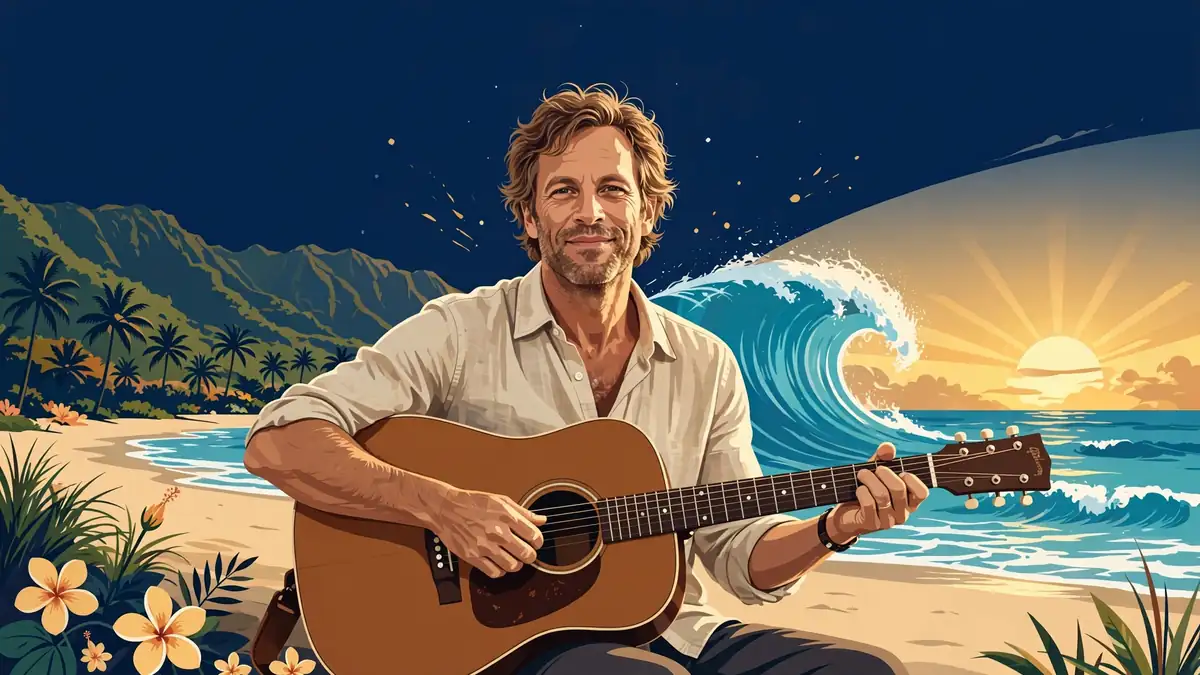
Jack Johnson‘s net worth is estimated at $20 million to $25 million as of November 2026. The Hawaiian singer-songwriter built that fortune the slow way: more than 25 million albums sold worldwide, four albums that reached No. 1 on the Billboard 200, a record label he owns outright, and a touring schedule that still sells out amphitheatres in 2026 — including a Hollywood Bowl date in October and a new documentary film, SURFILMUSIC, that sent him back on the road across the United States, Australia and New Zealand.
Jack Johnson: Quick Facts
| Estimated net worth | $20 million (range: $20 million to $25 million) |
|---|---|
| Profession | Singer-songwriter, musician, former professional surfer, filmmaker, record label founder |
| Nationality | American |
| Born | May 18, 1975 (age 51) |
| Height | 5 feet 11 inches (180 cm) |
| Primary income sources | Album sales and streaming, concert touring, Brushfire Records, film soundtracks and publishing |
| Active years | 2001–present |
| Last reviewed | November 2026 |
- Early Life and Background
- Education
- Career Journey
- Rise to Fame
- Main Sources of Income
- Salary and Earnings
- Businesses and Investments
- Brand Deals and Sponsorships
- Houses, Cars and Other Assets
- Awards and Achievements
- Net Worth Growth Over the Years
- Social Media Presence
- Personal Life
- Sources & Reporting
- Frequently Asked Questions
- Final Thoughts
Early Life and Background
Jack Hody Johnson was born on May 18, 1975, on the North Shore of Oahu, Hawaii, and the ocean set the terms of his childhood. His father, Jeff Johnson, was a well-known surfer, and his mother, Patti, raised three boys — Pete, Trent and Jack, the youngest — within sight of the Banzai Pipeline, one of the most famous and most dangerous surf breaks on earth. Johnson started surfing at five. By 14 he had a sponsorship deal with Quicksilver and was competing on the professional circuit, and at 17 he became the youngest invitee ever to reach the finals of the Pipeline Masters, the prestige event held at his home break.
One week after that Pipeline Masters final, the surfing career ended as suddenly as it had risen. Johnson wiped out at Pipeline and drove face-first into the reef. He needed more than 100 stitches in his forehead — some accounts put the number at 150 — and lost several teeth in the collision. He later turned the accident into the song “Drink the Water,” and the forced months away from the surf, guitar in hand, are the hinge his whole career turns on. His mother gave him tablature books while he recovered, and the boy who had planned to surf for a living started learning other people’s songs properly for the first time.
The surfing years left two things that still shape his money story. First, a friendship with Kelly Slater, the Floridian who would become the greatest competitive surfer in history; the two grew up competing against each other and remain close, and Slater appears in Johnson’s early surf films. Second, a complete absence of interest in the fame machinery that usually surrounds a pop career. Johnson’s stage manner — barefoot or in flip-flops, a small band, no spectacle — is not a marketing pose. It is the same posture he had at 17, and it explains why his fortune looks so different from a typical pop star’s: almost all of it comes from records and tickets, very little from endorsements or licensing his face.
A note for searchers, because the confusion is constant: this article is about Jack Johnson the singer, born in 1975. A different Jack Johnson — the boxer, born in 1878, the first Black heavyweight champion of the world — has his own net worth pages, his own career earnings of roughly $2.4 million across a career that ended in the 1930s, and no connection to the musician beyond a shared name. Several low-quality net worth sites mix the two men up, sometimes in the same article. Every figure in this piece refers to the Hawaiian singer-songwriter.
Education
Johnson attended Kahuku High School on Oahu’s North Shore, then left Hawaii for the University of California, Santa Barbara, where he studied film and graduated with a B.A. in Film Studies in 1997. The choice mattered more than it looked. UCSB gave him three things: a film education that produced his first career, a band, and a wife.
The band was Soil, a college group in which Johnson played rhythm guitar. Soil opened for the Dave Matthews Band and Sublime, which put a 20-year-old Johnson on real stages in front of real crowds years before he had a record deal. The film work started at the same time. Johnson shot surf footage between classes, and his student-era habit of filming his friends surfing became, within a few years, a genuine second profession.
And at UCSB he met Kim Baker, a fellow student who would become his wife in 2000 and, later, his partner in the record label and the two family foundations. Kim studied mathematics — she later taught the subject — and the partnership has been strikingly durable by music-business standards: one marriage, three children, no public splits, and a shared public life built around environmental work rather than celebrity. The degree itself also paid off in a literal sense. Johnson’s first income as an adult came not from music but from surf films, and the film-studies training is what made those films good enough to sell.
Career Journey
Johnson’s career has run in three overlapping acts — surf filmmaker, recording artist, label owner — and the first act paid for the second. His debut surf film, Thicker Than Water (2000), shot in Australia, Indonesia, Hawaii, India and Ireland with Slater among the surfers, won an award at the ESPN Film Festival and established Johnson as a director with a distinct eye: patient, sunlit, allergic to hype. The September Sessions followed in 2002, filmed with Slater off Sumatra, and A Brokedown Melody in 2004. The films sold, toured surf shops and festivals, and gave Johnson a small but real income while he figured out whether music was a hobby or a living.
Music had been gathering quietly alongside. Johnson learned guitar at 14, wrote songs through his UCSB years, and in 1999 his song “Rodeo Clowns” appeared on Philadelphonic, the album by G. Love & Special Sauce, a friend from the Santa Barbara scene. That placement was the first time a Johnson song reached a national audience, and it connected him to the network — G. Love, Ben Harper, Harper’s producer J. P. Plunier — that would carry his first records. Harper, in particular, took Johnson on tour as an opening act in 2001, putting the unknown Hawaiian in front of the exact audience most likely to buy his debut.
Brushfire Fairytales arrived on January 23, 2001, on the small Enjoy Records label. Johnson recorded it in seven days. The album was a sleeper: college radio and word of mouth pushed it past one million US sales by early 2003, it was certified platinum by the Recording Industry Association of America, and a distribution deal with Universal Records gave it national reach. Its 1.2 million US sales, recorded in Johnson’s discography, remain the foundation of his catalogue. The follow-up, On and On, released on May 6, 2003, did better still — No. 3 on the Billboard 200, platinum by 2005 — and by then Johnson had his own label, Brushfire Records, and his own studio, the Mango Tree, on the North Shore.
The third album is the one that made the fortune. In Between Dreams, released March 1, 2005, peaked at No. 2 on the Billboard 200, went double platinum in the United States and five-times platinum in both Britain and Australia, and its singles — “Better Together,” “Good People,” “Breakdown” and the Grammy-nominated “Sitting, Waiting, Wishing” — became permanent fixtures of early-2000s radio. Wikipedia’s album page puts its worldwide sales above 15 million copies, a figure that, if right, makes it one of the best-selling acoustic albums of its decade. Even the conservative reading — two million certified US sales — puts it far ahead of anything else in Johnson’s catalogue.
The run of chart-toppers that followed is unusual for an artist with no hit-single machinery behind him. The Curious George soundtrack, released in February 2006, became Johnson’s first No. 1 album on the Billboard 200 and has sold more than three million copies, according to Amoeba Music — the first soundtrack built around a children’s film to top the chart, and still the best-selling children’s soundtrack of its era. Sleep Through the Static (February 1, 2008) also hit No. 1, recorded entirely with solar power at the Mango Tree studio, and sold 1.7 million copies in the United States. To the Sea (2010) and From Here to Now to You (2013) both reached No. 1 as well, giving Johnson four Billboard 200 chart-toppers in eight years.
The pace slowed after 2013, by choice as much as by market. All the Light Above It Too arrived in 2017, and Meet the Moonlight, produced by Blake Mills, followed on June 24, 2022. A dub reworking, In Between Dub, came out in 2023. Then, in November 2025, Johnson’s Instagram announced SURFILMUSIC, a documentary film tracing his path from teenage surfer to musician. The film was released on March 13, 2026, in Austin, Texas, and Johnson toured behind it from June to October 2026 across the United States — including the Hollywood Bowl on October 10, 2026 — before taking the tour to Australia and New Zealand in November 2026, with South American and European dates booked into 2027.
Rise to Fame
Johnson’s rise breaks the usual pop pattern in almost every respect. There was no talent show, no viral moment, no reinvention. His first hit, “Flake,” crept up the charts in 2001 on the back of touring and college radio. His biggest album, In Between Dreams, arrived four years into his recording career, not at its start. And his fame has never depended on a single song: ask ten fans for their favourite Johnson track and you will get ten answers — “Better Together,” “Banana Pancakes,” “Upside Down,” “Sitting, Waiting, Wishing,” “Good People,” “Flake,” “Taylor,” “Do You Remember.” That spread is commercially valuable. A catalogue with a dozen mid-level classics streams more evenly, and ages better, than a catalogue built on one giant single.
The Ben Harper tours of 2001–2003 did the heavy lifting. Harper’s audience was Johnson’s audience — adult, album-buying, concert-going — and Johnson arrived on those stages with a debut record that sounded like nothing else on the radio in 2001, a year dominated by *NSYNC, Eminem and Linkin Park. The contrast worked in his favour. Reviewers who found him one-dimensional also kept coming back to the same word: restraint. Johnson’s songs are short, quiet and melodically plain, and that plainness turned out to be durable. In Between Dreams still sells, still streams, and still soundtracks weddings and surf trips twenty years on.
The Curious George soundtrack in 2006 pushed him past the adult-alternative audience into family households. “Upside Down,” written for the film, became his most recognisable song, and the album’s No. 1 debut made Johnson one of the few artists of his generation to top the Billboard 200 with a soundtrack, a studio album and, effectively, a children’s record. It also gave his catalogue a second life: parents who bought the soundtrack for their children kept buying the studio albums for themselves.
Fame, for Johnson, has always been capped by his own choices. He does not chase radio formats, does not collaborate for chart position, and releases albums when he has something to say — five years passed between From Here to Now to You and All the Light Above It Too, and another five before Meet the Moonlight. The gaps cost him momentum and, in pure dollars, probably tens of millions in forgone touring and recording income. They also kept his audience loyal: when he announced the 2026 SURFILMUSIC tour, Bandsintown listed 21 upcoming shows and 3.21 million followers waiting on them, two decades after his debut.
Main Sources of Income
Johnson’s money comes from four streams, and the mix is what makes his fortune unusual among musicians of his generation. Recorded music is the base: more than 25 million albums sold worldwide since 2001, with 10.8 million of those in the United States alone as of 2010, according to Nielsen SoundScan, and 20 million worldwide by 2015. Those are catalogue sales, not front-loaded hits — In Between Dreams and the Curious George soundtrack still move units every year — which means the income arrives steadily rather than in spikes.
Streaming is the second recorded-music stream, and it is now large enough to measure. Johnson’s Spotify catalogue passed 8.85 billion total streams by November 21, 2026, according to Kworb’s chart tracking, with about 2.37 million streams a day. He holds around 11.4 million monthly listeners and 4.36 million Spotify followers, per the Royalties Calculator’s artist page. That service’s model puts his Spotify earnings at a minimum of roughly $36,000 a month, or about $435,000 a year — a third-party estimate, not a reported figure, but a useful floor for the streaming line alone. His YouTube channel, jackjohnsonmusic, adds a separate stream: 971,000 subscribers and 938 million lifetime views as of November 11, 2026, per vidIQ, with about 14 million views in October 2026 alone.
Touring is the largest single earner, and the one Johnson controls most tightly. He has toured consistently for 25 years, headlining amphitheatres and sheds across North America, Australia and Europe, and the 2026 SURFILMUSIC run shows the demand has not faded: the Greek Theatre at UC Berkeley on September 30, 2026, the Hollywood Bowl on October 10, 2026, and a November swing through Perth, Sydney, Melbourne and Auckland, followed by South American dates in February 2027 and European dates in June and July 2027, including the Eden Project in Cornwall. No public gross is published for his tours, and we do not invent one. What is public is the structure: Johnson tours with a small band — bassist Merlo, Zach Gill on keys, drummer Adam Topol — keeps production simple, and plays venues in the 5,000-to-18,000 range, which keeps costs low and margins high relative to arena-scale pop acts.
The third stream is Brushfire Records, the label Johnson founded with his wife Kim. Every one of his albums has been released through Brushfire, and the label also releases records for G. Love & Special Sauce, Matt Costa, Mason Jennings, ALO and Zach Gill. Owning the label changes the economics of every record he makes: instead of a typical artist royalty of 15–20 percent of wholesale, a label owner keeps the label’s share as well, subject only to his distribution deal with Universal. That ownership is the single biggest reason a $20–$25 million net worth is plausible on 25 million albums sold, where a signed artist with the same sales might have far less.
The fourth stream is film and publishing. The three surf films, the Curious George soundtrack, sync placements in film and television, and publishing income from a catalogue of songs other artists have recorded — the Black Eyed Peas interpolated his “Gone” as “Gone Going” on Monkey Business, an album that sold more than ten million copies — all pay steadily. Publishing is the quietest line in his accounts and one of the most durable: songs written in 2001 still earn every time they are streamed, covered or placed.

Salary and Earnings
Johnson has no salary in the conventional sense, and no public record of a per-show fee, a record advance or an annual income. That absence is worth stating plainly, because most net worth pages for musicians fill the gap with invented numbers. What can be documented is the shape of his earnings, album by album, from certifications and chart positions that are public record.
| Album | Year | Billboard 200 peak | Certified sales (US) |
|---|---|---|---|
| Brushfire Fairytales | 2001 | 34 | Platinum — 1.2 million |
| On and On | 2003 | 3 | Platinum |
| In Between Dreams | 2005 | 2 | 2× Platinum |
| Sing-A-Longs and Lullabies for the Film Curious George | 2006 | 1 | 3 million-plus copies (worldwide, per Amoeba Music) |
| Sleep Through the Static | 2008 | 1 | Platinum — 1.7 million |
| To the Sea | 2010 | 1 | Gold-plus (certification data incomplete in public sources) |
| From Here to Now to You | 2013 | 1 | Gold-plus (certification data incomplete in public sources) |
| All the Light Above It Too | 2017 | — | About 58,000 first-month US copies (TheRichest earnings table) |
| Meet the Moonlight | 2022 | — | Streaming-era release; no public unit figure |
The table tells the earnings story better than any single number. Johnson’s commercial peak ran from 2003 to 2013, when five consecutive albums went top three and four hit No. 1. Physical sales in that window — the last decade when albums sold in millions — did the heavy work. The 2017 and 2022 albums sold far fewer physical copies, which is normal for the streaming era, but they keep the touring machine fed: each new record is a reason to tour, and touring is where the money now sits.
On the question readers ask most — what does he make per concert? — there is no public answer, and the honest one is that it varies widely by venue and by year. A sold-out Hollywood Bowl night grosses in the low seven figures before costs; a theatre date grosses far less. Johnson’s low-overhead model (small band, modest staging, no dancers, no pyro) means he keeps more of each gross than an arena pop act. The $2-per-ticket charitable donation attached to his 2026 dates — $1 to REVERB’s climate projects and $1 to the Johnson Ohana Foundation — also tells you something about the ticket economics: a $2 carve-out is only viable when the underlying ticket price supports it.
One more earnings detail is easy to miss. Because Johnson owns Brushfire Records, his “salary” is really a business owner’s draw: label profits, publishing, touring income and royalties flow through companies he controls, not through a pay cheque. That structure also explains why his published net worth has stayed flat at $20–$25 million for years rather than climbing steeply: he gives a large share away, spends little on lifestyle, and reinvests in the label and the foundations rather than accumulating visible assets.
Businesses and Investments
Brushfire Records is the business, and it is best understood as a small, deliberately unfashionable company that has outlasted most of its peers. Johnson founded it as the Moonshine Conspiracy, the imprint behind his first records, and renamed it Brushfire as it grew. The label’s Los Angeles offices and studios were rebuilt as a model of low-impact operation — solar power, recyclable CD packaging, power-saving systems — and its roster stayed small and loyal: G. Love & Special Sauce, Matt Costa, Mason Jennings, ALO, Zach Gill. None of them became superstars, and that was never the point. Brushfire is a catalogue business: a shelf of records that sell a little every year, forever, with minimal overhead.
The Mango Tree Studio, Johnson’s home studio on the North Shore, is the other fixed asset. On and On was the first album recorded there, and Sleep Through the Static was recorded there entirely on solar power — a detail Johnson publicised at the time, in 2008, when solar recording was still a novelty. The studio is both a workplace and a property improvement: a professional recording facility attached to a Hawaiian home, used by Johnson and by Brushfire artists.
His investment activity beyond music is quiet and largely philanthropic rather than commercial. With Kim, he founded the Kokua Hawaii Foundation in 2003, which funds environmental education in Hawaiian schools, and the Johnson Ohana Charitable Foundation in 2008, which channels tour profits and donations to environmental, art and music education causes. The All At Once campaign, run through the foundations, matches fans with local non-profits at every tour stop. These are not investments in the financial sense — they are the destination of a large share of his earnings — but they are the institutions he has built with his money, and they explain where much of the $20–$25 million has gone rather than where it sits.
What Johnson has not done is also informative. There is no public record of a restaurant empire, a clothing line, a tech portfolio or a property fund in his name, and no venture-capital activity. The contrast with peers is stark: where other musicians of his era turned fame into brands, Johnson turned it into a label, a studio and two foundations, and kept the rest in the bank. That restraint is the main reason his net worth is $20–$25 million and not $100 million — and the main reason the $100 million-plus figures on some sites are not credible, as the growth section below explains.
Brand Deals and Sponsorships
This is the shortest section in the article, and that is the point. Johnson has almost no brand deals, and the near-absence is one of the most distinctive facts about his finances. His only significant sponsorship came before he was famous: the Quicksilver deal he signed as a 14-year-old competitive surfer, which supplied boards and clothing while he was on the junior circuit. Since becoming a musician, he has not fronted a major consumer brand campaign, licensed his name to a product line, or taken a payday for endorsing anything.
What he does instead is partner with non-profits. The 2026 tour’s $2-per-ticket donation, split between REVERB and the Johnson Ohana Foundation, is typical: the commercial relationship runs toward charities, not sponsors. His All At Once campaign works the same way, giving local environmental groups a platform at his shows. Even the corporate-adjacent work — the Curious George soundtrack for Universal Pictures, the distribution deal with Universal Records — is music work, not endorsement work.
Compare that with the standard pop-star income stack, where endorsements often out-earn records, and the shape of Johnson’s $20–$25 million becomes clear. He left the endorsement money on the table entirely. The trade was deliberate: a career with no brand obligations is a career with no brand risk, and Johnson’s audience trusts him precisely because he has never sold them anything but records and tickets. For a reader weighing the estimate, the implication runs both ways. His fortune is smaller than it could have been — a singer with 25 million albums sold and a clean image could have commanded eight-figure endorsement deals — but it is also more honestly earned, and less exposed to a sponsor pulling out.

Houses, Cars and Other Assets
Johnson lives on the North Shore of Oahu, where he grew up, in a home that doubles as the Mango Tree Studio site. No purchase price, mortgage or valuation for the property is public, and we do not estimate one: Hawaiian property records for a private residence are not the kind of figure a responsible estimate invents. What is public is the choice. He did not move to Los Angeles, Nashville or New York. He stayed on the street where he learned to surf, and built his working life around that address.
The visible assets beyond the house are modest. The Mango Tree Studio itself — a professional recording facility with solar power — is the most valuable single item after the property. His guitar collection is a working musician’s set, not a collector’s vault: the acoustic guitars he tours with are tools, and he is known for playing the same instruments for years. There is no public record of a luxury car collection, a yacht, a private jet or a second home, and Johnson’s public image — flip-flops, a linen shirt, a bicycle as often as a car — is consistent with the record. His spending, as far as anyone can document it, runs to surfboards, studio gear, his children’s schooling and the foundations.
That modesty runs deeper than image. It is the arithmetic behind the estimate. A musician who earned tens of millions across 25 years, gave a large share to charity, owns one home and one studio, and does not collect cars or art will show a net worth in the $20–$25 million band — substantial, but far below the nine-figure fortunes of peers who monetised every part of their fame. The late Jimmy Buffett built a far larger empire from a similar laid-back beach sound, but Buffett did it by licensing his name to restaurants, hotels and retirement communities — exactly the path Johnson declined.
Awards and Achievements
Johnson’s trophy shelf is thin by pop standards and heavy on the honours that match his priorities. The headline items are two Grammy nominations in 2006: Best Male Pop Vocal Performance for “Sitting, Waiting, Wishing,” and Best Pop Collaboration with Vocals for “Gone Going,” his collaboration with the Black Eyed Peas. He did not win either, and he has never won a Grammy — a fact worth stating, because several net worth pages imply otherwise.
The same year, 2006, he won the Brit Award for Best International Male Solo Artist, beating a field of far bigger-selling acts. The win is a useful marker of how far his reputation travelled: a Hawaiian acoustic singer with no hit single in Britain winning a Brit is a measure of industry respect, not sales. He has also received nominations at the ESPY Awards, where his surf-film work crossed into sports recognition.
The awards that seem to matter most to him are the humanitarian ones. In 2010 he received the Humanitarian Award at the Billboard Touring Awards, recognising the tour-profit donations and the All At Once campaign. In 2012 the National Wildlife Federation gave him its National Conservation Achievement Award in Communications, for using his platform — records, tours, films — to carry environmental messages. Four Billboard 200 No. 1 albums, more than 25 million albums sold, and two foundations that have channelled millions into Hawaiian schools and environmental causes: that is the achievement list, and it reads more like a working musician’s record than a celebrity’s.
Net Worth Growth Over the Years
The published record for Johnson’s wealth is unusually stable, which is itself a finding. Unlike athletes or actors whose fortunes spike with a single contract, Johnson’s estimate has sat in the same band for a decade, because his income is catalogue-driven and his spending is flat.
| Year | Published estimate | Source |
|---|---|---|
| 2017 | $20 million | TheRichest |
| 2021 | $25 million | WealthyPersons (December 2021) |
| 2022 | $20 million | Celebrity Net Worth |
| 2025 | $20 million | DailyWikiBio |
| 2026 | $25 million | NetWorthSpot (November 1, 2026) |
| 2026 | $20–$25 million (our estimate) | NetWorthCraft review, November 2026 |
Two things stand out. First, the two long-running estimators — Celebrity Net Worth and TheRichest — have held at $20 million for years, while the $25 million figures come from more recent updates. The gap is small and the direction is consistent: the honest statement is a range, not a single number, and $20 million is the safer anchor. Second, the outlying figures deserve a direct answer. Several AI-written pages put Johnson at $120 million, $150 million or even $180 million, and one content farm claims “hundreds of millions.” None of them cites a source for the number. None of them explains how a musician with no endorsement income, no brand empire and a public record of giving tour profits away would accumulate nine figures. The $20–$25 million band is the one supported by named outlets; the nine-figure claims are not supported by anyone, and we set them aside.
Growth, in Johnson’s case, looks less like a rising line and more like a plateau with a long tail. The big money was made between 2001 and 2013, when physical albums still sold in millions and four records topped the chart. Since then, streaming and touring have replaced album sales as the engine, and the fortune has grown slowly — a few million from catalogue royalties, a touring year here, a film there — while donations have pulled in the other direction. The 2026 SURFILMUSIC tour and the 2027 dates booked behind it are the most likely near-term lift: a full touring year for an artist of his scale adds low-seven-figure net income after costs and donations, which would push the top of the range upward without changing its shape.
Social Media Presence
Johnson’s social footprint is large where it counts and quiet where it does not. On Spotify he holds about 11.4 million monthly listeners and 4.36 million followers, with 8.85 billion lifetime streams as of November 21, 2026 — numbers that put him ahead of most of his acoustic peers and explain why streaming now rivals touring as his steadiest income. On YouTube, the jackjohnsonmusic channel has 971,000 subscribers and 938 million lifetime views as of November 11, 2026, and it is still growing: about 14 million views in October 2026 alone, a surge tied to the SURFILMUSIC tour.
Instagram is his announcement channel — the SURFILMUSIC film was revealed there on November 21, 2025 — but no reliable public follower count is published, and we do not quote one. Bandsintown, the tour-discovery service, lists 3.21 million followers tracking his shows, with 21 upcoming dates on the books at the time of writing. He is not a poster, not a controversy merchant, and not a brand ambassador on any of these platforms. The accounts exist to announce records and tours, and they do that job without the engagement-farming that fills other musicians’ feeds.
The commercial point is simple. Johnson’s audience finds him through the music, not through the feed, and his streaming numbers are high relative to his social-media noise. That is the profile of a catalogue artist: the songs do the marketing, year after year, and the social accounts are a noticeboard rather than a business.
Personal Life
Johnson married Kim Baker on July 22, 2000. They met at UC Santa Barbara, where she studied mathematics and he studied film, and they have three children — two sons and a daughter. The family lives on the North Shore of Oahu, and Kim is a full partner in the public work: the two co-founded the Kokua Hawaii Foundation and the Johnson Ohana Charitable Foundation, and she has been credited alongside him in the foundations’ work for two decades.
The personal life is unusually private for a musician of his profile. There are no public feuds, no tabloid cycles, no second act of reinvention. The most recent personal detail to reach the press is also the most characteristic: a 2026 Outside Online profile found the 51-year-old Johnson spending his non-touring time farming on the North Shore, a pursuit he took up alongside surfing as a way of staying outdoors and feeding his family from the land around his home. Surfing, he told the magazine, keeps him fit; farming gave him something he had not expected — a second daily practice, as routine as the guitar.
That is the whole of it, and the privacy is part of the financial story. A career with no scandal, no divorce settlement, no lawsuit and no public spending spree is a career whose fortune stays where it was earned. Johnson’s net worth is, in the end, a record of subtraction as much as addition: the money he made, minus the money he gave away, minus almost nothing spent on the apparatus of fame.
Sources & Reporting
Celebrity Net Worth — the $20 million estimate, the long-running anchor figure for Johnson’s wealth, corroborated by Viberate’s artist page.
TheRichest — the $20 million estimate and the earnings table covering the 2017 album All the Light Above It Too (about 58,000 first-month US copies).
NetWorthSpot — the $25 million estimate, updated November 1, 2026, with a channel-level estimate of about $2 million for jackjohnsonmusic on YouTube.
WealthyPersons — the $25 million estimate as of December 2021, and the record of four Billboard 200 No. 1 albums.
Wikipedia — discography and certification data (US sales, chart peaks, RIAA multi-platinum awards), the biography (born May 18, 1975; Pipeline Masters final at 17; the 100-plus-stitch injury; Thicker Than Water, The September Sessions), and the SURFILMUSIC film announcement and 2026 tour dates.
Amoeba Music — career biography (Quicksilver sponsorship at 14, the Soil band, the “Rodeo Clowns” placement, the Curious George soundtrack selling more than three million copies).
Kworb — Spotify totals as of November 21, 2026: 8.85 billion streams, about 2.37 million daily streams.
vidIQ — YouTube channel data as of November 11, 2026: 971,000 subscribers, 938 million lifetime views, about 14 million views in October 2026.
Bandsintown — 2026 tour dates (Greek Theatre, September 30, 2026; Hollywood Bowl, October 10, 2026), 3.21 million followers, 21 upcoming shows, and the $2-per-ticket donation split.
Ticketmaster — 2026–2027 tour dates, including the Australia and New Zealand SURFILMUSIC leg and the 2027 South American and European dates.
Outside Online — the 2026 profile “Jack Johnson Is 51. Surfing Keeps Him Fit, but Farming Gave Him Something He Didn’t Expect,” and the SURFILMUSIC film coverage.
SurferToday — the Pipeline wipeout account and the transition from surfing to music, including Johnson’s own description of the accident.
GlamXGossip — height (5 feet 11 inches), marriage to Kim Johnson since 2000, three children, and the Grammy nomination record.
The Famous People — the 2006 Brit Award win for Best International Male Solo Artist, the 2010 Billboard Touring Humanitarian Award and the 2012 National Wildlife Federation conservation award.
DailyWikiBio — the $20 million estimate as of 2025, the 25-million-albums-sold figure, and the report that 100% of tour profits went to charity in past touring cycles.
Reporting window: November 2026. Figures are estimates built from public reporting; no audited financial statement exists for Jack Johnson. Where sources disagree, this article publishes the range and names who says what.
Frequently Asked Questions
What is Jack Johnson’s net worth in 2026?
Jack Johnson’s net worth is estimated at $20 million to $25 million as of November 2026. Celebrity Net Worth and TheRichest both put him at $20 million, while NetWorthSpot (updated November 1, 2026) and WealthyPersons put him at $25 million. We anchor on $20 million. Claims of $100 million or more on low-quality sites are unsourced and not credible.
How old is Jack Johnson?
Jack Johnson was born on May 18, 1975, on the North Shore of Oahu, Hawaii. He is 51 years old as of November 2026.
Is Jack Johnson married?
Yes. Jack Johnson married Kim Baker on July 22, 2000. They met at the University of California, Santa Barbara, and have three children — two sons and a daughter. Kim co-founded Brushfire Records and the couple’s two charitable foundations with him.
What is Jack Johnson’s most famous song?
“Upside Down,” written for the 2006 film Curious George, is his most recognisable song, followed closely by “Better Together,” “Banana Pancakes” and the Grammy-nominated “Sitting, Waiting, Wishing.” His catalogue has no single dominant hit — a dozen songs share the streaming — which is why his records keep earning steadily.
Is Jack Johnson still touring in 2026?
Yes. Johnson toured the United States from June to October 2026 behind his documentary film SURFILMUSIC, playing the Hollywood Bowl on October 10, 2026, then took the tour to Australia and New Zealand in November 2026. South American dates are booked for February 2027 and European dates, including the Eden Project, for June and July 2027.
Where does Jack Johnson live?
Jack Johnson lives on the North Shore of Oahu, Hawaii, where he was born and raised, with his wife Kim and their three children. His home there includes the Mango Tree Studio, where he has recorded since 2003.
How much does Jack Johnson make per concert?
No public figure exists for Johnson’s per-show fee, and any site quoting one is guessing. Touring is his largest income stream: he headlines amphitheatres seating 5,000 to 18,000 people with a small band and minimal staging, which keeps margins high. His 2026 dates also donate $2 from every ticket — $1 to REVERB’s climate projects and $1 to the Johnson Ohana Foundation.
Is the singer Jack Johnson related to the boxer Jack Johnson?
No. They share a name and nothing else. The boxer Jack Johnson (1878–1946) was the first Black heavyweight champion of the world and earned about $2.4 million across his career. The singer Jack Johnson was born in Hawaii in 1975. Several low-quality net worth sites mix the two men up; this article covers the singer only.
Final Thoughts
Jack Johnson’s $20–$25 million fortune is the least flashy fortune in modern pop, and that is exactly what makes it interesting. He made it the old way — records that sold in millions, tours that sold out for 25 years, a label he owns — and he kept it by refusing most of the ways musicians usually make money. No endorsement empire, no brand licensing, no second home in the press. The money that did not go to his family went to his foundations, his studio and his label, and the 2026 SURFILMUSIC tour shows the machine still runs: a 51-year-old surfer-turned-songwriter, barefoot on stage at the Hollywood Bowl, playing songs written two decades ago to crowds that still know every word. The estimate is modest by celebrity standards. The career behind it is not.
Published on November 23, 2026. Last reviewed November 2026. Found an error? See our corrections policy.