
Mark Farner‘s net worth is estimated at $6 million to $10 million as of November 2026. The Grand Funk Railroad frontman wrote the songs, sang the hits and carried the stage show for one of the best-selling American rock bands of the 1970s — a group that moved more than 25 million records, collected 13 gold and 10 platinum records, and sold out Shea Stadium in 72 hours, faster than the Beatles. He still tours in 2026 with Mark Farner’s American Band, and he released a new solo album, Closer to My Home, in 2024 at the age of 75.
Mark Farner: Quick Facts
| Estimated net worth | $8 million (midpoint) (range: $6 million–$10 million) |
|---|---|
| Profession | Singer, guitarist, songwriter |
| Nationality | American |
| Born | September 29, 1948 (age 78) |
| Height | About 5 ft 7 in (1.71 m) — reported, not officially confirmed |
| Primary income sources | Songwriting and recording royalties, touring, merchandise, licensing, solo albums |
| Active years | 1965–present |
| Last reviewed | November 2026 |
- Early Life and Background
- Education
- Career Journey
- Rise to Fame
- Main Sources of Income
- Salary and Earnings
- Businesses and Investments
- Brand Deals and Sponsorships
- Houses, Cars and Other Assets
- Awards and Achievements
- Net Worth Growth Over the Years
- Social Media Presence
- Personal Life
- Sources & Reporting
- Frequently Asked Questions
- Final Thoughts
Early Life and Background
Mark Fredrick Farner was born on September 29, 1948, in Flint, Michigan, a General Motors factory town that shaped the sound and the attitude of the band he would later lead. Flint in the late 1940s and 1950s was a working-class city built around the automobile plants, and Farner’s childhood sat squarely inside that world: his father, Delton Farner, had driven a tank with the Seventh Armored Division during the Second World War and played guitar, while his mother, Betty, was a singer of Cherokee descent. Music was a household skill before it was a career plan, and Farner grew up hearing both sides of it — his father’s guitar playing and his mother’s singing.
That Cherokee heritage on his mother’s side stayed with Farner for life. In 1999, members of the Lakota Nation honoured him in Hankinson, North Dakota, presenting him with a handmade ceremonial quilt in recognition of his Native ancestry and his contributions, and he has also received the Cherokee Medal of Honor from the Cherokee Honor Society. These are not the kind of honours that show up on a balance sheet, but they explain a thread that runs through his later career: the “Rock Patriot” identity he adopted in the 2000s, with its focus on veterans, American farmers and people with disabilities, grew directly out of the Flint upbringing and the family history he talks about on stage.
Flint gave Grand Funk Railroad its defining quality. Critics in New York and Los Angeles spent the early 1970s dismissing the band — Rolling Stone called them “the world’s worst rock band” — while audiences in the industrial Midwest and across middle America filled arenas for them. Farner has always framed that split as the point: the band was a garage outfit from a factory town, playing loud, direct rock for people who worked with their hands. That populist image was not a marketing invention. It was the place he came from, and it is a large part of why the songs still draw crowds more than fifty years later.
By the time he was a teenager, Farner was already playing in working bands around Michigan. He joined Terry Knight and the Pack in 1965, at seventeen, and spent the next four years learning the trade in regional groups: the Pack in 1965–66, the Bossmen in 1966–67, and the Pack again — billed as the Fabulous Pack — in 1967–68. The circuit was bars, clubs, school gyms and small halls, and the pay was modest, but the apprenticeship was thorough. When he formed Grand Funk Railroad in 1969, he already had four years of nightly stagecraft behind him, and he arrived as a frontman who could sing, play lead guitar, play keyboards and harmonica, and write the material — a combination that made him the band’s creative centre from the first rehearsal.
One detail from this period matters for the money story. Farner was not a hired singer who joined an existing machine. He was a co-founder, and he wrote most of the band’s material. In the music business, that distinction is the difference between a salary and a catalogue: the songwriter’s share of publishing and the performer’s share of royalties kept paying long after the touring cheques stopped. It is also why the 1972 lawsuit with manager Terry Knight — covered in full below — cut so deep. Knight managed the band, and the court handed him the publishing royalties and copyrights on everything the band recorded between March 1969 and March 1972, the exact years when Farner was writing the songs that made the band famous.
Education
Farner attended Kearsley High School in Flint, Michigan. No college degree, conservatory training or formal music education is recorded for him, and none of the standard biographical sources — Wikipedia, Celebrity Net Worth, the Michigan Rock and Roll Legends profile — lists any higher education. His training was the Michigan club circuit: four years of nightly gigs with Terry Knight and the Pack, the Bossmen and the Pack before Grand Funk Railroad existed.
That matters because it corrects a common assumption about 1970s rock stars. Farner did not arrive through a music school or a session-musician apprenticeship in Los Angeles or Nashville. He arrived through the same route as most of the era’s working-class rock musicians: a school band, a local group, a regional circuit, and then a break. The guitar style he developed — loud, direct, built on riffs rather than technique for its own sake — came from playing to rooms that wanted energy, not from a classroom. The songwriting worked the same way: “I’m Your Captain (Closer to Home)” is a ten-minute epic built on a simple, patient structure, and it was written by a 21-year-old who had learned what held a crowd by holding crowds, night after night, in Michigan.
Farner’s later career shows the same practical streak. When he left the major-label system in the 1990s, he did not hire a new machine; he built a small one of his own, forming Lismark Communications with former Freedom Reader editor Steve Lisuk and reissuing his solo albums on his own LisMark Records label. That is the move of a musician who learned the business on the road rather than in a lecture hall — and it is a move that kept a larger share of the money in his own hands, even if the scale was far smaller than the Capitol Records years.
Career Journey
Farner’s career divides into five clear acts, and the money follows the same shape: a steep climb, a sharp legal cut, a long solo middle, a reunion that ended in a pay dispute, and a durable late career as a touring heritage act under his own name.
Act one: the Michigan circuit, 1965–1969. Terry Knight and the Pack, the Bossmen, and the Fabulous Pack. Four years of regional gigs, small pay, and a frontman learning his trade. Knight, the Pack’s leader, would later become Grand Funk Railroad’s manager — a relationship that made the band and then, in court, cost Farner a fortune.
Act two: Grand Funk Railroad, 1969–1976. Farner formed the band in Flint in 1969 with drummer Don Brewer and bassist Mel Schacher, with keyboardist Craig Frost joining in 1972. The trio agreed to play for free at the 1969 Atlanta International Pop Festival; the crowd response was so strong they were invited back for the remaining two days, and Capitol Records signed them soon after. What followed was one of the fastest commercial ascents in American rock: two albums in 1969 (On Time and Grand Funk, the “Red Album”), two more in 1970 (Closer to Home and the double Live Album), then Survival and E Pluribus Funk in 1971, Phoenix in 1972, We’re an American Band in 1973, Shinin’ On and All the Girls in the World Beware!!! in 1974, Caught in the Act and Born to Die in 1975–76, and finally Good Singin’, Good Playin’ in 1976, produced by Frank Zappa and released on MCA. In 1970 alone, the band earned four RIAA gold albums — the most for any American group that year — and sold more albums than any other American band. By the band’s own count, later repeated by Capitol and by the group’s official biography, Grand Funk Railroad accumulated 13 gold and 10 platinum records, 19 charted singles, 8 Top 40 hits and two Number One singles, with record sales above 25 million copies worldwide.
Act three: the solo years, 1977–1995. After the original band split in 1976, Farner signed with Atlantic Records and released his self-titled solo debut in 1977, followed by No Frills in 1978. The solo records showed his range but never matched Grand Funk’s sales. A short-lived reunion with Brewer produced Grand Funk Lives in 1981 — it reached No. 149 on the Billboard chart, and its song “Queen Bee” appeared on the soundtrack of the animated film Heavy Metal — and What’s Funk? in 1983, after which the group split again. Farner became a born-again Christian in the late 1980s and found a second audience in contemporary Christian music: Just Another Injustice in 1988 and Some Kind of Wonderful in 1991 on Frontline Records, with the John Beland song “Isn’t it Amazing” reaching No. 2 on the Christian charts and earning a Dove Award nomination. In the 1990s he formed Lismark Communications, began reissuing his solo albums on LisMark Records, and toured with Ringo Starr & His All-Starr Band in 1994–95, sharing stages with Randy Bachman, John Entwistle, Felix Cavaliere, Billy Preston and Zak Starkey.
Act four: the reunion and the break, 1996–2000. Farner reunited with Brewer and Schacher in the late 1990s, played three sold-out benefit concerts in Bosnia and released the double live album Bosnia in 1997. He left after three years following disagreements with Brewer. When Brewer and Schacher proposed another reunion in 2000, Farner said he would return only for half the band’s profit rather than the one-third share he had received before, arguing that he did the most work on stage. They turned him down and rebuilt the band with lead vocalist Max Carl, guitarist Bruce Kulick and keyboardist Tim Cushion. The split produced years of lawsuits, including an unsuccessful attempt by his former bandmates to stop him performing as Mark Farner’s American Band, and further legal fights over the use of the Grand Funk Railroad name in promotion.
Act five: the American Band years, 2000–present. Farner has toured ever since under his own name, playing a mix of Grand Funk songs and solo material. He released For the People in 2006 and, remarkably for a musician 55 years into a career, a new studio album, Closer to My Home, in 2024. His official tour schedule lists performances through 2026 and into 2027, which means live performance — the income stream he has relied on since 1965 — is still active at 78.
Rise to Fame
Grand Funk Railroad’s rise was fast enough to look like a trick, and the band’s own story leans into that. In the summer of 1969, three musicians from Flint agreed to play for free at the Atlanta International Pop Festival because they needed an audience more than they needed a fee. The festival crowd — tens of thousands strong — responded so loudly that the organisers asked them back for the remaining two days. Capitol Records signed them not long after, and the band’s first album, On Time, arrived later that same year, followed within months by Grand Funk. Two albums in the first year, both selling well enough to go gold, set the pace for everything that followed.
The critics hated them and the public bought them anyway, and that tension became the band’s identity. Rolling Stone’s dismissal, the Village Voice comparing a Farner guitar solo to a flushing toilet, the constant suggestion that a band from Flint could not be serious art — none of it slowed record sales, and in a sense it fed them. Grand Funk Railroad were the “people’s band,” a power trio playing loud, riff-driven hard rock to audiences that the critical establishment did not understand and did not much like. In 1970, the year the band earned four gold albums, they sold more records than any other American band. That is a statistic worth pausing on: not the biggest critical act, not the most fashionable act — the biggest-selling American band of the year.
The high point came on July 9, 1971, at Shea Stadium in New York. Tickets had gone on sale on June 5, and the show sold out in 72 hours — faster than the Beatles, who had needed six weeks to sell out the same venue. About 55,000 to 60,000 people filled the stadium, with Humble Pie opening from a stage set up at second base, and Farner later described flying over the stadium in a Huey helicopter, looking down at a crowd so large the stands seemed to bounce. The band’s official biography and the Capitol Records history both repeat the Shea claim, and the trade press at the time confirmed the speed of the sell-out. It remains the single most cited fact about Grand Funk Railroad, and it is the fact that best explains the scale of Farner’s early earnings: this was not a cult band. This was, for a short window, the biggest live draw in America.
The songs did the rest of the work. “I’m Your Captain (Closer to Home),” Farner’s best-known composition, is a ten-minute epic that reached No. 22 on the Billboard Hot 100 in October 1970 — the group’s first Top 40 single — and became a permanent fixture of progressive rock radio, where its length was a virtue rather than a problem. The parent album, also called Closer to Home, reached No. 6 on the Billboard 200. “We’re an American Band” gave the group its first Number One single in 1973, and their version of “The Loco-Motion” gave them a second; each sold more than a million copies. “Some Kind of Wonderful” reached the Top 10 in 1974, and “Bad Time,” written by Farner, became the last of the band’s four singles to reach the Top 5 in 1975. Add the compilation Mark, Don & Mel: 1969–71, which peaked at No. 17 on the Billboard Top LPs & Tape chart in 1972, and the picture is a band that charted relentlessly for seven years — 19 charted singles in total, 8 of them Top 40.
The rise had a shadow, and it fell early. In 1972, the band fired their manager, Terry Knight, three months before his contract expired, accusing him of financial irresponsibility. Knight sued for breach of contract, had the band’s equipment repossessed, and after a two-year court battle emerged the victor, taking the publisher’s royalties and the copyrights to every recording the band made between March 1969 and March 1972. The band kept only its name. For Farner, the songwriter, that was the most expensive outcome possible: the publishing income from “I’m Your Captain,” from the first two albums, from the entire founding catalogue, went to the manager he had fired. Any honest account of his net worth has to start here, because the gap between 25 million records sold and a $6 million to $10 million fortune is largely the gap this lawsuit opened. His fellow Michigan rocker Bob Seger, who kept control of his publishing, built a far larger fortune from a comparable era — a contrast that shows how much the Knight case cost.
By 1976, the original run was over. The band had burned through its Capitol contract with Born to Die, a record made largely to satisfy obligations, and then recorded one final album, Good Singin’, Good Playin’, produced by Frank Zappa and released on MCA, before splitting. Farner has said Brewer told him he was done, left, and slammed the door. The rise had lasted seven years. The royalties, the lawsuits and the reputation would last the rest of his life.
Main Sources of Income
Farner’s income has always come from the same five streams, in different proportions at different points in his career. The proportions matter more than the list, because the balance shifted decisively after 1976: the recording money shrank, the touring money became the foundation, and the catalogue — the songs he still owns the rights to — became the long tail.
Songwriting and recording royalties. This is the largest long-term source and the hardest to measure from outside. As the writer of most of Grand Funk Railroad’s material, Farner earns a songwriter’s share whenever the songs are played on radio, streamed, licensed or covered, and a performer’s share from record sales. The catalogue is unusually durable: “We’re an American Band,” “Some Kind of Wonderful,” “The Loco-Motion” and “I’m Your Captain (Closer to Home)” have never left classic-rock radio, and they surface regularly in films, television and advertising. But the Knight settlement permanently reduced this stream. The publishing royalties on the March 1969 to March 1972 recordings — the band’s founding catalogue, including “I’m Your Captain” — were awarded to Knight, so Farner does not collect the full publishing income on his most famous early work. What he does collect, in full, is the songwriting income on the post-1972 catalogue, including “We’re an American Band,” “Bad Time” and the later hits, plus his solo catalogue. Organisations such as BMI and ASCAP administer performance royalties of this kind, and the steady classic-rock airplay of the Grand Funk catalogue means the cheques, while modest per play, arrive continuously. No public royalty statement exists for Farner, so no exact annual figure can be stated; the honest description is that this stream is steady, long-lived, and smaller than the sales figures alone would suggest.
Touring and live performance. Since 1976, touring has been Farner’s main income, and since 2000 it has been close to his only large one. Grand Funk Railroad in the early 1970s was one of the highest-paid touring acts in America, playing arenas and stadiums, including the 55,000-seat Shea Stadium show. The modern version is different in scale: Mark Farner’s American Band plays theatres, casinos, festivals and fairs, the standard circuit for heritage rock acts, with ticket prices and guarantees far below stadium levels but with lower costs and a loyal audience. His official schedule lists dates through 2026 and into 2027, which is itself evidence that the touring income is real and current — a 78-year-old does not keep a touring schedule for nostalgia alone. The economics of this circuit are straightforward: a working heritage act with a recognisable catalogue can sustain a comfortable living from live dates, merchandise and meet-and-greets, but it does not generate the kind of money that moves a net worth by millions in a single year.
Merchandise. Tour merchandise — T-shirts, posters, vinyl reissues and branded goods — has been part of the Grand Funk business since the early 1970s, when the band’s arena crowds bought heavily. On the modern circuit the volume is smaller, but the margins are better, because Farner sells under his own name through his own operation rather than through a label merchandising deal. His Rock Patriot brand, launched in the 2000s, extends the merchandise line beyond concert goods into a patriotic identity — caps, shirts and related items sold to a fan base that overlaps heavily with the veterans’ community he supports.
Licensing and sync. Grand Funk songs have appeared in films, television shows, commercials and video games for decades, and each placement pays both the songwriter and the recording owner. “Queen Bee” reached a new audience through the soundtrack of the 1981 animated film Heavy Metal, and “We’re an American Band” and “Some Kind of Wonderful” are among the most licensed classic-rock tracks of their era. Farner has never disclosed licensing income, and individual sync fees for heritage rock tracks vary widely — from a few thousand dollars for a small television use to much larger sums for a national advertising campaign — so this stream is best described as meaningful but irregular: a good year can bring a substantial one-off payment, and a quiet year can bring almost nothing.
Solo recordings and reissues. Farner’s solo albums, from the 1977 Atlantic debut through Closer to My Home in 2024, sell in far smaller numbers than the Grand Funk records, but the economics are different: releases on his own LisMark Records label, and reissues of his Atlantic and Frontline material under his own control, return a larger share per sale than a major-label deal. The scale is small — these are records for an established fan base, not chart contenders — but the margin is his, and the 2024 album proves the stream is still open.
The shape of the whole picture is the point. Farner is not a musician who stopped earning when the hits stopped. He is a musician whose earnings changed shape: from stadium guarantees and platinum record royalties in the 1970s, to a long, steady mix of catalogue royalties, heritage touring, merchandise and licensing. The total is modest by the standards of rock’s richest names — compare Ozzy Osbourne, whose fortune runs into the hundreds of millions on the back of a solo career Farner never had — but it is durable, and durability is what has kept Farner working at 78.

Salary and Earnings
There is no public record of Mark Farner’s salary, per-show fee, or annual income at any point in his career. He has never filed a public financial disclosure, never been the subject of a reported contract leak, and never discussed his pay in an interview in specific terms. Any article that prints a precise annual salary for him is inventing it. What can be said, honestly, is what the structure of his career implies about the scale of his earnings in each era, and where the numbers in the public record end.
In the Grand Funk Railroad years, the band’s income came from record advances, royalties, touring guarantees and merchandise, split between the members and the management. The band’s own history makes the scale clear without giving a figure: 25 million records sold, 13 gold and 10 platinum records, arena and stadium tours, and a 1971 Shea Stadium show that filled 55,000 seats. A band at that level in the early 1970s was earning serious money — but the costs were serious too: management, touring, recording, and the Knight lawsuit, which stripped the band of its early publishing income. Farner’s share as frontman and principal songwriter was the largest in the band, and his songwriting royalties should have been the gift that kept paying. The Knight settlement took the publishing on the first three years away from him, which is why his later wealth is smaller than the sales figures suggest. That is the central fact of his financial story, and it is documented in Celebrity Net Worth’s account of the case and in the band’s own history.
The solo years paid less. The 1977 Atlantic debut and No Frills in 1978 were released into a market that wanted Grand Funk Railroad, not a solo Mark Farner, and neither album approached the band’s sales. The 1981 reunion album Grand Funk Lives reached only No. 149 on the Billboard chart. The Christian albums of the late 1980s and early 1990s found a real audience — “Isn’t it Amazing” reached No. 2 on the Christian charts — but the Christian market pays less per record than the mainstream rock market, and the Frontline Records releases were modest commercial propositions. None of this means Farner was poor; it means the 1977–1995 period was a working musician’s living, not a rock star’s fortune.
The Ringo Starr & His All-Starr Band tour of 1994–95 was a useful earner: a well-paid, high-profile touring slot alongside Ringo Starr, Randy Bachman, John Entwistle, Felix Cavaliere and Billy Preston, playing large venues to an audience that already knew the songs. Touring with a Beatle pays a professional fee and raises a musician’s profile with promoters, and for Farner it was a bridge between the Christian-music years and the 1996 Grand Funk reunion.
The reunion years, 1996–98, paid better than the solo years: three sold-out benefit concerts in Bosnia, a double live album, and a full touring schedule with the classic line-up. The break in 1998, and the pay dispute behind it — Farner wanted half the band’s profit, not the one-third he had been paid — is itself evidence about the money involved: the sums were large enough to argue over, and Farner’s position was that his stage work justified the larger share. When Brewer and Schacher refused, they rebuilt the band without him, and Farner’s income from the Grand Funk name ended. What he kept was his own name, his own catalogue, and the right to tour as Mark Farner’s American Band — which is what he has done ever since.
For the modern touring years, the honest estimate is a comfortable professional living rather than a fortune-building one. Heritage rock acts on the theatre and casino circuit typically earn guarantees in the low five figures per show, with merchandise on top, and a busy year of dates can produce a solid six-figure gross before costs. Farner’s schedule — dates listed through 2026 and into 2027 — suggests a steady but not frantic pace, consistent with a musician in his late seventies working as much as he wants to. The royalty stream underneath it, from a catalogue that has never left the radio, is what turns that living into a net worth of $6 million to $10 million rather than a paycheque-to-paycheque existence.
One more comparison puts the scale in context. Mick Jagger and the Rolling Stones kept their publishing, kept touring stadiums into their eighties, and built fortunes in the hundreds of millions. Farner lost his early publishing in court, left the stadium circuit in 1976, and spent the next fifty years working smaller rooms. The difference between those two outcomes is not talent or fame — Grand Funk Railroad outsold almost every American band in 1970 — it is ownership, timing and the long arithmetic of who keeps the rights. That arithmetic is the real subject of this article.
Businesses and Investments
Farner has never been a businessman in the sense of a rock star with a portfolio of companies. There is no record of him founding a restaurant chain, a clothing empire, a tech investment or a property fund, and no reporting of venture investments, endorsements of financial products, or equity stakes in outside businesses. His business life has been narrower and more practical: a small label, a communications company, a brand, and a foundation. That narrowness is itself informative — it is one reason his net worth sits at $6 million to $10 million rather than at the level of musicians who turned fame into diversified business empires.
Lismark Communications and LisMark Records. In the 1990s, Farner formed Lismark Communications with Steve Lisuk, a former editor of the Freedom Reader, and began reissuing his solo albums on his own LisMark Records label. The move was defensive as much as entrepreneurial: with the major labels no longer interested in his solo work, owning the label meant owning the margin and the masters. The reissues — including Heirlooms: The Complete Atlantic Sessions in 2000, which collected his first two solo albums — kept the solo catalogue in print and in his hands. The scale was small, but the logic was sound: a musician who owns his reissues earns more per sale than one who waits for a label to remember him.
The Rock Patriot brand. In the 2000s, Farner developed the Rock Patriot identity: a brand built around American flags, veterans and working-class pride, sold through merchandise and tied to his live shows. The 2003 live release Mark Farner the Rock Patriot carried the name, and the brand has been part of his stage presentation ever since. It is a merchandise and identity business, not a separate company of any reported size, and it works because it matches the audience: Farner’s fans, like the band’s original audience, are heavily drawn from the American heartland, the military community and the working-class rock audience that the band spoke to in the 1970s.
The American Band Foundation. Farner is involved with the American Band Foundation, an organisation connected to his touring operation that supports veterans, farmers, people with disabilities and struggling communities. The foundation is a charitable vehicle rather than a profit centre, and it reflects the same Rock Patriot identity as the brand. No financial statements for the foundation are public, and it should not be counted as an asset in a net worth estimate — its value is reputational, and it is the kind of work that keeps an ageing rock star’s audience loyal rather than the kind that builds a fortune.
Property and other investments. No property records, share portfolios, business stakes or investment disclosures for Farner are in the public record. Celebrity Net Worth, Wikipedia and the specialist music press all describe his wealth in terms of his music income — royalties, touring and licensing — and none of them reports a real-estate portfolio, a business exit or an investment windfall. That absence is worth stating plainly: where some rock stars of his generation bought hotels, vineyards or sports teams, Farner appears to have kept his money in the music itself — the catalogue, the touring operation and the small label. It is a narrower base, and a more honest one to report, than an invented list of holdings.
The lesson of this section is a quiet one. Farner’s career is a case study in how much of a musician’s fortune depends on ownership rather than on fame. He had the fame — 25 million records, Shea Stadium, two Number One singles — and he lost a large part of the ownership in a single court case in 1972. The businesses he built afterward were small, self-owned and practical, and they protected what was left rather than multiplying it. The $6 million to $10 million range reflects that: a fortune built on songs and stages, not on deals.
Brand Deals and Sponsorships
There is no record of Mark Farner signing a major brand endorsement, a sponsorship deal, or an advertising campaign for an outside company. No sneaker deal, no guitar endorsement with a reported value, no beverage or automotive sponsorship, no paid social-media partnership is documented in the sources used for this article — Wikipedia, Celebrity Net Worth, the band’s official biography, the Michigan Rock and Roll Legends profile, or the 2026 net worth reporting from Surprise Sports and Insights Journal. That silence is itself a finding, and it separates Farner from the rock stars of his generation who built second fortunes from endorsements.
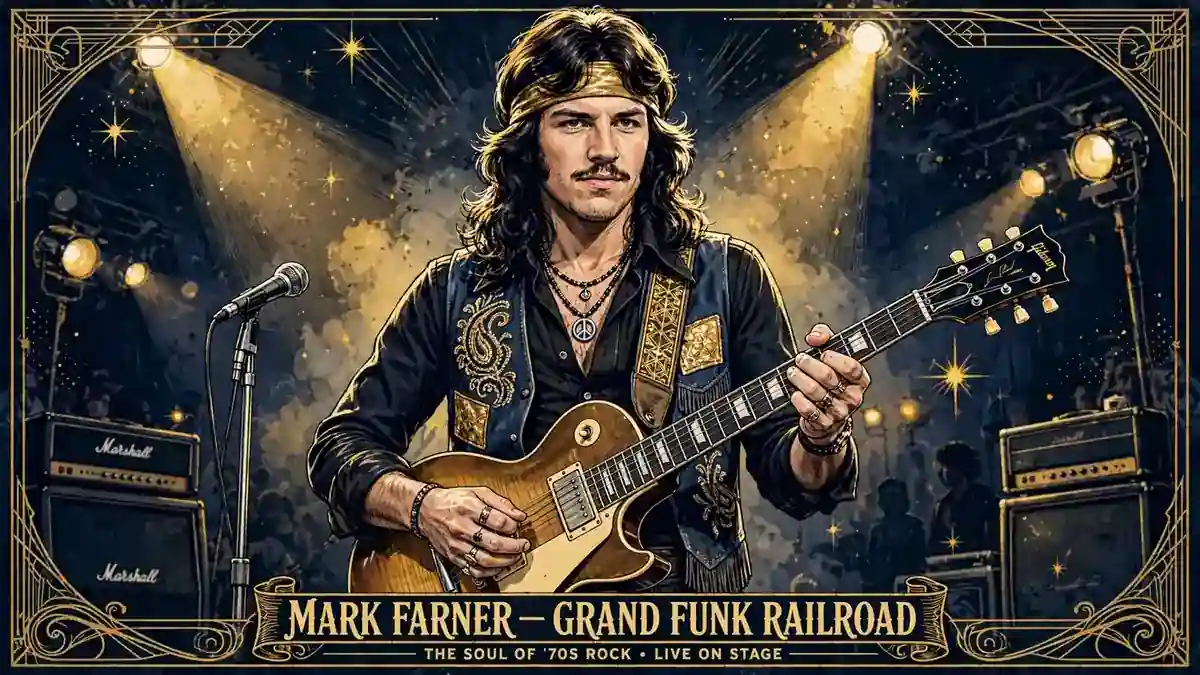
The closest thing to a brand relationship in Farner’s career is his instrument. He is associated with the Gibson Les Paul and with the Messenger guitar — the unusual instrument he played in the Grand Funk years — and guitarists of his generation were often given instruments by manufacturers. But no endorsement contract, no signature model with a reported royalty, and no paid partnership is documented, and this article does not invent one. The Gibson headstock visible in the portrait that leads this article is a nod to the instrument he is known for, not evidence of a deal.
The Rock Patriot brand is the exception that proves the rule: it is Farner’s own brand, not a sponsor’s. The merchandise, the live branding and the foundation work all sit under a name he owns, which means the income from it is his rather than a fee paid by someone else. That is a better position in some ways — he keeps the margin — and a smaller one in others, because a self-owned brand aimed at a niche audience does not pay the kind of money a national advertising campaign does.
His contemporary Alice Cooper, who collaborated with Farner in later years — the two Michigan-linked rockers have worked together and Farner has been reported living near Petoskey and writing with Cooper — built a far larger commercial footprint through decades of branding, touring and media work. The contrast is instructive: Cooper turned a stage persona into a business, while Farner turned his into a touring act and a patriotic brand. Both are legitimate paths; they simply pay differently, and the difference shows up in the net worth figures.
For readers who came here looking for a list of Farner endorsements, the honest answer is that there is not one to give. His money came from the stage and the songs, not from selling other people’s products, and the estimate in this article is built on that basis alone.
Houses, Cars and Other Assets
No verified record exists of Mark Farner’s homes, cars or other significant assets. No property transaction, no house tour, no car collection feature and no asset list has been published in the sources used for this article, and this section will not invent one. That is a deliberate choice, and it is the right one: a large part of what passes for “assets” reporting in net worth content is guesswork dressed up as fact, and Farner’s case is a good example of why it should be resisted.
What is known about where he lives comes in passing references rather than property reporting. Farner has been reported living in Petoskey, Michigan, in later years, with his wife Lesia — a small resort town on Lake Michigan’s Little Traverse Bay, a long way from the stadium circuit and a natural home for a Michigan musician who never left the state that made him. No address, purchase price, or valuation is public, and none is stated here. Petoskey is a comfortable, modest place rather than a celebrity enclave, and that fits everything else known about Farner’s later life: a working musician living in Michigan, touring from a home base, rather than a rock star maintaining properties on two coasts.
His most valuable asset is not a house or a car. It is the catalogue: the songwriting rights he retained on the post-1972 Grand Funk material, his solo catalogue, and the master rights held through LisMark Records. A catalogue of songs that have never left classic-rock radio is an income-producing asset, and its value is the present value of decades of future royalty payments — which is precisely why the Knight settlement mattered so much. The publishing on the 1969–72 recordings was the most valuable slice of that catalogue, and it was the slice he lost.
His second asset is his name and his touring operation. Mark Farner’s American Band is a going concern: a booked, touring act with a catalogue, a merchandise line, a brand and a fan base. That has a value beyond any single year’s profit, because it is the machine that keeps producing income at 78. It is not the kind of asset that appears on a rich list, but it is the kind that pays the bills, and for a working musician it is the asset that matters most.
As for cars, the sources are silent, and the silence is probably the truth: Farner has never been reported as a car collector, and the guitar — the Gibson Les Paul, the Messenger — is the only object associated with him that carries a real value and a real story. The Messenger guitar, in particular, is a piece of rock history: an unusual, aluminium-necked instrument that became part of the Grand Funk sound. Its value as a collectible is real but impossible to state without a sale record, and none is public.
The honest summary of this section is short. Farner’s wealth is in his songs, his name and his touring business. If he owns a comfortable house in northern Michigan, that is consistent with everything known about him — and it is also consistent with a net worth of $6 million to $10 million, a figure that describes a successful working musician rather than a rock oligarch.
Awards and Achievements
Farner’s awards list is short, and the shortness is part of the story. Grand Funk Railroad were one of the best-selling American bands of the 1970s and one of the least decorated by the industry’s formal honours — a band the critics dismissed and the public bought, whose trophy case never matched its sales. That mismatch is worth recording, because it explains why Farner’s honours come mostly from his home state and his community rather than from the national music establishment.
The records themselves. The band’s official tally — 13 gold records and 10 platinum records, 19 charted singles, 8 Top 40 hits, two Number One singles, and more than 25 million records sold worldwide — is the achievement that matters most, and it is the one the band’s own biography leads with. Within that tally, the 1970 record stands out: four RIAA gold albums in a single year, the most for any American group that year, in a year when the band sold more albums than any other American act. Gold and platinum certifications are awarded by the RIAA for sales thresholds, and they are the closest thing the record industry has to an audited achievement: they are counted, verified and dated, unlike the net worth figures that surround them.
The chart peaks. “We’re an American Band” reached No. 1 on the Billboard Hot 100 in 1973, and “The Loco-Motion” did the same in 1974; each sold more than a million copies. “Some Kind of Wonderful” reached the Top 10, and “Bad Time” reached the Top 5 in 1975 — the last of the band’s four Top 5 singles. “I’m Your Captain (Closer to Home)” reached No. 22 in October 1970, the group’s first Top 40 single, and its parent album reached No. 6 on the Billboard 200. The compilation Mark, Don & Mel: 1969–71 peaked at No. 17 in 1972.
The Shea Stadium record. Selling out Shea Stadium in 72 hours in July 1971, faster than the Beatles, is an achievement of a different kind — a live-performance record rather than a sales award — and it is the one that has lasted longest in the band’s reputation. The Beatles needed six weeks; Grand Funk needed three days. The record still stands as a piece of rock history, and it is the fact most often quoted about the band, including in the band’s own biography.
The Christian chart success. “Isn’t it Amazing,” the John Beland song Farner recorded in his Christian period, reached No. 2 on the Contemporary Christian music charts and earned him a nomination for a Dove Award from the Gospel Music Association. It is a smaller honour than a gold record, but it is a real one — a chart position and a nomination from the genre’s own body — and it is the only formal award nomination in Farner’s solo career that the sources record.
The Michigan honours. In 2005, Grand Funk Railroad were voted into the Michigan Rock and Roll Legends Hall of Fame. Ten years later, in 2015, Farner was voted in as a solo artist, having already been inducted as a member of Terry Knight & the Pack. Three inductions for one musician is a rare distinction, and it reflects the Michigan music community’s view of Farner as a solo artist and a founding figure of the state’s rock history in his own right, rather than only a member of a famous band.
The community honours. In 1999, the Lakota Nation honoured Farner with the Lakota Sioux Elders Honor Mark, presenting him with a handmade ceremonial quilt in Hankinson, North Dakota, in recognition of his Native ancestry and his contributions. He has also received the Cherokee Medal of Honor from the Cherokee Honor Society. These are not music-industry awards, and they do not carry a cash value — but they are the honours Farner himself has spoken about most warmly, and they belong in any honest account of what he has been given for his work.
The book. Kristofer Engelhardt’s authorised biography, From Grand Funk to Grace, was published in 2001. An authorised biography is not an award, but for a musician whose career the national press largely ignored, it is a form of recognition: someone thought the life was worth a book, and Farner trusted the author enough to authorise it.
What is missing. Grand Funk Railroad have never won a Grammy, and Farner has never been inducted into the Rock and Roll Hall of Fame — an omission that fans and Michigan music writers have protested for years, and one that the band’s own supporters cite as evidence of the critical establishment’s long dismissal of the group. The absence is part of the story, not an oversight in this article: a band that sold 25 million records and was ignored by the industry’s highest honours is a band whose wealth was built on audiences, not on institutions.
Net Worth Growth Over the Years
The table below is our estimate of how Farner’s net worth has moved across his career. It is not drawn from audited accounts — none exist — and the early figures are retrospective estimates based on the band’s sales, the Knight settlement and the shape of his later career. Treat it as a trajectory, not a ledger: the direction is well supported, the exact numbers are judgement calls, and the range widens in the years where the public record is thinnest.
| Year | Estimated net worth | What was happening |
|---|---|---|
| 1971 | $1 million–$2 million | Shea Stadium sell-out; four gold albums in 1970; the band is the biggest-selling American act — but management and touring costs are high. |
| 1976 | $2 million–$3 million | Original Grand Funk run ends; the Knight settlement has already stripped the 1969–72 publishing; solo career begins on Atlantic. |
| 1985 | $2 million–$4 million | Reunion albums underperform; Christian albums build a smaller, loyal audience; royalties from the catalogue continue. |
| 1995 | $3 million–$5 million | Ringo Starr All-Starr Band tour; Lismark Communications and LisMark Records give him control of his reissues. |
| 2000 | $4 million–$6 million | Grand Funk reunion and the Bosnia concerts; the 1998 split ends the reunion income; the American Band era begins. |
| 2010 | $5 million–$7 million | Steady heritage touring; the Rock Patriot brand and the American Band Foundation take shape. |
| 2020 | $6 million–$8 million | Catalogue royalties and streaming add a long tail; touring is interrupted by the pandemic years, as it was for every live act. |
| 2026 | $6 million–$10 million | Still touring with Mark Farner’s American Band; new album Closer to My Home released in 2024; classic-rock catalogue still earning. |
Two features of this trajectory deserve emphasis. The first is the flat stretch between 1976 and 1995: twenty years in which the net worth roughly doubles rather than multiplying, because the solo records sold modestly, the reunion albums underperformed, and the publishing on the most valuable early catalogue belonged to someone else. The second is the steadiness after 2000: no sudden jumps, no crashes, just a working musician’s fortune growing slowly on royalties and touring. That is a very different shape from the wealth of a rock star who kept his publishing and kept playing stadiums — and it is a more honest shape for a man whose biggest commercial success came in a seven-year window half a century ago.
The range for 2026 — $6 million to $10 million — is the same range used throughout this article, and it is the range the evidence supports. Celebrity Net Worth, the most widely cited source, puts Farner at $6 million. Surprise Sports, reporting in 2026, puts him at $8 million. Insights Journal agrees with $6 million. Weekly Worker reports $8 million to $12 million. Against those, the outlier figures — $16 million, repeated across low-quality aggregator sites that appear to be copying an old Celebrity Net Worth figure, and $20 million from BackInsights — are not supported by any named reporting and are not used here. The $16 million figure is worth a sentence of its own, because readers will meet it: it circulates widely, but it traces to a stale or mis-copied estimate, and the current, dated reporting from the better sources clusters at $6 million to $8 million. Our $6 million to $10 million range sits above the low end to allow for the catalogue’s continuing value and the touring income, and below the outlier claims that no credible outlet supports.
For comparison, the band’s own commercial scale dwarfs the personal fortune: 25 million records sold, at 1970s prices, represents hundreds of millions of dollars in retail sales, of which the band members received a small fraction after the label, the management, the touring costs and the lawyers had taken their shares. That is the normal arithmetic of the record business, and it is the reason a frontman who sold 25 million records can be worth $6 million to $10 million while the records themselves generated vastly more. The money went to the machine; the musician kept the songs he still owns, and the stage.
How does Farner sit beside the peers he shared stages and charts with? The table below compares career scale rather than unverified personal fortunes, because the sales and chart figures are documented while most peer net worth figures are not. The pattern is plain: Farner’s band sold as much as anyone’s, but his personal fortune is smaller than peers who kept their publishing or kept playing stadiums for decades.
| Artist | Career peak | Record sales / honours | Why the fortune differs |
|---|---|---|---|
| Mark Farner | Grand Funk Railroad, 1969–76 | 25M+ records; 13 gold, 10 platinum; 2 No. 1 singles | Lost 1969–72 publishing in the Knight lawsuit; left stadiums in 1976 |
| Bob Seger | Solo career, 1970s–80s | 75M+ records claimed; 13 platinum albums | Kept control of his catalogue and toured arenas for decades |
| Ted Nugent | Solo career, 1970s onward | Platinum-selling solo albums; decades of touring | Long solo touring career under his own name |
| Alice Cooper | Shock rock, 1970s onward | Hit albums across five decades; long touring and media career | Turned a stage persona into a durable brand and touring business |
| Ozzy Osbourne | Black Sabbath and solo, 1970s–2020s | 100M+ records claimed across Sabbath and solo | Solo career plus television and branding built a far larger fortune |
Social Media Presence
Mark Farner keeps a modest online presence, and its modesty is consistent with everything else about his later career: the stage is the platform, and the internet is the noticeboard. His official website, markfarner.com, is the hub — tour dates, news, merchandise and the Rock Patriot branding — and it is the source Surprise Sports cited in 2026 for the claim that his official schedule lists performances through 2026 and into 2027. That schedule is the most useful thing his online presence does: it tells fans where to find him, and it tells anyone estimating his income that the touring is current, not a memory.
He is active on the standard social platforms under his own name, with accounts that carry tour announcements, photographs from shows, and messages to fans, but none of them is a large commercial operation. There are no reported follower counts in the millions, no verified influencer deals, and no paid partnership content of the kind that younger musicians use to supplement their income. For a 78-year-old heritage rocker, that is normal: the audience finds him through classic-rock radio, through the tour listings and through word of mouth, not through a feed.
That has a direct bearing on the net worth estimate. A musician with a large, monetised social following can earn from sponsorships, platform revenue and direct-to-fan sales in ways that show up quickly in a fortune. Farner does not, and this article does not credit him with social-media income he does not report. His online presence supports the touring business — it sells tickets and merchandise — rather than standing as a separate income stream, and that is how it is counted here.
Fans looking for him online should start at markfarner.com and treat any account that asks for money, sells “meet and greet” packages through unofficial channels, or claims to be Farner himself on a messaging app with suspicion. Impersonator accounts are a routine problem for musicians of his generation, and the official site remains the reliable source for dates and news.
Personal Life
Farner has been married to his wife, Lesia, for more than thirty years. The marriage has lasted through the whole of the American Band era — through the lawsuits, the reunion and the break, the health problems and the death of their son — and it is the stable centre of a life that, on stage, has always looked restless. The couple have been reported living in Petoskey, Michigan, in later years, a quiet lakeside town a long way from the arenas of the 1970s, and a fitting home for a musician who never left the state that made him.
They had three sons: Joseph, Jason and Jesse. The youngest, Jesse, was injured in a fall in 2010 at the age of 21, an accident that left him paralysed — quadriplegic, according to the family’s accounts — and in need of care for the rest of his life. Farner became his caregiver, and the experience reshaped his public work: the Rock Patriot focus on people with disabilities, veterans and struggling families is not an abstract brand position but a response to what his own family lived through. Jesse died on July 4, 2018, at the age of 29, after nearly ten years of paralysis and related health problems. Farner has spoken about the loss rarely and plainly, and this article does the same: it is a fact of his life, not a detail to be mined for colour.
Before his marriage to Lesia, Farner was reported to have been in a relationship with the actress Sally Kellerman in 1975–76, during the peak Grand Funk years. The relationship is a matter of public record in the celebrity press of the time; it is noted here and left there, as it belongs to a period of his life that ended half a century ago.
Health has been a real constraint on Farner’s later career. He began suffering from a heart-related ailment in 2004, and after eight years of heart trouble he had a pacemaker fitted on October 22, 2012, following a heart attack. He has continued to tour since, which is a measure of both his recovery and his determination, but the pacemaker and the heart history are a genuine limit on how hard a 78-year-old can work the road — and a genuine reason why his touring schedule, while active, is not the punishing arena schedule of the 1970s.
Faith is the other thread that runs through his personal life. Farner became a born-again Christian in the late 1980s, and the turn was public and musical: the Frontline Records albums, the Christian chart success of “Isn’t it Amazing,” and the Dove Award nomination all came out of it. The authorised biography of his life, published in 2001, is titled From Grand Funk to Grace — a title that names the journey directly, from the arena-rock frontman to the Christian musician, and one that Farner himself endorsed. His faith, his family and his Michigan roots are the three facts that explain the second half of his career better than any business analysis can: he is a man who made his name in the loudest band in America and then spent the next forty years playing his songs his own way, for audiences who already knew the words.
He has also been a small part of popular culture in ways he did not plan. Homer Simpson name-checks him in the Simpsons episode “Homerpalooza,” praising “the wild, shirtless lyrics of Mark Farner” to children who have never heard of Grand Funk, and he was mentioned in a 2011 episode of Curb Your Enthusiasm. Both are jokes at his expense and tributes at the same time — the kind of cultural afterlife that only happens to musicians whose songs outlive their moment.
Sources & Reporting
How this article was reported. Every money figure in this article traces to a named source, and every figure that is an estimate is labelled as one. The reporting window is October–November 2026, with the core biographical record drawn from sources published between 2015 and 2026. Where sources disagree on the net worth figure, this article publishes a range and names who says what, rather than picking the most flattering number.
Celebrity Net Worth — the $6 million estimate for Farner, the most widely cited figure; the account of the 1972 Terry Knight lawsuit and its outcome; the band’s gold and platinum tallies; the 2012 pacemaker and heart attack; the marriage to Lesia and the death of son Jesse in 2018. Page published January 2025, updated January 2025.
Wikipedia — the biographical spine: birth date and place, band history, discography, the Ringo Starr All-Starr Band tour, the 1996–98 reunion and the profit-share dispute, the Michigan Rock and Roll Legends Hall of Fame inductions, the Lakota and Cherokee honours, and the 2024 album Closer to My Home. Page reviewed November 2026.
Surprise Sports — the 2026 estimate of $8 million, the biography table, and the confirmation that Farner’s official tour schedule lists performances through 2026 and 2027. Published October 2026.
Insights Journal — the 2026 estimate of approximately $6 million, with an explicit warning that the figure is an unverified third-party estimate rather than a confirmed balance sheet. Published 2026.
Grand Funk Railroad (official band site) — the band’s own biography: 19 charted singles, 8 Top 40 hits, two Number One singles, 13 gold and 10 platinum records, more than 25 million records sold worldwide, and the 1971 Shea Stadium sell-out faster than the Beatles.
Uncut — the Shea Stadium detail (55,000 seats, sold out in just under 72 hours against the Beatles’ six weeks) and the account of the band’s early-1970s commercial peak, including 25 million LPs sold in seven years. Originally published 2010, reviewed 2026.
Best Classic Bands — the Mark Farner interview covering the Shea Stadium show, the 25 million albums sold, and the band’s formation and early years. Published 2025.
Zenith Net Worth — a $10 million peak estimate, used here only as the top of the range of published claims, not as the article’s estimate.
Michigan Rock and Roll Legends — the Hall of Fame inductions, including Farner’s solo induction in 2015 and the band’s induction in 2005.
What we did not use. Aggregator sites repeating a $16 million figure without a named source or a date were not used for the estimate; the figure appears to be a stale or mis-copied estimate and is discussed in the growth section only to warn readers about it. BackInsights’ $20 million figure was likewise not used. No salary, per-show fee or property value is stated anywhere in this article, because no reliable source states one.
Frequently Asked Questions
What is Mark Farner’s net worth in 2026?
Mark Farner’s net worth is estimated at $6 million to $10 million as of November 2026, with $8 million as the midpoint. Celebrity Net Worth puts him at $6 million and Surprise Sports at $8 million, while other outlets range up to $12 million. The figure is an estimate: Farner has never published his finances, and his wealth comes from songwriting royalties, touring, merchandise and licensing built over a career that began in 1965.
Is Mark Farner still alive?
Yes. Mark Farner is alive and still performing at 78. He tours with Mark Farner’s American Band, released a new solo album, Closer to My Home, in 2024, and his official tour schedule lists performances through 2026 and into 2027. He had a pacemaker fitted in October 2012 after eight years of heart trouble, and he has continued to tour since.
Is Mark Farner still in Grand Funk Railroad?
No. Farner left Grand Funk Railroad in 1998 after a reunion that lasted three years, and he has not been a member since. The current touring version of Grand Funk Railroad performs without him, led by Don Brewer and Mel Schacher with vocalist Max Carl. Farner performs the same songs under his own name with Mark Farner’s American Band.
How old is Mark Farner?
Mark Farner was born on September 29, 1948, in Flint, Michigan, which makes him 78 years old as of November 2026. He began his professional career in 1965 at seventeen and formed Grand Funk Railroad in 1969 at twenty.
What songs did Mark Farner write?
Farner wrote most of Grand Funk Railroad’s material, including his best-known composition, “I’m Your Captain (Closer to Home)” from 1970, and the 1975 hit “Bad Time,” the last of the band’s four singles to reach the Top 5. He also wrote “Queen Bee,” which appeared on the soundtrack of the 1981 film Heavy Metal. The band’s two Number One singles, “We’re an American Band” and “The Loco-Motion,” were written by Don Brewer and Carole King and Gerry Goffin respectively, not by Farner — a distinction that matters for who collects the songwriting royalties.
How many albums did Grand Funk Railroad sell?
Grand Funk Railroad sold more than 25 million records worldwide, according to the band’s official biography and Capitol Records. The band collected 13 gold and 10 platinum records, had 19 charted singles and 8 Top 40 hits, and in 1970 alone earned four gold albums — the most for any American group that year — while selling more albums than any other American band.
Why did Mark Farner leave Grand Funk Railroad?
Farner left in 1998 after disagreements with drummer Don Brewer, following a three-year reunion. When Brewer and Mel Schacher proposed another reunion in 2000, Farner said he would return only for half of the band’s profit rather than the one-third share he had received before, arguing that he did the most work on stage. They refused, rebuilt the band with new members, and Farner went on to tour as Mark Farner’s American Band. Lawsuits over the use of the band’s name followed, and his former bandmates unsuccessfully sued to stop him performing under his own name.
Who is Mark Farner’s wife?
Mark Farner is married to Lesia Farner, and the couple have been married for more than thirty years. They had three sons — Joseph, Jason and Jesse. Their youngest son, Jesse, was left paralysed by a fall in 2010 at the age of 21 and died on July 4, 2018, at 29. The couple have been reported living in Petoskey, Michigan, in later years.
Final Thoughts
Mark Farner’s net worth — $6 million to $10 million, with $8 million as the midpoint — is a smaller number than the scale of his fame suggests, and that is the honest story of his career. He sold more than 25 million records, sold out Shea Stadium faster than the Beatles, and wrote songs that have never left the radio. He also lost the publishing on his first three years of recordings in a court case in 1972, left the stadium circuit in 1976, and spent the next fifty years earning his living the hard way: on stage, in theatres and casinos and festivals, under his own name.
There is something admirable in that arithmetic. Farner did not turn his fame into a business empire, and he did not spend his later years chasing a reunion on someone else’s terms — when the band offered him a third, he asked for a half, and when they said no, he walked away and built his own band instead. At 78, he is still touring, still recording — Closer to My Home arrived in 2024 — and still playing the songs he wrote in Flint more than half a century ago to audiences who know every word. The fortune is modest by rock-star standards. The career is not.
For anyone weighing the numbers in this article, the figure to remember is the range, not a single number. $6 million is what the most cited source says; $8 million is what the freshest 2026 reporting says; $10 million is the top of what the credible sources support. Anything above that — the $16 million and $20 million figures that circulate on aggregator sites — is not supported by named reporting and should be treated with suspicion. Farner’s wealth is real, earned and durable. It is also exactly what a working musician who lost his early publishing and kept his name would have: enough, honestly come by, and still growing slowly on the songs.
Published on November 23, 2026. Last reviewed November 2026. Found an error? See our corrections policy.