
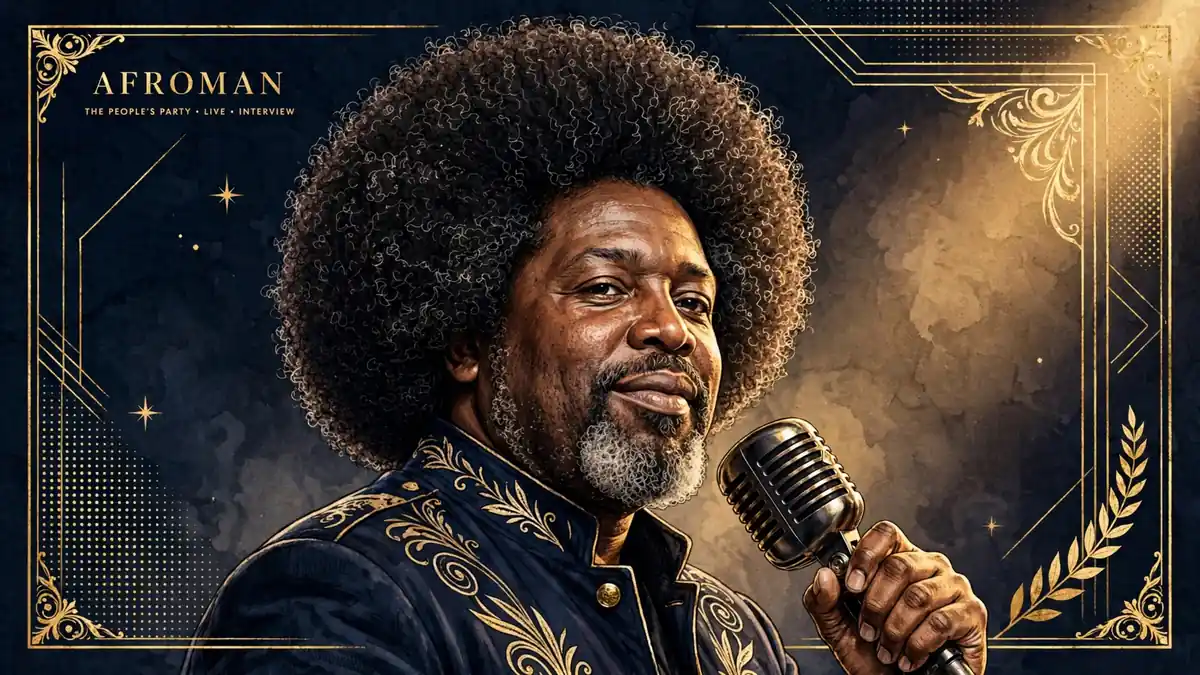
Afroman‘s net worth is estimated at $1–3 million as of November 2026. The rapper born Joseph Edgar Foreman turned one joke song recorded for pennies into a Grammy-nominated global hit, a six-album deal with Universal Records, and a 25-year independent career — then turned a botched police raid on his Ohio home into a viral merch empire and a courtroom win that saved him from a $3.9 million lawsuit.
Afroman: Quick Facts
| Estimated net worth | $1–3 million (range: $200,000–$6 million) |
|---|---|
| Profession | Rapper, singer, songwriter, producer |
| Nationality | American |
| Born | July 28, 1974 (age 52) |
| Height | 5 ft 8 in (173 cm) — most listings; some outlets list 6 ft |
| Primary income sources | Music royalties, touring, merchandise, licensing |
| Active years | 1998–present |
| Last reviewed | November 2026 |
- Early Life and Background
- Education
- Career Journey
- Rise to Fame
- Main Sources of Income
- Salary and Earnings
- Businesses and Investments
- Brand Deals and Sponsorships
- Houses, Cars and Other Assets
- Awards and Achievements
- The 2022 Raid and the 2026 Free-Speech Trial
- The 2024 Presidential Run
- Net Worth Growth Over the Years
- Social Media Presence
- Personal Life
- Sources & Reporting
- Frequently Asked Questions
Early Life and Background
Joseph Edgar Foreman was born on July 28, 1974, in Los Angeles, California. His childhood did not stay in one place. He spent his earliest years in Mississippi, moved to South Central Los Angeles, and later lived in Palmdale, a desert city on the northern edge of Los Angeles County, with a brief stay in Las Vegas before settling for a time in Hattiesburg, Mississippi. That restless map shows up in his music: the West Coast drawl, the Southern storytelling, and the small-town eye for ordinary life.
Music reached him through church. As a boy he played drums and guitar in church, and by the time he was 13 he was writing lyrics and beats at home. The stage name came from schoolyard teasing — a girl mocked his afro hairstyle, and the nickname stuck so hard it became a career. BlackPast, the African American history encyclopedia, records that he began selling homemade mixtapes to classmates in the eighth grade, and that a rap he wrote about one of his teachers sold more than 400 copies around school. That is the first hard number in Afroman’s money story, and it is a telling one: he was selling his own product, direct to his own audience, years before a label ever called.
Palmdale shaped the voice. It was a working-class desert town far from the studios and video shoots of Los Angeles, and the everyday scenes he watched there — unpaid bills, missed buses, chores left undone — became the raw material of his best-known songs. He has said that leaving Southern California for Mississippi helped his music, because audiences in the South and Midwest were more open to experimenting with new sounds than the crowds back in Los Angeles. The move to Hattiesburg in 1999 would turn out to be the most important business decision of his early career, because it put him in the room with the producer and bandmates who built his breakout record.
His family background stays mostly private. No public record names his parents beyond Mr. and Mrs. Foreman in fan-compiled biographies, and nothing reliable is published about siblings. That privacy is a pattern that runs through his whole adult life: the jokes are public, the family is not.
Education
Afroman attended Palmdale High School and dropped out in 1991, before graduating. He was 17. The decision looks reckless on paper and turned out to be the fork in the road: instead of a diploma he chose the mixtape economy he had already tested in middle school, recording at home and selling tapes hand to hand.
There is no record of college, trade school, or formal music training. What he learned, he learned by doing — writing songs, playing drums and guitar in church, and figuring out how to get a tape into a stranger’s hands for cash. That self-taught path explains a lot about how his money works today. He never had a major-label machine teaching him the business, so he built his own: his own label, his own merch, his own touring schedule. The education gap is real, and it shows in the gaps in his catalog’s paperwork, but the street-level sales instinct he picked up at 13 never left him.
Career Journey
Afroman’s first album, My Fro-losophy, arrived in 1998 and flopped. His second, Sell Your Dope, followed in 1999, the year he moved to Hattiesburg, Mississippi. There he met drummer Jody Stallone, keyboardist and bassist Darrell Havard, and producer Tim Ramenofsky, who recorded under the name Headfridge. The four of them formed the working band behind the sound that would make him famous: live drums, funk bass, blues guitar, and a frontman telling jokes over the top of it.
The breakthrough came in the spring of 2000, when Ramenofsky produced and released the album Because I Got High on the tiny independent label T-Bones Records. There was no radio campaign and no video budget. The record was sold at local concerts and passed around on Napster, the file-sharing service that was then the main way young listeners discovered music. The title track was a comic list song about everyday tasks derailed by smoking weed — cleaning the room, paying child support, going to class — and it spread because it was funny, quotable, and easy to share. Afroman has said the song started with his own unwillingness to clean his room, and he simply kept adding chores to the list.
The Howard Stern Show picked the track up and played it, and that exposure pushed it out of the file-sharing underground and into the mainstream. By late 2001 it was a genuine hit. Universal Records signed Afroman to a six-album deal, and in 2001 the label released The Good Times, a compilation that stitched his first two albums together with new songs. The deal was the peak of his major-label career, and it is worth pausing on what it meant: a rapper who had been selling tapes to classmates a decade earlier now had a global corporation distributing his jokes.
The major-label phase did not last. Afroman released a run of albums through the 2000s — four in 2004 alone, starting with the double-disc Afroholic… The Even Better Times on April 20 — and gradually returned to independent life, releasing music through his own Hungry Hustler imprint and older labels including Cosmic Wire and Federal. Editorialge, in a March 2026 profile, counts 24 studio albums across his catalog, a number that makes him one of the most prolific rappers of his generation even if most of those records never charted. The catalog is the asset now: every album adds songs that can stream, sync, and sell at the merch table.
He also kept a foothold in live music that never went away. After the single broke, he joined the lineup of Cypress Hill’s fall festival Smoke Out alongside the Deftones and Method Man, a booking that put him in front of exactly the audience that already knew every word of his hit. That festival circuit — clubs, mid-size venues, cannabis-friendly bills — became his permanent home, and it still pays his bills in 2026.
Rise to Fame
The numbers behind the rise are unusually well documented for an independent artist, because the song charted in so many countries at once. “Because I Got High” peaked at No. 13 on the Billboard Hot 100, debuting at No. 67 on August 18, 2001, jumping to No. 33 in its second week, reaching the top 20 by September 1, and spending 10 weeks on the chart. It went further abroad: No. 1 in the United Kingdom, Ireland, Germany, Australia and New Zealand. By early 2002 it had sold over a million copies worldwide, and it was certified platinum.
Then came the nomination that still defines his credibility. “Because I Got High” was nominated for the Grammy Award for Best Rap Solo Performance in 2002, putting a joke song recorded on an indie budget in the same category as Jay-Z’s “Izzo (H.O.V.A.)” and Missy Elliott. He did not win, but the nomination did something a chart position could not: it made the music industry take a comedy rapper seriously, at least for one night. Jay-Z’s own fortune grew into the billions from that same era, a contrast that says a lot about how differently two 2002 Grammy nominees’ money stories can run.
Hollywood came calling too. The song was featured in Jay and Silent Bob Strike Back (2001), The Perfect Score (2004) and Disturbia (2007), and each placement meant a sync fee plus a fresh wave of listeners discovering a song they thought they already knew. Those film placements are the reason the track still earns: a song in a movie gets licensed again every time the movie streams, airs on cable, or lands on a playlist.
The fame had a sharp edge. Afroman became a textbook one-hit wonder in the public mind, and the label that had signed him for six albums drifted away as the follow-up singles failed to repeat the trick. His second single, “Crazy Rap (Colt 45 & 2 Zig Zags),” has a loyal following and still streams well, but it never came near the Hot 100 run of its predecessor. The one-hit label cost him radio and press attention, but it never cost him the audience that shows up to hear the hit live — and that audience is the reason his touring income never dried up. Among the musicians profiled on NetWorthCraft, few have squeezed as many years of income out of a single song as he has.
What competitors usually miss is how early the viral mechanics were. “Because I Got High” went viral in 2000 and 2001, years before YouTube, TikTok, or streaming playlists existed. Napster did the job that algorithms do now, and The Howard Stern Show did the job that a late-night clip does now. Afroman was a viral artist before the word had a business model, and that is why his catalog behaves like a modern creator’s catalog: one evergreen asset, refreshed by memes, movie placements, and controversy, paying out a little at a time for decades.
Main Sources of Income
Afroman’s money comes from four places, and the balance between them has shifted over 25 years. Recorded music was the biggest slice in 2001 and 2002, when the single was selling a million copies and the Universal deal paid an advance. Today the biggest slice is live performance, with recorded music second, merchandise third, and licensing a steady fourth. Nothing in his income is a salary. It is all performance fees, royalty checks, merch-table cash, and sync licenses — the classic independent-musician mix, which is exactly why the public estimates of his wealth swing so widely.
Recorded music still earns because the catalog is deep and the hit is evergreen. “Because I Got High” alone accounts for over 266 million views on YouTube, according to streaming data cited by Editorialge, and it streams on Spotify, Apple Music, and YouTube every day. The rest of the catalog adds to the base: his video for “Will You Help Me Repair My Door” has passed 11 million YouTube views, and the “Lemon Pound Cake” video has passed 5 million. Twenty-four studio albums mean hundreds of tracks, each one a small royalty stream, and the hit keeps pulling new listeners into the rest of the catalog.
Live shows are the workhorse. Afroman plays club dates, mid-size venues, and festival bills across the United States and occasionally abroad, including the One Time At Band Camp Tour and festival appearances such as Tortuga Music Festival and Rock The Park. A promoter pays a fee, the merch table sells shirts and hats, and meet-and-greet packages add a premium tier. For an independent artist with no label advance to repay, a tour is close to pure cash flow, and it is the reason he can keep releasing albums without a hit: the shows fund the studio time.
Merchandise deserves its own mention because the 2022 police raid turned it into a serious business. After the raid, Afroman sold raid-themed products — shirts, hats, and items tied to the “Lemon Pound Cake” videos — to an audience that had just watched the whole story unfold on social media. Viral moments convert to merch sales faster than any other income stream, and he has been willing to sell the joke back to the people laughing at it. Direct-to-fan sales through his own channels mean he keeps the retail margin instead of splitting it with a label.
Licensing is the quiet earner. Film placements in Jay and Silent Bob Strike Back, The Perfect Score, and Disturbia paid sync fees at the time and keep paying as those films stream. Internet memes and TV uses of the song bring periodic checks. It is the smallest of the four streams in most years, but it is also the most passive: the song does the work while he is on the road.

Salary and Earnings
Afroman has no salary, and no employer. His earnings are best read as a fee schedule, and the clearest public number is the booking fee: event organizers pay between $25,000 and $39,999 for a U.S. performance, according to booking data cited by Editorialge in 2026, with an average confirmed fee of about $29,750 in the listings they reviewed. At that rate, a run of 20 to 30 shows a year produces $500,000 to $1.2 million in gross performance fees before travel, band pay, and management — and the merch table adds to it on top.
Annual income estimates from the net-worth blogs cluster around $100,000 a year, a figure that appears in CA Knowledge and Touch Weekly’s 2023 and 2024 profiles, which also put his monthly income near $9,000. Treat those numbers with care: they are modeled estimates, not filings, and they look low against the booking-fee math, which suggests the touring years are far better than the quiet years. The honest read is that his income is lumpy — a busy festival summer can be worth several quiet winters — and any single-year figure smooths over that reality.
The peak earnings period was 2001 and 2002: the million-selling single, the Universal six-album advance, the film syncs, and the Smoke Out festival run all landed within about 18 months. No audited figure for the advance has ever been published, and we do not invent one. What is documented is the scale of the hit: over a million copies sold by early 2002, a No. 1 single in five countries, and a Grammy nomination. The money that followed was real, and so was the comedown: when the follow-up singles stalled, the major-label checks stopped, and the income shifted to the slower, steadier streams of touring and royalties that still pay him today. 21 Savage’s touring-heavy income follows a similar shape on a much bigger scale, and the comparison is useful: for rappers outside the streaming elite, the stage is the paycheck.
Streaming royalties are the hardest stream to pin down, because the per-stream rate depends on the platform, the territory, and who owns the master. What is certain is the volume: 266 million YouTube views on one video, millions more across the catalog, and steady Spotify play for a song that turns 25 in 2026. At typical streaming rates that catalog earns tens of thousands of dollars a year, not hundreds of thousands — a meaningful slice of a $1–3 million net worth, but not the engine of it.
Businesses and Investments
Afroman’s main business is himself, structured through his own label, Hungry Hustler, which has released much of his later catalog, alongside the older T-Bones Records imprint that put out the breakout album. Owning the label means owning the masters on the independent releases, which is the single most valuable business decision an artist in his position can make: every stream of a song he owns pays him the label share as well as the artist share. He also owns a significant portion of his rights on the older material, according to profiles of his career, which is unusual for an artist who once signed a six-album major deal and is a large part of why the catalog still pays.
Beyond the label, his business activity is merch and direct-to-fan sales: clothing, accessories, and physical media sold at shows and online. The raid-themed merchandise line that followed the 2022 raid is the clearest example — a product line built in days from a news event, sold to an audience that was already watching. Some low-quality net-worth sites credit him with real estate portfolios and tech startup investments; we found no reliable reporting to support either claim, so we do not repeat them as fact. The same goes for the wilder numbers floating around online, including a blog post that claims a $10–15 million net worth built on NFTs and Fiverr sponsorships — that post confuses Afroman with a different kind of internet creator, and its numbers contradict every established estimator. We flag it here as a debunked figure, not a source.
What he has not done is also informative. There is no record of a restaurant chain, a clothing line with a major retailer, a cannabis brand with a licensing deal, or a venture fund. His business is narrow and deep: songs, shows, shirts. That narrowness is a weakness in a wealth ranking and a strength in real life — there are no failed side businesses draining the balance sheet, and no outside investors with a claim on the catalog.
Brand Deals and Sponsorships
Brand work is the smallest of Afroman’s income streams, and it is mostly tied to cannabis culture. In 2014 he became a spokesman for NORML, the marijuana-law reform organization, and for Weedmaps, the cannabis dispensary directory — a natural fit for an artist whose signature song is a comic ode to getting high, and a deal that paid in fees and exposure rather than in the kind of money a pop star commands. Niche brand partnerships with independent lifestyle and cannabis brands have followed, on a much smaller scale than the endorsement deals of major pop stars.
There are no reported deals with a sneaker company, a beverage brand, a car maker, or a fashion house, and no evidence of a paid social-media endorsement business. His social following is modest by celebrity standards, and his brand value sits in authenticity with a specific audience rather than in reach. That is why the NORML and Weedmaps deals matter more than their dollar value: they were the only major brands willing to stand next to a song about smoking weed, and they paid him to be exactly who he already was.

Houses, Cars and Other Assets
As of 2026, Afroman lives in Adams County, Ohio, in the Winchester home that became famous for the wrong reason in 2022. That house is his most documented asset, because the raid put its address, its security cameras, and its kitchen counter into the public record. No reliable source publishes the purchase price or a current valuation, and we do not guess one. What is documented is that deputies seized more than $5,000 in cash from the house during the raid and later returned the money, after finding no evidence of the crimes the warrant alleged.
Beyond the Ohio house, the public record is thin. Some net-worth blogs list luxury cars and property portfolios; none of them cite a deed, a registration, or a sale record, and the claims contradict each other, so they are not repeated here. The assets we can verify are the ones that matter most to the estimate anyway: the music catalog, the label, and the touring business. A catalog of 24 studio albums with a platinum, Grammy-nominated single is an income-producing asset that a house is not, and it is the reason his net worth survives without a visible property portfolio.
His cars are not a matter of public record either. He has not built a public image around vehicles, and no credible report ties him to a collection. The honest summary is that Afroman’s wealth is in rights and reputation, not in real estate or automobiles — and that is exactly what makes his net worth hard to estimate and easy to get wrong.
Awards and Achievements
The headline achievement is the Grammy nomination: Best Rap Solo Performance in 2002 for “Because I Got High.” It remains his only Grammy nomination, and it is the credential that separates him from every other comedy rapper of his era. The song’s chart run is the second achievement: No. 13 on the Billboard Hot 100, 10 weeks on the chart, No. 1 in the UK, Ireland, Germany, Australia and New Zealand, and over a million copies sold by early 2002.
The third achievement is longevity. Twenty-four studio albums, a catalog that still streams 25 years after the hit, and a touring schedule that runs into 2026 put him in rare company among one-hit wonders. Most artists with one global hit are a trivia question within a decade; Afroman is still selling tickets. His fourth achievement is the one nobody predicted: the March 2026 courtroom win, when a jury in West Union, Ohio sided with him on every claim in a $3.9 million defamation suit and awarded the deputies who sued him nothing. Busta Rhymes, another Grammy-nominated rapper from the same era, built his wealth on a far bigger catalog of hits — the contrast shows how much of Afroman’s story runs on a single song and a single courtroom.
He has no BET Award, no MTV Video Music Award, and no American Music Award on the public record. The achievements that exist are the ones that pay: a platinum single, a Grammy nomination, a 25-year touring career, and a free-speech verdict that made national news.
The 2022 Raid and the 2026 Free-Speech Trial
On August 21, 2022, deputies from the Adams County Sheriff’s Office executed a search warrant at Afroman’s home in Winchester, Ohio. The warrant was based on a tip from a confidential informant who claimed the house held a basement dungeon with kidnapped women, and it alleged drug trafficking and kidnapping. The deputies broke down the door with weapons drawn, searched the house, and found nothing to support the allegations. They seized a small amount of marijuana and more than $5,000 in cash, and they left damage behind. No criminal charges were ever filed, and the cash was later returned. Afroman also alleged that officers took $400 from his home during the raid.
His response was pure Afroman: he turned his home security footage into music videos. The best known, “Lemon Pound Cake,” mocked the deputies for being distracted by a cake sitting on his kitchen counter during the search, and it pulled 5 million YouTube views. “Will You Help Me Repair My Door” passed 11 million. The videos made him money twice — once in ad revenue and streams, and again in raid-themed merchandise sold to the audience that was watching the story unfold.
On March 13, 2023, seven of the officers sued him for defamation and invasion of privacy, seeking $3.9 million in damages. The case, formally Cooley v. Foreman, claimed that his videos and social media posts went beyond parody into false statements, including accusations against individual deputies. A judge dismissed two of the five claims before trial, and the ACLU of Ohio filed an amicus brief calling the suit a functional SLAPP — a lawsuit meant to silence speech rather than to recover real damages.
The trial ran March 16 to 18, 2026, in West Union, Ohio, before visiting Judge Jonathan Hein. After deliberating for hours, the 10-person jury returned a full defense verdict the same day, rejecting every claim of defamation and invasion of privacy. No damages were awarded to any of the seven plaintiffs, and the judge stated from the bench that no plaintiff verdict had prevailed. As of mid-2026, no appeal had been filed. Afroman said after the verdict that he had not won so much as America had — a line that was widely quoted in the coverage.
The money angle matters. Had he lost, the $3.9 million the deputies sought was many times his entire estimated net worth — his wealth was reported at the time to be roughly $200,000 on the low-end estimate, far less than the claim. The verdict did not make him richer, but it protected everything he had built, and the publicity around the trial drove a fresh wave of streams and merch sales. It is the clearest example in his career of a crisis becoming an income stream, and it is the freshest fact in this article: most of his competitors’ net-worth pages were written before the trial and still treat the lawsuit as an open threat.
The 2024 Presidential Run
On December 20, 2022, Afroman declared his candidacy for the 2024 United States presidential election as an independent candidate. His campaign manager, Jason Savage, announced it on his behalf, and the platform was built from the themes of his music and his life: legalization of marijuana, reform of law enforcement, and action on inflation and the housing market. He had first floated the idea during a concert in Missouri earlier in 2022.
The campaign did not raise serious money, did not appear on a major-party ballot, and did not come near the White House. It did something else instead: it gave him a reason to tour, a stream of interviews, and a news hook that kept his name in the press through an election year. It also fit the character he had built for two decades — the outsider making a joke that turns out to be a serious point. He has said nothing public about running again, and there is no record of a 2028 campaign.
Net Worth Growth Over the Years
Afroman’s wealth curve is not a steady climb. It is a spike, a long flat stretch, and a slow rebuild — and the published numbers reflect that shape. Celebrity Net Worth, which has tracked him since at least 2023, put him at $1 million in 2023 and $200,000 in its March 2026 update, a drop that likely reflects the site’s reassessment rather than a real loss of $800,000. TheRichest, at the other end, has published $4–6 million. Most 2026 profiles land between $1 million and $3 million, which is where we anchor.
| Year | Estimated net worth | What drove it |
|---|---|---|
| 1998 | Under $50,000 (estimated) | Debut album flops; mixtape sales in school |
| 2001 | Approaching $1 million (estimated) | Hit single sells over a million copies; Universal six-album deal |
| 2002 | $1–2 million (estimated) | Grammy nomination; film syncs; peak touring |
| 2010 | $500,000–$1 million (estimated) | Independent catalog; steady club touring |
| 2020 | $1 million (Celebrity Net Worth) | Catalog streaming; NORML/Weedmaps work |
| 2023 | $1 million (Celebrity Net Worth) | Touring returns; raid videos go viral |
| 2026 | $1–3 million (NetWorthCraft estimate) | Touring, catalog royalties, merch; lawsuit won |
Why do the estimates disagree so much? Three reasons. First, nobody files his accounts: as an independent artist, his touring fees and royalty splits are private, so every estimator is guessing from the same thin public record. Second, the estimators use different methods — Celebrity Net Worth weighs reported income and visible assets conservatively, while TheRichest appears to capitalize the long-term value of the streaming catalog at a much higher multiple. Third, the lawsuit distorted the picture: for three years, a $3.9 million claim hung over a man whose low-end net worth was reported at $200,000, and some estimators appear to have discounted his wealth for the legal risk. With the verdict in and the claim gone, the $1–3 million band is the fairest reading of the evidence. The honest range, from the lowest published figure to the highest, is $200,000 to $6 million, and we print it in full rather than hiding the disagreement.
One more comparison helps. Ghostface Killah’s fortune and Redman’s fortune were built the same way — a strong 1990s and 2000s catalog, then decades of touring and independent releases — and both sit in the same low-millions band as Afroman. The pattern is consistent: rappers of that era who kept their catalogs and kept touring held their wealth, while those who spent the advance and stopped working did not.
Social Media Presence
Afroman’s social media is where his second career happened. The raid videos that became “Lemon Pound Cake” and “Will You Help Me Repair My Door” spread on YouTube and TikTok, and the trial clips from March 2026 went viral across the same platforms, pulling his catalog back into the conversation. His YouTube channel is the strongest of his profiles: the “Because I Got High” video alone has passed 266 million views, and the raid-era videos add tens of millions more. He is active on X, where he has posted about his family and his campaign, and on Instagram, where tour dates and merch drops are announced. He also maintains an official site, afroman.org, which carries his biography, tour dates, and net-worth commentary in his own voice.
His following is modest by the standards of a mainstream star, and that is the point: he does not need a stadium-sized audience, because the audience he has buys tickets and shirts. The social numbers that matter for his money are not follower counts but view counts on the catalog — 266 million on the hit, 11 million on the door video, 5 million on the cake video — because those are the numbers that pay royalties. The March 2026 trial gave him his biggest social spike in years, and it arrived at exactly the moment his catalog needed it.
Personal Life
Afroman is reported to be married to Angie Foreman, who is described in several biographies as his steadfast partner, with one profile dating the marriage to 2020. He keeps his family life private, and the details are thin: he has posted on social media about celebrating his daughter’s 21st birthday, and profiles disagree on whether he has one daughter, two children, or three. We report the disagreement rather than picking a number, because no reliable source has settled it and his own posts are the only first-hand evidence.
He lives in Winchester, Ohio, in Adams County, about 50 miles from Cincinnati — a long way from the Los Angeles and Palmdale of his youth, and a deliberate choice that fits the independent life he has built. His faith background is Christian, and he played drums and guitar in church as a boy. He has spoken openly about cannabis, which is the subject of his most famous song and the platform of his presidential run, and he has advocated for its legalization through his work with NORML.
The personal-life section is short because the record is short, and that is a deliberate choice. Where the sources conflict — on the number of children, on his height, on his exact wealth — this article says so instead of smoothing the disagreement into a false certainty. Kendrick Lamar’s profile shows the other end of the spectrum: a rapper of the same generation whose every deal is documented in the business press. Afroman’s life is documented in songs, court records, and tour posters, and the estimate in this article is built from exactly that record.
Sources & Reporting
Celebrity Net Worth — the $200,000 figure in its March 2026 update, the low end of the published range, plus the $1 million figure it carried in 2023 and 2024. Reporting window: 2023–March 2026.
Wikipedia — birth date and place, early-life moves, the 1998 and 1999 albums, the Napster and Howard Stern Show story, the Universal six-album deal, the 2002 Grammy nomination, the 2014 NORML and Weedmaps role, and the 2022 presidential candidacy announcement. Reporting window: ongoing, last checked November 2026.
BlackPast — the eighth-grade mixtape sales, the teacher rap that sold over 400 copies, the 1991 dropout from Palmdale High School, and the 1998 debut album. Reporting window: published December 2021.
Blue Note Hawaii — the T-Bones Records release, the Napster distribution, the Howard Stern Show boost, the film placements, the Grammy nomination, and the Cypress Hill Smoke Out lineup. Reporting window: venue biography, checked November 2026.
Editorialge — the $25,000–$39,999 booking fee range, the 24 studio albums, the 266 million YouTube views for “Because I Got High,” the 11 million views for “Will You Help Me Repair My Door,” the TheRichest $4–6 million figure, and the March 2026 trial timeline. Reporting window: March 2026 profile.
LegalClarity and FindLaw — the August 21, 2022 raid, the $5,000-plus cash seizure, the March 13, 2023 filing, the $3.9 million claim, the March 16–18, 2026 trial, and the full defense verdict with no damages awarded. Reporting window: March 2026.
Kronenberger Rosenfeld — the case name Cooley v. Foreman, the dismissal of two of the five claims, and the analysis of the verdict for independent artists. Reporting window: March 20, 2026.
Afroman.org — the $1.5–3 million 2026 estimate, the tour and festival billing, and the four income streams. Reporting window: 2026, checked November 2026.
TheCityCeleb — the $2 million estimate, the marriage to Angie Foreman, and the Freedom of Speech album in 2026. Reporting window: 2026.
Kemi Filani — the $1.5–3 million estimate and the 2026 trial victory in the career summary. Reporting window: March 2026.
Frequently Asked Questions
What is Afroman’s net worth in 2026?
Afroman’s net worth in 2026 is estimated at $1–3 million. Celebrity Net Worth lists a much lower $200,000, while TheRichest puts him as high as $4–6 million, so the honest range runs from $200,000 to $6 million. The $1–3 million middle band is where most 2026 estimates land, built on 25 years of touring, catalog royalties and independent releases.
What is Afroman’s real name?
Afroman’s real name is Joseph Edgar Foreman. He was born on July 28, 1974, in Los Angeles, California. He took the stage name Afroman after being teased about his afro hairstyle as a youngster.
How did Afroman make his money?
He made his money from music royalties, live touring, merchandise and licensing. His biggest earner remains the 2000 single Because I Got High, which peaked at No. 13 on the Billboard Hot 100, topped charts in the UK, Australia, Germany and Ireland, and still earns streaming and sync royalties. US promoters pay him a reported $25,000 to $39,999 per show.
How much did Because I Got High earn Afroman?
Because I Got High was released in 2000 on the independent T-Bones Records label, spread through Napster and The Howard Stern Show, and became a worldwide hit in late 2001. It earned a Grammy nomination for Best Rap Solo Performance in 2002, sold over a million copies by early 2002, and landed Afroman a six-album deal with Universal Records.
Is Afroman married, and does he have children?
Afroman is reported to be married to Angie Foreman, and he has spoken on social media about celebrating his daughter’s 21st birthday. Reports disagree on how many children he has, with some biographies listing one daughter and others listing two or three children, and he keeps his family life private.
How old is Afroman, and how tall is he?
Afroman was born on July 28, 1974, which makes him 52 years old in November 2026. Most biographical listings put his height at 5 feet 8 inches (173 cm), although some outlets list him as tall as 6 feet.
What happened in Afroman’s police raid lawsuit?
In August 2022, Adams County, Ohio sheriff’s deputies raided his Winchester home on a warrant alleging drug trafficking and kidnapping. They found no evidence, filed no charges, and returned the cash they seized. Seven deputies then sued him for $3.9 million over music videos he made from the raid footage. On March 18, 2026, a jury in West Union, Ohio ruled in Afroman’s favor on every claim and awarded the deputies nothing.
Is Afroman still touring and making music in 2026?
Yes. He still tours the United States, playing club dates, mid-size venues and festivals, including the One Time At Band Camp Tour and festival bills such as Tortuga Music Festival. He also keeps releasing independent albums through his own Hungry Hustler imprint, with Freedom of Speech arriving in 2026.
Final Thoughts
Afroman’s money story is the opposite of the overnight-success tale it looks like from the outside. One song made him famous in 2001, but the fortune — modest as it is next to the billionaires of rap — was built in the 25 years after, one show, one stream, and one shirt at a time. The $1–3 million estimate reflects a career that never had a second hit and never needed one: a platinum single that still pays, a catalog of 24 albums, a touring business that never stopped, and a label he owns outright.
The 2026 trial is the newest chapter and the most instructive. A $3.9 million lawsuit could have wiped out everything he had built, and instead it became a merch line, a viral moment, and a free-speech verdict that put his name back in the news for the right reasons. That is the pattern of his whole career: take what happens, turn it into a song, and sell the song back to the people who laughed. For a rapper who started by selling tapes to classmates in the eighth grade, it is the same business he has always been in — only the audience got bigger.
Published on November 15, 2026. Last reviewed November 2026. Found an error? See our corrections policy.