
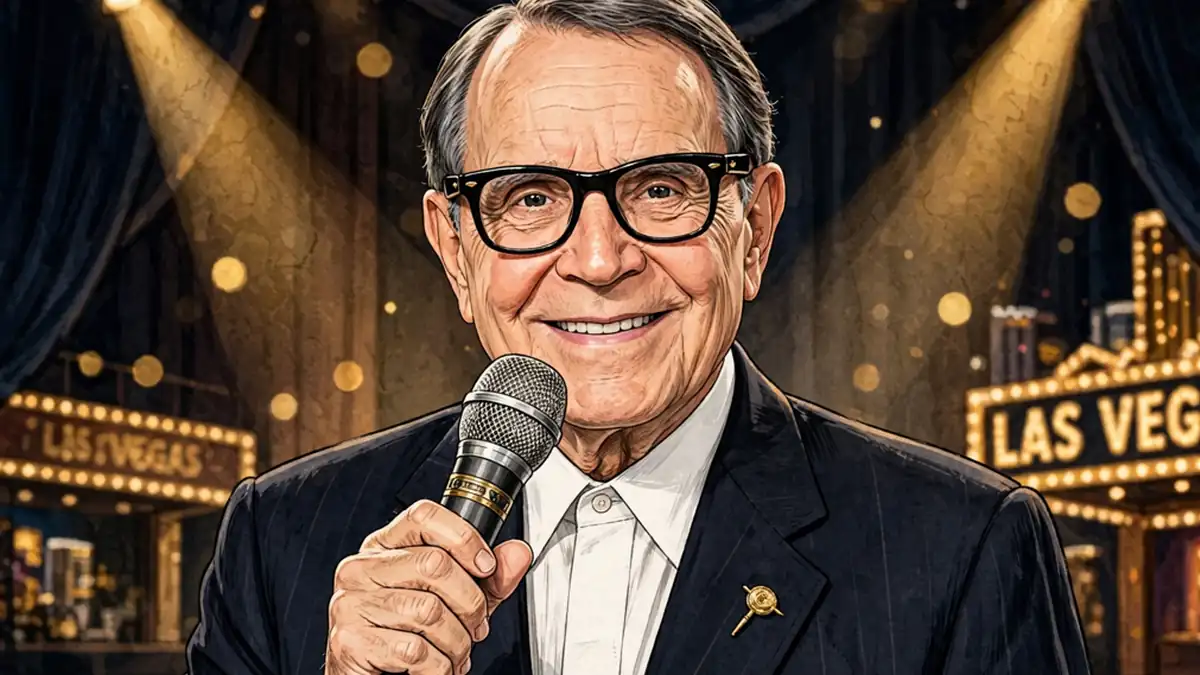
Rich Little‘s net worth is estimated at $5 million to $10 million as of November 2026. The Canadian-American impressionist known as the “Man of a Thousand Voices” built that fortune across seven decades in show business — from a first paid gig at 17 in Ottawa to 24 Dean Martin Celebrity Roasts, three HBO specials, an eight-year headlining run at the Desert Inn, and, at 87, a working Las Vegas residency at the Laugh Factory inside Horseshoe Las Vegas.
Rich Little: Quick Facts
| Estimated net worth | $5 million (anchored) (range: $5 million to $10 million) |
|---|---|
| Profession | Comedian, impressionist, voice actor |
| Nationality | Canadian-American (born in Canada; naturalized U.S. citizen in 2010) |
| Born | November 26, 1938 (age 87) |
| Height | Not publicly listed in any reliable source |
| Primary income sources | Las Vegas live shows and residencies, television appearances, voice acting, comedy albums, book royalties |
| Active years | 1956–present |
| Last reviewed | November 2026 |
- Early Life and Background
- Education
- Career Journey
- Rise to Fame
- Main Sources of Income
- Salary and Earnings
- Businesses and Investments
- Brand Deals and Sponsorships
- Houses, Cars and Other Assets
- Awards and Achievements
- Net Worth Growth Over the Years
- Social Media Presence
- Personal Life
- Sources & Reporting
- Frequently Asked Questions
Early Life and Background
Richard Caruthers Little was born on November 26, 1938, in Ottawa, Ontario, Canada, the middle of three sons. His father, Lawrence Peniston Little, was a surgeon who served as a lieutenant commander in the Royal Canadian Naval Volunteer Reserve during the Second World War and later worked for the Department of Veterans’ Affairs until his death in 1959. His mother, Elizabeth Maud Wilson, known as Betty, was a housewife who grew up in Sarnia, Ontario. The family background was comfortable and established: Little was a third-generation Canadian, descended from English stock on his father’s side and Irish on his mother’s, and his maternal line included John Willson, Speaker of the 5th Parliament of Upper Canada in the 1820s. His maternal grandfather was a judge, and his paternal great-grandfather, William Carruthers Little, sat as a Liberal-Conservative Member of Parliament in the Canadian House of Commons from 1867 to 1881.
The mimicry started early and it started at school. As a boy, Little amused classmates by imitating his teachers, and the ear that would later carry more than 200 voices was already forming. At 11, he acted in two documentary films for Crawley Films of Ottawa, his first screen work. As a teenager he took a job as an usher at the Elgin Theatre in Ottawa, and he used the hours standing at the back of the house to perfect voices while the films played. He also acted with the Ottawa Little Theatre, winning his first acting award at the Eastern Ontario Drama Festival in Deep River, Ontario, for playing Bo Decker in the play Bus Stop.
The turning point came at 17. Little had formed a double act with Geoff Scott, another young impressionist who later went into journalism and politics. The pair concentrated on Canadian political figures — Prime Minister John Diefenbaker and Ottawa mayor Charlotte Whitton among them — and in 1956 they won a talent contest on Ottawa station CBOT. That win was Little’s first paid work as an impressionist, and it led to an appearance on Pick the Stars, the CBC’s national talent contest, where the duo tied for first place. A season on The Jackie Rae Show in 1956–57 followed, and Little premiered his Charlotte Whitton impression to a national audience. The two teenagers built a 10-minute act they performed at Shriners’ conventions and Knights of Columbus meetings, and Little was earning money from his voices before he had finished school.
Radio gave him his first steady pay. While still a student he worked summer vacations as a relief announcer on Ottawa station CFRA, performing comedy sketches with Les Lye on Lye’s morning show. In the early 1960s he was hired as a disc jockey on CJET in Smiths Falls, Ontario, where his 4-to-8 p.m. weekday shift gave him hours of airtime to slip impressions into a music show. In 1961 he co-hosted Folderol, a half-hour suppertime show of light humour and interviews on CBOT, for 26 weeks. By the early 1960s he was working Toronto coffee houses and nightclubs, and the Ottawa boy with the good ear was becoming a working Canadian comic.
Two records from 1963 show how fast the Canadian career was moving — and how quickly it could go wrong. Through the Canadian division of Capitol Records, Little issued My Fellow Canadians with his radio partner Les Lye, a satirical album in the style of Vaughn Meader’s hit The First Family, built around his impressions of Diefenbaker, Lester Pearson and Tommy Douglas. His second album that year, Scrooge and the Stars, had him playing all the roles in Dickens’ A Christmas Carol as 22 different Hollywood stars, from Jack Benny to Jack Webb. It was released in early November 1963 and withdrawn weeks later: Little had cast John F. Kennedy as the Spirit of Christmas Present, and the president was assassinated days after the record reached shops. The episode cost him a record and taught him a lesson about timing that he carried into a career built on political impressions.
Education
Little attended Lisgar Collegiate Institute in Ottawa, one of the city’s oldest secondary schools. No university degree or formal drama-school training appears anywhere in the reliable record of his life — and that absence is part of the story. His training was the Elgin Theatre balcony, the Ottawa Little Theatre stage, the CFRA and CJET radio studios, and the nightclub rooms of Toronto. He learned voices by listening: standing at the back of a cinema, repeating a line until the cadence matched, then adding the walk and the gesture. The Eastern Ontario Drama Festival award for Bus Stop was the closest thing to a credential, and it was won on stage, not in a classroom.
That practical education shaped the economics of his career. Little never had a studio contract or a network salary to fall back on; he was a freelance act from the start, paid per appearance, per record, per week of a casino contract. The upside was independence and a working life that stretched past 70 years. The downside was that every dollar had to be earned in the room, night after night — a fact that explains both the size of his fortune and its ceiling. He built a comfortable living from a skill that could not be scaled the way a film star’s could, and he kept working into his late eighties because the work itself was the business.
Career Journey
Little’s American break was engineered in Canada. The writing team of Peppiatt and Aylesworth, Canadians who had moved to Hollywood and worked on variety series including The Judy Garland Show, knew Little’s work from The Jackie Rae Show and had written his original Canadian nightclub act. They played a recording of Little for Garland and her musical director Mel Tormé — Tormé had met Little when both performed on a CBC variety show in Toronto and the two had bonded over old films — and pushed for an audition. It worked. In January 1964, Little made his American television debut on CBS’s The Judy Garland Show, impressing Garland by imitating male stars including James Mason, her co-star in A Star Is Born. He was 25, and he had arrived on American television in a single appearance.
The two years after Garland were a tour of American variety television: Jackie Gleason, Rudy Vallée, Mike Douglas, George Burns and Al Hirt all had him on their shows. His first performance in the United States had actually come earlier, in December 1963 at Guy Lombardo’s inn and country club in Tierra Verde, Florida, but the Garland appearance was the one that registered. Peppiatt and Aylesworth kept writing for him, bringing him onto The Jimmy Dean Show, The Kopykats and The Julie Andrews Hour, and he moved permanently to the United States in late 1965 while continuing to appear in Canada. In 1966 he starred in his own CBC Radio comedy series, The Rich Little Show, keeping one foot in the market that had made him.
By the late 1960s he was a fixture of the variety circuit: The Ed Sullivan Show, The Dean Martin Show, Rowan & Martin’s Laugh-In, Hollywood Squares and The Tonight Show Starring Johnny Carson. He made his first appearances on The Dean Martin Show and The Jimmy Dean Show in the 1965–66 season, and the Martin connection became the spine of his television career. He was a semi-regular on the Emmy-winning ABC variety series The Julie Andrews Hour in 1972–73, and his best-known continuing series was The Kopycats, hour-long segments of The ABC Comedy Hour broadcast in 1972 and taped in England, in which the cast — Little, Frank Gorshin, Marilyn Michaels, George Kirby, Joe Baker, Fred Travalena, Charlie Callas and Peter Goodwright — performed sketches entirely in celebrity impersonation, in full costume and makeup.
Acting work ran alongside the impressions. He debuted in the Canadian series This Hour Has Seven Days in 1964 and played Stan Parker in the sitcom Love on a Rooftop in 1966–67. Film roles included The Phynx (1970) and Another Nice Mess (1972), in which he played Richard Nixon with the voice and mannerisms of Oliver Hardy. He appeared in the feature Dirty Tricks (1981) and Happy Hour (1987), did voice work in Better Off Dead (1985), and turned up in drama and comedy series including Fantasy Island, CHiPs, Police Woman, MacGyver, Murder, She Wrote, The Love Boat, The Nanny and Santa Barbara. None of these parts made him a film star, and none needed to: they kept his face on television between variety bookings and they paid union scale on top of his stage fees.
Voice work became a second career in its own right, and it paid in ways stage work could not. Little voiced the Pink Panther in the 1965 animated short Sink Pink. He narrated the three specials that launched the animated series The Raccoons — The Christmas Raccoons (1980), The Raccoons on Ice (1981) and The Raccoons and the Lost Star (1983) — and his older brother Fred voiced Cedric Sneer in the same series. He was also hired, outside any comic context, as a voice double when actors could not complete dialogue because of illness: he imitated David Niven for Trail of the Pink Panther (1982) and Curse of the Pink Panther (1983), supplied the voice of James Cagney in the television film Terrible Joe Moran (1984) after Cagney had suffered a stroke, and dubbed Gene Kelly, uncredited, in the 1991 television special Christmas at the Movies after Kelly lost his voice. That kind of work is invisible and it is also steady: studios pay well for a voice that can finish a dead or ailing star’s lines without the audience noticing.
The Nixon impression deserves its own paragraph because it became a second act. Through the 1970s Little played President Richard Nixon so often that the impression became his signature political voice, and he once performed it in front of Nixon himself — who, Little says, did not realise he was being imitated and wondered why Little was talking to him in such a funny voice. In 1992 he voiced Nixon in the animated film Bébé’s Kids and appeared as Nixon on the soap opera Santa Barbara. The most famous Nixon outing came on April Fool’s Day 1992, when he appeared on NPR’s Talk of the Nation as Nixon announcing his candidacy for president with the slogan “I didn’t do anything wrong, and I won’t do it again.” Listeners flooded NPR with outraged calls before the programme revealed the hoax in its second half. Nearly 30 years later, in 2020, Little built a play around the same president, Trial on the Potomac: The Impeachment of Richard Nixon, based on Geoff Shepard’s 2015 book The Real Watergate Scandal, and performed it Off Broadway for a five-week run in 2021.
Rise to Fame
The Dean Martin Celebrity Roasts made Little a household name in the 1970s. He appeared in 24 of the specials, roasting Don Rickles, Jack Benny, Johnny Carson, Frank Sinatra, Jimmy Stewart and Kirk Douglas, and the format was built for him: a room full of famous faces, each one a voice he already owned. The roasts ran in prime time, they were repeated endlessly, and they put his impressions in front of audiences who never went to a nightclub. Jack Benny’s response to Little’s imitation of him is part of the legend: the comedian sent Little an 18-carat gold money clip engraved with the message, “With Bob Hope doing my walk and you doing my voice, I can be a star and do nothing.”
The Tonight Show was the other pillar. Little had an unofficial monthly slot on The Tonight Show Starring Johnny Carson for several years and guest-hosted the programme about a dozen times — a rare honour that put him in Carson’s chair, in front of Carson’s audience, doing Carson’s own voice. He later played Carson in the HBO television movie The Late Shift (1996). The relationship ended without notice after his August 1982 appearance. Little says in his memoir that Carson banned him because the host was offended by the impression, a claim supported by Henry Bushkin, Carson’s long-time lawyer, who said nobody got under Carson’s skin more than Little. Fred DeCordova, Carson’s producer, gave a different account, saying the show simply was not interested in hiring him any more because of a lack of new impressions. Either way, the bookings stopped, and the loss of the Tonight Show platform coincided with the broader drying-up of variety television that pushed Little toward Las Vegas.
The HBO specials kept him visible as variety faded. Rich Little’s Christmas Carol, his first HBO special, was produced by CBC Television and aired in December 1978, then on HBO in 1979; Little played famous comedians in established roles — W. C. Fields as Ebenezer Scrooge, Paul Lynde as Bob Cratchit — and the special won an International Emmy Award and a Rose d’Or. A second HBO special followed in 1983 with Rich Little’s Robin Hood, casting Groucho Marx as Robin Hood, Humphrey Bogart as Prince John, John Wayne as Little John, Carol Channing as Maid Marion, Laurel and Hardy as the Sheriffs of Nottingham and George Burns as Alan-a-Dale. He hosted the 53rd Academy Awards in 1981, becoming the first Canadian to host the Oscars, and he hosted a syndicated revival of You Asked For It from 1981 to 1982. His own NBC series, The Rich Little Show (1975–76), and a second-season appearance on The Muppet Show filled out a television résumé that few impressionists have matched.
The 2007 White House Correspondents’ Association dinner showed both his standing and his limits. Chosen as the featured entertainer a year after Stephen Colbert’s pointed performance, Little was read by commentators as a deliberately uncontroversial choice. Before the event, The Washington Post noted that many of his best-known impressions were of performers and political figures who had died or were no longer prominent, and comedian Lewis Black called the act dated and politically harmless. President George W. Bush was reported to have enjoyed the performance, but reviewers were cool, and Time later included the routine among performances that had “bombed” at the annual dinner. The episode captures the commercial problem that shaped Little’s later career: his gallery was the golden age of Hollywood and the presidents of the 1960s and 1970s, and as those figures faded from public memory, so did the television demand for them. His own explanation, given to The New York Times in 2013, was blunt: “It’s much easier to do Humphrey Bogart than Tom Cruise. How do you imitate Brad Pitt? George Clooney? Wouldn’t mean anything.” Modern stars, he argued, deliver lines naturalistically, and naturalistic delivery gives an impressionist nothing to hold onto.
What saved the career was the stage. Las Vegas had been part of his life since the mid-1960s — dates at the Golden Nugget, a 1969 debut at the Sands on a two-year contract, four weeks at Caesars Palace in 1973 opening for The Osmonds, a month at the Desert Inn with Juliet Prowse in 1974, eight years headlining the Desert Inn in the late 1970s and 1980s, the MGM Grand with Nell Carter in 1985, Bally’s with Charo in 1986, and return dates at the Sands and the Golden Nugget in 1991 and 1992. As television work dried up in the mid-1980s, the focus shifted from Hollywood to Las Vegas in full. He sold his house in Los Angeles, relocated to Las Vegas in 1990, and bought a home there in 1992, the year he signed an exclusive long-term contract with the Sahara and staged a revamped version of The Kopykats with other impersonators. He later starred in The Presidents at Paris Las Vegas from 2002, playing nine presidents from Kennedy to George W. Bush, and moved to the Suncoast in 2004.
The longest run of his life came late. From 2015 until 2024 he was a regular performer at the Laugh Factory in the Tropicana, where his one-hour show Rich Little Live! — a career retrospective with video highlights and the charcoal sketches he had drawn of the celebrities he impersonated — ran five nights a week. His publicist’s biography records it as the longest-running one-man show in Las Vegas, eight years on an original 12-week contract. The Tropicana closed in April 2024 and was demolished that October to make way for a new stadium for the Athletics, and Little said he intended to return to the Laugh Factory once the club found a new Strip location. He did not wait long: from September 2025 he performed his one-hour show three nights a week at the Copa Room in the Tuscany Suites and Casino, with general admission tickets at $49.95, and on April 6, 2026, he began a residency at the new Laugh Factory at Horseshoe Las Vegas, performing three evenings a week, Monday through Wednesday at 6:30 p.m., with tickets from $40.95. Ticketmaster listings show the residency running through November 2026 and into December. At 87, he is still doing the thing he was first paid for at 17.
Main Sources of Income
Live performance has been the engine of Little’s income for 60 years, and it still is. The Las Vegas residencies — the Sahara contract in the 1990s, the Desert Inn headlining years, the eight-year Tropicana run, the Tuscany Copa Room dates and the current Horseshoe Laugh Factory residency — are the closest thing an impressionist gets to a salary: a fixed room, a fixed schedule, a guaranteed fee per show, repeated for months or years. A one-hour show, three to five nights a week, in a room of a few hundred seats at roughly $41 to $50 a ticket, produces a steady income that television guest spots never could. The 2015–2024 Tropicana run alone, at five shows a week across most of nine years, represents thousands of paid performances, and it is the single largest contributor to the fortune.
Television appearances were the second stream, and in the 1960s and 1970s they were the most lucrative per hour. Variety guest spots, the 24 Dean Martin roasts, the Tonight Show guest-hosting dates, the Julie Andrews series, the Kopykats run and the HBO specials all paid network and cable fees, and the roasts and specials were repeated for years. The Academy Awards hosting gig in 1981 carried a fee and a profile that fed the live business. By the mid-1980s that stream had narrowed to guest roles in drama series and the occasional special, and the balance of his income shifted decisively toward the stage.
Voice acting is the third stream, and it has the best economics of the three: a voice session pays a session fee plus residuals, and the work can be done without travel or a live audience. The Pink Panther short, the Raccoons specials, the Futurama appearances — he guest-starred as himself in the season-two episode “Raging Bender” and in the film Futurama: Bender’s Game, playing his own celebrity head impersonating Howard Cosell — and the voice-double jobs for Niven, Cagney and Kelly all fall here. The Raccoons work also carried syndication and home-video residuals across decades. Comedy albums are the fourth stream: nine comedy albums across his career, starting with the two Capitol LPs in 1963, plus the 1981 LP The First Family Rides Again, in which he joined Melanie Chartoff, Michael Richards, Shelley Hack and Vaughn Meader in satirising Ronald Reagan’s first months in the White House. Album money in the 1960s and 1970s was real money, and the catalogue continues to earn small amounts.
The fifth stream is books. His memoir, Little by Little: People I Have Known and Been, was published in 2017 by Dog Ear Publishing, and it sells steadily to the nostalgia audience that fills his Las Vegas room. It also supplied the material for the one-man shows of the 2010s, including Jimmy Stewart and Friends, which he performed at the Westgate and on tour — a show built around his Stewart impression, which he had earlier used to record the crosswalk messages for intersections in Stewart’s hometown of Indiana, Pennsylvania. Book royalties are a small line next to a Vegas contract, but they are the kind of income that arrives without a stage.
Fellow Vegas headliner Terry Fator, whose own Las Vegas fortune was built on a five-year Mirage contract, shows the scale of what a Strip residency can be worth at the top end; Little’s career ran at a smaller, steadier level, in smaller rooms, for far longer. Canadian comedy peer Martin Short, another Canadian who crossed into American variety television, followed a similar path from Canadian stages to U.S. network television, though Short’s film and series career took him further into mainstream stardom.
Salary and Earnings
No contract figure for Little has ever been published, and any article that states a precise annual salary for him is inventing it. What the record does support is a clear shape: high per-appearance fees in the variety era, a long middle period of steady casino money, and a late career of smaller-room residency income that is still active in 2026.
In the 1960s and 1970s, a variety guest spot on a network show paid a union-scale fee plus a premium for a name act, and a performer with Little’s profile — a dozen Tonight Show guest-hosting dates, 24 roasts, three HBO specials — was commanding fees well above scale. The HBO specials in particular paid at cable-special rates, and the Christmas Carol special’s International Emmy and Rose d’Or wins raised the fee he could ask for the next one. The Dean Martin roasts paid per special, and 24 of them across a decade is a substantial body of paid television work. None of these fees is public, so we do not put a number on them; the honest statement is that television was his highest-paid work per hour and his least reliable work per year.
The casino contracts are where the money became regular. A headliner at the Desert Inn for eight years in the late 1970s and 1980s, then an exclusive long-term contract at the Sahara from 1992, then The Presidents at Paris Las Vegas from 2002, then the Suncoast from 2004, then nine years at the Tropicana’s Laugh Factory — that is four decades of contracted Strip work. Casino headliner contracts of that era typically paid a weekly guarantee against a percentage of the room, and a performer who held a room for eight years was earning a comfortable professional income, not a superstar one. The comparison that puts it in perspective is the room size: Little played showrooms of a few hundred seats, while the Strip’s biggest names played arenas. His income was correspondingly smaller and steadier.
Current earnings are easier to pin down, because the current show is ticketed and public. The Horseshoe Laugh Factory residency runs Monday through Wednesday at 6:30 p.m., with tickets from $40.95, and the Tuscany Copa Room run charged $49.95 for general admission. Three shows a week in a comedy-club room, at those prices, produces a modest weekly gross before the club’s share and costs — enough to keep an 87-year-old performer working, not enough to move a net-worth estimate on its own. The value of the residency at this stage is continuity: it keeps the name live, it sells the memoir, and it keeps the catalogue earning.
One claim that circulates on aggregator sites needs correcting. A page on The Most 10 presents a table showing Little’s net worth rising from $10 million in 2022 to $12 million in 2023, $15 million in 2024 and $18 million in 2026, attributing the growth to television appearances, tech-startup investments and a production company. No source is given for any of those figures, no startup or production company is named, and the page’s own text contradicts its table. Another aggregator, AimSurplus, puts the figure above $30 million with no sourcing at all. A third, Hail Networth, describes a “Rich Little” building a creator app and an agency — a different person entirely, an influencer, confused with the 87-year-old impressionist. None of these pages is a reliable source, and none of their figures is used in our estimate. The $5 million figure from Celebrity Net Worth, repeated by NetWorthPost, NetWorthHub and The Legit, and the $5 million to $10 million range used by Mabumbe, are the only figures with any paper trail, and they are the basis of the range published here.
Businesses and Investments
Little was never a businessman in the way modern celebrities are. There is no production company, no restaurant chain, no merchandise empire and no documented portfolio of startup investments attached to his name. The closest thing to a business he owned was the act itself: a one-man show, a set of voices, a library of video clips and a reputation that filled rooms. That is a real asset — it generated income for 70 years — but it is not a saleable company, and it does not appear on any balance sheet.
What he did own, at various points, was property. He owned a house in Los Angeles, which he sold when he relocated to Las Vegas in 1990, and he bought a home in Las Vegas in 1992, the year of the Sahara contract. No address, purchase price or current value is public, and we do not guess at one. Las Vegas residential property bought in 1992 and held for three decades would have appreciated substantially, and that appreciation is part of the case for the upper end of the $5 million to $10 million range — but it is an inference, not a documented figure, and it is labelled as one.
The intellectual property is the other asset worth naming. Nine comedy albums, three HBO specials, the Raccoons narration, the Futurama appearances and the memoir form a catalogue that earns small, continuing amounts from streaming, licensing and reissue. The voice-double work for Niven, Cagney and Kelly was work-for-hire and carries no ownership. The Nixon play, Trial on the Potomac, was a creative project rather than a commercial one — a five-week Off Broadway run in 2021, staged from conviction rather than profit. Taken together, the catalogue is a modest annuity, not a fortune-maker, and that is consistent with the anchored estimate.
Brand Deals and Sponsorships
Brand work in Little’s career was voice work, not endorsement. In 1987 he provided the voice of Crispy, the mascot of Post’s Crispy Critters cereal — a commercial voice job of the kind that paid a session fee and a usage buyout. He did not front a product line, sign a sneaker deal or lend his face to a campaign, because his face was never the product; his voices were. That distinction matters for the money: a voice actor’s commercial fee is a fraction of a celebrity endorser’s fee, and it is paid once rather than renewed annually.
The modern equivalent of a brand deal for Little is the residency itself, which is effectively a sponsorship by a venue: the Laugh Factory puts his name on the marquee, sells the tickets, and takes its share, while he supplies the show. The Tropicana run, the Tuscany run and the Horseshoe run are all versions of that arrangement. There are no documented endorsement contracts, no paid social-media partnerships and no product lines in his name, and the article does not invent any.
Houses, Cars and Other Assets
The documented property record is short: a Los Angeles house, sold around 1990, and a Las Vegas home bought in 1992. Little has lived in Las Vegas ever since, and trackers that describe him as owning property there are repeating that 1992 purchase, not reporting a new one. No second home, no ranch, no overseas property and no property portfolio appears in any reliable source. His lifestyle, by every account, is modest for a man with a 70-year career: a working performer who lives in the city where he works and drives himself to the gig.
Cars are a blank in the record. Aggregator pages that credit him with a “luxury car collection” give no makes, no models and no source, and the claim is not repeated here. The one physical asset that is documented and distinctive is the set of charcoal sketches he drew of the celebrities he impersonated, which he displayed during Rich Little Live! at the Tropicana. They are personal art with sentimental value, not a collection with a market price, but they are the most characteristic thing he owns: a gallery of the voices, drawn by the man who did them.
The other asset is the archive. Decades of television appearances — the Garland debut, the roasts, the Tonight Show dates, the HBO specials — exist on tape, and the memoir and the one-man show draw on that footage nightly. The archive’s commercial value is limited: variety clips earn little in licensing, and the specials belong to the networks that commissioned them. Its value to Little is practical rather than financial — it is the raw material of the current show.
Awards and Achievements
Little’s honours list is long, and it is the strongest evidence that the industry valued him even when the pay cheques were modest. He was named Comedy Star of the Year by the American Guild of Variety Artists in 1974. He received a star on the Hollywood Walk of Fame in 1983. He was inducted into Canada’s Walk of Fame in 1998, the same year a Golden Palm Star on the Palm Springs Walk of Stars was dedicated to him, and into the Casino Legends Hall of Fame in 1999. He was given a star on the Las Vegas Walk of Stars in 2005, inducted into the Canadian Comedy Hall of Fame in 2001, and appointed to the Order of Canada in 2022 with the rank of Officer — the second-highest rank in Canada’s civilian honours system, and the capstone of a career that began on a CBC talent show in 1956.
The awards for specific work are fewer but weightier. Rich Little’s Christmas Carol won an International Emmy Award and a Rose d’Or in 1979, the two most prestigious prizes in international television, for a special in which one man played every part. Hosting the 53rd Academy Awards in 1981 made him the first Canadian to host the Oscars, a first that still stands in his biography. The eight-year Tropicana run is itself a record of a kind: his publicist’s biography calls it the longest-running one-man show in Las Vegas history, on an original contract of 12 weeks that stretched to eight years.
Charity work fills out the record. Little has supported the Juvenile Diabetes Fund and the Children’s Miracle Network, has been named to the Miami Children’s Hospital International Pediatrics Hall of Fame, and has been honoured by the naming of the Rich Little Special Care Nursery at Ottawa Civic Hospital. He has also been a major supporter of veterans through the Gary Sinise Foundation. These are not money stories, but they are part of why the honours kept coming: the industry rewards the performers who show up, and Little showed up for 70 years.
Net Worth Growth Over the Years
The growth table below is an honest reconstruction, not a set of audited figures. The early years are marked as estimates based on career stage, because no net-worth figure for Little was published before the 2010s. The 2016 figure comes from NetWorthPost, which reported $5 million as of mid-2016 and attributed it to authoritative sources. The 2023 figure comes from The Legit, which reported “over $5 million” as of May 2023. The 2026 figure is our own range, anchored at the $5 million that Celebrity Net Worth and the other trackers still publish. The flat line from 2016 to 2026 is the point: Little’s fortune was built by 2016, and the last decade has been maintenance — a working residency, a memoir, a catalogue — rather than growth.
| Year | Estimated net worth | What was happening |
|---|---|---|
| 1964 | Under $100,000 (estimate) | American television debut on The Judy Garland Show; variety circuit begins |
| 1972 | $500,000–$1 million (estimate) | The Kopykats, The Julie Andrews Hour, Dean Martin roasts under way |
| 1983 | $2–$3 million (estimate) | Hollywood Walk of Fame star; HBO specials; Desert Inn headlining years |
| 1992 | $3–$4 million (estimate) | Sahara exclusive contract; Las Vegas home bought |
| 2016 | $5 million | NetWorthPost reports $5 million as of mid-2016 |
| 2023 | Over $5 million | The Legit reports “over $5 million” as of May 2023 |
| 2026 | $5 million–$10 million | Anchored at $5 million; Horseshoe Laugh Factory residency running |
How does that compare with the comedians who worked the same rooms? Jim Carrey, the Canadian comic who followed Little from the same Toronto club circuit to Hollywood stardom, built a film fortune on a scale Little never approached, because film pays for a face the whole world sees at once while an impression pays for a room at a time. Chris Rock and Dave Chappelle turned stand-up into arena and streaming money in a way the variety era never offered. Kevin Hart did the same a generation later. Little’s fortune is smaller than any of theirs, and his career is longer than any of theirs — the trade he made, whether he chose it or not, was longevity for scale. Variety-era peer Chevy Chase, who came up through the same Saturday-night television world, shows the same pattern from the other side: a big television break, a film career, and a fortune built in a shorter, hotter window.
Social Media Presence
Little is not a social-media performer, and his online presence is thin for a man still working in 2026. There is no verified, actively maintained personal account driving ticket sales for the Horseshoe residency; the show is sold through the Laugh Factory, Ticketmaster and the venue’s own listings, not through a creator funnel. That is a generational fact rather than a failure: his audience finds him through the marquee, the listings and word of mouth, the way it has since the 1960s. The confusion this creates online is real — search results for “Rich Little net worth” now surface pages about a young influencer of the same name, complete with an app and an agency, and at least one AI-generated article has merged the two men into a single fictional biography. Readers should treat any “Rich Little” social-media account or startup story with care: the impressionist is 87, lives in Las Vegas, and performs three nights a week at the Horseshoe. He is not launching an app.
The thin social presence is also a financial fact. A modern comedian with Little’s name recognition and a large following could monetise it; Little’s income comes from the room, not the feed. That limits the upside — there is no viral clip, no special sold to a streamer, no merchandise drop — and it also limits the risk. His audience is the people who buy a $41 ticket on a Monday night in Las Vegas, and that audience has kept him employed for nine years at the Tropicana and counting at the Horseshoe.
Personal Life
Little has been married four times, and the record of those marriages is unusually well documented — and unusually sad in places. He was engaged to Canadian actress Jean Christopher in 1965, but they did not marry. His first wife was Jeanne Worden, whom he met when she was working as a secretary on The Joey Bishop Show; they married on October 16, 1971, had a daughter, Bria, and divorced in 1989. He had a brief relationship with Lalette Cottrell of Delaware, with whom he had a second daughter, Lyndsay, born in 1988. He was engaged to magician Melinda Saxe from 1988 to 1991; she broke off the three-year relationship saying she had discovered he had secretly videotaped them having sex in 1988, and she later sued him for defamation, invasion of privacy and inflicting emotional distress, claiming he had joked about their relationship on stage. Little said the videotaping was consensual. The lawsuit was eventually settled out of court.
His second marriage was to comedian and impressionist Jeannette Markey, in 1994; they divorced in 1997. His third wife was Marie Marotta, whom he married on October 15, 2003. She died in 2010 of a deliberate overdose of sleeping pills after years of suffering from migraines and chronic pain — a loss Little has spoken about rarely and plainly. His fourth wife was Catherine Brown, a former reality-show contestant he met online; they married in a private ceremony in 2012 and divorced in October of the same year. As of 2026 he appears to be single, living in Las Vegas, with two daughters.
He became a naturalized citizen of the United States in 2010 — some accounts date the ceremony to January 10, 2008, in a Las Vegas courtroom; the 2010 date is the one his biography gives — and he has described himself politically as “basically a Republican,” though his act has generally been non-partisan. In 2021 he told the Daily Beast he believed Donald Trump won the 2020 presidential election. His older brother Fred was a social worker and voice actor who was the original voice of Cedric Sneer in The Raccoons and performed as an impressionist in smaller venues himself; his younger brother Chris was a commercial artist who designed the covers of Little’s albums. The family, in other words, supplied the voices, the artwork and the audience, and the middle son took the act to Las Vegas.
Sources & Reporting
Wikipedia — biographical spine of this article: birth, family, marriages, career chronology, honours, the Tropicana and Horseshoe residencies, and the 2025–2026 dates. Reporting window: page as crawled October 2026, with 2026 residency dates current to November 2026.
Celebrity Net Worth — the $5 million net-worth figure that anchors our estimate; the figure most other trackers repeat.
NetWorthPost — $5 million as of mid-2016, with career and personal-life detail; the earliest dated $5 million figure in the record.
The Legit — “over $5 million” as of May 2023, plus marriage and family detail and the 2023 status check.
Mabumbe — the $5 million to $10 million range, and the Tropicana run dates.
The New York Times — the January 2013 profile “A Spot-On Impression of a Stubborn Survivor,” source of Little’s account of why modern stars are hard to imitate and of the mid-1980s career decline.
Las Vegas Review-Journal — Las Vegas career history, including the Sands, Desert Inn and Sahara contracts.
BroadwayWorld — the Horseshoe Laugh Factory residency listing, November 2026 dates and $40.95 ticket price; also the 2020–2021 Nixon play coverage.
Ticketmaster — current Horseshoe residency dates and times, November–December 2026.
EBSCO — research-starter biography: the Judy Garland break, the Kopykats run, the 200-plus voices, the 2017 memoir, the 2022 Order of Canada appointment and the September 2025 Tuscany residency.
Figures that were checked and rejected: The Most 10’s $18 million table (no source, contradicted by its own text), AimSurplus’s “over $30 million” (no source), and Hail Networth’s influencer-app narrative (about a different person of the same name). None of these figures is used in this article.
Reporting window: sources published or updated between 2013 and November 2026, reviewed November 16, 2026. Where sources disagreed — the $5 million anchor against the $5–$10 million range, and the 2008 against the 2010 naturalization date — this article publishes the range or names both dates rather than picking one silently.
Frequently Asked Questions
What is Rich Little’s net worth in 2026?
Rich Little’s net worth is estimated at $5 million to $10 million as of November 2026, anchored at $5 million — the figure published by Celebrity Net Worth and repeated by most independent trackers. The range reflects the gap between the long-standing $5 million figure and a second group of trackers that put him at up to $10 million. Claims of $18 million or $30 million on aggregator sites have no source behind them and are not used in this estimate.
Is Rich Little still alive?
Yes. Rich Little is alive and still performing at 87. He began a residency at the Laugh Factory inside Horseshoe Las Vegas on April 6, 2026, performing Monday through Wednesday at 6:30 p.m., with Ticketmaster listings running through November and into December 2026. He previously performed at the Tuscany Suites and Casino’s Copa Room from September 2025.
How old is Rich Little?
Rich Little was born on November 26, 1938, in Ottawa, Ontario, Canada, which makes him 87 years old as of November 2026. He turns 88 on November 26, 2026. He has been performing professionally since 1956, when he won a CBC talent contest at 17 — a career of 70 years.
Who is Rich Little’s wife?
Rich Little is not currently married. He has been married four times: to Jeanne Worden (1971–1989), with whom he had a daughter, Bria; to comedian Jeannette Markey (1994–1997); to Marie Marotta (2003 until her death in 2010); and to Catherine Brown, a former reality-show contestant, in 2012 — a marriage that ended in divorce the same year. He has two daughters, Bria and Lyndsay.
What is Rich Little famous for?
Rich Little is famous as the “Man of a Thousand Voices,” the impressionist with a repertoire of more than 200 voices. His best-known impressions are of U.S. presidents — above all Richard Nixon — and of Johnny Carson, Frank Sinatra, Dean Martin, Jimmy Stewart and Humphrey Bogart. He appeared in 24 Dean Martin Celebrity Roasts, guest-hosted The Tonight Show about a dozen times, hosted the 1981 Academy Awards, and won an International Emmy for his HBO special Rich Little’s Christmas Carol.
Where does Rich Little perform now?
At the Laugh Factory inside Horseshoe Las Vegas, 3645 Las Vegas Boulevard South, where his residency Rich Little: Live in Las Vegas runs Monday through Wednesday at 6:30 p.m., with tickets from $40.95. Before that he performed at the Tropicana’s Laugh Factory from 2015 to 2024 and at the Tuscany Suites and Casino’s Copa Room from September 2025.
Did Rich Little do the voice of the Pink Panther?
Yes. Rich Little voiced the Pink Panther in the 1965 animated short Sink Pink. He also narrated the three specials that launched The Raccoons, voiced Richard Nixon in Bébé’s Kids (1992) and in Futurama, and worked as a voice double for David Niven, James Cagney and Gene Kelly when illness kept those actors from completing dialogue.
How did Rich Little make his money?
Mostly from live performance: four decades of Las Vegas casino contracts and residencies, including eight years headlining the Desert Inn and nine years at the Tropicana’s Laugh Factory. Television paid the highest fees per hour — 24 Dean Martin roasts, Tonight Show guest-hosting, three HBO specials — while voice acting, nine comedy albums and his 2017 memoir Little by Little added smaller, steadier streams. He has no documented business empire or endorsement fortune.
Final Thoughts
Rich Little’s fortune is the honest size for the career he had: $5 million to $10 million, anchored at $5 million, earned one room at a time over 70 years. He was never a film star and never a mogul, and the money shows it. What he was — the best impressionist of the variety-television age, the man who could be Nixon, Carson, Sinatra and Stewart in the same hour — paid him in decades of work rather than in a single windfall, and the work is still paying: at 87, three nights a week at the Horseshoe, tickets from $40.95, doing the voices he first got paid for at 17. The aggregator pages that put him at $18 million or $30 million are selling a different story, and a different man; the real one is on stage in Las Vegas, and the real figure is the one with a source behind it.
Published on November 16, 2026. Last reviewed November 2026. Found an error? See our corrections policy.