
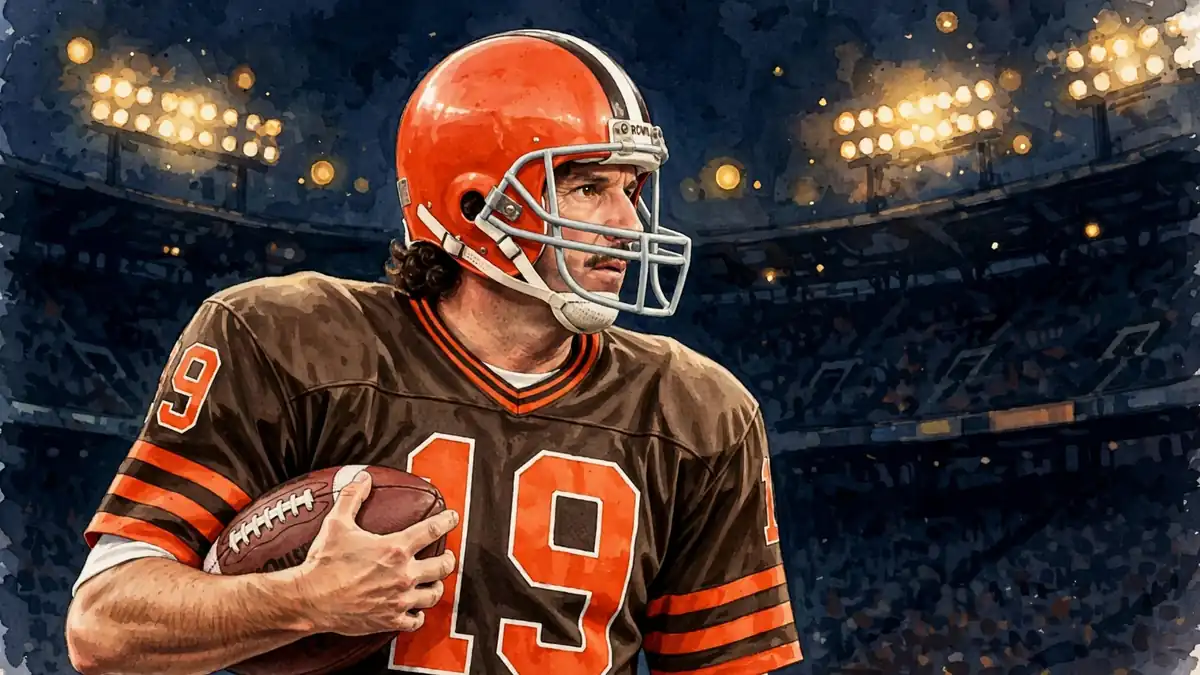
Bernie Kosar‘s net worth is estimated at $2 million as of November 2026. The former Cleveland Browns quarterback earned around $19 million across 12 NFL seasons, lost nearly all of it in a 2009 bankruptcy that left $44 in his checking account, and rebuilt a modest fortune around a protected NFL pension worth roughly $200,000 a year — a recovery capped by a liver transplant on November 17, 2025, which he marked one year later looking sharper and healthier than he had in years.
Bernie Kosar: Quick Facts
| Estimated net worth | $2 million (range: $100,000–$2 million) |
|---|---|
| Profession | Former NFL quarterback, broadcaster, businessman |
| Nationality | American |
| Born | November 25, 1963 (age 62) |
| Height | 6 ft 5 in (1.96 m) |
| Primary income sources | NFL salary (1985–1996), NFL pension, broadcasting and podcasting, book sales, wellness brand, restaurant licensing |
| Active years | 1985–1996 (NFL); 1982–1984 (college) |
| Last reviewed | November 2026 |
- Early Life and Background
- Education
- Career Journey
- Rise to Fame
- Main Sources of Income
- Salary and Earnings
- Businesses and Investments
- Brand Deals and Sponsorships
- Houses, Cars and Other Assets
- Awards and Achievements
- Net Worth Growth Over the Years
- Social Media Presence
- Personal Life
- Sources & Reporting
- Frequently Asked Questions
Early Life and Background
Bernard Joseph Kosar Jr. was born on November 25, 1963, in Youngstown, Ohio, and raised in Boardman Township, a suburb on the edge of the Mahoning Valley steel country. His father, Bernie Kosar Sr., sold Ingersoll-Rand compressors after an engineering background, and his mother Geri kept a Catholic household with three children — Bernie, his sister Beth and his brother Brian. Bernie was the oldest. The family lived Browns football the way most Youngstown families did in the 1970s: the team on television on Sundays, the kid in the yard pretending he was the quarterback.
That yard fantasy was literal. In a 2019 interview with the Browns’ own “Club 46” series, Kosar said he ran around his yard as a boy picturing himself in an NFL stadium. He grew into a 6-foot-5 frame that made the picture plausible, and at Boardman High School he played three sports — football, basketball and baseball — starting on the basketball team as a sophomore and becoming its leading scorer and rebounder, while also pitching and playing third base. His father and his Boardman coaches thought baseball was his best sport. Football was his favourite.
By his senior season in 1981, the football picture had sharpened. Kosar earned Parade magazine All-American honours and was named Ohio’s Division I offensive player of the year, with first-team All-Ohio recognition. Boardman finished 8–2 that year and missed the playoffs, but college recruiters had seen enough. The twist was which schools passed: Ohio State, the school Kosar desperately wanted, turned him down because head coach Earle Bruce could not look past his awkward throwing mechanics. Pitt and Penn State passed too. The rejections shaped everything that followed — Kosar carried them into every room he entered for the next decade.
The coach who did not pass was Howard Schnellenberger at the University of Miami. Schnellenberger watched the same sidearm delivery, the same slow feet, and saw a quarterback who read defences faster than his coaches did. Miami was not yet the power it would become — the Hurricanes had managed barely two winning seasons in the previous 11 years when Schnellenberger arrived in 1979 — but the coach was recruiting South Florida talent hard, and he offered Kosar a scholarship. Kosar took it. He also took note of the quarterbacks already in the Miami orbit: Jim Kelly had come through the program, and Dan Marino’s time at the University of Pittsburgh was the standard every young passer in the region measured himself against.
Education
Kosar enrolled at the University of Miami in 1982 and redshirted his first season, using the year to learn Schnellenberger’s passing offence. The classroom mattered as much to him as the field. He enrolled in the University of Miami School of Business and pursued a double major in finance and economics — a choice that reads as irony now, given how his post-career finances unfolded, but at the time it marked him as the rare quarterback who treated the degree as a real asset. He graduated early, in the spring of 1985, with two years of college eligibility still unused.
His academic record earned him a place on the 1984 Academic All-America first team, and in 1998 he was inducted into the CoSIDA Academic All-America Hall of Fame. The early graduation was more than a line on a résumé: because Kosar finished his degree after the regular 1985 NFL Draft order had been set, it opened the door to the supplemental draft — the mechanism he used to steer himself to Cleveland. Years later he took a seat on the University of Miami’s board of regents, a post that kept him tied to the school long after his playing days.
On the field, the education was just as fast. As a redshirt freshman in 1983 he started all 12 games, completed 61.5 percent of his passes for 2,328 yards and 15 touchdowns, and led Miami to an 11–1 regular season. As a sophomore in 1984 he set school records with 3,642 passing yards and 25 touchdowns, was named a second-team All-American and finished fourth in Heisman Trophy voting. His Miami career completion mark of 62.3 percent stood as a school record. The degree, the records and the national title all arrived before his 22nd birthday.
Career Journey
Kosar’s route into the NFL was a piece of gamesmanship as calculated as anything he did on the field. On March 14, 1985, at a press conference in Miami, he announced he was forgoing his final two years of college eligibility. He also announced, in plain terms, that he wanted to play for the Cleveland Browns in his native Ohio. The Browns were coming off a 5–11 season in 1984, and Kosar had grown up a fan of the team. He entered the supplemental draft, and on July 3, 1985, Cleveland signed him to a five-year contract. The fans recorded a song in his honour — “Bernie, Bernie,” to the tune of “Louie Louie” — before he had thrown a regular-season pass.
The plan was for Kosar to sit behind Gary Danielson as a rookie. Danielson injured his shoulder in the fifth week, Kosar took over, and by the time Danielson healed, the job was Kosar’s for good. He completed half his passes in a run-heavy offence that year, and the Browns squeezed into the playoffs at 8–8 before losing to the Miami Dolphins. The next four seasons were the peak of the franchise’s modern history: Cleveland reached the playoffs in each of Kosar’s first five years and played in the AFC Championship Game three times, in the 1986, 1987 and 1989 seasons. All three ended in defeat — the first two against John Elway’s Denver Broncos, including the game remembered for “The Drive” — but the run made Kosar a civic figure in Cleveland, not just a quarterback.
The 1987 season was his individual peak: a Pro Bowl selection, the only one of his career, built on the sharpest stretch of his time as a starter. Across his nine Cleveland seasons he directed nine game-winning drives in the fourth quarter at Cleveland Stadium, a figure the Associated Press cited in November 2026 when it looked back at his career. His style never changed: slow feet, a sidearm release that scouts had dismissed since high school, and a pre-snap read of defences that teammates and coaches described as savant-like. He beat teams with his head, because his body gave him no other way to do it.
The end in Cleveland was abrupt and bitter. After a coaching change, head coach Bill Belichick released Kosar midway through the 1993 season. Fans reacted with fury — the move is still cited in Cleveland as one of the most unpopular personnel decisions in franchise history — and Kosar signed with the Dallas Cowboys for the rest of the season. He served as Troy Aikman’s backup on the team that won Super Bowl XXVIII, earning the one championship ring of his career without starting the game. He finished his career with the Miami Dolphins from 1994 to 1996, starting two games and losing both, and retired after the 1996 season at age 33 with a career record of 53–54–1.
The career totals tell the story of a very good, never quite elite, quarterback: 1,994 completions in 3,365 attempts for 23,301 yards and 124 touchdowns against 87 interceptions, a passer rating of 81.8, across 126 games. He threw 51 career fumbles into the record as well, and was sacked 273 times — the price of standing tall behind lines that were rarely dominant. In the playoffs he completed 56.3 percent of his passes for 1,953 yards and 16 touchdowns in 10 games.
Rise to Fame
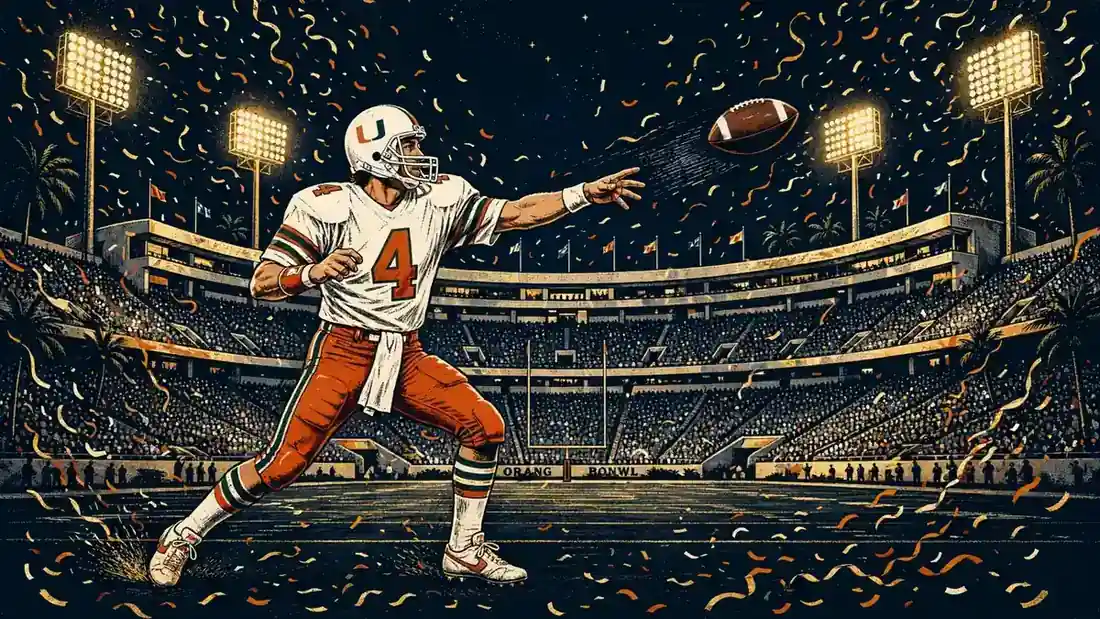
Kosar was famous before he was a professional, and the fame came from one night in January 1984. As a redshirt freshman he led Miami into the Orange Bowl against top-ranked Nebraska, the defending national champions, and threw for 300 yards and two touchdowns in a 31–30 upset that gave the Hurricanes their first national championship. It was the game that announced Miami as a national power and Kosar as the face of it. A year later came the other game every college fan of the era remembers: the 1984 shootout against Boston College that ended on Doug Flutie’s last-second “Hail Mary” pass, a loss that cost Miami a repeat title but fixed Kosar in the national memory as the quarterback on the wrong end of one of the sport’s most replayed plays.
In Cleveland, fame arrived differently — not from one game but from belonging. Kosar was the local kid who had chosen the Browns when the Browns were bad, who had forced his way home through the supplemental draft, and who played the position with an intelligence fans could see on every snap. He was the quarterback of the late-1980s Browns teams that came within a drive of the Super Bowl three times, and in a city that measures its athletes by loyalty as much as by rings, that was enough. He was inducted into the Cleveland Browns Legends, the franchise’s own hall of honour, and decades after his last snap he remained one of the most popular players in team history.
The fame had a second act, too. Kosar’s appearance in ESPN’s 30 for 30 episode “Broke” turned his financial collapse into a national case study, and his 2017 autobiography Learning to Scramble — written with Craig Stout — put his version of the story on the record. The book’s title works on two levels: the quarterback who could not run learning to buy time in the pocket, and the man who lost everything learning to rebuild a life. Both stories are why his name still draws a crowd in northeast Ohio.
Main Sources of Income
Kosar’s money has come from four distinct chapters, and the size of each one explains the shape of his net worth today. The first chapter was NFL salary: roughly $19 million over 12 seasons, front-loaded into two big Cleveland contracts. The second was business — restaurants, a hockey team, an arena football team — which made money for a while and then took most of it back. The third, and the one that keeps him solvent now, is the NFL pension, which Celebrity Net Worth reports pays him around $200,000 a year and which was the only asset fully protected in his bankruptcy. The fourth is the public-facing work of his later years: broadcasting, his “Journey With Bernie” podcast, his book, a wellness brand and a seminar series with the Ohio grocery chain Heinen’s.
That mix matters because it explains why a man who earned $19 million is worth $2 million. The salary was real, but it arrived in an era when quarterback pay was a fraction of today’s market — Kosar’s entire 12-year career earnings are less than half of what a top quarterback now earns in a single season — and it was spent, invested and in several cases simply handed to other people before the bankruptcy filing sorted out what was left. The pension, by contrast, pays every year whether Kosar works or not, and it is the floor under the current estimate. Everything else — the podcast, the book, the wellness products — adds income in smaller, steadier amounts.
There is also the income that never reached him. Kosar revealed in the “Broke” episode that he learned his father had used some of his NFL earnings to pay for mortgages and car payments, and had a separate side arrangement with the Cleveland Browns that paid the father $1 million. The revelation, reported by Celebrity Net Worth, is one of the darker details of his financial story: the people closest to a young athlete are often the ones managing the money, and in Kosar’s case that management cost him.
Salary and Earnings
Kosar’s contracts track the rise and the strange economics of quarterback pay in the late 1980s and early 1990s. His rookie deal, signed in July 1985, was a five-year contract worth $5.2 million with a $1 million signing bonus — about $840,000 a season on average — and it made him one of the four highest-paid quarterbacks in the league before he had played a snap, according to the Los Angeles Times reporting cited by ClutchPoints. For a 21-year-old from Boardman, it was life-changing money. For the Browns, it was the price of landing the hometown quarterback.
In July 1989 he signed a six-year deal that could have been worth $15 million, with a $3 million signing bonus. Celebrity Net Worth reports he likely earned only around $7.5 million from that deal, because of how the contract was structured and when it was cut short — a reminder that the headline value of an NFL contract and the cash a player actually collects are often two different numbers. Then came the contract that defines his earnings story. In late 1993 Kosar signed a seven-year, $27 million extension with the Browns that would have made him one of the highest-paid quarterbacks of all time to that point. Five weeks later, Belichick cut him. He collected $4 million in guaranteed money from the deal and nothing more.
After Cleveland, the numbers fell fast. He signed a one-year, $1 million deal with the Dallas Cowboys for the rest of the 1993 season and won his Super Bowl ring as a backup. In his final two seasons with the Miami Dolphins he earned between $600,000 and $700,000 a year, depending on performance bonuses. Added up, Celebrity Net Worth puts his career NFL salary at around $19 million; other outlets round the same total to nearly $20 million. The two figures describe the same career — the difference is rounding and bonus treatment — so we use $19 million as the reported total and note the $20 million figure as the rounded version.
| Contract | Reported value | What he actually collected |
|---|---|---|
| 1985 rookie deal, Browns (5 years) | $5.2 million + $1 million signing bonus | Full deal, about $840,000 a season |
| 1989 extension, Browns (6 years) | Up to $15 million + $3 million signing bonus | About $7.5 million, per Celebrity Net Worth |
| 1993 extension, Browns (7 years) | $27 million | $4 million guaranteed; cut five weeks later |
| 1993, Dallas Cowboys (1 year) | $1 million | Full deal; Super Bowl XXVIII ring |
| 1994–1996, Miami Dolphins | $600,000–$700,000 a year | Two seasons, bonus-dependent |
| Career NFL salary total | About $19 million | Rounded to nearly $20 million by some outlets |
Two things about that $19 million deserve emphasis. First, it was taxed, agented and spent in real time — there was no deferred-money structure of the kind modern quarterbacks use to smooth their earnings across decades. Second, the 1993 extension shows how quickly NFL wealth can evaporate: a $27 million deal became $4 million in five weeks because the guarantee was the only part that mattered. Kosar’s career is a case study in the difference between contract value and cash received, and it is the first of several lessons his finances teach.
For scale, consider his peers. Dan Marino, the quarterback Kosar studied as a young player, earned far more across a longer career at the top of the market, while John Elway — the man whose Drive ended two of Kosar’s best seasons — built a post-career fortune in car dealerships that dwarfed his playing salary. Brett Favre and Troy Aikman, who overlapped with Kosar’s final seasons, both converted their playing careers into broadcasting and business income on a scale Kosar never reached. Kosar’s $19 million was a large sum in 1993; it was not a fortune that could survive a decade of bad investments without careful management.
Businesses and Investments
After retiring in 1996, Kosar invested like a man who believed his football instincts would transfer to business. Some of the bets were high-profile. In 2001 he bought the Florida Panthers, the NHL franchise, along with pharmaceutical businessman Alan Cohen. He also bought a minority share in the Arena Football League’s Las Vegas Gladiators in 2007, announced the team would move to Cleveland and play as the Cleveland Gladiators, and on October 16, 2007 was named the franchise’s team president and CEO. He owned several Bernie Kosar’s Steakhouse restaurants in South Miami and Cleveland, published Bernie’s Insiders, a magazine covering the Browns, and hosted the Nestlé/Bernie Kosar Charity Classic at Tanglewood National Golf Club in Bainbridge Township, Ohio, through the 1990s.
Smaller ventures followed the same pattern of trading on his name. He lent his name to Kosar’s Wood-Fired Grill at the Hard Rock Casino Northfield Park in Northfield, Ohio, which opened in December 2013. He established the Bernie J. Kosar Jr. Charitable Trust in 1991 to fund programmes for children and young adults, and charitable work remained a constant even as the business ventures wobbled. In October 2023 he announced a line of wellness products called U Matter Wellness Essentials under his Kosar Wellness brand, selling supplements including digestive enzymes, fermented vegetable powder and effervescent humic fulvic acid tablets, and he teamed with Heinen’s, the Ohio grocery chain, for a motivational and wellness seminar series built around his autobiography.
The problem was not the ambition — owning an NHL team and running an arena football franchise are serious business moves — it was the financing. The ventures were heavily debt-financed, and when the 2008–2009 recession hit, the real estate deals underneath them collapsed. Kosar had invested in Florida real estate during the boom, and the bust left him owing a bank more than $9 million on deals that had gone bad. The Panthers and Gladiators stakes, the restaurants and the magazine did not produce the cash to cover those debts, and the personal loans he had made to friends and relatives added to the hole. The business chapter of his life ended the way the football chapter never did: with a filing in a Florida bankruptcy court.
What survived was the smaller, steadier work. The book, Learning to Scramble, published in 2017, gave him a product that sells without borrowed money. The wellness brand and the Heinen’s seminars gave him income tied to his own appearances rather than to borrowed money. The podcast, “Journey With Bernie,” gave him a platform that costs little to run. None of these will make him rich. All of them fit the shape of his current finances: modest, personal, and built on the one asset nobody could take from him — his name in Cleveland.
Brand Deals and Sponsorships
Honesty requires a flat statement here: there is no public record of Bernie Kosar signing a major national endorsement deal of the kind modern quarterbacks collect. No shoe contract, no car campaign, no national soft-drink spot appears in the reporting on his career. The endorsement market of the late 1980s was smaller and more concentrated than today’s — a handful of quarterbacks got the national deals, and Kosar, playing in Cleveland with an awkward throwing motion and a team that never reached the Super Bowl, was not one of them.
What he did have was local and regional commercial work tied to his name. The Nestlé/Bernie Kosar Charity Classic carried a corporate sponsor’s name alongside his for most of the 1990s. The Heinen’s seminar series in the 2020s put his name on a regional grocery chain’s wellness programme. The Hard Rock’s Wood-Fired Grill licensing deal put his name on a restaurant inside a casino. These are real commercial arrangements, and they paid him, but they belong to a different category from the endorsement fortunes of his peers. Jim Brown, the Browns legend from an earlier era, built a second career in film and activism that carried its own commercial value; Kosar’s commercial life stayed closer to home, in Cleveland and South Florida, and at a smaller scale.
That absence is itself a useful fact for anyone comparing quarterbacks of the era. Endorsement income is often the difference between a player who retires comfortable and one who retires rich, and Kosar’s career shows the gap. His $19 million came almost entirely from salary. When the salary stopped and the investments failed, there was no endorsement annuity to fall back on — only the pension.
Houses, Cars and Other Assets
Kosar’s property history is a short version of his whole financial story: a big purchase at the top of the market, a forced sale at the bottom, and a quieter purchase afterwards. In May 2006 he paid $3.499 million for a 10,000-square-foot mansion in Florida. Four years later, in 2010, he sold the house for $2.1 million — a loss of roughly $1.4 million before costs, and a clean illustration of what the housing crash did to debt-loaded buyers. The sale came a year after the bankruptcy filing, when the court process was sorting through his property holdings.
The Ohio purchase that followed was smaller and, by all public accounts, steadier. In 2012 he bought a farm in Ohio for $1.35 million, a rural base in the state where he grew up and where he still lives. Reporting in 2026 described the property as a working farm rather than a showpiece, and noted that its value had likely risen since the purchase given the size of the land and the improvements made — though no formal current appraisal has been publicly disclosed, so we do not put a number on it. The contrast with the Florida mansion is the point: the farm was bought with cash he could afford to spend, not with debt he could not afford to service.
Not every property survived the crash. In July 2010 it was reported that Kosar was on the verge of losing property in Geauga County, Ohio, for unpaid back taxes totalling $173,557.90, and in September 2010 the trustees of Auburn Township said they were considering buying the land in foreclosure. The figure is small next to the $18.9 million in the bankruptcy filing, but it shows how broad the damage was: the tax bill was on land, not on a house, and it was the kind of obligation that piles up when cash flow stops.

As for cars, the public record is thin, and we will not fill it with guesses. No verified list of a Kosar car collection exists in the reporting we reviewed. What the bankruptcy filing did document, in painful detail, was the state of his liquid assets: $44 in his checking account at the time of filing. That single figure did more than any property record to fix his story in the public mind. It also explains why the pension mattered so much: the court protected the NFL pension, which Celebrity Net Worth reports pays around $200,000 a year, while the houses, the business stakes and the cash were all exposed.
The asset picture today, as far as public records allow us to draw it, is modest: the Ohio farm, the pension, the book and brand income, and a public profile that still draws appearance and speaking fees in northeast Ohio. There is no evidence of a second property portfolio, a car collection or a hidden investment account. The $2 million estimate reflects a man who owns a home, draws a pension and works — not a man sitting on a portfolio.
Awards and Achievements
Kosar’s honours list is shorter than those of the quarterbacks he is usually compared with, and that is part of the story: he was a very good quarterback on teams that kept falling one game short. The entries that matter are the ones that mark the two peaks of his career — the college peak in 1983–84 and the professional peak in 1987 — plus the team honours that recognise what he meant to Cleveland.
- National champion, 1983 — led the Miami Hurricanes to their first national title, beating top-ranked Nebraska 31–30 in the Orange Bowl.
- Second-team All-American, 1984 — after a school-record 3,642 passing yards and 25 touchdowns; finished fourth in Heisman Trophy voting.
- First-team All-South Independent, 1983 — the regional honour that marked his breakout freshman season.
- Academic All-America first team, 1984 — and induction into the CoSIDA Academic All-America Hall of Fame in 1998.
- Pro Bowl, 1987 — his only Pro Bowl selection, the peak season of his NFL career.
- Super Bowl champion, XXVIII — as backup quarterback on the 1993 Dallas Cowboys.
- Cleveland Browns Legends — induction into the franchise’s own hall of honour, recognising nine seasons as the team’s quarterback and three AFC Championship Game appearances.
For comparison, the quarterbacks around him collected more silverware: Elway won two Super Bowls as a starter, Aikman won three, Favre won one and an MVP award, Marino set passing records that stood for decades. Kosar’s list has one championship ring earned from the bench and one Pro Bowl. The gap is real, and it shows up in the money too — the players with the rings and the records got the endorsements and the second careers. Kosar got the love of a city, which is worth a great deal in Cleveland and almost nothing on a balance sheet.
Net Worth Growth Over the Years
Kosar’s net worth has not grown in a straight line. It rose fast in his twenties, peaked in the early 1990s, collapsed in 2009, and has climbed slowly since — a curve that looks like a cliff with a long, flat recovery. The table below uses reported figures where they exist and labels the rest as estimates. The 2009 row is the one that defines him financially: the filing listed $9.2 million in assets against $18.9 million in liabilities, a negative net worth of about $9.7 million on paper, with $44 in the checking account.
| Year | Estimated net worth | What drove it |
|---|---|---|
| 1985 | About $1 million | Rookie deal: $5.2 million over five years, $1 million signing bonus |
| 1989 | $5 million–$7 million (estimate) | Six-year deal worth up to $15 million; peak earning years begin |
| 1993 | $8 million–$10 million (estimate) | $27 million extension signed, then cut; $4 million guaranteed collected |
| 1996 | $10 million+ (estimate) | Career salary total about $19 million; business investing begins |
| 2001 | High single-digit millions (estimate) | Florida Panthers purchase with Alan Cohen |
| 2006 | High single-digit millions (estimate) | Florida mansion bought for $3.499 million |
| 2009 | About –$9.7 million | Bankruptcy filing: $9.2 million assets, $18.9 million debts, $44 in checking |
| 2010 | Near zero | Chapter 7 liquidation ordered; Florida house sold for $2.1 million |
| 2016 | About $100,000 | NetWorthPost and Celebrity Net Worth figure of the period |
| 2025 | $2 million | Celebrity Net Worth updated figure (November 13, 2025); pension, book, wellness income |
| 2026 | $2 million (range $100,000–$2 million) | Current estimate; one year after liver transplant |
Why the range, and why anchor on $2 million rather than $100,000? Because the two figures come from different moments. The $100,000 figure circulated in the years right after the bankruptcy, when Kosar’s finances were at their lowest and the public record was thin — NetWorthPost dated its $100,000 estimate to early 2016, and ClutchPoints and Sportscasting both quoted Celebrity Net Worth at $100,000 in that period. The $2 million figure is Celebrity Net Worth’s current, updated figure, revised on November 13, 2025, and repeated by SoapCentral and other outlets covering his transplant. A net worth that rises from $100,000 to $2 million over a decade of pension payments, book sales, broadcasting and wellness work is plausible; a net worth frozen at $100,000 for a man drawing $200,000 a year from a pension is not. We publish the range so readers can see the disagreement, and anchor on the newer figure because it reflects the newer evidence.
One more honest note: the pre-2009 rows are estimates, not reported figures. Nobody published Kosar’s net worth in 1993, and the numbers above are inferred from his contract values minus the taxes, agent fees and spending that every athlete faces. We label them as estimates for that reason. The 2009 row, by contrast, is a court document, and it is the most reliable number in the whole table.
Social Media Presence
Kosar’s public presence today runs through X, where he posts as @BernieKosarQB, and through his “Journey With Bernie” podcast. He has used both to talk openly about his health in a way few former players do. In November 2025 he announced from his hospital bed that his liver transplant was scheduled for 5 a.m. on Monday, November 17, thanking fans for their thoughts and prayers. A week later he posted a video saying he felt good and was ready to enjoy the rest of his life. The posts drew wide coverage because they came directly from the patient, not through a team spokesman.
He has kept using the accounts since. In May 2026, on what would have been his donor’s birthday, he publicly recognised the family of Bryce Dunlap, the 21-year-old from North Olmsted, Ohio, whose liver he received. In June 2026 he was photographed at a Cleveland Guardians baseball game with Kansas City Chiefs tight end Travis Kelce, an appearance that drew attention from sports outlets covering both men. The pattern is consistent: Kosar posts rarely, personally, and usually about health, gratitude or Cleveland — not about money, and not about selling anything.
That restraint is worth noting for readers who expect a former athlete’s social media to be a sales channel. Kosar’s accounts function as a diary and a thank-you note, not a storefront. The wellness brand has its own presence, and the book has its own promotion, but his personal feed is mostly him, speaking plainly, to the city that still cheers for him.
Personal Life
Kosar married Babette Ferre, whom he met while at the University of Miami, on June 22, 1990. They had four children together — three daughters, Sara, Rachel and Becky, and a son, Joe — and divorced in 2007. The divorce was part of the financial unraveling: the bankruptcy filing listed $3 million owed to his ex-wife, one of the largest single debts in the case. When the children were younger they lived in Florida and spent time with him in Ohio, and Kosar coached his son Joe’s flag football team. In December 2015 he announced his engagement to Anna Tomaro, a hairstylist from Highland Heights, Ohio.
His father, Bernie Kosar Sr., died in September 2025 at the age of 87 in Ohio — weeks before his son’s transplant, and a loss Kosar was carrying publicly through the hardest autumn of his life. His mother Geri, who told Sports Illustrated’s Rick Telander in 1988 that she and her husband gave their children the freedom to blaze their own trails, was part of the close family circle that shaped his early years in Boardman.
Health has been the dominant fact of Kosar’s personal life for a decade. The concussions of his playing career left him with insomnia, slurred speech and a ringing in his head, symptoms he has discussed openly for more than ten years, including an experimental treatment programme he has promoted in the hope of helping other players with the signs of chronic traumatic encephalopathy. In 2024 he revealed he had been diagnosed with cirrhosis of the liver and Parkinson’s disease; a cirrhosis diagnosis in late 2023 had confirmed the severity of a condition he had felt for years without understanding. He was also diagnosed with early-stage dementia before the transplant, and had stopped doing radio and television appearances because of midbrain paralysis and delays in his ability to hold a conversation.
The transplant changed the trajectory. He went on the waiting list in July 2024, was hospitalised several times for life-threatening complications, and underwent five procedures to stop internal bleeding in the week before the operation. The surgery, at UH Cleveland Medical Center in University Circle, was performed by Dr. Zoe Stewart Lewis, who called it uneventful; Kosar was discharged a week later. On November 18, 2026 — 366 days after the transplant — he walked into an auditorium at the hospital carrying his granddaughter, Alia Rose Kosar-Beck, and told reporters he felt “happily surprised” at how well he was doing. Dr. Stewart Lewis said the clearest benefit of the transplant was that his brain was working for him again after years clouded by end-stage liver disease. He said he would keep advocating for organ donors and for former athletes living with cognitive problems.
He lives in Ohio, close to the community where he grew up, on the farm he bought in 2012. The life he describes now — waking up feeling good at 62, in his own words to a local magazine — is a long way from the $44 checking account of 2009, and it is the reason the financial story and the health story belong in the same article. Both are about the same thing: a man who lost nearly everything, twice, and kept showing up.
Sources & Reporting
How this article was reported. Every money figure above traces to a named outlet or a court filing. Where sources disagree, we publish the range and name who says what. Reporting window: November 2025 – November 2026, with historical contract and bankruptcy records from 1985–2010.
- Celebrity Net Worth — the $2 million net worth figure (page updated November 13, 2025); career earnings of about $19 million; the contract-by-contract breakdown ($5.2 million rookie deal, $15 million 1989 deal, $27 million 1993 extension, $4 million collected, $1 million Dallas deal, $600,000–$700,000 Miami seasons); the bankruptcy filing ($9.2 million assets, $18.9 million liabilities, $44 checking account, $200,000 annual pension); the Florida mansion purchase ($3.499 million) and sale ($2.1 million); the Ohio farm purchase ($1.35 million).
- theScore (Associated Press) — the liver transplant on November 17, 2025 at UH Cleveland Medical Center; the July 2024 waiting-list date; the cirrhosis and Parkinson’s diagnoses; the donor, Bryce Dunlap, 21; the one-year anniversary on November 18, 2026, including the “happily surprised” remark, the granddaughter Alia Rose Kosar-Beck, and Dr. Zoe Stewart Lewis’s comments; the nine fourth-quarter game-winning drives at Cleveland Stadium.
- Wikipedia — birth date and place, height and weight, college and professional career history, the Florida Panthers purchase with Alan Cohen in 2001, the Gladiators move and presidency in 2007, the bankruptcy dates (June 19, 2009 filing; January 6, 2010 conversion to Chapter 7), the Geauga County back-tax figure of $173,557.90, the Wood-Fired Grill opening in December 2013, and the Kosar Wellness launch in October 2023.
- ClutchPoints — the account of how Kosar went bankrupt, including the Los Angeles Times reporting that his rookie deal made him one of the four highest-paid quarterbacks in the league, and the earlier Celebrity Net Worth figure of $100,000.
- Sportscasting — the bankruptcy filing details, including the debts to the Browns, to his ex-wife Babette and to the Gladiators owner, and the $44 checking account.
- Associated Press — original reporting on the transplant and the one-year anniversary, carried by theScore and other outlets in November 2025 and November 2026.
- Barnes & Noble — publication details for Learning to Scramble (Bernie Kosar with Craig Stout, published September 10, 2017).
- Sportskeeda — the 2009 bankruptcy filing figures as listed in its roundup of NFL players who went bankrupt.
Outlets consulted without a figure used in this article include Cleveland Magazine, which first reported the cirrhosis and Parkinson’s diagnoses in 2024, and Browns Nation and Pro Football History, which supplied biographical colour on his Boardman years and the Belichick release. Where a fact appears in only one weak source, we have either attributed it to that source or left it out.
Frequently Asked Questions
What is Bernie Kosar’s net worth in 2026?
Bernie Kosar’s net worth is estimated at $2 million as of November 2026, according to Celebrity Net Worth, which updated its figure on November 13, 2025. Because older pages from the same outlet once put him near $100,000, we publish a range of $100,000 to $2 million and anchor on the newer figure.
How much money did Bernie Kosar earn in the NFL?
About $19 million in salary across 12 seasons, according to Celebrity Net Worth. His biggest deals were a five-year, $5.2 million rookie contract in 1985, a six-year deal worth up to $15 million in 1989, and a seven-year, $27 million extension in 1993 from which he collected only $4 million in guaranteed money after being cut five weeks later.
Why did Bernie Kosar go bankrupt?
He filed for bankruptcy in June 2009 after the 2008–2009 recession collapsed his debt-financed real estate deals. The filing listed $9.2 million in assets against $18.9 million in debts, including more than $9 million owed to a bank on bad real estate deals, $3 million owed to his ex-wife Babette, and $725,000 owed to the owner of the Cleveland Gladiators. Failed business ventures and personal loans to friends and relatives added to the losses.
Did Bernie Kosar really have only $44 in his bank account?
Yes. The bankruptcy filing revealed that his checking account held just $44 at the time of the filing in June 2009. The figure became the most quoted detail of the case because it showed how completely his cash had run out, even while he still held $9.2 million in assets on paper.
How much is Bernie Kosar’s NFL pension?
About $200,000 a year, according to Celebrity Net Worth. The pension was the only asset fully protected in his bankruptcy, and it is the steadiest income he has today — the floor under his current $2 million net worth estimate.
Did Bernie Kosar have a liver transplant?
Yes. After being diagnosed with cirrhosis of the liver and Parkinson’s disease in 2024, he went on the transplant waiting list in July 2024 and received a liver transplant on November 17, 2025, at UH Cleveland Medical Center. The donor was 21-year-old Bryce Dunlap of North Olmsted, Ohio. One year later, in November 2026, he reported feeling sharper and healthier, and said he would keep advocating for organ donors.
Who is Bernie Kosar’s wife?
Kosar was married to Babette Ferre from 1990 until their divorce in 2007. They have four children together: daughters Sara, Rachel and Becky, and son Joe. In December 2015 he announced his engagement to Anna Tomaro, a hairstylist from Highland Heights, Ohio.
Where does Bernie Kosar live now?
In Ohio, on a farm he bought in 2012 for $1.35 million. He previously owned a 10,000-square-foot mansion in Florida, bought for $3.499 million in 2006 and sold for $2.1 million in 2010. He remains a public figure in Cleveland, where he still makes appearances and hosts his “Journey With Bernie” podcast.
Final Thoughts
Bernie Kosar’s net worth in 2026 — $2 million, on a range of $100,000 to $2 million — is the smallest number in this article and the least interesting one. The interesting numbers are the ones around it: $19 million earned, $27 million promised and $4 million collected, $18.9 million owed, $44 left in the account, $200,000 a year from a pension nobody could touch. Put together, they describe a career that paid well, a business life that failed badly, and a recovery built on the least glamorous income an athlete can have — a pension, a book, a podcast and a farm in Ohio.
The recovery is real, and the transplant is part of it. A year after surgery that he might not have survived, Kosar walked into a hospital auditorium carrying his granddaughter and said he felt happily surprised to be doing so well. That is a better ending than the bankruptcy filing promised, and it is the reason his story still gets told: not because he kept the money, but because he kept showing up after he lost it.
Published on November 22, 2026. Last reviewed November 2026. Found an error? See our corrections policy.