
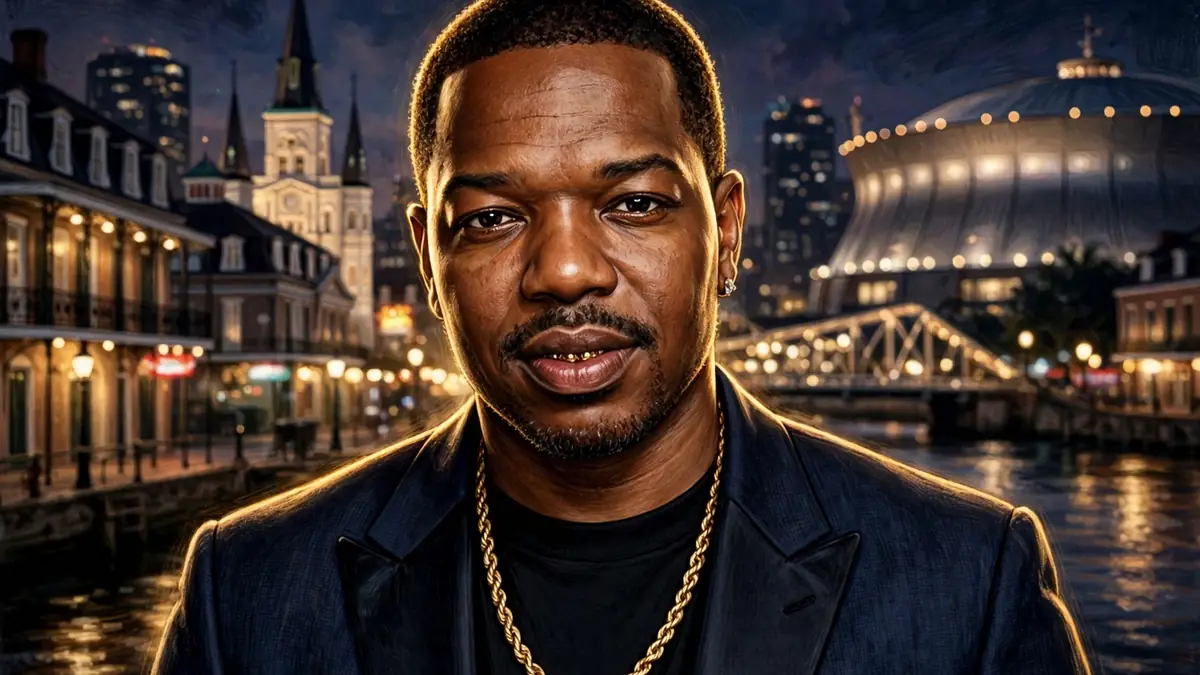
B.G.‘s net worth is estimated at $200,000 to $2 million as of November 2026. The New Orleans rapper born Christopher Noel Dorsey went from signing to Cash Money Records at 12 years old to coining the phrase “bling bling” on a platinum 1999 hit, then lost more than a decade to a federal prison sentence — and walked out in September 2023 to a reunion, a new record deal, and his first solo album in over 15 years.
B.G.: Quick Facts
| Estimated net worth | $200,000 (best-supported figure; published range $200,000–$2 million) (range: $200,000 to $2 million) |
|---|---|
| Profession | Rapper, songwriter, record label founder |
| Nationality | American |
| Born | September 3, 1980 (age 46) |
| Height | Not publicly documented |
| Primary income sources | Music royalties and streaming, live performances, Chopper City Records, Cash Money Records (since 2023) |
| Active years | 1993–present (recording paused 2012–2023 during imprisonment) |
| Last reviewed | November 2026 |
- Early Life and Background
- Education
- Career Journey
- Rise to Fame
- Main Sources of Income
- Salary and Earnings
- Businesses and Investments
- Brand Deals and Sponsorships
- Houses, Cars and Other Assets
- Awards and Achievements
- Net Worth Growth Over the Years
- Social Media Presence
- Personal Life
- Sources & Reporting
- Frequently Asked Questions
Early Life and Background
Christopher Noel Dorsey was born on September 3, 1980, in New Orleans, Louisiana, and grew up in the city’s Freret neighborhood. His father was largely absent from his childhood and was killed during an attempted robbery when Christopher was 12 years old — the same year his music career began. That timing is the hinge of his whole story: a child who lost his father and signed a record deal in the same stretch of life.
Dorsey started rapping young and first performed under the name Lil Doogie. As a young teenager he connected with Bryan “Baby” Williams, better known as Birdman, who had recently founded Cash Money Records with his brother Ronald “Slim” Williams. The meeting, by several accounts, happened at a local barbershop in 1993. Birdman signed him. Dorsey was 12. Few rappers in history have started that young, and the deal shaped everything that followed — the money, the fame, and the disputes that would later split the label’s first generation apart.
He shortened his stage name from Baby Gangsta to B.G., a name that stuck for three decades. His delivery — a nasal, unhurried drawl over Mannie Fresh’s bouncing New Orleans production — sounded older than he was. On record he rapped about the violence, drugs, poverty, and street culture of New Orleans with a darkness that set him apart from the label’s later crossover material. That tone became his signature, and it is part of why his early albums still get cited by Southern rap historians even though his commercial peak was short.
The Freret neighborhood he came from sits uptown, a few miles from the Magnolia Projects where Cash Money itself took root. The label’s whole identity was built on that geography: local kids, local producers, local slang, sold first to the city and then to the country. B.G. was the youngest veteran in the building — recording professionally before Cash Money had a national distribution deal, and helping to set the street-oriented sound the label later carried to a global audience.
Education
Almost nothing about B.G.’s formal schooling is publicly documented, and this article will not invent a record that does not exist. What the record does show is that his education was cut short by the music business: he signed to Cash Money at 12, was recording by 14, and had released three solo albums before he turned 19. For a child artist on an independent label in the 1990s, studio sessions, touring, and promotion filled the hours that school would have taken.
That gap matters to the money story. Artists who sign as children rarely control their contracts, their publishing, or their royalties — and B.G. would later say exactly that about his Cash Money years, accusing the label’s management of mishandling money owed to its artists. The dispute that pushed him out of Cash Money in the early 2000s was, at its core, a dispute about accounting: who earned what, and who kept it. A teenager with no lawyer of his own and no financial education is at a structural disadvantage in that argument, and B.G.’s career is a case study in it.
After his release from prison in 2023, B.G. completed a rehabilitation program run by the nonprofit Hope for Prisoners, graduating in September 2023 — a step he marked publicly on Instagram within weeks of his release. He has spoken since about learning the business side of music properly the second time around, running his own Chopper City Entertainment imprint rather than handing control to a label.
Career Journey
B.G. made his recording debut in 1995, at age 14, on the Cash Money album True Story, a duo project recorded with Lil Wayne — then only 11 years old — under the name the B.G.’z, with production from Mannie Fresh, Cash Money’s longtime in-house producer. It was a children’s record in the literal sense, and it announced the two youngest artists on the roster as a pair.
His solo debut, Chopper City, arrived in 1996, followed by It’s All on U, Vol. 1 and It’s All on U, Vol. 2 in 1997. All three were cut during Cash Money’s independent era, before the label’s distribution deal with Universal, and they sold regionally. The same year, B.G. joined Lil Wayne, Juvenile, and Turk to form the Hot Boys. Their debut album, Get It How U Live!, came out in October 1997 and became an important regional success, establishing the group’s sound: four distinct voices over Mannie Fresh’s synth-heavy bounce.
The turning point for the whole label came in 1998, when Cash Money signed a major distribution agreement with Universal Records. The deal put national marketing and distribution behind a catalog that had been built locally, and the Hot Boys’ second album, Guerrilla Warfare (1999), was the first full payoff. Produced largely by Mannie Fresh, whose own fortune was built as Cash Money’s architect, the album reached No. 5 on the Billboard 200 and No. 1 on the R&B/Hip-Hop Albums chart, and was eventually certified platinum. Its singles “We on Fire” and “I Need a Hot Girl” made the group one of the most influential rap acts to come out of New Orleans.
B.G.’s solo career peaked in the same window. Chopper City in the Ghetto, released April 20, 1999, debuted in the Top 10 of the Billboard 200, selling about 140,000 copies in its first week, and was certified platinum. The follow-up, Checkmate (2000), went gold and was his last album for Cash Money. He left after a dispute over money — the same dispute that also drove Juvenile and Turk out, while Lil Wayne stayed with the label.
On his own, B.G. launched Chopper City Records and released Livin’ Legend in 2003 and the pointedly titled Life After Cash Money in 2004. The Heart of tha Streetz, Vol. 1 followed in 2005, and its sequel, The Heart of tha Streetz, Vol. 2 (I Am What I Am), reached No. 6 on the Billboard 200 in 2006 — proof that he still held a substantial audience five years after leaving the biggest label in Southern rap. He also recorded with the Chopper City Boyz, releasing We Got This (2007) and Life in the Concrete Jungle (2008). His last studio album before prison was 2009’s Too Hood 2 Be Hollywood.
Then the music stopped. In November 2009, B.G. was arrested after a traffic stop in New Orleans in which police recovered three firearms from the vehicle. As a convicted felon, he was prohibited from possessing firearms. The federal case grew to include allegations that B.G. and another defendant tried to persuade a third man to falsely claim ownership of the weapons. In December 2011 he pleaded guilty to two counts of being a felon in possession of a firearm and one count of conspiracy to obstruct justice. In July 2012, a federal judge sentenced him to 14 years in prison, followed by three years of supervised release.
He served roughly 11 years and was released on September 5, 2023. Birdman was among the people who greeted him. Within days, Birdman announced on The 85 South Show that B.G. was officially back with Cash Money — a homecoming that closed a 21-year split. Gucci Mane had offered B.G. a $1 million record deal in 2022 while he was still incarcerated, according to HotNewHipHop, which gives a sense of how valuable his return was considered even before he recorded a note. B.G. told 2 Chainz shortly after his release that he planned to “flood the streets” with new music, talking about as many as eight albums.
The comeback took shape fast: singles through late 2023, the Gucci Mane collaboration album Choppers & Bricks at the end of that year, and in March 2025, Freedom of Speech — his first solo studio album since 2009, a gap of more than 15 years, released through his own Chopper City Entertainment with collaborations including Birdman, Juvenile, and Boosie Badazz. A companion documentary, Freedom of Speech: The Christopher Dorsey Untold Story, arrived alongside it.
Rise to Fame
B.G.’s rise had two engines: the Hot Boys and one single. The Hot Boys made him a group star; “Bling Bling” made him a pop-culture figure. Released in 1999 as the lead single from Chopper City in the Ghetto, “Bling Bling” featured the Big Tymers, Juvenile, Lil Wayne, and Turk, and reached No. 36 on the Billboard Hot 100. The chart peak understates it. The song took the slang term “bling bling” — shiny, expensive jewelry, cars, and conspicuous consumption — and pushed it into mainstream English so completely that the Oxford English Dictionary eventually added “bling” to its pages. Few rap singles have ever been responsible for putting a word into the dictionary.
One detail competitors usually miss: the track was not originally meant for B.G. at all. It was written as a Big Tymers song, and Mannie Fresh moved it onto B.G.’s album because the record was so dark and heavy that it needed something lighter. That single production decision changed B.G.’s career and the English language in the same move.
The album around it did the commercial work. Chopper City in the Ghetto moved about 140,000 copies in its first week, debuted in the Top 10 of the Billboard 200, and went platinum — over a million units. In the same year, the Hot Boys’ Guerrilla Warfare also went platinum, giving B.G. two platinum albums in twelve months. He was 18 and 19 years old.
His fame never again reached that height, and the reasons are structural rather than mysterious. He left the label that marketed him, at the exact moment that label became a national empire. His independent albums sold respectably — a No. 6 Billboard 200 debut in 2006 is a real achievement for an independent artist — but they did not have Universal’s machine behind them. Then, at 29, he went to federal prison for what became 11 years, removing him from the industry during the entire streaming transition. When he returned in 2023, the rap business he had left — physical sales, mixtape circuits, label advances — had been replaced by streaming, social video, and direct-to-fan releases. His 2024–2025 comeback, including the Hot Boys reunion, is best understood as a second rise: smaller in commercial scale than the first, but built on ownership of his label and catalog rather than on a deal signed when he was 12.
Main Sources of Income
B.G.’s money has come from four streams across three decades, and their balance has shifted completely between his two careers — the Cash Money years and the post-prison comeback.
1. Record sales and streaming royalties. The foundation is the catalog: five solo albums for Cash Money, three Hot Boys albums, and a long independent discography. The platinum Chopper City in the Ghetto and platinum Guerrilla Warfare remain his biggest-selling records, and they still earn. Streaming pays far less per play than a 1999 CD sale did, but the catalog has a second life: “Bling Bling” is a permanent old-school staple, and Hot Boys tracks stream steadily as 1990s Southern rap keeps finding new listeners. Publishing is the open question in his finances. Artists who signed as children on 1990s independent-label deals often hold little of their publishing, and B.G.’s public disputes with Cash Money were about exactly this kind of money. His current catalog income is real but modest — consistent with a $200,000 net worth rather than a multi-million one.
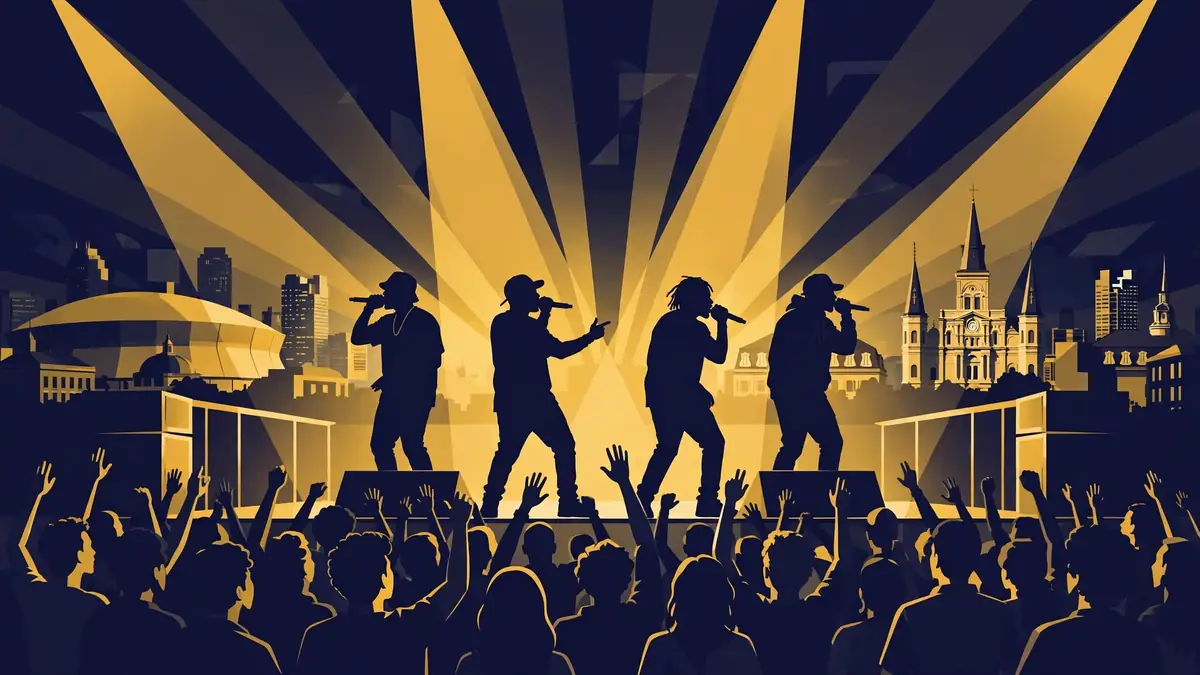
2. Live performances. Before prison, touring and shows were a working rapper’s steadiest cash. Since his release, live work has been his most visible income: the Hot Boys reunion at Lil Wayne’s Lil WeezyAna Fest on November 2, 2024, at the Smoothie King Center in New Orleans — the first time in many years that all four principal members shared a stage — plus festival and club dates through 2024 and 2025, and the Cash Money vs. No Limit Verzuz revival at ComplexCon in Las Vegas in 2025, where B.G. performed “Cash Money Is an Army” and “Bling Bling.” Fees for these appearances have not been disclosed, so no figure is stated here. What can be said is that reunion nostalgia is a genuine market: legacy acts with one famous song and one famous group routinely earn more per show in their forties than they did at their peak, because the audience now has money.
3. Chopper City Records / Chopper City Entertainment. The label B.G. founded after leaving Cash Money in 2002 is now his own business rather than a side project. It released his post-prison work, including Freedom of Speech (2025), and it controls the independent portion of his catalog. Owning the imprint means he keeps the label’s share of his new recordings instead of splitting it with a major — the structural difference between his first career and his second.
4. The Cash Money return. Birdman’s September 2023 announcement that B.G. was officially Cash Money again put him back inside the label system that made him, this time as a veteran rather than a child signee. The terms have not been disclosed. What matters financially is the combination: a legacy label’s marketing reach behind new releases, plus his own imprint’s ownership. The Gucci Mane collaboration Choppers & Bricks (2023) showed the model working — a joint project with a current star, released within months of his freedom.
What B.G. does not have, as far as any public record shows, is the kind of income that builds a large modern rap fortune: no fashion line, no liquor brand, no tech investment, no major endorsement portfolio. His wealth is music wealth, narrow and catalog-based, and the 11-year gap in his earning life is the single biggest fact in his finances.
Salary and Earnings
No salary, advance, or per-show fee from B.G.’s career has ever been publicly disclosed, and this section will not invent one. What the public record does support is a clear picture of when he earned, when he did not, and what the peaks were worth in units.
The peak earning window ran from 1999 to 2001. In that stretch B.G. released a platinum solo album, a platinum group album, and a gold solo follow-up. Chopper City in the Ghetto sold about 140,000 copies in its first week and went on to pass a million units; Guerrilla Warfare matched it; Checkmate went gold, meaning at least 500,000 units. At late-1990s royalty rates, a platinum album could generate low-seven-figure gross royalties for the label — but the artist’s share depended entirely on the contract, and B.G.’s later dispute with Cash Money was precisely that the artists were not seeing money they believed they were owed. The honest statement is that his peak years produced real money that he has said he did not fully receive.
The independent years, 2003 to 2009, paid differently. Without a major label’s advance system, income came from album sales, shows, and his own label’s margins. The Heart of tha Streetz, Vol. 2 debuting at No. 6 on the Billboard 200 in 2006 was the commercial high point of this period and would have been his best independent payday. Even so, independent rap economics in the 2000s were thin: a No. 6 debut on an independent label might mean 60,000 to 80,000 first-week copies, and the artist kept a larger slice of a smaller pie.
From 2012 to 2023 he earned effectively nothing as a recording artist. Eleven years in federal prison meant no touring, no new releases, no endorsements, and no ability to promote the catalog. Royalties from old records would have continued at a low level, but he could not record, perform, or sign deals. That is the hole in the middle of his financial life, and it is why his net worth sits where it does despite a platinum plaque and a word in the dictionary. A rapper who loses his thirties loses the decade when touring fees and catalog value usually compound.
Since September 2023, earnings have restarted on three tracks: new recordings (Choppers & Bricks, Freedom of Speech), live reunion appearances, and streaming of a catalog that the reunion publicity pushed back into playlists. None of the amounts are public. The direction is positive, but the base is small — a comeback catalog and a handful of festival stages, not a stadium tour.
One number that frames the whole picture: Gucci Mane’s reported $1 million record-deal offer in 2022, made while B.G. was still incarcerated. It shows the industry valued his name and story at seven figures before he had recorded a post-prison bar. Whether any money from that offer or from the Cash Money return ever changed hands is not public, so it is noted here as market interest, not as income received.
Businesses and Investments
B.G.’s business life is a single-company story: Chopper City. He founded Chopper City Records in 2002 after leaving Cash Money, initially distributed through Koch, and used it to release his independent albums — Livin’ Legend, Life After Cash Money, the Heart of tha Streetz volumes, and the Chopper City Boyz projects We Got This and Life in the Concrete Jungle. After his release, the imprint re-emerged as Chopper City Entertainment and released Freedom of Speech in 2025 along with its companion documentary. The label is his main business asset: it holds his independent catalog and the rights to his new work.
Beyond the label, there is no public record of investments — no real estate portfolio, no startup stakes, no restaurant or clothing venture, no disclosed stock holdings. That absence is itself information. Rappers who build eight-figure fortunes almost always do it outside music; B.G.’s public record shows a music-only career, interrupted for 11 years. Any article claiming otherwise is guessing.
The investment that matters most in his story is the one he made in 2023: betting his second career on ownership. Releasing through his own imprint, keeping the label share, and using the Cash Money name for reach rather than signing his rights away again is a different business model from the one he entered at age 12. If the comeback catalog grows — new albums, sync placements, a Hot Boys tour — the value sits in Chopper City Entertainment, and it is his.
Brand Deals and Sponsorships
There are no publicly documented brand deals, endorsements, or sponsorships in B.G.’s career — not in the Cash Money peak, not in the independent years, and not since his release. This is unusual for a rapper with a platinum record and a dictionary-level cultural contribution, and it has a plain explanation: his peak came before hip-hop endorsements became routine, his independent years were spent outside the major-label marketing system, and his thirties were spent in prison.
The closest thing to a commercial partnership in his recent career is the Gucci Mane collaboration, which is a music deal rather than a brand deal, and the Cash Money reunion appearances, which are performances rather than sponsorships. No fashion, beverage, footwear, or gaming partnership has been announced or reported for him as of November 2026. Readers should treat any site listing endorsement income for B.G. as unsourced unless it names the brand and the deal.
Houses, Cars and Other Assets
No property record, vehicle purchase, or asset holding of B.G.’s has been publicly reported, and none is claimed here. What is known about where he lives comes from interviews rather than deeds: in a 2025 interview with Bleu Magazine, B.G. said he now lives in Nevada, not New Orleans, having rebuilt his life after prison outside the city where he grew up. Whether he rents or owns there is not public.
The public record of his possessions is cultural rather than financial, and it belongs to the “Bling Bling” era: the Rolex watches, large necklaces, and solid gold teeth he wore at the height of his fame became part of the song’s imagery — the look the phrase described. Jewelry of that kind is a depreciating asset and a stage costume as much as a store of value, and no valuation of it exists.
His durable assets, as far as the record shows, are intangible: his share of the Cash Money and Hot Boys catalogs, his Chopper City imprint and its catalog, and his publishing to the extent he holds it. Those are the assets that generate the royalties behind the $200,000 estimate, and they are also the assets whose ownership was disputed in the first place.
Awards and Achievements
B.G. has no Grammy Award and no major industry award on the public record, and this article does not pad that fact. His achievements are measured in certifications, chart positions, and cultural reach rather than trophies:
Platinum album: Chopper City in the Ghetto (1999), certified platinum after debuting in the Top 10 of the Billboard 200 with about 140,000 first-week copies. Platinum group album: the Hot Boys’ Guerrilla Warfare (1999), No. 5 on the Billboard 200 and No. 1 on the R&B/Hip-Hop Albums chart. Gold album: Checkmate (2000). Top 40 single: “Bling Bling” reached No. 36 on the Billboard Hot 100. Top 10 independent comeback: The Heart of tha Streetz, Vol. 2 reached No. 6 on the Billboard 200 in 2006, five years after he left Cash Money.
The achievement that outlasts the chart positions is linguistic. “Bling Bling” took a piece of New Orleans street slang and made it a mainstream English word; the Oxford English Dictionary added “bling” in 2003. Rappers with far bigger fortunes have never put a word in the dictionary. It is the single most durable thing B.G. has made, and it is also the hardest to value — which is fitting, because it is the gap between his cultural importance and his bank balance that makes his net worth story worth telling.
The 2024–2025 reunion run belongs on the list too. The Hot Boys performing together at Lil WeezyAna Fest on November 2, 2024, and the Cash Money vs. No Limit Verzuz at ComplexCon in 2025, were events the culture had waited more than 15 years for. B.G. shared those stages with Lil Wayne, Juvenile, Turk, Mannie Fresh, and Birdman — the full first generation of Cash Money, together again.
Net Worth Growth Over the Years
Year-by-year figures for B.G. do not exist in any audited form, so the table below is an honest reconstruction: dated milestones with the estimate each period supports, not a fabricated ledger. The pattern is a rise, a long flat line, and a small recovery.
| Period | What happened | Estimated position |
|---|---|---|
| 1993–1998 | Child signee; regional albums; Hot Boys form | Modest; label-controlled income |
| 1999–2001 | Two platinum albums, one gold; “Bling Bling” hit | Peak; low seven figures gross, artist share disputed |
| 2002–2009 | Independent label; No. 6 Billboard debut in 2006 | Declining but steady; independent margins |
| 2010–2012 | Final pre-prison album; arrest and sentencing | Low; earning capacity ending |
| 2012–2023 | 11 years in federal prison | Minimal; catalog royalties only |
| 2023–2024 | Release; Cash Money return; reunion shows | Recovering; new income restarts |
| 2025–2026 | Freedom of Speech; Verzuz; documentary | $200,000 (Celebrity Net Worth, Nov 2026 snapshot) |
Why the published numbers disagree. Celebrity Net Worth puts B.G. at $200,000, in a snapshot dated November 5, 2026, on a page updated September 21, 2026 — the freshest rigorous figure available, and the one this article anchors on. Fame and Finance, by contrast, publishes $2 million in its headline figure while its own body text mentions $4 million — two different numbers inside one article, neither tied to a disclosed asset, contract, or filing. That internal contradiction is why we do not use the higher figures as the anchor. Our published range, $200,000 to $2 million, keeps the best-supported figure visible while acknowledging that other outlets claim more. If B.G. holds valuable publishing or catalog rights that are not public, the true figure could sit higher; nothing in the public record proves it, and nothing proves the $4 million claim either.
How he compares with his peers. The gap between B.G. and the rappers around him is the story of the 11 lost years. Celebrity Net Worth’s own rankings on the B.G. page list the top rappers at $2.8 billion (Jay-Z, whose fortune we profile here), $500 million (Dr. Dre), $400 million (Diddy and Drake), and $350 million (Kanye West). B.G. sits tied at No. 677 of the site’s 713 rapper profiles. The comparison is not a criticism; it is arithmetic. His Hot Boys bandmate Lil Wayne built a catalog, a label in Young Money, and a three-decade touring career on top of the same Cash Money start. Kendrick Lamar, another rapper whose fortune we profile, built his wealth on a continuous run of acclaimed albums and stadium touring. B.G.’s run was interrupted for a third of his adult life. The reunion shows and the 2025 album are the start of closing that gap, not the end of it.
Social Media Presence
B.G. returned to social media as part of his return to public life. He announced his release and his plans on Instagram in September 2023 — including a post on his 43rd birthday, September 3, 2023, saying it would be his last birthday behind bars — and used the platform to mark his graduation from the Hope for Prisoners rehabilitation program later that month. His posts since have mixed new-music announcements, reunion photos with the Hot Boys and Birdman, and messages to fans.
No verified follower count or engagement figure is stated here because social counts change daily and are not a reliable input to a net worth estimate. What matters for the money story is the function: Instagram is now his direct channel to fans and promoters, replacing the label publicity machine he relied on in the 1990s. For a legacy artist rebuilding, a direct line to the audience is a business asset — it sells the reunion shows and the new album without an intermediary taking a cut.
Personal Life
B.G. keeps his private life out of the press, and this article respects that. What is public: he was born Christopher Noel Dorsey, lost his father at 12, and has a manager, Tracy, who has stood by him from his release through the comeback — she was, by his own account in the Bleu Magazine interview, with him from the moment he walked out of prison. Fellow rappers including Boosie Badazz, T.I., and Birdman supported him through the transition.
He has spoken openly about the conditions of his supervised release, and they shape his daily life in a way no other rapper’s do. In 2024, a federal judge ordered that he submit his song lyrics to the government for review before recording or performing them, after prosecutors raised concerns about his performances and collaborations with other artists who had felony convictions. The judge stopped short of banning lyrics about violence or crime, but the order drew national attention for its free-speech implications — and B.G. answered it the only way he could, by naming his 2025 album Freedom of Speech and putting the title track’s argument on record. He told Bleu Magazine in April 2025 that the first couple of years in prison were rough, that he was threatened with a 25- to 30-year sentence for refusing to cooperate, and that he is now, in his words, “just happy to be free” with another shot at his career.
He now lives in Nevada, he told the same interview, rather than in New Orleans. The move is part of the rebuild: a new home base, a new label setup, and a career run on his own terms for the first time since he was a child.
Sources & Reporting
Celebrity Net Worth — the $200,000 estimate (snapshot November 5, 2026; page updated September 21, 2026), the career timeline, first-week sales of about 140,000 copies, the “Bling Bling” Hot 100 peak of No. 36, the prison timeline, the lyric-review court order, and the November 2, 2024 Hot Boys reunion date. AllMusic — biography and discography, including the platinum certification of Chopper City in the Ghetto, the gold follow-up Checkmate, and the 2023 Choppers & Bricks collaboration and 2025 Freedom of Speech releases. Wikipedia — birth date and full name (Christopher Noel Dorsey, September 3, 1980), Hot Boys formation in 1997, the five Cash Money solo albums, and the 2012–2023 incarceration dates. HotNewHipHop — Birdman’s September 2023 Cash Money return announcement, Gucci Mane’s $1 million offer in 2022, the eight-album plan told to 2 Chainz, and the Hope for Prisoners graduation. HipHopWired — release coverage, the July 18, 2012 sentencing date, and the guilty plea details. Bleu Magazine — the April 2025 interview covering the lyric-review order, the Nevada move, the manager Tracy, and the Lil WeezyAna Fest reunion. Reporting window: September 2023–November 2026, with the net worth figure anchored to the November 5, 2026 Celebrity Net Worth snapshot.
Frequently Asked Questions
What is B.G. rapper’s net worth in 2026?
B.G.’s net worth is estimated at $200,000 to $2 million as of November 2026. Celebrity Net Worth, the most rigorous published source, puts him at $200,000 in a snapshot dated November 5, 2026. Other outlets claim up to $2 million or even $4 million, but those figures come without disclosed assets or a stated method — one site publishes two different numbers inside the same article — so we anchor on $200,000 and show the full range.
What is B.G.’s real name?
B.G.’s real name is Christopher Noel Dorsey. He was born on September 3, 1980, in New Orleans, Louisiana. B.G. stands for “Baby Gangsta”; he also performed early in his career as Lil Doogie and is known as B. Gizzle.
How old is B.G. the rapper?
B.G. is 46 years old as of November 2026. He was born on September 3, 1980, and celebrated his 43rd birthday on September 3, 2023 — his last birthday behind bars before his release two days later.
Why did B.G. go to prison, and when was he released?
B.G. was arrested in November 2009 after a traffic stop in New Orleans in which police found three firearms in the vehicle. He pleaded guilty in December 2011 to two counts of being a felon in possession of a firearm and one count of conspiracy to obstruct justice, and was sentenced in July 2012 to 14 years in federal prison. He served about 11 years and was released on September 5, 2023.
Did B.G. invent the phrase “bling bling”?
B.G. did not invent the words from nothing — variations of “bling” had appeared before — but his 1999 single “Bling Bling” is what pushed the phrase into mainstream English. The song reached No. 36 on the Billboard Hot 100, and the term became so widespread that the Oxford English Dictionary added “bling” in 2003. The track was originally written for the Big Tymers before Mannie Fresh moved it onto B.G.’s album.
Is B.G. still making music in 2025 and 2026?
Yes. After his release in September 2023 he recorded the Gucci Mane collaboration album Choppers & Bricks (2023) and released Freedom of Speech in March 2025 — his first solo studio album in more than 15 years — through his own Chopper City Entertainment, with a companion documentary of the same name.
Are the Hot Boys back together?
Yes, on stage at least. B.G., Lil Wayne, Juvenile, and Turk reunited at Lil Wayne’s Lil WeezyAna Fest in New Orleans on November 2, 2024 — the first time in many years that all four had shared a stage — and B.G. performed with the Cash Money family again at the Cash Money vs. No Limit Verzuz revival at ComplexCon in Las Vegas in 2025. No new Hot Boys studio album has been announced as of November 2026.
What happened between B.G. and Birdman?
B.G. left Cash Money in the early 2000s after a dispute over money, accusing the label’s management of mishandling funds owed to its artists, and built his own Chopper City Records. The split lasted more than two decades. After B.G.’s release from prison in September 2023, Birdman greeted him personally and announced on The 85 South Show that B.G. was officially Cash Money again.
Final Thoughts
B.G.’s net worth — $200,000 on the best-supported figure, up to $2 million on the most generous published claims — is small next to his cultural footprint, and that gap is the whole story. He signed to Cash Money at 12, put a word in the dictionary at 18, went platinum twice before he could legally drink, and then lost 11 years to a federal prison sentence that froze his earning life in place. The money he made at his peak passed through contracts he signed as a child and a label he later accused of mishandling it. The comeback now underway — a Cash Money return, a Hot Boys reunion, a 2025 album called Freedom of Speech released on his own imprint — is built on ownership rather than on the deal that made him. Whether the second career closes the gap depends on the catalog, the stage, and the label he now controls. The word he gave the language is already permanent; the fortune is still being rebuilt.
Published on November 14, 2026. Last reviewed November 2026. Found an error? See our corrections policy.