
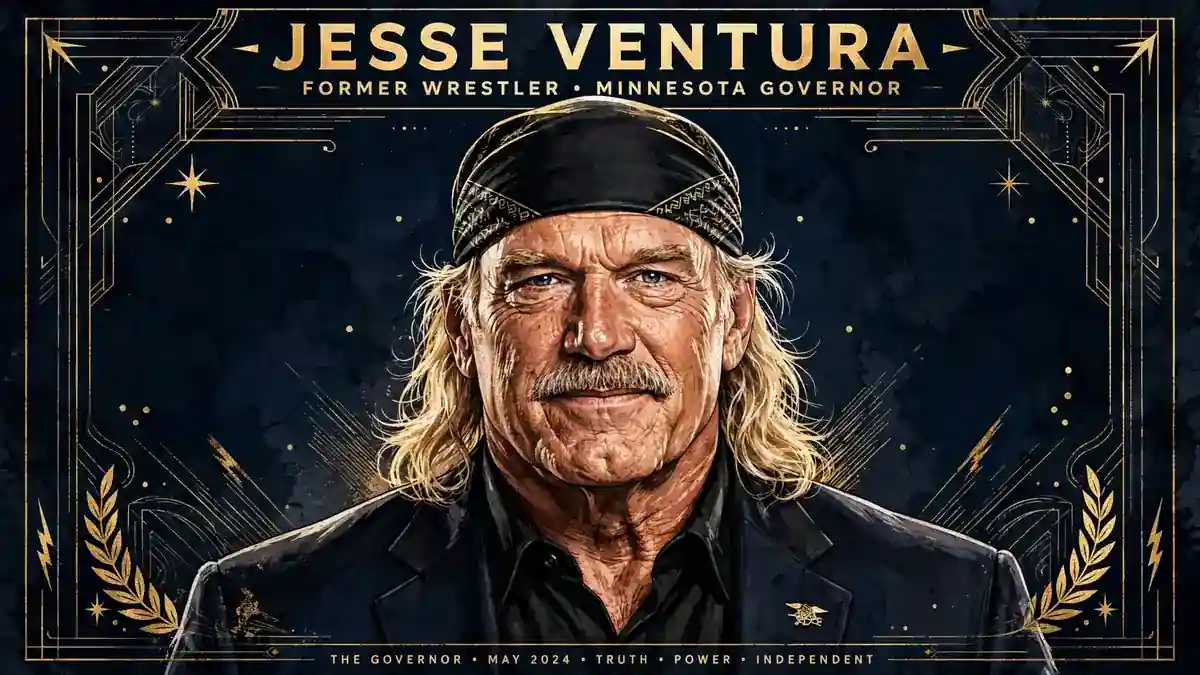
Jesse Ventura‘s net worth is estimated at $6 million to $7 million as of November 2026. That figure rests on something rare in celebrity wealth reporting: sworn court testimony. In 2014, Ventura told a Minnesota jury he earned $11 million between 2002 and 2012, with a single peak year — 2003, his first year out of the governor’s office — bringing in $3.8 million, mostly from a cable-news contract. The rest of the fortune was assembled across five decades and four careers: Navy SEAL, professional wrestler, Hollywood action star, and the governor of Minnesota.
Jesse Ventura: Quick Facts
| Estimated net worth | $7 million (range: $6 million to $7 million) |
|---|---|
| Profession | Retired professional wrestler, actor, author, former Governor of Minnesota |
| Nationality | American |
| Born | July 15, 1951 (age 75) |
| Height | 6 ft 4 in (1.93 m) |
| Primary income sources | Wrestling and commentary, film and television, governor’s salary, MSNBC contract, book royalties, legal awards |
| Active years | 1969–present (Navy 1969–1975; wrestling 1975–1986; politics 1991–2003; media and writing 2003–present) |
| Last reviewed | November 2026 |
- Early Life and Background
- Education
- Career Journey
- Rise to Fame
- Main Sources of Income
- Salary and Earnings
- Businesses and Investments
- Brand Deals and Sponsorships
- Houses, Cars and Other Assets
- Awards and Achievements
- Net Worth Growth Over the Years
- Social Media Presence
- Personal Life
- Sources & Reporting
- Frequently Asked Questions
Early Life and Background
Jesse Ventura was born James George Janos on July 15, 1951, in Minneapolis, Minnesota. His father, George William Janos, and his mother, Bernice Martha Lenz, a nurse, raised him in a working-class household shaped by military service — both of his parents’ generation had lived through the Second World War, and the discipline of that era ran through the family. Minneapolis in the 1950s and 1960s was a cold, blue-collar city, and Janos grew up big, restless, and drawn to physical competition. By his teens he stood out for size and strength, the raw material that would later make “The Body” a believable ring name rather than a joke.
The name change came later, but the reinvention instinct was there early. Janos did not grow up wealthy, and nothing in his background pointed toward Hollywood or the governor’s mansion. What his childhood did supply was a tolerance for hard physical work and a distrust of authority that would define every career he touched. He has described his younger self as a kid who wanted action, not a desk, and at 18 he chose the hardest door available: the United States Navy.
Ventura enlisted in 1969, at the height of the Vietnam War, and served in the Navy’s Underwater Demolition Teams, the forerunners of the modern SEALs. He remained on active duty until 1975, serving during the Vietnam era. The service left two permanent marks on his life. First, it gave him the “SEAL” credential that he has carried through wrestling promos, book jackets, and political campaigns ever since. Second, it left him with health problems he has linked publicly to Agent Orange exposure, including the blood clots that eventually ended his wrestling career. Whether or not the medical link is provable, the clots themselves are documented fact — they forced his retirement from the ring in 1986, at 35, when he was still one of wrestling’s most valuable talkers.
After leaving the Navy, Ventura drifted into the kind of odd jobs that fill out a wrestler’s origin story. He worked briefly as a bodyguard for The Rolling Stones during one of the band’s American tours, a gig that put him in rooms with rock stars and taught him how crowds respond to presence. Around the same time he began training for professional wrestling, adopting the ring name Jesse “The Body” Ventura — a persona built on bravado, bleach-blond hair, feather boas, and a sharp tongue. The name stuck so completely that “James Janos” became trivia and “Jesse Ventura” became the legal name he would later govern under.
Education
Ventura graduated from Roosevelt High School in Minneapolis in 1969, the same year he enlisted in the Navy. He briefly attended North Hennepin Community College before military service took over his life, but he never completed a degree, and no college credential plays any part in his career story. That matters for the money picture: unlike most governors, Ventura arrived in office with no university network, no law degree, and no party machine behind him. His education was the Navy, the wrestling locker room, and the road.
The lack of formal schooling never slowed him down, and in some ways it became a political asset. When he ran for governor in 1998, his pitch was built on being an outsider who had done real jobs — soldier, wrestler, actor, radio host — rather than climbing a party ladder. Voters who distrusted career politicians heard that as honesty. The same plain-spoken style later sold books: his first memoir, I Ain’t Got Time to Bleed, reached the New York Times bestseller list in 1999 without a ghostwriter’s polish or an academic’s footnotes, and it did so because readers believed the voice on the page.
For anyone tracking how Ventura built wealth without a degree, the lesson is blunt: his earning power came from performance, not credentials. Wrestling paid for charisma, Hollywood paid for screen presence, and politics paid — modestly, at $120,000 a year — for name recognition he had already earned elsewhere. The classroom never entered the equation.
Career Journey
Ventura’s professional life breaks into four acts, and each one paid him in a different currency. Act one was the Navy (1969–1975), which paid modestly but supplied the identity — SEAL, veteran, patriot — that he monetized for the next fifty years. Act two was wrestling (1975–1986 as an in-ring performer, then commentary into the 1990s), which made him famous and taught him to work a crowd. Act three was Hollywood (1987–2002), which turned fame into film paychecks and residuals. Act four was politics (1991–2003), which paid the least per year but raised his profile high enough to command a $2 million-a-year cable news contract the moment he left office. After politics came a fifth act — author, television host, and commentator — that has kept money coming in ever since.
He debuted as a wrestler in 1975, at 24, in the American Wrestling Association (AWA), the Minneapolis-based promotion that was then one of the biggest in the country. The AWA was a regional territory, and pay reflected that: top stars earned a living, not a fortune. Ventura’s gift was not technical wrestling but talk. He could cut a promo — a spoken challenge to an opponent — better than almost anyone in the business, and promoters noticed. In 1979 he won the AWA World Tag Team Championship alongside Adrian Adonis, his first title and the proof that the act worked.
The jump to the World Wrestling Federation (WWF, now WWE) came in the early 1980s, as Vince McMahon’s company was going national. Ventura arrived as a heel — a villain — and feuded with the company’s biggest babyface, Hulk Hogan, a rivalry that put him on the biggest cards of the era. But his body was failing him. Blood clots, which he has linked to his military service, forced him out of the ring in 1986. He was 35, and his in-ring career was over after eleven years.
Retirement turned out to be a promotion. Ventura moved to the broadcast table, where his voice was worth more than his body had been. As a color commentator alongside Gorilla Monsoon, he called WrestleManias I through III and became the most recognizable voice in wrestling after the ring announcer. His catchphrases — “Win if you can, lose if you must, but always cheat” — entered the sport’s language. He stayed with the WWF as a commentator into the early 1990s, and the role kept him on television every week while his acting career took off.
Acting started while he was still wrestling. His breakout film role came in 1987, when he played Blain Cooper — the cigar-chomping, minigun-wielding soldier who delivers the line “I ain’t got time to bleed” — in Predator, opposite Arnold Schwarzenegger and Carl Weathers. The film became a genre classic, and Ventura’s eight minutes of screen time gave him a permanent place in action-movie history. The same year he played Captain Freedom in The Running Man, another Schwarzenegger vehicle. Film work continued through the 1990s — Ricochet (1991), Demolition Man (1993), Batman & Robin (1997), The Master of Disguise (2002) — mostly supporting roles that paid well for short shoots and kept his name in front of casting directors.
Politics began as a dare. In 1990 Ventura ran for mayor of Brooklyn Park, Minnesota, as an independent, and won. He served from 1991 to 1995, learning the mechanics of government on a small stage. The experience convinced him that a bigger run was possible, and in 1998 he entered the Minnesota governor’s race as the Reform Party candidate. The campaign cost about $300,000 — a shoestring beside his opponents’ budgets — and leaned on radio ads, wrestling-fan energy, and a blunt message: both parties had failed. On election night he won with 37 percent of the vote in a three-way race, beating Republican Norm Coleman and Democrat Hubert Humphrey III. It remains one of the most startling third-party victories in modern American politics.
He served a single term as Minnesota’s 38th governor, from January 4, 1999, to January 6, 2003. His record mixed fiscal conservatism — property-tax reform and a sales-tax rebate that returned money to residents — with social libertarianism and infrastructure spending, including support for the METRO Blue Line light rail. He left the Reform Party in 2000 for the Independence Party of Minnesota, citing internal dysfunction, and chose not to seek re-election in 2002. He was succeeded by Tim Pawlenty.
Leaving office, Ventura did what few ex-governors can: he cashed in his fame immediately. MSNBC hired him in 2003 to host a talk show, reportedly paying about $2 million a year. That single contract produced his best-ever income year — $3.8 million in 2003, according to his own court testimony. From there he built a durable second media career: the truTV series Conspiracy Theory with Jesse Ventura (2009–2012, three seasons), the Ora TV program Off the Grid (from 2014), books, radio, and speaking work. In December 2024 he returned to WWE as a commentator for Saturday Night’s Main Event, closing a circle that began forty years earlier, and he was back on commentary in May 2025.
Rise to Fame
Ventura became famous three times, in three different worlds, and each fame fed the next. The first fame was wrestling fame. By the early 1980s, “Jesse The Body” was one of the most recognized heels in the WWF, a man crowds paid to hate. His promos were events in themselves: he insulted the audience, praised himself, and sold the match before the bell rang. Wrestling fame in that era was regional and working-class, but it was intense — fans knew his face, his voice, and his catchphrases.
The second fame was Hollywood fame. Predator in 1987 put him in front of a global audience that had never watched wrestling. The film grossed nearly $100 million worldwide on an $18 million budget, and Ventura’s death scene — cut down by the alien hunter while firing his minigun — became one of the most quoted moments in action cinema. “I ain’t got time to bleed” is still printed on T-shirts. That single role did more for his long-term earning power than a decade of wrestling, because film residuals and convention appearances pay for decades while wrestling paydays end when the body gives out.
The third fame was political fame, and it dwarfed the other two. His 1998 governor’s victory was national news, covered by every network and newspaper in the country. Overnight, a former wrestler was a sitting governor, and the story was irresistible: the body-slammer who beat both parties. The win made him a household name to people who had never seen a wrestling match, and it gave him the platform — and the book deals, and the television contract — that produced his highest earnings. His memoir I Ain’t Got Time to Bleed, published in 1999, became a New York Times bestseller on the strength of that moment.
What ties the three fames together is that Ventura never tried to be respectable. He leaned into the outsider act in every arena: the villain wrestler who cheated, the actor who played killers, the governor who told both parties they were gangs. That consistency is why the fame lasted. Audiences could spot a reinvention; Ventura offered the same man in a different suit.
His profile has stayed alive in the 2020s. In the 2024 presidential election he endorsed the Democratic ticket of Kamala Harris and fellow Minnesota governor Tim Walz — a notable move for a man who built his brand on third-party independence. And in 2024 and 2025 he returned to WWE commentary, reminding a new generation of fans why his voice mattered. In August 2026, WWE invited him to SummerSlam in Minneapolis, his home turf; he did not appear, and PWInsider’s Mike Johnson reported his belief that Ventura now lives in Mexico full-time. The no-show itself became news — a sign that, at 75, Ventura still moves the needle without lifting a finger.
Main Sources of Income
Ventura’s money comes from six streams, and their balance has shifted sharply across his life. Wrestling paid him in the 1970s and 1980s, acting paid him in the late 1980s and 1990s, politics paid him modestly from 1991 to 2003, television paid him handsomely in 2003 and the years after, books have paid him steadily since 1999, and two lawsuits produced lump sums that most net-worth pages undercount. No single stream made him rich. The fortune is the sum of five decades of mid-level paydays that never stopped.
Wrestling and commentary. His in-ring years in the AWA and WWF paid a working star’s wage for the era — strong money for the late 1970s and early 1980s, but nothing like modern WWE contracts. His peak wrestling years brought in an estimated $400,000 to $500,000 a year at best, according to secondary reporting, and his commentary work kept a paycheck coming after his body quit. The more durable wrestling money came later: royalties and merchandise, and a 1991 lawsuit against the WWF (then Titan Sports) over video royalties that ended with a court award of $801,333 plus $8,625 for merchandise sales. That verdict — nearly $810,000 in 1991 dollars — is one of the few hard, documented lump sums in Ventura’s financial record, and it is missing from most net-worth pages.
Film and television acting. Predator and The Running Man paid supporting-actor salaries in 1987, and the films’ long afterlife in home video, streaming, and cable reruns has produced residuals ever since. His later roles — Demolition Man, Ricochet, Batman & Robin — added more. Acting was never his biggest income source, but it was the one that kept paying without new work, and it raised his quote for everything that followed.
Political salaries. As mayor of Brooklyn Park (1991–1995) he earned a modest municipal salary, reported at about $30,000 a year. As governor he earned about $120,000 a year — a good salary, but the smallest annual pay of his peak earning years. The governorship’s value was never the paycheck; it was the fame that the paycheck’s office conferred.
Television hosting. The MSNBC contract of 2003, at roughly $2 million a year, was the single richest deal of his life. It drove his $3.8 million peak income year. Later television work — Conspiracy Theory on truTV for three seasons, Off the Grid on Ora TV, and The World According to Jesse — paid less per year but ran for longer, and the shows kept his book sales alive.
Books. Ventura has written more than ten books, starting with the 1999 bestseller I Ain’t Got Time to Bleed. Later titles include Don’t Start the Revolution Without Me (2008), American Conspiracies (2010), 63 Documents the Government Doesn’t Want You to Read (2011), DemoCRIPS and ReBLOODlicans (2012), and Marijuana Manifesto (2016). Royalties from a bestseller and a deep backlist produce steady, if modest, annual income, and book tours double as paid speaking gigs.
Legal awards. Beyond the 1991 WWE royalties verdict, Ventura won a jury award of $1.8 million in July 2014 in his defamation case against the estate of Navy SEAL Chris Kyle — $500,000 for defamation and $1.3 million for unjust enrichment. An appeals court later overturned the verdict, and the case ended in a confidential settlement in 2017, so the final amount he kept is not public. The $1.8 million figure should not simply be added to his net worth, and this article does not do so — but the settlement, whatever its size, was real money, and the case itself cost him income: his earnings fell from $676,000 in 2011 to $190,000 in 2012 after the book at the center of the dispute was published.

Salary and Earnings
The most reliable numbers in Ventura’s financial story come from his own mouth, under oath. During the 2014 defamation trial, Ventura testified that his total income between 2002 and 2012 was $11 million — an average of $1 million a year across a decade that included his peak and his worst year. That sworn figure is the spine of this estimate, and it is worth pausing on: few celebrities have ever put a decade of income on the court record, and Ventura’s number is the reason the $6–$7 million net worth range holds up under scrutiny.
The year-by-year detail he gave the jury fills in the shape of that decade. His best year was 2003, when he earned $3.8 million — the year he left the governor’s office and MSNBC put him on air at about $2 million a year, with book advances and speaking fees stacked on top. His worst years came a decade later: in 2011, the year before Chris Kyle’s American Sniper was published, he earned $676,000. In 2012, after the book’s “Scruff Face” anecdote identified him as the man Kyle claimed to have punched out in a bar, his income fell to $190,000. Ventura argued in court that the book cost him his truTV series, book sales, and speaking dates — a drop of nearly $500,000 in a single year — and the jury agreed he had been defamed.
Before that decade, the documented numbers are thinner but still useful. His governor’s salary was about $120,000 a year from 1999 to 2003 — roughly $480,000 across the term, before taxes. His MSNBC salary, at about $2 million a year, was more than sixteen times his governor’s pay, which explains why he never looked back at politics as a money-maker. His mayoral salary in Brooklyn Park was about $30,000 a year. His peak wrestling years, in the mid-1980s, brought an estimated $400,000 to $500,000 a year at best — strong money for the era, when even top WWF stars earned far less than today’s performers. John Cena, a generation later, built a fortune on contracts Ventura’s era never offered.
Acting pay is the least documented part of his earnings, because supporting-actor salaries from the 1980s and 1990s were rarely disclosed. What is known is the structure: a flat fee for the shoot, plus residuals that trickle in for years. Predator has been re-released, streamed, and re-shown for nearly forty years, and every cycle sends a small check to its cast. Those residuals are small individually — hundreds or low thousands of dollars a year per film — but across a dozen films and four decades they add up to a meaningful sum.
Putting the pieces together, Ventura’s career earnings likely total $20 million or more before taxes and spending, spread across fifty years. That he is worth $6–$7 million today, rather than far more, reflects the shape of his career: he earned his biggest money late (2003), spent heavily on the legal fight that followed, and has lived for years on modest, steady income rather than big paydays. He has also never chased the endorsement and business deals that turned other wrestlers into nine-figure fortunes — a choice, not an accident, for a man who built his brand on refusing to sell out.
Businesses and Investments
Ventura never built a business empire, and that is one of the honest limits on his net worth. Unlike Dwayne Johnson, who turned wrestling fame into a tequila brand, a production company, and a string of endorsement deals worth hundreds of millions, Ventura’s business life stayed small and personal. He has no production company of note, no restaurant chain, no clothing line, and no public record of venture investing. His wealth is a wage-earner’s wealth, assembled from salaries, fees, royalties, and court awards rather than equity.
What he does have is a backlist. More than ten books, several of them bestsellers, form a small publishing business in themselves. Each new title revives the old ones, and the books feed his speaking and appearance fees: a convention or campus that books Jesse Ventura is buying the governor, the wrestler, and the author in one package. That bundle is his real business model, and it has worked for twenty-five years.
His investments, so far as public records show, are conservative. He owns property in Minnesota and Mexico, holds no reported stakes in startups or public companies, and has never been linked to the kind of debt-fueled real-estate or crypto bets that have sunk other celebrities. The 2014 trial revealed a man whose income had fallen to $190,000 a year and who was fighting for his reputation, not a man hiding assets. There is no evidence of offshore accounts, shell companies, or hidden portfolios — and in a fifty-year public life, that absence is itself a finding.
The one business-adjacent venture that drew attention was his role as a spokesperson for BetUS, an online sportsbook, in the years after he left office. The deal paid him, but it also drew criticism from people who thought a former governor should not be fronting a gambling site. Ventura has never been shy about paid work he believes in, and he defended the arrangement as a free-market choice. The episode captures his commercial style: he will take a check for saying what he thinks, but he has never built anything designed to outlive him.
Brand Deals and Sponsorships
Endorsements were never a major income stream for Ventura, and that is a deliberate part of his story. In the 1980s, wrestlers of his stature routinely picked up local car-dealer spots and merchandise deals; Ventura’s merchandise royalties were real enough to sue over in 1991, when he won $801,333 in video royalties plus $8,625 for merchandise from the WWF. But he never became a pitchman in the modern sense. There are no long-running national campaigns, no shoe deals, no energy-drink contracts in his record.
The BetUS sportsbook deal, signed after his governorship, is the closest thing to a headline endorsement in his career. It paid him to lend his name and voice to an online betting platform at a time when such deals were still controversial for public figures. The money was useful — it came during the years his income was sliding toward the 2012 low — but the reputational cost was real, and Ventura has not repeated the model.
More typical of his commercial life are the smaller, steadier deals: paid convention appearances, wrestling nostalgia events, book-tour sponsorships, and his 2024–2025 return to WWE as a commentator and ambassador. The WWE return is the most interesting of these, because it pays him to be himself — the voice fans remember from the 1980s — rather than to sell a product. For a 75-year-old, that is the ideal endorsement: low effort, high nostalgia value, and no reputational risk.
Compared with his peers, the gap is stark. Hulk Hogan built a merchandising machine; Johnson built an empire. Ventura built a reputation and rented it out by the appearance. The difference shows up directly in the net worth column: $6–$7 million for Ventura against $25 million for Hogan and hundreds of millions for Johnson. Ventura’s choices explain the gap, and he has never suggested he regrets them.

Houses, Cars and Other Assets
Ventura’s property life is modest by celebrity standards and unusual in its shape. He and his wife, Terry, split their time between White Bear Lake, Minnesota, and a retreat in Los Cabos, Baja California Sur, Mexico. The Mexican property is the more famous of the two: an off-grid, solar-powered home about an hour from the nearest paved road, where Ventura has said he lives without grid electricity. “I live one hour from pavement and one hour from electricity,” he has said of the place. “I drive down and back every year and it’s truly an adventure to live down there where I do, because I’m off the grid. I have electricity, but it’s all solar.”
The Mexico home is a lifestyle choice that doubles as a financial one. Living off-grid in Baja California costs far less than maintaining a large American property, and it fits a man who has spent his life telling institutions to leave him alone. Reports in 2026 — including PWInsider’s account of his SummerSlam absence — suggest he now spends most of his time there, effectively living in Mexico full-time.
His Minnesota footprint has shrunk over the years. He once owned a 5,100-square-foot home at 9978 Walnut Grove Lane North in Maple Grove, Minnesota, with five bedrooms; the property was later listed for $720,000. The family retains a residence in White Bear Lake, keeping a Minnesota base for family and for the political roots that still define his public identity.
Cars have never been a headline part of Ventura’s asset story. He is famously a motorcycle man — he has ridden Harleys for decades, and the image of the governor on a bike was a staple of Minnesota press coverage in 1999. There is no reported collection of exotic cars, no fleet, no garage feature in a magazine. The most valuable things he owns, by his own account, are his books, his name, and the two homes. That is a small asset base for a man with his fame, and it is the second reason — after the absence of business equity — that his net worth sits at $6–$7 million rather than $20 million.
Awards and Achievements
Ventura’s trophy case spans four fields, which is itself the achievement. In wrestling, he won the AWA World Tag Team Championship with Adrian Adonis in 1979 and was inducted into the WWE Hall of Fame in 2004, the sport’s highest honor. His commentary work earned him a reputation as one of the great color commentators in wrestling history, and his promos are still studied by wrestlers learning the craft.
In film, his achievement is durability rather than awards: Predator (1987) is a permanent entry in the action canon, and his line “I ain’t got time to bleed” is among the most quoted in the genre. The Running Man and Demolition Man added two more cult classics to the filmography.
In politics, the achievement needs no embellishment. Winning the Minnesota governorship in 1998 as a Reform Party candidate — with 37 percent of the vote against both major parties, on a $300,000 campaign — remains one of the great upsets in American electoral history. He was the first Reform Party candidate to win a major statewide office, and no third-party candidate has matched the feat since at that level. His single term delivered a property-tax overhaul, a sales-tax rebate, and the start of the METRO Blue Line light-rail system.
In writing, his first book, I Ain’t Got Time to Bleed (1999), reached the New York Times bestseller list, and several later titles did the same in their categories. For a man with no college degree, a bestselling authorship career is its own credential — and it is the credential that has kept paying the longest.
Net Worth Growth Over the Years
Ventura’s wealth curve is not a smooth climb; it is a series of jumps followed by long plateaus, with one sharp dip. The table below is our estimate, built from the documented anchors — his sworn 2002–2012 income, his known salaries, and the court awards — rather than from the invented year-by-year figures that fill weaker net-worth pages.
| Year | Estimated net worth | What drove it |
|---|---|---|
| 1986 | $500,000–$1 million | Eleven years of wrestling pay; commentary career beginning; first film roles ahead |
| 1991 | $1–$2 million | WWF royalties verdict of $801,333 plus $8,625; mayoral salary; acting roles accumulating |
| 1999 | $2–$3 million | Predator residuals; bestselling memoir; elected governor |
| 2003 | $4–$5 million | Peak income year: $3.8 million, mostly the MSNBC contract at about $2 million a year |
| 2012 | $4–$5 million | Income fell to $190,000 after the Kyle book; legal costs mounting; no new peak earnings |
| 2014 | $5–$6 million | Jury awarded $1.8 million in the Kyle case (later overturned; settled confidentially in 2017) |
| 2020 | $6–$7 million | Steady book, speaking, and media income; low spending; off-grid living in Mexico |
| 2026 | $6–$7 million | WWE commentary return; stable backlist and appearance income; no major new paydays |
The shape tells the story. Ventura got rich slowly, peaked in 2003, and has essentially held his wealth steady for two decades — neither growing it through business nor losing it through excess. The 2012 dip is visible in income, not in net worth, because he had assets to ride it out. The 2014 verdict looks like a jump on paper, but the appeal and the confidential settlement mean the real gain was smaller than $1.8 million, and this table does not credit him with the full amount. What the table does show is a man who earned roughly $20 million across a lifetime and kept about a third of it — a normal outcome for a wage-earner with no equity windfall and a costly lawsuit in the middle.
Social Media Presence
Ventura uses social media the way he has used every platform: as a megaphone for opinions, not as a business. His main account is on X (formerly Twitter), @GovJVentura, where he posts about politics, veterans’ issues, and wrestling nostalgia. Reporting puts his following at roughly 174,000 — modest for a former governor, but engaged: his posts on elections and third-party politics routinely draw thousands of replies. He has been posting there since 2013, and his feed is one of the few places where his unfiltered voice still appears daily.
Facebook is his largest audience by far, with roughly 596,000 to 601,500 followers or likes on his page, according to booking-agency and analytics reporting. The page carries book announcements, event shares, and memoir excerpts, and it is where his oldest fans — the wrestling audience of the 1980s and the Minnesota voters of 1998 — still find him. Instagram is smaller, at roughly 28,000 to 33,000 followers across reported handles, and it is the least active of his accounts.
For net worth purposes, the social following matters in one way: it is not monetized. Ventura does not run sponsored posts, sell merchandise through his feeds, or operate a subscription channel. The accounts are a political and personal outlet, not an income stream. That is consistent with everything else in his financial life — he owns the audience, but he has never built a business on it.
Personal Life
Ventura has been married to Theresa “Terry” Larson Masters since July 18, 1975 — three days after his 24th birthday, and before any of his fame. The marriage has lasted fifty years, through the Navy, the wrestling road, Hollywood, the governor’s mansion, and the lawsuit years. Terry has been the stabilizing force in his life by every account, including his own, and she manages much of the practical side of their life between Minnesota and Mexico. They have two children, Tyrel and Jade, both adults now, who have stayed largely out of public life.
The family’s long stability is a financial fact, not just a biographical one. Ventura has never been through a divorce settlement, and his wealth has never been split. In a field where two or three marriages are normal, a single fifty-year marriage is one of the quiet reasons his $6–$7 million survived intact.
Outside work, Ventura’s life is built around the outdoors, motorcycles, and the off-grid Mexican retreat. He has been open about his health, including the blood clots that ended his wrestling career and his belief that Agent Orange exposure during his Navy service contributed to them. He remains politically active in commentary, endorsing the Harris–Walz ticket in 2024 and speaking regularly on third-party politics. At 75, he is alive, active, and still arguing — which is, for Jesse Ventura, the normal state of affairs.
Sources & Reporting
Celebrity Net Worth — the $7 million estimate (updated January 10, 2026); the sworn 2002–2012 income total of $11 million; the 2003 peak of $3.8 million; the 2011 income of $676,000 and 2012 income of $190,000; the $1.8 million Kyle jury award ($500,000 defamation, $1.3 million unjust enrichment); the 2017 confidential settlement; and the biographical spine (Navy service 1969–1975, Rolling Stones bodyguard work, governorship 1999–2003, truTV and Ora TV shows).
Wikipedia — birth date and full name (James George Janos, July 15, 1951, Minneapolis); governor’s term dates (January 4, 1999 – January 6, 2003) and mayoral term (January 11, 1991 – January 13, 1995); marriage date (July 18, 1975); residences in White Bear Lake, Minnesota, and Los Cabos, Mexico; the 2024 Harris–Walz endorsement; the off-grid Mexico quote.
TheCityCeleb — the $6–$7 million range; the 37 percent vote share in 1998; the $120,000 governor’s salary; the book list including I Ain’t Got Time to Bleed and Marijuana Manifesto; the 2024 WWE commentary return.
GreenEcoDream — the $300,000 campaign cost; the $801,333 WWE royalties verdict plus $8,625 for merchandise; the $5–$15 million in damages originally sought in the Kyle case.
Ringside News — the August 2026 SummerSlam absence and PWInsider’s report that Ventura now lives in Mexico full-time.
MN2S — social audience figures (Facebook 601,500; Instagram 32,800) for the social media section.
WWE — Hall of Fame induction (2004) and the December 2024 Saturday Night’s Main Event commentary return.
Reporting window: sources published or updated between 2024 and November 2026, with the anchor estimate updated January 10, 2026. Figures that rest on a single weak source are labeled as reported estimates in the text; the $15 million and $18 million figures found on low-authority sites were excluded for lack of any sourcing trail, as was an unsourced claim of a $200–$300 million fortune. Where sources disagreed, this article publishes the range and names who says what.
Frequently Asked Questions
What is Jesse Ventura’s net worth in 2026?
Jesse Ventura’s net worth is estimated at $6 million to $7 million as of November 2026. Celebrity Net Worth puts the figure at $7 million (updated January 10, 2026), and other biography outlets use the same $6–$7 million range. The estimate is supported by Ventura’s own sworn court testimony that he earned $11 million between 2002 and 2012.
How did Jesse Ventura make his money?
Ventura earned money across five decades and four careers: professional wrestling and commentary in the 1970s–1990s, film roles including Predator (1987) and The Running Man (1987), political salaries as mayor of Brooklyn Park and governor of Minnesota, a roughly $2 million-a-year MSNBC hosting contract in 2003, royalties from more than ten books, and two lawsuit awards — $801,333 in WWF video royalties in 1991 and a $1.8 million defamation jury award in 2014 that was later overturned and settled confidentially in 2017.
How much did Jesse Ventura earn as governor of Minnesota?
Ventura earned about $120,000 a year as governor of Minnesota, serving one term from January 1999 to January 2003 — roughly $480,000 across the term. That was the smallest annual pay of his peak earning years: the MSNBC contract he signed after leaving office paid about $2 million a year, more than sixteen times his governor’s salary.
What happened in the Jesse Ventura vs Chris Kyle lawsuit?
Chris Kyle’s 2012 memoir American Sniper included a story about a bar fight with a man called “Scruff Face,” later identified as Ventura. Ventura sued for defamation in 2012, saying the story cost him his truTV show and speaking work — his income fell from $676,000 in 2011 to $190,000 in 2012. In July 2014 a Minnesota jury awarded him $1.8 million ($500,000 for defamation and $1.3 million for unjust enrichment). An appeals court later overturned the verdict, and the case ended in a confidential settlement in 2017.
Is Jesse Ventura still alive?
Yes. Jesse Ventura is alive and 75 years old as of November 2026. He returned to WWE as a commentator in December 2024 and was back on commentary in May 2025. He was invited to SummerSlam in Minneapolis in August 2026 but did not appear; reports at the time said he now lives in Mexico full-time.
Where does Jesse Ventura live now?
Ventura splits his time between White Bear Lake, Minnesota, and an off-grid, solar-powered home in Los Cabos, Baja California Sur, Mexico. He has said the Mexican home sits about an hour from the nearest paved road and runs entirely on solar power. Reporting in August 2026 suggested he now spends most of his time in Mexico.
Who is Jesse Ventura’s wife?
Jesse Ventura has been married to Theresa “Terry” Larson Masters since July 18, 1975 — three days after his 24th birthday, before any of his fame. The couple has two adult children, Tyrel and Jade, and their fifty-year marriage is one of the longest in the public eye among former wrestlers and politicians.
How tall is Jesse Ventura?
Jesse Ventura is 6 feet 4 inches tall (1.93 m). His size was central to his wrestling persona as Jesse “The Body” Ventura and to his casting in action films such as Predator, where he played the towering soldier Blain Cooper opposite Arnold Schwarzenegger.
Final Thoughts
Jesse Ventura’s $6–$7 million fortune is the honest sum of a life lived in four different spotlights. He earned it the slow way — a decade in the ring, a decade on screen, a term in the governor’s mansion, and a second media career built on the fame the first three created. The numbers that anchor the estimate are unusually solid for this kind of article, because Ventura put them on the court record himself: $11 million across 2002–2012, a $3.8 million peak year in 2003, and a $190,000 trough in 2012 when a book he said defamed him cut his income by two-thirds.
What the fortune is not is just as telling. Ventura never built a business, never chased endorsements, and never turned his name into an empire the way his wrestling peers did. He took the checks for doing the work — wrestling, acting, governing, writing, talking — and kept the rest of his life his own: a wife of fifty years, two homes, one of them off the grid, and a voice that still says no to both parties. At 75, living mostly in Mexico and still showing up on WWE television, he remains what he has always been: the outsider who beat the system once, and never felt the need to beat it again.
Published on November 14, 2026. Last reviewed November 2026. Found an error? See our corrections policy.