
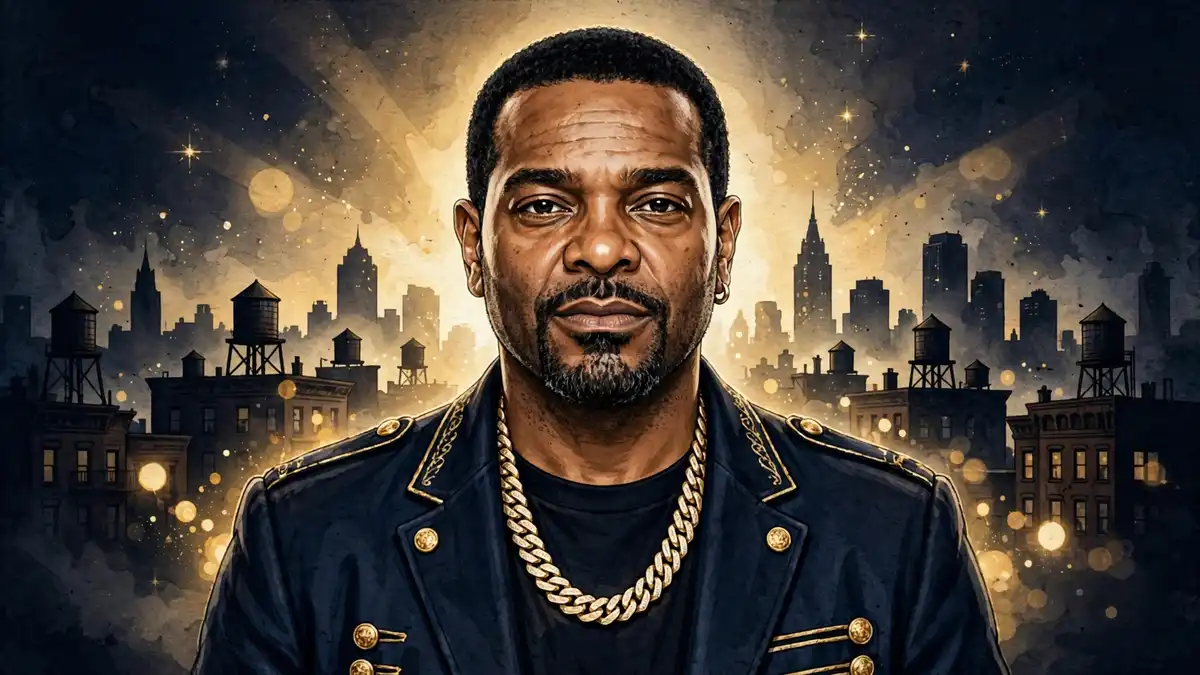
Jim Jones‘s net worth is estimated at $400,000–$1 million as of November 2026. The Harlem rapper co-founded The Diplomats, scored a platinum No. 5 hit with “We Fly High,” sold hundreds of thousands of albums, built the Vampire Life clothing brand, and spent a decade on VH1 reality television — and still ended up with one of the smallest fortunes of any rapper of his stature, after a New Jersey foreclosure turned a $680,000 house into a $1.24 million debt.
Jim Jones: Quick Facts
| Estimated net worth | $400,000 (range: $400,000–$1 million) |
|---|---|
| Profession | Rapper, record executive, entrepreneur, reality television personality |
| Nationality | American |
| Born | July 15, 1976 (age 50) |
| Height | 5 ft 11 in (180 cm, reported) |
| Primary income sources | Music royalties and touring, Diplomat Records, Vampire Life clothing, reality television |
| Active years | 1997–present |
| Last reviewed | November 2026 |
- Early Life and Background
- Education
- Career Journey
- Rise to Fame
- Main Sources of Income
- Salary and Earnings
- Businesses and Investments
- Brand Deals and Sponsorships
- Houses, Cars and Other Assets
- Awards and Achievements
- Net Worth Growth Over the Years
- Social Media Presence
- Personal Life
- Sources & Reporting
- Frequently Asked Questions
Early Life and Background
Joseph Guillermo Jones II was born on July 15, 1976, in the Bronx, New York, and raised mostly in Harlem by his maternal grandmother. His mother, Nancy Jones, is of Aruban descent; his father, Joseph Guillermo Jones I, was of Puerto Rican descent. He grew up with two sisters, Precious and Keisha. The household was not a comfortable one, and Jones has described a childhood marked by trouble at school and long stretches on Harlem streets — the same blocks that later gave his music its vocabulary.
Two friendships from those years shaped everything that followed. He grew close to Freekey Zekey as a boy, and he met Cameron Giles — the future Cam’ron — in Harlem as a teenager. He also crossed paths early with Damon Dash, the future Roc-A-Fella co-founder, a connection that later pulled Dipset into the orbit of Jay-Z’s label. The friendships were not industry networking. They were neighborhood bonds formed years before any of them had a record deal, and they explain why Dipset functioned more like a family business than a group assembled by a label.
Harlem in the 1980s and early 1990s gave Jones his education in the music business before he ever recorded a verse. He watched the neighborhood’s drug economy, its fashion codes, and its slang move through the streets, and he absorbed all three. When Dipset later built its identity on sped-up soul samples, pink fur, and Harlem slang, it was selling a version of the block Jones had grown up on. The grandmother who raised him kept him anchored while the streets pulled the other way, a tension that runs through his earliest songs: pride in where he came from, paired with a clear-eyed account of what it cost.
Jones was still a teenager when he started spending time around studios and video shoots, learning the mechanics of the rap business from the edges — carrying bags, hyping crowds, watching how records got made and sold. That apprenticeship matters to the money story. Jones entered the industry as a worker before he entered it as an artist, and the habit stuck: he has spent his career running labels, clothing lines, and side businesses alongside his own recording, even when the businesses returned less than the music did.
Education
There is no public record of Jim Jones finishing high school, let alone attending college, and he has never claimed a degree. Celebrity Net Worth notes that he described trouble at school during his childhood, and his own accounts of those years focus on the streets rather than the classroom. The honest version of this section is short: his schooling ended early, and the music business became his education.
What he learned instead was practical and specific. By his late teens he understood how mixtapes moved through Harlem, how a crew’s look could become a brand, and how a record executive thought about an artist’s value. In 2005, when Koch Records (later Entertainment One Music) appointed him an A&R executive, the label was paying for that street-level knowledge, not for a credential. The appointment is the clearest proof that the industry valued what he had learned outside school: he was hired to find and shape other artists, a job that depends on taste, relationships, and judgment about what sells.
Jones has also spoken over the years about learning the business the hard way — through contracts he signed too young, deals that favored the label, and money that arrived slower than the lifestyle it was supposed to fund. Those lessons show up later in the foreclosure story, where a mortgage taken on in his peak-earning years quietly grew into a seven-figure debt while payments stopped. School did not teach him to read a mortgage statement. The record business did not either, at least not in time.
Career Journey
Jones started out as Cam’ron’s hype man — the loud, charismatic presence at the side of the stage — and only gradually became a rapper in his own right. The Diplomats, formed by Jones and Cam’ron in 1997 with Freekey Zekey and later Juelz Santana, made their first commercial appearance on Cam’ron’s 2000 album S.D.E. The group’s debut, the double album Diplomatic Immunity (2003), reached the Top 10 of the Billboard 200 and earned a gold certification from the RIAA, carried by “Dipset Anthem,” “I Really Mean It,” and “I’m Ready.” A second album, Diplomatic Immunity 2, followed in 2004. The records sold on the strength of a sound nobody else had: sped-up soul samples, flamboyant street fashion, and Harlem slang delivered at a volume that made the group impossible to ignore.
Jones launched his solo career with On My Way to Church in August 2004. The 21-track album peaked at No. 18 on the Billboard 200, No. 3 on the Independent Albums chart, and No. 4 on the Top R&B/Hip-Hop Albums chart, with “Certified Gangstas” and “Crunk Muzik” as its calling cards. It was a solid debut for a rapper who had started as a hype man, and it proved he could carry a record without Cam’ron beside him. The second album, Harlem: Diary of a Summer (August 2005), did better still: No. 5 on the Billboard 200, No. 1 on both the Top R&B/Hip-Hop Albums and Independent Albums charts, and about 350,000 copies sold. The same year, Koch Records appointed him an A&R executive, giving him a salary and a say in other artists’ careers on top of his own recording income.
The third album changed his life. Hustler’s P.O.M.E. (Product of My Environment), released November 7, 2006, through Diplomat Records and Koch Records, debuted at No. 6 on the Billboard 200 with about 106,000 copies in its first week, topped the R&B/Hip-Hop and Independent Albums charts, and spent 21 weeks on the Billboard 200. Its lead single, “We Fly High,” produced by Zukhan Bey, reached No. 5 on the Billboard Hot 100, topped the Hot Rap Songs chart, reached No. 4 on Hot R&B/Hip-Hop Songs, and went platinum. It was Jones’s first Top 10 hit and remains his biggest. The song’s “Ballin’!” refrain and the jump-shot gesture that went with it escaped hip-hop entirely: professional athletes started working the motion into touchdown and victory celebrations, and the record became the first independent release to top Billboard’s Hot Ringmasters chart, selling more than 1.1 million mastertones in the ringtone era. The official remix stacked T.I., Diddy, Juelz Santana, Birdman, Jermaine Dupri, and Young Dro onto one track — a roll call of mid-2000s rap royalty that showed how far a Harlem independent record had traveled. The album’s success briefly earned Jones a deal with Columbia Records.
The years after the peak were prolific but less lucrative. Pray IV Reign (2009) reached No. 9 on the Billboard 200 behind the single “Pop Champagne,” and Capo (2011) reached No. 20 with about 21,000 copies in its first week. In 2006 he formed ByrdGang with Chink Santana, Juelz Santana, and NOE; their album M.O.B.: The Album (2008) peaked at No. 29 on the Billboard 200 and sold about 65,000 copies. Internal disputes fractured Dipset through the late 2000s — relationships between Jones, Cam’ron, and other members strained until the group went quiet — but the members reunited periodically, releasing Diplomatic Ties in 2018. The 2018 reunion tours and the group’s enduring catalog kept money coming in, though never at the 2006 level.
Jones’s late career has been a study in staying power. Wasted Talent arrived in 2018, and he teamed with the Heatmakerz, Dipset’s longtime production team, for 2019’s El Capo, a soulful New York record featuring Cam’ron, Fat Joe, Fabolous, Jadakiss, Benny the Butcher, Conway the Machine, and Rick Ross. He recorded The Fraud Department with producer Harry Fraud, then formed the Lobby Boyz with Brooklyn rapper Maino; their self-titled album arrived in 2022. In 2025 he released At the Church Steps, a 17-track project whose title nods to his 2004 debut, with Fabolous, Dave East, Maino, Fivio Foreign, and Conway the Machine; an expanded deluxe edition followed. In June 2026, at 49 years old and weeks short of his 50th birthday, he released another 17-track album, The Landlord, featuring Maino, Fabolous, and Fetty Wap. He also returned to the BET Awards stage in 2025 to perform “We Fly High,” a reminder that one song still defines him in the public mind nearly twenty years on.
Rise to Fame
Jones’s rise happened in two stages, and the gap between them is the key to his whole career. The first stage was collective: Dipset’s rise from 2000 to 2004 made him famous in New York without making him a star. He was the group’s Capo — the enforcer, the hype man, the one whose presence made the crew feel dangerous — while Cam’ron held the spotlight. The second stage was solo, and it arrived all at once in the autumn of 2006, when “We Fly High” turned a supporting player into a headliner.
The timing mattered. Hip-hop in 2006 was at the peak of the ringtone economy, and “We Fly High” was built for it: a slow, hypnotic beat, a one-word hook, and a gesture anyone could copy. The song’s success was not a fluke of marketing. It was a record that worked in clubs, on radio, on cell phones, and on television sports highlights at the same time, and each of those uses paid separately. The platinum certification, the No. 5 Hot 100 peak, and the 1.1 million mastertones were separate revenue streams from the same three minutes of music, and they arrived in a year when Jones also had a No. 6 album and a No. 1 rap album on the charts.
Reality television gave him a second kind of fame, different from the first. When he joined VH1’s Love & Hip Hop: New York in 2011 alongside Chrissy Lampkin, viewers who had never bought a Dipset record met him as a boyfriend, a fiancé, and a son caught between his partner and his mother. The show ran his relationship as one of its central storylines for seasons one, two, and ten, and the exposure led to the spinoff Chrissy & Mr. Jones (2012, two seasons) and later Jim & Chrissy: Vow or Never. Television paid him, kept his name in front of audiences between albums, and introduced him to a demographic that music alone never reached. It also locked his public identity to his relationship: for millions of viewers, Jim Jones is Chrissy Lampkin’s partner first and a rapper second. The show also helped launch another star — Cardi B came up through the same Love & Hip Hop: New York cast years later, a reminder of how much talent that franchise moved through.
The fame never fully converted into wealth, and that is the honest core of this profile. Jones earned real money — platinum singles, chart-topping albums, television salaries, a clothing line — but he earned it as an independent artist on Koch, splitting revenue with a label and a crew, in an era when streaming had not yet replaced record sales. He never had a major-label machine behind him for long, never had a catalog deal or a brand empire on the scale of his peers, and the debts that piled up in the 2010s ate what the good years had built. The rise was real. The fortune it should have produced was not.
Main Sources of Income
Jones’s income has always come from four streams, and their balance has shifted over time. Music came first and still pays: royalties from the Dipset catalog and his solo albums, streaming revenue from a catalog that gets rediscovered every time “We Fly High” trends, and touring, including Dipset reunion shows and his own dates. The catalog is his most durable asset. “We Fly High” still earns — a platinum record from 2006 with a hook that lives on in sports celebrations does not stop generating royalties — and the steady drip of his later albums, from El Capo through The Landlord, keeps new material in the pipeline.
Television became the second stream in 2011 and stayed one for more than a decade. Love & Hip Hop: New York paid per-episode fees across seasons one, two, and ten, and the spinoffs added producer fees — Lampkin served as an executive producer on Chrissy & Mr. Jones, and the couple’s shared brand meant shared checks. Reality stars of Jones’s standing typically earn tens of thousands of dollars per episode, and while his exact per-episode figure is not public, the run lasted long enough to matter: a decade of VH1 checks is a real income line, even if it never approached the money of a hit album cycle.
The third stream is business: Diplomat Records, where he serves as co-CEO alongside Cam’ron, and the Vampire Life clothing brand, which sells apparel and merchandise tied to his “vamp” imagery. The label earns from its releases and partnerships; the clothing line earns from direct sales and drops. Neither business has published revenue figures, and both have been described as modest operations rather than empires — but they have kept Jones’s name on products for twenty years, which is itself a form of income.
The fourth stream is the miscellany of a working rapper’s life: features and guest verses, appearances, hosting, and social media promotion. These pay in thousands per engagement rather than hundreds of thousands, and they arrive irregularly. Together the four streams have kept Jones earning into his fifties — the 2026 album and the BET Awards performance are proof of that — but they have never added up to the kind of wealth that survives a seven-figure debt. The gap between gross career earnings and net worth is the whole story of this profile.

Salary and Earnings
No contract, tax filing, or audited statement of Jim Jones’s earnings has ever been published, so every salary figure in this section is an estimate built from reported chart data, industry norms, and the few numbers on the public record. The peak year was 2006. Hustler’s P.O.M.E. sold about 106,000 copies in its first week and spent 21 weeks on the Billboard 200; “We Fly High” went platinum and sold more than 1.1 million mastertones. A platinum single in the ringtone era, on an independent label deal, would have generated low-seven-figure gross revenue across sales, ringtones, radio, and licensing — but Jones split that money with Diplomat Records, Koch Records, producers, and the featured artists on the remix, and the label recouped its costs first. His personal take from his biggest year was substantial by any normal standard and small by rap-superstar standards: enough to buy a $680,000 house the same year, not enough to retire on.
Album sales give a rough shape to the rest of his career. Harlem: Diary of a Summer sold about 350,000 copies — his best-selling album by units. M.O.B.: The Album sold about 65,000. Capo opened with about 21,000 copies in its first week. Each of those records paid Jones as artist, and in some cases as label executive, but the per-album checks shrank as the industry moved from CDs to downloads to streaming, and as his chart positions slipped from the Top 5 to the Top 20 and below. By the 2010s, his music income was mostly catalog royalties and touring rather than new-release sales.
Reunion touring has been a meaningful earner in recent years. Dipset reunion shows command five-figure fees per appearance, and Jones has toured steadily with the group and on his own, including dates around the 2025 and 2026 album releases. Online breakdowns have put his annual income in the $1 million to $2 million range in recent years — a figure we treat as unconfirmed, since it rests on no named source — but even at the top of that range, the money has gone toward living costs, business overhead, and old debts rather than accumulation. That is the arithmetic that produces a $400,000 net worth after a 28-year career: the income was real, and so were the outflows.
The comparison with his Dipset partners sharpens the point. Cam’ron, the group’s frontman, is reported at roughly $6 million, and Juelz Santana at roughly $2 million, in the same 2026 online breakdowns that put Jones at the bottom of the group. Those partner figures are secondary estimates, not independently verified, but the ranking is consistent across sources: Jones, the co-founder who built the group with Cam’ron, ended up the least wealthy of its three main members. The reasons are not mysterious — fewer solo hits, no major-label payday, and the foreclosure — but the result is unusual enough to be the first thing people ask about him.
Businesses and Investments
Jones has started more businesses than most rappers of his generation, and the list reads like a map of his interests. Diplomat Records, the label he co-founded with Cam’ron, is the oldest and most important: it released his solo albums and the group’s records, and as co-CEO he earns from the label’s catalog and partnerships. The label’s value is its catalog — Diplomatic Immunity and the solo albums still stream — rather than any new signings, and its revenue is modest compared with a major label. But it gave Jones something few artists of his era had: ownership of his masters’ home and a say in how they were sold.
Vampire Life is his best-known consumer brand. Built around the “vamp” imagery he adopted in his music — late nights, sunglasses indoors, a whole aesthetic of nocturnal luxury — the line sells clothing and merchandise, and it has survived for well over a decade, outliving most rapper clothing lines from the 2000s. Lampkin’s women’s line, Lady Vamp, grew out of the same brand. Jones has also run Nostic, an earlier clothing venture, and ByrdGang as both a rap group and a clothing line. None of these has ever disclosed revenue, and none appears to have scaled into a national retail presence; they sell to a loyal core audience, and they keep the brand alive between album cycles.
His most unusual investment was sports. In 2017 he became a minority owner of the Richmond Roughriders, an indoor football team in the American Arena League, saying he wanted to connect indoor football with hip-hop culture. The investment was short-lived — the franchise later relocated and changed identities — and it is not clear Jones made money from it. He also launched Dipskate, a freestyle inline-skating team and lifestyle concept, an idea that reflected his taste for left-field branding more than any commercial logic. Real estate, which content farms routinely list as one of his assets, is the weakest claim in the pile: the only property with a documented paper trail is the New Jersey house he lost to foreclosure, and no verified record shows a portfolio of homes in New York or Atlanta. We list it here as a claim, not a fact.
Jones also held a corporate job inside the business: his 2005 appointment as an A&R executive at Koch Records (later Entertainment One Music) put him on the other side of the signing table, scouting and shaping other artists. The role came with a salary and a title, and it showed the industry’s respect for his ear. It also gave him a view of how label economics actually work — knowledge that, by his own later account, arrived too late to save him from the deals and debts of his early career.
Brand Deals and Sponsorships
Jones has never had a signature endorsement deal of the kind that defines modern rap wealth — no sneaker line, no liquor brand, no headphones partnership. His brand work has been smaller and closer to his own businesses: Vampire Life collaborations, merchandise drops tied to album releases, paid social media promotion, and appearances. The absence is itself a data point. Endorsement money in hip-hop flows to artists with either chart dominance or a mainstream media profile, and Jones’s fame peaked before the endorsement economy matured, then moved to reality television, where the checks were steady but the brand deals were thinner.
What he did have was cultural placement that money cannot buy. “We Fly High” became a sports anthem without a sponsorship contract — athletes adopted the jump-shot gesture on their own, and the song’s presence in stadiums and highlight reels was earned, not bought. The Dipset aesthetic — the pink, the fur, the slang — influenced fashion without a fashion deal attached. Vampire Life monetized some of that influence directly, through merchandise, but the larger cultural footprint never had a corporate sponsor writing checks against it. For a net worth profile, that distinction matters: influence and income are not the same thing, and Jones has had far more of the first than the second.
In recent years his promotional work has moved to social media, where sponsored posts and appearances pay per engagement. Industry norms for an artist of his following put a single sponsored post in the low thousands of dollars — useful income, not wealth-building income. The pattern holds across his whole career: many small revenue lines, none of them large enough alone to build a fortune, and all of them vulnerable to the debts that were accumulating in the background.

Houses, Cars and Other Assets
The asset side of Jim Jones’s balance sheet is thin, and the one property everyone knows about is the one he lost. In 2006, at the height of the “We Fly High” moment, Jones and Chrissy Lampkin bought a New Jersey home for $680,000, financed with a mortgage at 6.875% interest and monthly payments of roughly $4,500. Payments stopped in 2010. A foreclosure lawsuit filed in 2017 showed the outstanding balance had climbed to about $1.24 million after interest and charges, and the bank foreclosed; the property was sold through a sheriff’s auction in 2019. The house is the single most important fact in this profile. It explains, in one documented transaction, how a platinum-selling rapper ends up with a $400,000 net worth: he bought at the peak, stopped paying during the lean years, and let interest turn a $680,000 purchase into a $1.24 million liability.
Reports of IRS liens above $1.5 million have circulated in 2026 online breakdowns of his finances, alongside mentions of lawsuits and child-support disputes reported by TMZ, The Jasmine Brand, and HipHopDX. We could not independently verify the lien figure from court records, and we do not present it as established fact — but the foreclosure alone is enough to explain the shape of his finances, and the lien reports, if accurate, would deepen the hole. What is established is that no bankruptcy filing appears in the public record as of October 2026: Jones has not filed for Chapter 7 or Chapter 11, which separates his situation from that of peers who did. He is not bankrupt. He is, by the numbers, a working musician carrying the cost of debts taken on twenty years ago.
Cars and jewelry — the assets Jones’s public image leans on hardest — are the least documented part of his wealth. He has been photographed with luxury cars and heavy jewelry throughout his career, and the Dipset image depended on visible spending. But cars depreciate, jewelry is hard to value without appraisals, and neither appears in any public record tied to his name. We do not count them as assets. His real assets are the ones with a paper trail: the music catalog, the Diplomat Records stake, the Vampire Life brand, and the future earnings from touring and television. Those are genuine, and they are worth far less than the $10 million to $25 million figures that content farms attach to his name without a single source.
Awards and Achievements
Jones has never won a Grammy, and his trophy case is not the point of his career — but the achievements that matter to his money story are chart positions, certifications, and longevity, and those are documented. “We Fly High” reached No. 5 on the Billboard Hot 100, topped the Hot Rap Songs chart, and earned a platinum certification from the RIAA. Diplomatic Immunity went gold. Harlem: Diary of a Summer and Hustler’s P.O.M.E. both reached the Top 5 of the Billboard 200 and topped the R&B/Hip-Hop and Independent Albums charts, and Pray IV Reign reached No. 9. Three solo albums in the Billboard 200 Top 10 is a record most rappers never touch, and Jones did it as an independent artist on Koch.
The less formal achievements may matter more to his income. He co-founded one of the most influential rap groups of the 2000s, helped build a sound and a look that defined New York hip-hop for a decade, and stayed relevant for 28 years — from Dipset’s first appearance in 2000 to a 17-track album in June 2026, released weeks before his 50th birthday. He performed “We Fly High” at the BET Awards in 2025, nineteen years after the song’s release. Longevity is not a trophy, but it is a revenue stream: the catalog keeps earning, the reunion tours keep selling, and the television work keeps coming because audiences still know the name. The achievement is survival. The cost of it is visible in the net worth figure.
Net Worth Growth Over the Years
Jones’s net worth did not grow in a straight line. It peaked early, fell hard, and has recovered only slowly — a shape that looks nothing like the smooth upward tables content farms publish for him. The table below uses the figures that can be tied to a source or a dated event, and labels the rest as estimates.
| Year | Estimated net worth | What happened |
|---|---|---|
| 2003 | Under $500,000 (estimate) | Diplomatic Immunity goes gold; Jones is still mainly Cam’ron’s hype man |
| 2006 | $2–$3 million (estimate, peak) | “We Fly High” hits No. 5; Hustler’s P.O.M.E. debuts at No. 6; buys the $680,000 New Jersey house |
| 2010 | Under $1 million (estimate) | Mortgage payments stop; album sales and chart positions fall |
| 2017 | Under $500,000 (estimate) | Foreclosure lawsuit filed; balance shown at about $1.24 million |
| 2019 | $400,000 (Celebrity Net Worth) | New Jersey house sold at sheriff’s auction; Dipset reunion tours continue |
| 2024 | $400,000 (Celebrity Net Worth) | Catalog, touring, and television keep income steady; debts cap accumulation |
| 2026 | $400,000–$1 million | New albums At the Church Steps and The Landlord; Celebrity Net Worth reaffirms $400,000 in September |
The honest reading of this table is that the 2006 figure is the only peak, and everything since has been a long recovery that never reached it. Content farms that show Jones climbing from $10 million to $25 million between 2022 and 2026 are not describing a real person: they contradict the foreclosure record, the September 2026 Celebrity Net Worth update, and the simple fact that no new income stream of that size has appeared in his career. The growth story here is a cautionary one — a reminder that in hip-hop, as in any business, the size of the hit matters less than what you keep.
Social Media Presence
Jones is active on Instagram and X (formerly Twitter), where he promotes new music, Vampire Life drops, tour dates, and television appearances, and where he weighs in — often loudly — on hip-hop debates. His following is in the low millions on Instagram, large enough to sell merchandise and promote shows, small enough that sponsored posts pay in the low thousands rather than the five figures a bigger star commands. Social media is a working tool for him rather than a wealth engine: it keeps the audience warm between albums and moves product, but it does not replace the income a hit record used to provide.
The platforms have also been the stage for his feuds. His 2012 dispute with Azealia Banks over the word “vamp” played out online, as did his long-running friction with Jay-Z’s camp and his periodic public disagreements inside Dipset. Those moments generate attention, and attention generates streams, but they also cost him: the 2008 assault case that followed an altercation with an associate of Jay-Z at a Manhattan Louis Vuitton store ended in a guilty plea, with legal costs on top. Social media amplifies both sides of that ledger.
Personal Life
Jones has been in a relationship with reality television personality Chrissy Lampkin since 2004, after the two met in Miami. They became engaged in 2011 — the proposal played out on Love & Hip Hop: New York — and they have not married since, a fact that became one of the show’s longest-running storylines. Lampkin, born April 27, 1971, built her own career from the same television exposure: she starred in the spinoff Chrissy & Mr. Jones, worked as an executive producer, and launched the Lady Vamp clothing line. Celebrity Net Worth lists her own net worth at $500,000 as of August 2026 — slightly above Jones’s — built from reality television salaries, producer fees, fashion work, and appearances. The couple has said repeatedly that they do not consider a marriage certificate necessary to validate a relationship that has lasted more than two decades, and as of 2025 they remained together, still fielding the same question about a wedding.
Jones has a son, Joseph Guillermo Jones III — known as Pudie — born May 20, 2003, from a previous relationship. He has not publicly identified his son’s mother. His mother, Nancy, became a familiar figure to television audiences through her strained relationship with Lampkin on the show, a storyline that mixed real family tension with reality-television editing in proportions nobody outside the family can separate.
His feuds are part of the personal record too. The conflict with Jay-Z grew out of Dipset’s tangled relationship with Roc-A-Fella and Jones’s criticism of Jay-Z’s leadership at Def Jam; Jay-Z answered “We Fly High” with the diss track “Brooklyn High,” and the bad blood led to the 2008 Louis Vuitton altercation and guilty plea. He feuded with Tru Life through the late 2000s, a staple of New York mixtape culture, and with Azealia Banks in 2012 over the “vamp” label. Through all of it, he reconciled with Cam’ron enough to record and tour together again — the friendship that started the whole story has outlasted every feud around it. The Jay-Z fortune, built on the same Roc-A-Fella world Jones once orbited, is the starkest measure of how differently two careers from the same scene can end.
Sources & Reporting
Celebrity Net Worth — the $400,000 estimate (updated September 7, 2026), the foreclosure record ($680,000 purchase, 6.875% mortgage, $1.24 million balance, payments stopped 2010), the Chrissy Lampkin $500,000 figure (updated August 4, 2026), and the career narrative used throughout. Wikipedia — discography, chart peaks, sales figures (350,000 for Harlem: Diary of a Summer, 106,000 first-week for Hustler’s P.O.M.E., 65,000 for M.O.B.), the Koch A&R appointment, and the Columbia Records signing. Billboard — chart positions for “We Fly High” (No. 5 Hot 100, platinum), the albums’ Billboard 200 peaks, and the 21-week chart run for Hustler’s P.O.M.E. Scintillating Stars — the independent $400,000 estimate (updated September 8, 2026), height 5 ft 11 in, and the son’s identity. I Am Hip Hop Mag — the November 7, 2006 release date and first-week sales for Hustler’s P.O.M.E. Reporting window: September–November 2026, with the net worth anchor re-checked on November 11, 2026.
Frequently Asked Questions
What is Jim Jones’s net worth in 2026?
Jim Jones’s net worth is estimated at $400,000–$1 million as of November 2026. Celebrity Net Worth, the most-cited tracker, lists him at $400,000 in its September 2026 update, and the next-closest independent estimate agrees. Broader online breakdowns stretch the range toward $1 million. Claims of $10 million to $25 million from content farms carry no sourcing and contradict the documented foreclosure record.
Why is Jim Jones’s net worth so low?
Three reasons. First, his biggest success came as an independent artist on Koch Records, so the “We Fly High” money was split with the label, producers, and the Dipset crew. Second, he bought a $680,000 New Jersey house in 2006, stopped paying the mortgage in 2010, and watched the balance grow to about $1.24 million before the bank foreclosed. Third, his chart peak was brief — one platinum single and three Top 10 albums — and later income from touring, television, and clothing never replaced it.
How much money did Jim Jones make from “We Fly High”?
No exact figure is public. The single reached No. 5 on the Billboard Hot 100, went platinum, and sold more than 1.1 million mastertones, and the album it led debuted at No. 6 with about 106,000 first-week copies. Gross revenue across sales, ringtones, radio, and licensing was likely in the low seven figures, but Jones split it with Diplomat Records, Koch Records, and producers, and the label recouped costs first — so his personal take was far smaller than the song’s gross.
Is Jim Jones married to Chrissy Lampkin?
No. Jones and Chrissy Lampkin have been together since 2004 and became engaged in 2011, with the proposal shown on Love & Hip Hop: New York, but they have never married. They have said repeatedly that they do not consider a marriage certificate necessary, and they remained together as of 2025. Lampkin’s own net worth is estimated at $500,000.
How old is Jim Jones?
Jim Jones is 50 years old. He was born Joseph Guillermo Jones II on July 15, 1976, in the Bronx, New York, and turned 50 in July 2026 — weeks after releasing his album The Landlord in June 2026.
How tall is Jim Jones?
Jim Jones is reported to be 5 feet 11 inches tall (180 cm), with a reported weight of about 82 kg (181 lbs). His height is listed consistently across biography sources, though it has never been officially confirmed.
Did Jim Jones file for bankruptcy?
No. As of October 2026 there is no public record of Jim Jones filing for Chapter 7 or Chapter 11 bankruptcy. He did lose his New Jersey home to foreclosure — the bank took legal action in 2017 and the property was sold at a sheriff’s auction in 2019 — and unverified online reports mention IRS liens above $1.5 million, but foreclosure and bankruptcy are different things, and he has not filed for bankruptcy.
What is Vampire Life, and does Jim Jones still own it?
Vampire Life is Jim Jones’s clothing and merchandise brand, built around the “vamp” imagery from his music. He founded it and still runs it, with his partner Chrissy Lampkin’s Lady Vamp line as a sister brand. It has sold steadily for well over a decade but has never disclosed revenue or scaled into national retail, so it contributes modest income rather than major wealth.
Final Thoughts
Jim Jones’s $400,000 net worth is the most honest number in hip-hop’s wealth conversation, because it refuses to flatter anyone. He had the hit, the group, the television show, and the clothing line — and he still ended up with less than a mid-level executive, because the hit was split six ways, the house was bought at the top, and the debts were left to grow. The content farms that print $10 million or $25 million for him are selling a fantasy in which every famous rapper is rich. The record shows something more useful: a 28-year career, three Top 10 albums, a platinum single that still pays, a new album at 50, and a fortune that never arrived. The lesson is not that Jones failed. It is that fame and wealth are different currencies, and he was paid mostly in the first.
Published on November 11, 2026. Last reviewed November 2026. Found an error? See our corrections policy.