
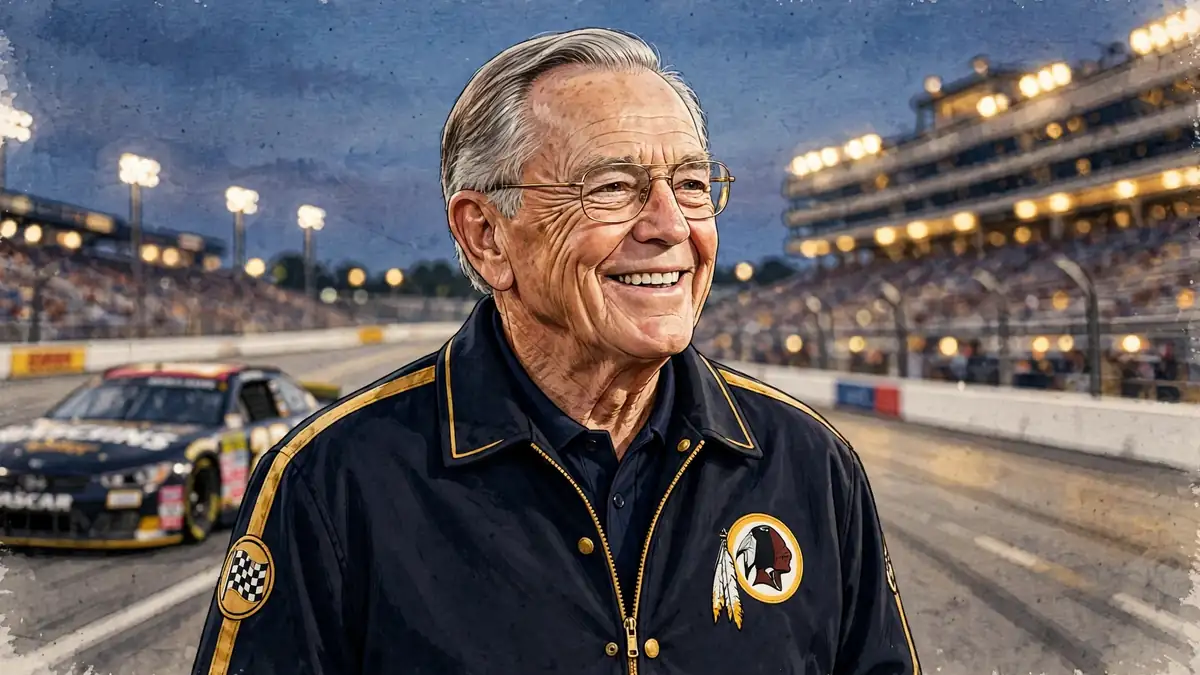
Joe Gibbs‘s net worth is estimated at $60 million–$100 million as of November 2026. The three-time Super Bowl-winning coach built the first half of that fortune on NFL sidelines — including a five-year, $28.5 million Washington contract that made him the league’s highest-paid coach in 2004 — and the second half as founder and owner of Joe Gibbs Racing, a NASCAR team Forbes valued at $230 million in 2020. In December 2025 his racing group sold its manufacturing arm to a New York private equity firm, a deal that pushed the freshest estimate of his personal wealth to $100 million.
Joe Gibbs: Quick Facts
| Estimated net worth | $70 million (range: $60 million–$100 million) |
|---|---|
| Profession | Former NFL head coach; NASCAR team owner |
| Nationality | American |
| Born | November 25, 1940 (age 85) |
| Height | 1.68 m (5 ft 6 in) |
| Primary income sources | NFL coaching contracts, Joe Gibbs Racing ownership, sponsorship and prize money, minority-stake deals |
| Active years | 1964–present (coaching 1964–2008; NASCAR ownership 1992–present) |
| Last reviewed | November 2026 |
- Early Life and Background
- Education
- Career Journey
- Rise to Fame
- Main Sources of Income
- Salary and Earnings
- Businesses and Investments
- Brand Deals and Sponsorships
- Houses, Cars and Other Assets
- Awards and Achievements
- Net Worth Growth Over the Years
- Social Media Presence
- Personal Life
- Sources & Reporting
- Frequently Asked Questions
Early Life and Background
Joe Jackson Gibbs was born on November 25, 1940, in Mocksville, North Carolina, the older of two sons of Jackson Cephus Gibbs and Winnie Era Blalock Gibbs. His younger brother was Jim Gibbs. Mocksville is a small town in Davie County, and Gibbs has described his childhood there as plain and rooted in church and family — he became a Baptist at the age of nine, a faith he has carried openly through both of his careers.
In 1955, when Gibbs was 14, the family moved to Southern California. The move put him at Santa Fe High School in Santa Fe Springs, where he played quarterback and was named All-San Gabriel League as a senior in 1959. He lettered in basketball and baseball as well, but football was the sport that shaped him. Gibbs was a decent high school quarterback, good enough to play in college, and honest enough later in life to admit he could see the gap between himself and the players who would make it as professionals. That clear-eyed self-assessment pushed him toward coaching while he was still a teenager in spirit, if not yet in job title.
The California years also gave Gibbs his first taste of the coaching tree that would define his career. At San Diego State he played under Don Coryell, the offensive innovator whose passing schemes later became known as Air Coryell. Gibbs watched how Coryell taught, how he broke down film, how he designed plays to attack a defence’s weak spot rather than simply out-muscling it. Those lessons travelled with Gibbs for the next four decades, from college sidelines to Super Bowls to a NASCAR pit box, where preparation and detail matter in much the same way.
Money was not part of the Gibbs family story in those early years, and nothing in his background suggested a future fortune. His father worked, the family lived modestly, and Gibbs’s first jobs in football paid coaching wages that would look tiny beside the contracts he signed later. The wealth came late, in his fifties and sixties, and it came from two separate careers stacked on top of each other — a pattern no other figure in American sport has matched. Gibbs is the only person to win a Super Bowl as a head coach and a NASCAR Cup Series championship as a team owner, and that double career is the whole explanation for his net worth.
Education
Gibbs graduated from Santa Fe High School in 1959 and attended Cerritos College before transferring to San Diego State University. He earned a Bachelor of Arts degree from San Diego State in 1964 and a master’s degree from the same university in 1966. Both degrees came while he was already coaching — he started as a graduate assistant and offensive line coach under Coryell at San Diego State in 1964, so his classroom work and his sideline work ran side by side for two years.
The master’s degree mattered more than it might look on a biography page. In the 1960s, a graduate degree was a real credential for a young coach trying to climb from college assistant jobs to the NFL, and it gave Gibbs a fallback if coaching did not work out. It also shaped how he ran a room: Gibbs became known as a teacher first, a coach who could explain a complicated scheme in plain language and get players with modest talent to execute it. Teammates and assistants from his Washington years still describe his meeting rooms as classrooms, with Gibbs at the board drawing up protections and route combinations until every player could recite them.
San Diego State also gave Gibbs his professional network. Coryell’s staff and players scattered across college football and the NFL in the late 1960s and 1970s, and Gibbs moved with that network: Florida State in 1967, USC in 1969, Arkansas in 1971, then the NFL with the St. Louis Cardinals in 1973. Each stop added a layer — college recruiting at Florida State and USC, running-back coaching at Arkansas, pro personnel work with the Cardinals — and each stop paid a little more than the last. None of it made him rich. What it did was build the reputation that Washington would pay for in 1981.
Career Journey
Gibbs’s coaching career began in 1964 as offensive line coach at San Diego State under Don Coryell, a post he held through 1966. He coached the offensive line at Florida State in 1967 and 1968, then moved to USC, where he coached the offensive line under John McKay in 1969 and 1970. In 1971 he joined Frank Broyles’s staff at Arkansas as running backs coach, staying through 1972. Those eight college seasons taught him every corner of an offence, and they put him on the radar of NFL teams looking for young assistants who could teach.
The NFL came calling in 1973, when Gibbs joined the St. Louis Cardinals as running backs coach, a job he held for five seasons through 1977. In 1978 he spent a single season as offensive coordinator of the Tampa Bay Buccaneers, then returned to Coryell in 1979 as offensive coordinator of the San Diego Chargers. The two Chargers seasons, 1979 and 1980, were the making of his reputation: the Air Coryell offence, with Dan Fouts throwing to Charlie Joiner, Kellen Winslow and John Jefferson, led the league and made Gibbs one of the hottest coordinator names in football. Washington hired him as head coach in 1981.
Gibbs coached Washington for 12 seasons in his first stint, from 1981 to 1992. He retired after the 1992 season, at 52, and turned his full attention to the NASCAR team he had founded that same year with his sons. He stayed away from football for 11 years, then returned in January 2004 as Washington’s head coach and team president, signing the five-year, $28.5 million contract that made him the NFL’s highest-paid coach at the time. He coached four more seasons, 2004 to 2007, and resigned on January 8, 2008, after completing four years of the five-year deal. His combined NFL head coaching record stands at 154–94 in the regular season and 17–7 in the postseason, across 16 seasons with one franchise.
Parallel to all of that, Gibbs built a second career in motorsport. In 1992 he and his sons founded Joe Gibbs Racing, starting with a single Cup Series car. The team won its first Daytona 500 in 1993 with Dale Jarrett driving, and it has grown into one of NASCAR’s two dominant organisations, alongside Hendrick Motorsports. Gibbs has owned the team continuously since 1992 — more than 33 years — and remains its owner and central figure in 2026, with his daughter-in-law Heather Gibbs and grandson Ty Gibbs now listed among its owners after the deaths of his two sons.
Rise to Fame
Gibbs arrived in Washington in 1981 as a 40-year-old first-time NFL head coach, and his first season looked like a mistake: the team started 0–5. Owner Jack Kent Cooke kept faith, Gibbs steadied the team, and Washington finished 8–8. The next season, shortened by a players’ strike, Washington won Super Bowl XVII, beating the Miami Dolphins 27–17 in January 1983 with Joe Theismann at quarterback and John Riggins running behind the Hogs offensive line. Gibbs was 42, and he had a championship in his second season.
The second title came five years later. In the 1987 season Washington won Super Bowl XXII 42–10 against the Denver Broncos, with Doug Williams — the first Black quarterback to start and win a Super Bowl — throwing four touchdown passes in the second quarter. The third title came in the 1991 season, a 37–24 win over the Buffalo Bills in Super Bowl XXVI, with Mark Rypien at quarterback. Three Super Bowls, three different quarterbacks, and none of the three is in the Pro Football Hall of Fame. That detail is the heart of Gibbs’s coaching reputation: he won with systems, preparation and offensive lines, not by inheriting a franchise quarterback.
Gibbs entered the Pro Football Hall of Fame in 1996, only four years after his first retirement — a fast induction that reflected how the voters viewed the three titles. He was still only 55. Most coaches wait far longer, and many with similar records never get in. The Hall of Fame induction also gave Gibbs a permanent place in the sport’s commercial life: appearances, speaking engagements and endorsements that continued long after he stopped coaching.
Fame in NASCAR came more slowly and then all at once. Joe Gibbs Racing won its first Cup Series championship in 2000 with Bobby Labonte, then two more with Tony Stewart in 2002 and 2005, and two more with Kyle Busch in 2015 and 2019 — five Cup titles with three different drivers and three different manufacturers. The team also won four Xfinity Series championships and passed 400 combined wins across the Cup and Xfinity Series. In 2020 Gibbs was inducted into the NASCAR Hall of Fame, making him one of a small group of people enshrined in two major American sports halls of fame. By then the racing team, not the coaching career, was the larger part of his wealth.
Main Sources of Income
Joe Gibbs’s money comes from four places, and the balance between them has shifted over time. In the 1980s and early 1990s, NFL coaching salaries were the main source. From 1992 onward, the racing team took over. Since his final retirement from coaching in 2008, almost everything has flowed from Joe Gibbs Racing and the deals around it, with speaking, books and endorsements adding smaller sums on top.
The first source is NFL coaching pay. Gibbs coached in the NFL for 16 seasons as a head coach and several more as an assistant, but the big money arrived only at the end: the five-year, $28.5 million contract he signed in January 2004. ESPN reported the deal at the time, and Sports Business Journal confirmed it made Gibbs the NFL’s highest-paid coach. He completed four of the five years before resigning in January 2008, so he collected roughly four-fifths of the headline figure — about $22.8 million — before bonuses and benefits. His first stint, from 1981 to 1992, paid far less: head coaches in that era earned hundreds of thousands of dollars a year, not millions, and Gibbs’s salary in the 1980s was never publicly reported in detail. A fair reading is that his total career NFL coaching earnings sit somewhere in the low tens of millions, with the 2004 contract supplying most of it.
The second source, and the largest, is Joe Gibbs Racing. Gibbs founded the team in 1992 and has owned it ever since. A NASCAR Cup Series team earns money from sponsorship, prize money, manufacturer support, merchandise and media-rights distributions, and JGR has been one of the best at all five for three decades. Forbes valued the team at $225 million with revenue of $135 million in 2017, and at $230 million in 2020, second only to Rick Hendrick’s Hendrick Motorsports. Secondary reporting based on those figures puts JGR’s 2024 revenue at about $135 million, with roughly $116 million of that from sponsorships — Toyota, Interstate Batteries and Mavis Tires among the longest-standing partners. Those are team revenues, not Gibbs’s personal income, and the team also carries large costs: driver salaries, a staff of hundreds, cars, engines, travel and a race shop. But the value of the team itself is the core of his wealth. Owning a controlling stake in a business valued at $230 million, even after selling minority stakes in 2023, leaves a personal position worth far more than any coaching contract he ever signed.
The third source is equity deals around the team. In June 2023 JGR sold minority stakes to Harris Blitzer Sports & Entertainment — the sports group run by Josh Harris and David Blitzer — and to Arctos Partners, the private equity firm that buys minority stakes in sports teams. The size of the stakes and the price were not disclosed, but the structure mattered: Gibbs became a limited partner of HBSE as part of the transaction, which tied him to a group that owns the Philadelphia 76ers, the New Jersey Devils and, since 2023, the Washington Commanders — the same franchise he once coached. Selling a minority stake in a private business usually means cash in hand for the seller, and it also sets a market value for the remaining stake. Then, on December 1, 2025, JGR sold its manufacturing arm, Joe Gibbs Manufacturing Solutions, to Torque Capital Group, a New York private equity firm. The manufacturing business, which had moved from making racing parts into advanced composites for solid rocket motors, was rebranded JGA Space & Defense, with Torque planning more than $25 million of investment and a 60,000-square-foot facility in Huntersville, North Carolina. The sale price was not disclosed, so no figure from that deal can be added to Gibbs’s net worth — but the deal is almost certainly part of why Celebrity Net Worth raised its estimate to $100 million in November 2026, and it is the freshest piece of evidence in this article.
The fourth source is everything else: books, speaking, endorsements and a long-ago NFL ownership stake. Gibbs wrote Racing to Win and Game Plan for Life, the second of which became the name of his men’s ministry work. He has been a paid speaker for decades, drawing on the unusual story of winning championships in two sports. And in 2002, Gibbs and two partners bought a reported 5 percent stake in the Atlanta Falcons for $27 million, according to Sports Business Journal. He resigned from the Falcons’ board when he returned to coach Washington in 2004, and the later sale of that stake was never publicly detailed — but a 5 percent slice of an NFL franchise bought in 2002 would have grown sharply in value by the time he exited, since NFL franchise values rose several times over in that period. We do not put a number on that gain because no source does.

Salary and Earnings
Gibbs’s salary history splits cleanly into two eras. The first era, 1964 to 2003, was a working coach’s pay: college assistant wages in the 1960s, NFL assistant wages in the 1970s, and head-coach wages in the 1980s and early 1990s that were comfortable but not fortunes. No reliable source publishes his Washington salary for the 1981–1992 stint, and we do not guess at it. What is known is the shape of the era: in 1981, even successful NFL head coaches earned well under $1 million a year, and Gibbs’s pay rose gradually across 12 seasons rather than jumping. His three Super Bowl wins would have brought bonuses and raises, but the big money in NFL coaching did not arrive until the late 1990s and 2000s, after he had already retired once.
The second era is documented precisely. On January 7, 2004, Gibbs came out of retirement to rejoin Washington as head coach and team president, signing a five-year contract worth $28.5 million. ESPN’s Len Pasquarelli reported the figure, and Sports Business Journal’s account the same week confirmed Gibbs became the NFL’s highest-paid coach, ahead of the $5 million a year Washington had been paying Steve Spurrier. The contract worked out to $5.7 million a year, and coaching salaries do not count against the salary cap, so the team could pay it freely. Sports Business Journal also reported that the deal gave Gibbs no ownership stake in the team but contained a mechanism that could let him earn extra income tied to a percentage of the increase in the franchise’s value during his tenure — an unusual clause that linked his pay to the club’s rising worth.
Gibbs resigned on January 8, 2008, after four seasons, with one year left on the deal. He stayed on in a “special advisor” role to owner Daniel Snyder, a position he held for years afterward. The advisor role kept him connected to the franchise without the grind of coaching, and it likely carried a salary, though no figure was ever reported. After 2008 Gibbs drew no coaching salary at all. His income from that point has come from the racing team, and that is a key point for readers comparing him with active coaches: Gibbs has not had a paycheck from football in 18 years, and his wealth has grown anyway, because the asset he owns — the race team — kept growing while he watched from the pit box.
For comparison, the coaching market has moved far past Gibbs’s 2004 deal. By 2026, top NFL head coaches earn $15 million to $20 million a year, roughly three times what Gibbs made at his peak — a market later coaches such as Bill Belichick and Andy Reid benefited from far more than Gibbs ever did. That gap is not a knock on Gibbs; it is a reminder that his fortune was built by owning a team, not by coaching one. The $28.5 million contract matters to his net worth mainly as the seed capital of his later wealth — money earned in his sixties that he did not need to spend, because the racing business was already paying its own way.
Businesses and Investments
Joe Gibbs Racing is the business, and everything else is a footnote to it. Gibbs founded JGR in 1992 with his sons J.D. and Coy, starting from a small shop and a single car sponsored by Interstate Batteries — a sponsor that has stayed with the team for more than 30 years, one of the longest partnerships in NASCAR. The team now runs four cars in the NASCAR Cup Series and three in the Xfinity Series, with a driver development programme feeding young talent upward. Its 2025 Cup lineup featured Denny Hamlin, Christopher Bell and Ty Gibbs, Gibbs’s grandson, carrying the family name on the car itself.
The team’s competitive record is the reason sponsors pay. JGR has won five Cup Series championships — Bobby Labonte in 2000, Tony Stewart in 2002 and 2005, Kyle Busch in 2015 and 2019 — and four Xfinity Series championships, along with more than 425 NASCAR race wins in total, including four Daytona 500s and four Brickyard 400s. A team that wins that often can charge more for sponsorship, keep drivers longer, and attract manufacturer backing; Toyota has been JGR’s manufacturer partner for years, supplying engines and technical support through Toyota Racing Development. The technical alliance JGR formed with 23XI Racing in 2021 extended that reach further, sharing data and resources with the team co-owned by Denny Hamlin and Michael Jordan.
The ownership picture changed in June 2023, when JGR sold minority stakes to Harris Blitzer Sports & Entertainment and Arctos Partners. The current owners are listed as Joe Gibbs, Heather Gibbs — Coy’s widow — Ty Gibbs, HBSE and Arctos. Gibbs also became a limited partner of HBSE in the same transaction, which gives him a small piece of a much larger sports portfolio. The deal valued the team in private, but neither side disclosed the price, so the Forbes 2020 figure of $230 million remains the last public valuation, and the team’s value has very likely risen since — NASCAR’s new media-rights deals and the general rise in sports franchise values both point upward. We do not adjust the $230 million figure upward without a source; we simply note that it is six years old and that the 2023 sale suggests the market agreed with it or bettered it.
The December 2025 manufacturing sale is the newest chapter. Joe Gibbs Manufacturing Solutions began as the team’s in-house parts operation and grew into a maker of advanced composites and precision-machined parts for solid rocket motor propulsion — work for the aerospace and defence industries, far from the racetrack. Torque Capital Group bought the business from JGR on December 1, 2025, rebranded it JGA Space & Defense, and announced more than $25 million of investment plus a 60,000-square-foot facility in Huntersville, with an option to double the footprint. The sale price was not disclosed, and the racing team kept its core business — the sale covered the manufacturing arm, not the race team itself. For Gibbs personally, the deal converts a side business into cash or value realised, and it sharpens the picture of JGR as a racing operation rather than a diversified manufacturer.
Beyond racing, Gibbs’s investments are mostly private and undocumented. The 2002 Falcons stake — a reported 5 percent bought with two partners for $27 million — is the only NFL equity deal on the public record. He also owned an NHRA Pro Stock team at one stage, a smaller motorsport venture that ran alongside the NASCAR operation. His books and his Game Plan for Life ministry are businesses of a different kind: the ministry runs men’s events and materials built around his 2009 book, and Gibbs has spoken at its gatherings for years. None of these ventures carries a public valuation, and we do not invent one for any of them.
Brand Deals and Sponsorships
Gibbs the man has never been a big personal endorser; Gibbs the team owner has been one of the best sponsorship sellers in NASCAR. The distinction matters. Most of the sponsor money in this story belongs to Joe Gibbs Racing, not to Joe Gibbs personally, and it arrives as team revenue that pays drivers, engineers and mechanics before it ever reaches an owner. But a team that holds sponsors for decades is worth more than one that churns through them, so the sponsorship record feeds his net worth through the team’s value.
Interstate Batteries is the anchor: the battery maker has sponsored JGR cars since the team’s first season in 1992, a run of more than three decades that is rare in any sport. Toyota supplies the manufacturer partnership, and Mavis Tires has become a major backer in recent years, alongside long-running supporters such as FedEx, which backed Denny Hamlin’s No. 11 car for many seasons, and Mars brands, which sponsored Kyle Busch’s No. 18 car for years through M&M’s and Snickers. Secondary reporting puts JGR’s 2024 sponsorship income at about $116 million of roughly $135 million in total revenue — a sponsorship share of more than 85 percent, which is high even by NASCAR standards and reflects how many blue-chip brands want their names on JGR cars.
On the personal side, Gibbs’s endorsement profile is modest. He has appeared in team sponsor campaigns, spoken at corporate events for sponsors, and lent his name to the Game Plan for Life ministry rather than to consumer products. He has no signature shoe, no restaurant chain, no clothing line. That restraint fits the man: Gibbs is known for long hours, plain speech and a dislike of self-promotion, and his commercial life has always run through the team rather than through his own image. The money followed the same path.
Houses, Cars and Other Assets
Gibbs lives in the Charlotte, North Carolina area with his wife Pat — in Huntersville, where Joe Gibbs Racing is based — and has also kept a home in Virginia from his Washington coaching years. Celebrity Net Worth’s profile of Gibbs notes a property worth $6–7 million, though the outlet does not break down the address or the basis of that figure, so we repeat it only as that outlet’s reporting and do not treat it as a verified appraisal. What is certain is that Gibbs’s property is a small part of his wealth compared with the race team; for a man worth tens of millions, a family home in North Carolina is a residence, not an investment portfolio.
Cars are a different story, because Gibbs’s cars are business assets as much as personal ones. JGR’s race shop in Huntersville holds a fleet of Cup and Xfinity cars, haulers, engines and equipment worth many millions — but those belong to the team, not to Gibbs personally, and they depreciate fast in a sport where a car is rebuilt after every race. Gibbs himself is not known as a collector of exotic road cars, and no public record lists a personal collection. His most valuable physical assets are his equity stakes: the controlling interest in JGR, the limited-partner interest in HBSE, and whatever remains from earlier deals. Those stakes do not show up in a driveway photograph, which is one reason estimates of his wealth vary so widely — the valuable things he owns are private-company shares, not houses and cars a reporter can count.
The December 2025 manufacturing sale adds a wrinkle to the asset picture. Before the sale, Gibbs’s group owned both a race team and a manufacturing business that supplied aerospace and defence customers; after it, the manufacturing business belongs to Torque Capital Group and the race team stands alone. If the sale brought cash into JGR or to Gibbs personally, that cash is now part of his wealth in liquid form rather than tied up in factory equipment. The price was not disclosed, so we cannot say how much — only that a sale of that kind, to a private equity buyer planning $25 million of further investment, is consistent with a business that had real value beyond the racetrack.
Awards and Achievements
Gibbs’s honours list is unusual because it spans two sports’ halls of fame. He was inducted into the Pro Football Hall of Fame in 1996, in the class that followed his first retirement. He was inducted into the NASCAR Hall of Fame in 2020, after the team’s fifth Cup championship — a coaching-to-ownership path no peer, not even Nick Saban, has matched in a second sport. Very few people are enshrined in two halls of fame for two different sports, and no one else has done it as a head coach in one and a team owner in the other.
The football record behind the first induction: three Super Bowl wins (XVII, XXII, XXVI), four NFC championships, eight playoff appearances in his first 12 seasons, a 154–94 regular-season record and a 17–7 postseason record. Gibbs won the NFL Coach of the Year award twice, in 1982 and 1983, and his teams finished with only three losing seasons in 16 years. The 1991 team, which went 14–2 and won Super Bowl XXVI, is still talked about in Washington as one of the best single-season teams of the modern era.
The NASCAR record behind the second induction: five Cup Series championships, four Xfinity Series championships, more than 425 NASCAR race wins, four Daytona 500 victories and four Brickyard 400 victories. JGR drivers have included Dale Jarrett, Bobby Labonte, Tony Stewart, Kyle Busch, Denny Hamlin, Martin Truex Jr., Christopher Bell and Ty Gibbs. The team won championships with three different drivers and three different manufacturers — a breadth that mirrors the three-quarterback pattern in football and points to the same skill: building a system that wins with different people in the key seat.
Gibbs has also been recognised outside the two sports. He was named to the Washington Commanders’ Ring of Fame, and his 1991 team and his coaching tree — assistants who went on to head-coaching jobs of their own — are part of his legacy in the NFL. In NASCAR, his team’s driver development programme has produced a steady line of young drivers, including his grandson Ty Gibbs, who moved from the team’s development ranks to a full-time Cup Series seat. Those honours do not carry prize money, but they carry commercial value: a Hall of Fame coach and owner can charge more for appearances, books and speaking, and his team’s name opens doors with sponsors that a lesser-known owner could not open.
Net Worth Growth Over the Years
Gibbs’s wealth grew in steps, not in a straight line, because it depended on two careers that peaked 20 years apart. The table below uses only figures that named outlets have actually published at each date; where no outlet published a figure, we say so rather than inventing one. Every number in it is an estimate, not an audited fact.
| Year | Reported estimate | What changed |
|---|---|---|
| 1981 | Not publicly reported | Gibbs becomes Washington head coach; coaching pay is modest by modern standards |
| 1992 | Not publicly reported | Retires from coaching after third Super Bowl; founds Joe Gibbs Racing the same year |
| 2000 | Not publicly reported | JGR wins first Cup championship with Bobby Labonte; team value starts climbing |
| 2004 | Contract $28.5 million over five years | Returns to Washington on the NFL’s richest coaching deal (ESPN, Sports Business Journal) |
| 2017 | Team valued $225 million; revenue $135 million | Forbes ranks JGR second among NASCAR teams, behind Hendrick Motorsports |
| 2020 | $60 million personal; team valued $230 million | Celebrity Net Worth lists Gibbs at $60 million; Forbes values JGR at $230 million; Gibbs enters NASCAR Hall of Fame |
| 2023 | $60 million personal | JGR sells minority stakes to HBSE and Arctos; Gibbs becomes an HBSE limited partner |
| 2025 | $70 million personal | Several trackers update Gibbs to $70 million; JGR revenue reported at about $135 million |
| November 2026 | $60 million–$100 million personal | Celebrity Net Worth updates to $100 million; JGR sells manufacturing arm to Torque Capital Group (price undisclosed) |
Two things stand out from that timeline. First, the personal estimate barely moved for years — $60 million was the standard figure from about 2020 through 2024 — and then it jumped in two steps, to $70 million in 2025 updates and to $100 million in Celebrity Net Worth’s November 2026 update. The second jump followed the manufacturing sale by less than a year, which suggests the outlet credited Gibbs with value realised from that deal. Second, the team value has been far more stable than the personal estimate: $225 million in 2017, $230 million in 2020, and no public update since. If the team is still worth roughly $230 million, and Gibbs still controls most of it after the 2023 minority sale, then even the top of our range — $100 million — looks cautious rather than generous. The gap between a $230 million team and a $60 million personal fortune is explained by minority partners, team debts and costs, taxes, and the fact that a private team cannot be sold in pieces at full value overnight. Our range respects that gap instead of assuming Gibbs could bank the whole team value tomorrow.
For readers weighing the $60 million figure against the $100 million figure, here is the honest way to read them: $60 million is the long-standing estimate built on the coaching career plus a race team valued in 2020; $70 million is the 2025 refresh that several trackers adopted; $100 million is the newest figure, published days before this article, and it appears to reflect the December 2025 manufacturing sale and the team’s continued success. None of the three is provably wrong, because none of them is based on a public filing. We publish the range and let the reader see the spread, rather than picking one number and pretending the others do not exist.
Social Media Presence
Joe Gibbs himself keeps a low profile online. He has no verified personal Instagram or X account that he uses as a public figure, and he does not post about his wealth, his family or his daily life. That is consistent with a man of 85 who built his career before social media existed and who has always preferred the meeting room and the race shop to the spotlight. Readers looking for Gibbs online will mostly find the team’s accounts, not his own.
Joe Gibbs Racing is a different matter. The team runs active accounts on X, Instagram, Facebook and YouTube under the Joe Gibbs Racing name, posting race updates, driver content, behind-the-scenes shop footage and sponsor material. NetWorthSpot notes the team’s YouTube channel has passed 100,000 subscribers — a modest number beside the big driver channels, but a real audience that the team monetises through video and sponsor integration. Ty Gibbs, his grandson and a current Cup Series driver, is active on social media in his own right, and his presence keeps the Gibbs name in front of younger NASCAR fans who never saw his grandfather coach a football game.
The social media gap is worth noting because it cuts against the usual celebrity wealth story. Most figures in this net-worth niche earn part of their money from their own following; Gibbs earns his from a business that has a following. His personal brand is the team’s record, not his feed, and that record — five Cup titles, three Super Bowls — does the talking that other celebrities do with posts.
Personal Life
Gibbs married Patricia Escobar — Pat Gibbs — on January 29, 1966, when he was a 25-year-old graduate assistant at San Diego State. They have been married for 60 years, through every move of his coaching career and the building of the race team, and they live in the Charlotte, North Carolina area. Pat has stayed largely out of public life, appearing at Hall of Fame ceremonies and team events rather than seeking attention of her own.
The couple had two sons, J.D. Gibbs and Coy Gibbs, and both became central to Joe Gibbs Racing — and both died young, losses that have shaped the family’s public story as much as any championship. J.D. Gibbs, born February 21, 1969, became president of JGR in 1997 and ran the team’s day-to-day business for more than two decades. He was diagnosed with a neurological brain disease in 2015 and died on January 11, 2019, aged 49. Coy Gibbs, born December 9, 1972, worked in the team and founded its motocross arm, JGRMX, in 2008. He died in his sleep on November 6, 2022, aged 49, hours after his son Ty won the Xfinity Series championship. Gibbs has spoken about both losses in the context of his faith, and the family has kept the team running through them — Heather Gibbs, Coy’s widow, is now a co-owner of JGR alongside Joe and Ty.
Gibbs has eight grandchildren, including Ty Gibbs, who drives the No. 54 Cup Series car for JGR, and Jackson Gibbs, who also works for the team. The third generation is now the public face of the family business in the same way Gibbs’s sons were in the 1990s and 2000s. Gibbs became a Baptist at nine and has written and spoken openly about his faith, including in his book Game Plan for Life and through the ministry of the same name. He has supported youth work in Virginia through Youth For Tomorrow, a residential home for young people, over many years. Those commitments are part of why his public image has stayed steady across six decades: the same plain-spoken, preparation-obsessed coach who won in Washington is the owner still standing on pit road in his eighties.
Sources & Reporting
Celebrity Net Worth — personal net worth estimate of $100 million, updated November 20, 2026, and the $60 million figure it carried before that update; also the $28.5 million contract figure and the $6–7 million property note. Reporting window: November 2026.
ESPN — the five-year, $28.5 million Washington contract of January 2004 and Gibbs’s status as the NFL’s highest-paid coach at the time, reported by Len Pasquarelli. Reporting window: January 2004.
Sports Business Journal — confirmation of the $28.5 million deal, the team-president title, the absence of an ownership stake, the franchise-value clause, and the reported 2002 purchase of a 5 percent Atlanta Falcons stake with two partners for $27 million. Reporting window: January 2004.
Forbes — Joe Gibbs Racing valued at $225 million with $135 million revenue in 2017 and at $230 million in 2020, second among NASCAR teams behind Hendrick Motorsports, as cited in contemporaneous reporting. Reporting window: 2017–2020.
Wikipedia — biographical spine: birth date and place, parents, education, coaching posts and dates, playing and coaching record (154–94 regular season, 17–7 postseason), Super Bowl wins, Hall of Fame inductions, JGR championships, the June 2023 minority-stake sale to HBSE and Arctos, family details and the deaths of J.D. and Coy Gibbs. Reporting window: accessed November 2026.
PR Newswire — Torque Capital Group’s December 1, 2025 acquisition of Joe Gibbs Manufacturing Solutions from Joe Gibbs Racing, the JGA Space & Defense rebrand, the $25 million-plus investment and the 60,000-square-foot Huntersville facility; sale price not disclosed. Reporting window: December 2025.
Interesting Football — the $60–70 million estimate range and the $100 million ranking of Gibbs among NASCAR team owners in 2026. Reporting window: 2025–2026.
Net Worth Post — the $60 million estimate and the coaching-career framing of Gibbs’s wealth. Reporting window: 2026.
The Pop Radar — the $70 million estimate in its 2025 profile of Gibbs. Reporting window: 2025–2026.
Sportskeeda — JGR’s Forbes 2020 valuation of $230 million, the 2023 minority-stake sale, and coverage of the December 2025 manufacturing sale. Reporting window: 2024–2025.
Where sources disagreed on the headline figure — $60 million, $70 million and $100 million — this article publishes the full range and names the source behind each figure rather than picking one. Team revenue and sponsorship figures for 2024 ($135 million revenue, about $116 million from sponsorships) come from secondary trackers citing the team’s reported performance, and are labelled as such in the text. No figure in this article comes from an unaudited claim, a social media post, or an unnamed source.
Frequently Asked Questions
What is Joe Gibbs’s net worth in 2026?
Joe Gibbs’s net worth is estimated at $60 million–$100 million as of November 2026. Celebrity Net Worth raised its figure to $100 million in an update dated November 20, 2026, while most other trackers still list $60 million and several 2025 updates list $70 million. We anchor on $70 million as a working midpoint and publish the full range because no public filing states his personal wealth.
How did Joe Gibbs make his money?
Gibbs made his money in two careers. He earned NFL coaching salaries for 16 seasons as a head coach, including a five-year, $28.5 million Washington contract in 2004. He then built the larger share of his wealth as founder and owner of Joe Gibbs Racing, the NASCAR team Forbes valued at $230 million in 2020, plus minority-stake sales in 2023 and the December 2025 sale of the team’s manufacturing arm.
How much did Joe Gibbs earn as an NFL coach?
His best-documented payday was the five-year, $28.5 million contract he signed with Washington in January 2004, worth $5.7 million a year and the richest coaching deal in the NFL at the time. He completed four of the five years before resigning in January 2008, collecting roughly $22.8 million of the headline figure. His 1981–1992 salary was never publicly reported in detail.
Does Joe Gibbs still own Joe Gibbs Racing?
Yes. Gibbs founded Joe Gibbs Racing in 1992 and remains its owner in 2026. In June 2023 the team sold minority stakes to Harris Blitzer Sports & Entertainment and Arctos Partners, and the current owners are listed as Joe Gibbs, Heather Gibbs, Ty Gibbs, HBSE and Arctos. The December 2025 sale covered only the team’s manufacturing arm, not the race team itself.
How much is Joe Gibbs Racing worth?
Forbes valued Joe Gibbs Racing at $230 million in 2020, second among NASCAR teams behind Hendrick Motorsports, with revenue of $135 million in its 2017 valuation. No newer public valuation exists. The June 2023 minority-stake sale to HBSE and Arctos did not disclose a price, so $230 million remains the last published figure, and the team’s value has very likely risen since.
How many Super Bowls did Joe Gibbs win?
Gibbs won three Super Bowls as head coach of Washington: Super Bowl XVII in the 1982 season, Super Bowl XXII in the 1987 season, and Super Bowl XXVI in the 1991 season. He won them with three different quarterbacks — Joe Theismann, Doug Williams and Mark Rypien — none of whom is in the Pro Football Hall of Fame. He also won four NFC championships and reached the playoffs 10 times in 16 seasons.
Who is Joe Gibbs’s wife?
Joe Gibbs has been married to Patricia “Pat” Gibbs since January 29, 1966 — a marriage of 60 years. They live in the Charlotte, North Carolina area and had two sons, J.D. and Coy Gibbs, and eight grandchildren, including NASCAR driver Ty Gibbs.
How old is Joe Gibbs?
Joe Gibbs was born on November 25, 1940, in Mocksville, North Carolina, which makes him 85 years old as of November 2026. He coached in the NFL until January 2008 and has owned Joe Gibbs Racing since 1992, a span of more than 33 years in NASCAR.
Final Thoughts
Joe Gibbs’s fortune is the product of a career no one else in American sport has matched: three Super Bowls on the sideline, then five NASCAR Cup Series championships from the owner’s box. The coaching money — above all the $28.5 million Washington deal of 2004 — gave him capital; the race team gave him lasting wealth, in the form of a business Forbes valued at $230 million and that still carries his family name on its cars through his grandson Ty.
The honest number is a range, not a single figure: $60 million–$100 million, with $70 million as the working midpoint. The bottom of the range is the long-standing estimate built on the 2020 team valuation; the top is the newest figure, published in November 2026 after the manufacturing sale. What would settle the question is a disclosed sale price — for the 2023 minority stakes, or for the December 2025 manufacturing deal — and until one appears, any outlet that states a single number with certainty is overstating what the public record supports. Gibbs himself has never discussed his wealth in public, and at 85 he shows no sign of selling the team that made most of it. The fortune, like the career, looks built to last.
Published on November 22, 2026. Last reviewed November 2026. Found an error? See our corrections policy.