
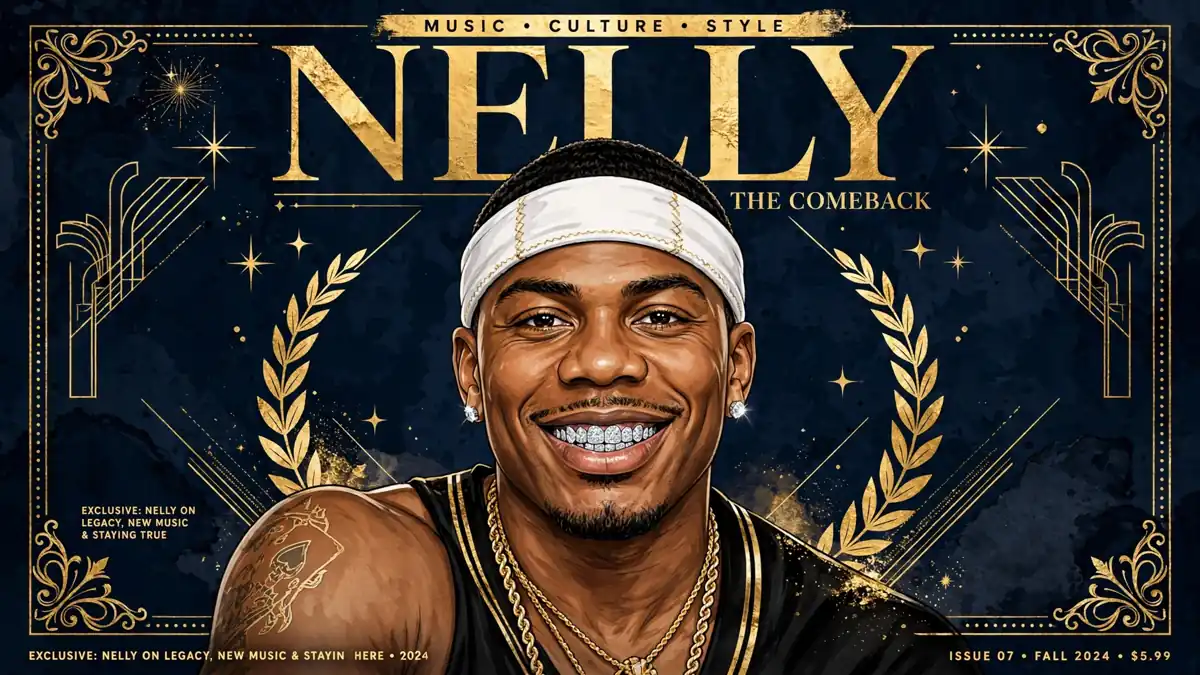
Nelly‘s net worth is estimated at $50 million to $70 million as of November 2026. The top of that range is the figure most outlets still print: Celebrity Net Worth puts him at $70 million. The bottom reflects a harder look at the record — a second estimate built from public deals lands closer to $40 million to $50 million, and the single largest transaction in his career, the 2023 catalog sale, was reported rather than confirmed by the buyer. Three money stories explain the fortune either way: a diamond-selling debut that made him the best-selling rapper of his era, a fashion line that turned a song lyric into a denim empire, and a 2023 decision to sell half his recorded-music catalog for a reported $50 million. Add a 2025 world tour that grossed a reported $44.9 million across 51 shows, and the picture is a performer whose second act has been at least as lucrative as his first.
Nelly: Quick Facts
| Estimated net worth | $50 million to $70 million (range: $50 million to $70 million) |
|---|---|
| Profession | Rapper, singer, actor, entrepreneur |
| Nationality | American |
| Born | November 2, 1974 (age 51) |
| Height | 5 feet 8 inches (1.73 m) |
| Primary income sources | Music catalog and royalties, touring, fashion brands, spirits, television |
| Active years | 1993–present |
| Last reviewed | November 2026 |
- Quick Facts
- Early Life and Background
- Education
- Career Journey
- Rise to Fame
- Main Sources of Income
- Salary and Earnings
- Businesses and Investments
- Brand Deals and Sponsorships
- Houses, Cars and Other Assets
- Awards and Achievements
- Net Worth Growth Over the Years
- Social Media Presence
- Personal Life
- Sources & Reporting
- Frequently Asked Questions
- Final Thoughts
Early Life and Background
Cornell Iral Haynes Jr. was born on November 2, 1974, in Austin, Texas. His parents divorced while he was young, and he moved with his mother to St. Louis, Missouri, growing up in the University City area. That move shaped everything that followed: his accent, his slang, his stage name’s Midwestern drawl, and a sound that mixed Southern rap with pop hooks and a country lilt. St. Louis in the 1980s and 1990s was not a rap capital. New York and Los Angeles set the agenda, and the South was still fighting for respect on radio. Nelly built his career by refusing that geography, rapping about his own streets in a style radio programmers outside Missouri could sing along to.
Money was tight in the Haynes household, a fact Nelly has returned to in interviews across his career. He has described a childhood where music was the cheapest entertainment available and where local talent shows and neighborhood crews offered the only visible route out. He started writing rhymes as a teenager and fell in with a group of St. Louis friends who would become the St. Lunatics. The crew gave him a stage, an audience, and a discipline: songs had to work in a club, on a car stereo, and on a schoolyard chant. That test — a hook that survives all three — became the commercial engine of his career.
Two details from those years matter for the money story. First, Nelly did not arrive as a solo act manufactured by a label. He arrived with a crew, a local following, and a regional hit already in circulation, which gave him bargaining power most debut artists never get. Second, he arrived late by industry standards, already in his mid-twenties when his debut album landed. The delay meant his peak earning years were compressed into a short, intense window — roughly 2000 to 2005 — and it explains why the business moves that followed, from fashion to sports ownership, started almost as soon as the checks did.
Education
Nelly attended University City High School in St. Louis, where he played baseball and ran track alongside his early music work. He was a serious baseball prospect in his teens, and the sport remained a lifelong interest — he later played in celebrity softball games and stayed close to St. Louis sports culture. He did not pursue a college degree. By his late teens, the St. Lunatics were his full-time project, rehearsing, performing locally, and shopping demos.
The absence of a college path is relevant only because it sharpens the contrast with what came next. Nelly’s business education happened in recording studios, in label meetings, and in the fashion trade, where he learned margins, licensing, and wholesale by doing it. His later involvement in a St. Louis music-production school — a venture tied to Vatterott College that carried his name — was, in part, an attempt to formalize the route he had taken informally: training local talent in the business side of music, not just the performance side.
Career Journey
The St. Lunatics formed in 1993, with Nelly alongside Ali, Murphy Lee, Kyjuan, and City Spud. Their local single “Gimme What U Got” built enough heat in St. Louis that Universal Records signed Nelly as a solo artist in 1999, a decision the label made partly on the strength of the crew’s regional following. The solo deal was a bet that a St. Louis rapper with pop instincts could sell nationally. It paid off faster than almost anyone at the label expected.
His debut album, Country Grammar, arrived in June 2000. It opened at No. 3 on the Billboard 200 with first-week sales of about 235,000 copies, according to contemporary chart reporting, and it kept selling for years. The title track reached No. 7 on the Hot 100, “E.I.” became a club staple, and “Ride Wit Me” crossed over to pop radio. The album was certified diamond by the Recording Industry Association of America (RIAA) in 2016, meaning 10 million units in the United States on sales plus streaming equivalents. For context, very few rap albums have ever reached diamond status, and Country Grammar remains one of the best-selling rap debuts in American history.
The follow-up, Nellyville, arrived in June 2002 and went further, faster. It debuted at No. 1 on the Billboard 200 with about 715,000 first-week copies. “Hot in Herre” spent seven weeks at No. 1 on the Hot 100, and “Dilemma,” his duet with Kelly Rowland, spent ten weeks at No. 1. “Air Force Ones” gave him a third hit from the same record and, as a cultural artifact, did something no other song had done: it turned a sneaker into a chart hit and a sneaker deal into a song. Nellyville has sold more than 6.5 million copies in the United States, and the RIAA ranks Nelly as the fourth best-selling hip-hop artist in American history, with 21 million albums sold domestically.
The next decade was a study in staying power rather than peak dominance. Sweat and Suit, released on the same day in September 2004, debuted at No. 2 and No. 1 on the Billboard 200 respectively — a two-album stunt no rapper had pulled off at that scale. Brass Knuckles followed in 2008, 5.0 in 2010 with the hit “Just a Dream,” and M.O. in 2013. None matched the first two albums, but each kept his catalog earning and his touring audience intact. In 2021 he released Heartland, a country-leaning album featuring Florida Georgia Line, Kane Brown, and Blanco Brown, a deliberate return to the country influences audible in “Country Grammar” itself.
Rise to Fame
Nelly’s rise was not a slow build. It was a single summer. In 2000, “Country Grammar (Hot Shit)” — a playground chant turned into a rap hook, with its sing-song chorus and St. Louis slang — went from regional curiosity to national radio fixture within months. The song’s appeal was its accessibility: children could chant it, pop stations could play it, and rap fans could respect the flow underneath it. That triple audience is rare, and it is the reason the album sold in places rap albums had not traditionally sold.
By 2002, he was the biggest rapper in America by the simplest measure available: units moved. Nellyville‘s first week was nearly three times his debut’s, and his two No. 1 singles that year dominated both rap and pop radio. He won his first Grammy Awards in 2003, collected endorsement offers from brands that had never worked with a rapper from St. Louis, and became a fixture on television, from award shows to his own reality programming. The fame also brought the scrutiny that follows any rapid fortune: lawsuits, a high-profile tax bill, and tabloid coverage of his personal life, all of which are covered later in this article because each one touched the money.
What separated Nelly from other early-2000s rap stars was timing. He peaked just as the CD business reached its final boom years, before file-sharing and streaming collapsed album revenue. His biggest records sold as physical albums at full price, in the millions, in a window that closed within a few years. Artists who peaked five years later earned far less per fan. That timing is a large part of why his catalog was worth a reported $100 million valuation two decades later: the songs were recorded, sold, and embedded in pop culture during the last era when records printed money at scale.
Main Sources of Income
Nelly’s income has come from five streams, and their relative importance has flipped over time. In the 2000s, album sales and touring dominated. In the 2010s, fashion, endorsements, and television kept the money moving while new music slowed. In the 2020s, the catalog sale and nostalgia touring took over. The breakdown below separates what is documented from what is estimated, because the distinction matters for a fortune built partly on private deals.
Recorded music and royalties. With more than 21 million albums sold in the United States and over 40 million records worldwide by the most commonly cited counts, Nelly’s catalog is his foundation. Even before the 2023 sale, streaming kept the biggest songs earning: “Hot in Herre,” “Dilemma,” and “Ride Wit Me” remain playlist fixtures, and catalog streaming pays the rights holder every month. After selling half his recorded-music assets, he retained the other half, so royalties still arrive — at roughly half the previous rate on the covered works, with the exact split covered by private contract terms.
Touring. Live performance has been his most reliable income since the mid-2000s, and nostalgia touring revived it dramatically in 2025. The Where The Party At Tour, a 54-date world run with Ja Rule, Eve, Fabolous, Jermaine Dupri, Chingy, and the St. Lunatics, reported a gross of $44.9 million across 51 reported shows, according to box-office reporting summarized by Net Worth VIP. Gross is not profit — promoters, venues, production, crew, travel, and taxes all come out first — but even a conservative artist share of a gross that size represents one of the largest paydays of his career.
Fashion and consumer brands. Apple Bottoms and Vokal, covered in detail below, generated wholesale revenue in the tens of millions at their peak, though Nelly’s personal take from those businesses was a share of profits and licensing, not the full revenue figure. His MoShine spirits brand, launched in 2023, added a new consumer line.
Television and acting. Film roles, a BET reality series, a Dancing with the Stars run, and the Peacock series Nelly and Ashanti: We Belong Together have paid appearance and production fees. None of these individually rivaled music money, but together they kept him visible between album cycles, which is what makes nostalgia touring possible.
Sports and other investments. A minority stake in the Charlotte Bobcats NBA franchise, bought in the mid-2000s, gave him a seat in professional sports ownership at a time when few rappers held one. The size of the stake and the sale terms were never disclosed, so this stream is best described as a prestige investment with an unknown return rather than a quantified windfall.
Salary and Earnings
Nelly has never had a salary in the conventional sense, and no label contract or tour guarantee from his career has been published in full. What the public record does contain is a series of anchor points that let a reader triangulate his earnings without inventing a yearly paycheck.
The first anchor is album revenue. At early-2000s CD prices, a diamond album and a multi-platinum follow-up generated tens of millions in wholesale revenue, of which the artist’s royalty share — typically a fraction after recoupment of advances, recording costs, and marketing — would still run into eight figures across the two records. Nelly’s exact royalty rate was never disclosed, so any article that prints a precise “he earned X from Country Grammar” figure is guessing. The honest statement is that the two albums together made him a multi-millionaire several times over before he turned thirty.
The second anchor is the catalog sale. In July 2023, TMZ reported that Nelly had sold a 50 percent interest in his recorded-music catalog to HarbourView Equity Partners for $50 million. Music Business Worldwide covered the transaction, and Parade and Celebrity Net Worth both repeat the $50 million figure. Two cautions belong on that number. HarbourView never publicly confirmed the price, so $50 million is a reported figure, not a buyer-confirmed one. And the simple math that follows — a $50 million half implying a $100 million whole — covers only the assets included in the deal, which spanned eight albums and hits including “Ride Wit Me,” “Hot in Herre,” “Dilemma,” and “Shake Ya Tailfeather.” It does not mean every song Nelly ever touched was valued at that rate. Still, a $50 million cash payment in a single transaction is the largest documented payday of his career, and it explains why most estimators revised his net worth upward after 2023 rather than down.
The third anchor is touring gross. The $44.9 million reported gross for the 2025 Where The Party At Tour is a box-office figure, not an artist paycheck. Industry practice on a multi-act nostalgia tour typically leaves the headliner with a substantial but minority share after the promoter, venues, support acts, and production costs are paid. Even so, the tour’s scale — 54 dates across Australia, Europe, Canada, and the United States — marks it as a career-level earner, not a routine club run.
The fourth anchor is the tax lien, which cuts the other way. In September 2016, TMZ reported that the IRS had filed a federal tax lien of $2,412,283 against Nelly, alongside a separate Missouri state tax debt reported earlier that year. Fans rallied online with a #SaveNelly streaming campaign, and Nelly’s representatives said at the time that he was working with the IRS to resolve the debt. The lien is useful evidence precisely because it is a government filing rather than an estimate: it shows that, as late as 2016, his tax affairs lagged his fame by millions of dollars. It also frames the recovery that followed — by 2023, he was in a position to sell half a catalog for a reported $50 million, which suggests the tax matter was settled without derailing his career.
Annual earnings claims printed by thin content sites — figures such as “$3 million a year” or “$300,000 a month” — appear in this article’s research but are not repeated as fact here, because none of them trace to a named source with access to his accounts. The pattern of his career is lumpy, not salaried: huge album years, quiet years, a fashion peak, a tax hole, a catalog payday, a tour windfall. Any smooth yearly salary curve for Nelly is fiction.
Businesses and Investments
Apple Bottoms. Nelly launched the women’s denim brand Apple Bottoms in 2003 with Yomi Martin and Ian Kelly. The concept was specific: jeans cut for curvy women, at a time when mainstream denim largely ignored that customer. The brand caught fire, helped by celebrity wearers and by Flo Rida’s 2007 hit “Low,” which name-checked “Apple Bottom jeans.” Revenue claims for the brand conflict in a way readers should see plainly. One set of outlets reports about $60 million in wholesale sales within two years of launch; another set claims the brand grossed more than $150 million at its peak. Both figures describe brand revenue, not Nelly’s personal profit, and the brand’s later years were quieter — it went dark after less than a decade, despite a teased comeback in 2020. Reports in 2025 described a revived Apple Bottoms, including a Bubly sparkling-water collaboration and work by his wife Ashanti on a collection. The brand’s real contribution to his net worth is best understood as a large but time-limited profit stream plus enduring brand equity, not a permanent annuity.
Vokal. His menswear line Vokal, launched in 1997 before his solo breakthrough, was the earlier fashion bet. It sold streetwear through the early 2000s and gave Nelly a template for Apple Bottoms: celebrity-fronted, music-adjacent, distributed through retail rather than direct sales. Vokal never reached Apple Bottoms’ scale, and it faded from public reporting in the 2010s. Its importance is historical — it proves the fashion instinct predated the fame, rather than following it.
MoShine. In 2023, Nelly entered spirits with MoShine, a moonshine brand created with Piedmont Distillers of North Carolina. The name nods to Missouri — “Mo” — and the product launched at 60 proof in peach and passion fruit flavors for national distribution. Celebrity spirits is a crowded market, and MoShine’s sales figures have not been disclosed, so this article treats it as a growing equity stake with unknown current value rather than a quantified fortune pillar. Its strategic value is clearer: it gives a 51-year-old performer a consumer product that does not depend on radio play.
Derrty Entertainment. Nelly’s own label imprint, Derrty Entertainment, released projects by the St. Lunatics and affiliated acts. Label ownership meant a share of other artists’ revenue alongside his own, though none of its signings matched his solo success. The imprint’s main financial role was control: owning the pipeline around his music rather than renting it entirely from a major label.
Charlotte Bobcats stake. In the mid-2000s, Nelly bought a minority stake in the Charlotte Bobcats NBA franchise, becoming one of the first rappers with a piece of a major professional sports team. The stake’s size, purchase price, and eventual sale were never disclosed. NBA franchise values have risen enormously since then, which makes the stake a tantalizing “what if” — but without disclosure, it cannot be counted as a specific dollar contribution to his net worth, and this article does not.
Other ventures. Nelly has attached his name to a St. Louis music school venture, a restaurant interest in New York — he described the NoMad restaurant Zoi Mediterranean as his in October 2026 coverage of a birthday party for Ashanti — and various short-lived product lines. Each follows the same pattern: a brand extension that trades on his name for a share of a business he does not run day to day. Taken together they diversify his income, but none has produced a second catalog-scale payday.
Brand Deals and Sponsorships
Nelly’s endorsement career began with the song that made a sneaker famous. “Air Force Ones,” from Nellyville, was a full-length advertisement for Nike’s classic basketball shoe that Nike never had to commission. The song’s success led to a Nike collaboration, including a limited-edition sneaker tied to the track, and it remains the textbook example of a rapper monetizing a product mention. He also worked with Reebok, appeared in campaigns for Ford, and took a Burger King partnership — a spread of mainstream, non-music brands that reflected his pop-radio audience.
The endorsement logic changed as his chart career cooled. Later deals leaned on nostalgia and on his image as a 2000s icon rather than a current hitmaker, which is a smaller but steadier market. The 2025 Apple Bottoms and Bubly collaboration fits that pattern: a heritage brand pairing with a current beverage brand, aimed at consumers who remember the original jeans. None of these deals carried a disclosed fee, so this article does not assign dollar values to individual endorsements. The cumulative point is documented, though: across two decades, brands paid repeatedly for access to Nelly’s audience, and that income filled gaps between album cycles.
Houses, Cars and Other Assets
Nelly’s best-documented property story is also his worst investment. He bought an 11,000-square-foot Tuscan-style mansion on 12 acres in Wildwood, Missouri, outside St. Louis, for $1.925 million — reports differ on whether the purchase closed in 1998 or 2002, and this article notes the discrepancy rather than picking a year. He intended to renovate it, reportedly as a gift for his sister, but the renovation never finished and the house sat empty for nearly two decades, deteriorating and drawing local complaints. In February 2021 it was listed at $599,000, and it later sold through a short sale on undisclosed terms, according to The Economic Times. The arithmetic is stark: a $1.925 million purchase, a $599,000 asking price twenty years later, and a sale that left the lender short. It is the single clearest example in his record of money lost rather than made.
Beyond Wildwood, Nelly’s property holdings are sparsely documented. He has lived between St. Louis and New York in recent years — the Peacock series follows the couple’s life across both cities — but purchase prices for any current homes have not been publicly reported, and this article does not invent them. His car collection has been covered in lifestyle pieces over the years, with luxury vehicles and custom work typical of a rapper of his era, but no audited inventory exists. The same honesty applies to jewelry, including the diamond-covered grill and the famous Band-Aid he wore on his cheek early in his career: culturally iconic, financially unquantified. Readers should treat any article that prices his car collection to the dollar as speculation.
What can be said with confidence is that his asset base today is dominated by intangible property: the half of his catalog he kept, his name and likeness rights, his fashion brand equity, and his spirits stake. Those assets produce income without the maintenance costs that sank the Wildwood house, which may be one reason his recent business moves favor brands over buildings.
Awards and Achievements
Nelly has won three Grammy Awards. “Hot in Herre” won Best Male Rap Solo Performance in 2003, “Dilemma” with Kelly Rowland won Best Rap/Sung Collaboration the same year, and “Shake Ya Tailfeather” with P. Diddy and Murphy Lee won Best Rap Performance by a Duo or Group in 2004. Parade reports three wins from twelve nominations across his career. He has also won multiple American Music Awards and BET Awards, and he received a star-level honor at the 2025 iHeartRadio Music Awards, where he was recognized alongside the year’s biggest pop acts — a marker of how thoroughly his 2000s work has entered the canon.
The commercial achievements matter more for the money story than the trophies. Country Grammar is diamond-certified. Nellyville produced two of the longest-running No. 1 singles of the decade. The RIAA’s ranking of Nelly as the fourth best-selling hip-hop artist in American history, with 21 million albums sold domestically, puts him behind only a handful of names in a genre that now dominates streaming. His singles certifications add depth: “Hot in Herre” is diamond as a single, “Dilemma” is multi-platinum, and “Ride Wit Me” and “Country Grammar” are multi-platinum as well. Each certification represents royalties still paying today.
Acting and television achievements round out the record. His film role as Earl Megget in The Longest Yard (2005), alongside Adam Sandler and Chris Rock, remains his best-known screen part. He finished third on season 29 of Dancing with the Stars in 2020, partnered with Daniella Karagach. His BET series Nellyville ran in 2014 and 2015, and his Peacock series with Ashanti, premiering June 26, 2025, was renewed for a second season, with all eight new episodes arriving November 19, 2026, according to AllHipHop’s October 2026 reporting.
Net Worth Growth Over the Years
The table below reconstructs Nelly’s fortune from reported milestones. Figures before 2023 are estimates inferred from album sales, fashion revenue claims, and the 2016 tax lien; they are not audited accounts. The point of the table is the shape of the curve — a steep rise, a long plateau, a dip, then a catalog-driven recovery — not false precision about any single year.
| Year | Estimated net worth | What drove it |
|---|---|---|
| 2000 | $2 million – $5 million | Country Grammar breakout; first major tour and endorsement income |
| 2002 | $15 million – $25 million | Nellyville peak; two No. 1 singles; Apple Bottoms launch year |
| 2005 | $25 million – $35 million | Sweat/Suit double release; film work; Bobcats stake |
| 2010 | $20 million – $30 million | Catalog royalties and touring; fashion peak passing |
| 2016 | $15 million – $25 million | $2.4 million federal tax lien year; touring income offsetting tax pressure |
| 2023 | $50 million – $70 million | Reported $50 million HarbourView catalog sale resets the baseline |
| 2025 | $50 million – $70 million | Where The Party At Tour grosses a reported $44.9 million; Peacock series premieres |
| 2026 | $50 million – $70 million | Tour tail, season 2 of the Peacock series, MoShine and revived Apple Bottoms |
Two features of that curve deserve emphasis. First, the 2023 jump is the only one tied to a single disclosed transaction, which is why it carries more weight than the earlier estimates. Second, the 2016 dip is visible in the public record — a tax lien is a legal filing, not a rumor — which gives the recovery narrative a documented low point. Most celebrity fortune stories skip the low point. Nelly’s includes one, and the fortune that followed it is more credible for it.
A peer comparison helps place the figure. Nelly’s $50 million to $70 million range sits below the nine-figure fortunes of rap’s billionaire tier — Jay-Z, Diddy, and Dr. Dre built theirs on liquor, tech, and label empires far larger than Nelly’s — and above the single-digit millions typical of one-era rap stars who never owned their catalogs or built brands. His closest peers are the other early-2000s hitmakers who kept touring and kept a piece of their publishing: artists whose fortunes rest on a handful of songs the whole country knows by heart. In that group, Nelly’s diamond debut and his $50 million catalog sale put him near the top.
Social Media Presence
Nelly’s social media presence is built for nostalgia marketing. His verified Instagram account, @nelly, mixes tour footage, throwback clips, fashion promotion for Apple Bottoms, MoShine posts, and family moments with Ashanti — including the October 2026 birthday tribute in which he called her “the one thing I’d never stop choosing.” That post, covered by People, drew the kind of engagement that shows why his audience remains commercially valuable: fans who grew up on his music now follow his family life, and that attention converts into tour tickets and streaming.
He uses social media as a tour and product channel first and a personal diary second. Tour announcements, Apple Bottoms relaunches, and MoShine drops all run through his accounts, and the Peacock series gives followers a reason to keep watching between tours. He does not publish follower-count milestones or sponsorship rates, so this article avoids quoting a follower number that would be stale within weeks. The commercially relevant fact is not a count but a behavior: his posts still move tickets for a 25-year-old catalog, which is the rarest asset in music.
Personal Life
Nelly and Ashanti’s relationship is one of pop music’s longest-running stories. They first dated in the early 2000s, beginning around 2003, and spent roughly a decade together before splitting around 2013. They stayed apart for another decade, then reunited in September 2023. A marriage record obtained by TMZ showed they had quietly married on December 27, 2023, in St. Louis County, and they welcomed their son, Kareem Kenkaide Hayes, on July 18, 2024. Ashanti’s estimated net worth is often reported around $8 million — a separate fortune from her own music career, and not counted in Nelly’s figure in this article.
Nelly has two older children, Chanelle and Cornell Haynes III, from a previous relationship. His family life has been part of his television work for a decade, from Nellyville to the Peacock series, which follows the couple’s parenting, their two-city life, and the strain touring puts on a new family. In the second season, according to AllHipHop, Ashanti’s storyline follows her push to re-record her debut album and control her own masters, while Nelly’s follows the physical toll of years on the road — a neat summary of where both careers stand in 2026.
Legal troubles have punctuated the personal story. A 2015 tour-bus stop in Tennessee led to drug charges that were later resolved. A 2017 allegation of sexual assault, which Nelly denied, ended with no charges filed after the accuser declined to cooperate further, according to contemporary reporting. An August 2024 arrest in Missouri on an ecstasy-possession allegation and a failure-to-appear warrant was reported widely; Nelly said afterward that he believed the warrant related to an old traffic matter. This article includes these episodes because they affected his public standing and, in the tax case, his finances directly — not as gossip, but as part of the record behind the estimate.
His January 2025 performance at a ball celebrating Donald Trump’s inauguration drew criticism from some fellow artists and praise from others, and Nelly defended the decision publicly as a performance for the office rather than an endorsement of a party. The episode did not visibly dent his touring business — the Where The Party At Tour that followed was his biggest grossing run in years — but it showed the limits of nostalgia as a shield: an artist whose songs belong to everyone’s youth can still divide the room as an adult.
Sources & Reporting
Celebrity Net Worth — the $70 million headline estimate and the July 2023 HarbourView transaction summary; reporting window 2023–2026. Parade — $70 million estimate, $50 million catalog figure, three Grammy wins from twelve nominations, and the Longest Yard role; 2025 profile. HotNewHipHop — TMZ-sourced July 2023 report of the 50 percent catalog sale for $50 million, eight albums covered. Music Business Worldwide — trade coverage of the HarbourView acquisition of select recorded-music assets. People — October 2026 Ashanti birthday coverage, marriage date of December 27, 2023, son Kareem’s July 2024 birth, and the Peacock series renewal. AllHipHop — October 2026 reporting on season 2 of Nelly and Ashanti: We Belong Together, premiering November 19, 2026. HipHopDX — December 2024 announcement of the 54-date Where The Party At Tour lineup and routing. The Economic Times — Wildwood mansion purchase at $1.925 million, February 2021 listing at $599,000, and short sale. TMZ — September 2016 reporting of the $2,412,283 federal tax lien and the December 2023 marriage record. RIAA — diamond certification for Country Grammar and Nelly’s domestic album-sales ranking. Reporting window for this article: July 2023 catalog coverage through October 2026 tour and television reporting.
Frequently Asked Questions
What is Nelly’s net worth in 2026?
Nelly’s net worth is estimated at $50 million to $70 million as of November 2026. Celebrity Net Worth puts the figure at $70 million, while a more cautious reading of the public record — the reported $50 million catalog sale, tour grosses that are not take-home pay, and the documented 2016 tax lien — supports the lower half of the range.
How much did Nelly sell his music catalog for?
TMZ reported in July 2023 that Nelly sold a 50 percent interest in his recorded-music catalog to HarbourView Equity Partners for $50 million. The buyer never publicly confirmed the price, so $50 million is a reported figure. The deal covered eight albums and hits including “Ride Wit Me,” “Hot in Herre,” “Dilemma,” and “Shake Ya Tailfeather,” implying a $100 million valuation for the covered assets.
How much did Nelly make from Country Grammar?
His exact royalty earnings from Country Grammar were never disclosed. The album is diamond-certified in the United States, meaning 10 million units, and it opened with about 235,000 first-week copies in June 2000. At early-2000s album prices, the record generated tens of millions in wholesale revenue, of which Nelly’s royalty share after recoupment would have run into eight figures across his first two albums combined.
What businesses does Nelly own?
Nelly launched the menswear line Vokal in 1997 and the women’s denim brand Apple Bottoms in 2003, and he launched the MoShine moonshine brand with Piedmont Distillers in 2023. He also owned the Derrty Entertainment label imprint and held a minority stake in the Charlotte Bobcats NBA franchise in the mid-2000s. Sales figures for MoShine and the Bobcats stake were never disclosed.
Is Nelly still married to Ashanti?
Yes. Nelly and Ashanti reunited in September 2023 after a decade apart and married on December 27, 2023, according to a St. Louis County marriage record obtained by TMZ. They welcomed their son Kareem Kenkaide Hayes on July 18, 2024, and star together in the Peacock series Nelly and Ashanti: We Belong Together, whose second season arrived November 19, 2026.
How much did Nelly’s 2025 tour gross?
The Where The Party At Tour, a 54-date world run with Ja Rule, Eve, Fabolous, Jermaine Dupri, Chingy, and the St. Lunatics, grossed a reported $44.9 million across 51 reported shows. That is a box-office gross, not Nelly’s personal pay: promoters, venues, support acts, production, crew, and taxes are paid from it first.
Did Nelly have tax problems?
Yes. In September 2016, TMZ reported that the IRS filed a federal tax lien of $2,412,283 against Nelly, alongside a separate Missouri state tax debt reported earlier that year. His representatives said he was working with the IRS to resolve it. The episode is part of why this article uses a range rather than a single figure: his fortune dipped in the mid-2010s before the 2023 catalog sale rebuilt it.
What happened to Nelly’s Missouri mansion?
Nelly bought an 11,000-square-foot mansion on 12 acres in Wildwood, Missouri, for $1.925 million, intending to renovate it. The renovation never finished, the house sat empty for nearly two decades, and it was listed at $599,000 in February 2021 before selling through a short sale on undisclosed terms. It stands as the clearest documented loss in his property record.
Final Thoughts
Nelly’s fortune is a story of two windfalls separated by twenty years. The first was a pair of albums that sold in the last great CD boom, when a diamond record still meant ten million physical sales at full price. The second was a decision, in 2023, to sell half of what those albums built for a reported $50 million — cashing in a catalog while nostalgia for it was at its peak, then riding that nostalgia on a 54-date tour that grossed a reported $44.9 million. Between those windfalls sits the rest of the record: a fashion brand that made tens of millions and then faded, a mansion that lost more than two-thirds of its value, a $2.4 million tax lien, and a marriage, a child, and a television second act that arrived in his fifties. The $50 million to $70 million range in this article is honest about the gap between the headline estimate and the documented deals — and about the fact that the most valuable thing Nelly still owns is the half of his catalog he kept, plus the audience that still knows every word of it.
Published on November 1, 2026. Last reviewed November 2026. Found an error? See our corrections policy.