
Omri Casspi‘s net worth is estimated at $8 million to $100 million as of November 2026. The wide spread is the story itself: the only current published estimate, from Celebrity Net Worth after its September 2026 update, puts him at $100 million, while older figures of $6 million to $8 million date from before his second career took off. Casspi earned $18,058,631 in NBA salary across ten seasons, then turned a one-year stop with the Golden State Warriors into a venture capital career — and in September 2026, Forbes reported his firm Swish Ventures had raised a $250 million fund, pushing its assets under management to roughly $800 million.
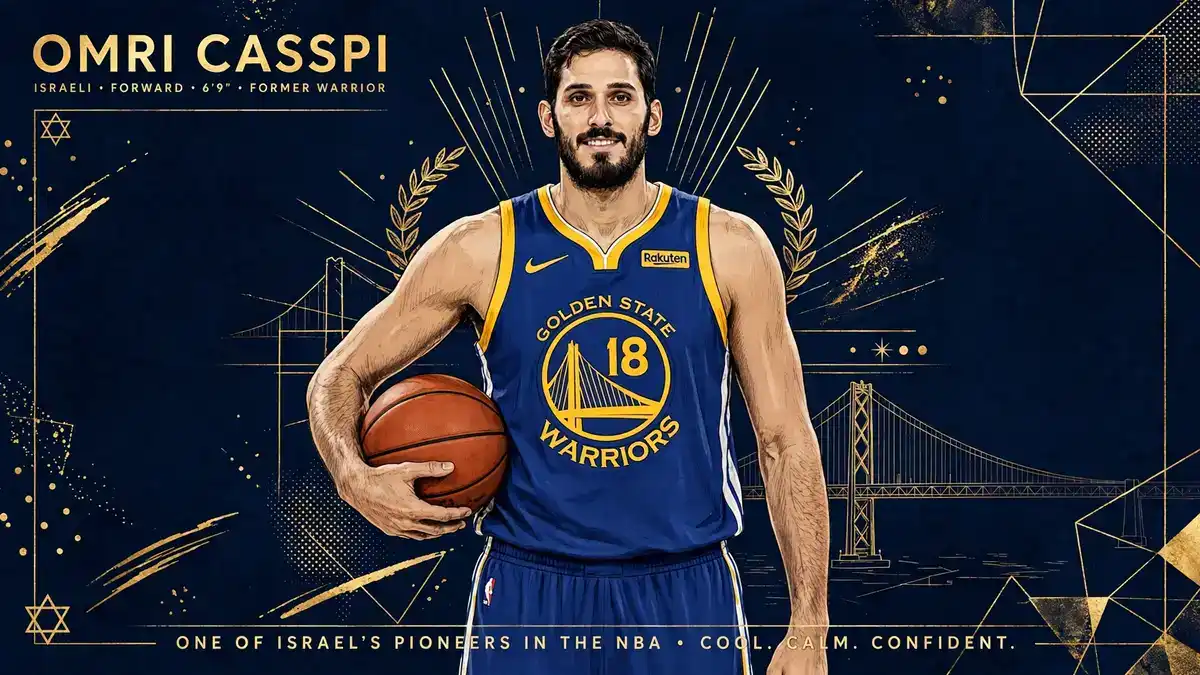
Omri Casspi: Quick Facts
| Estimated net worth | $100 million (range: $8 million to $100 million) |
|---|---|
| Profession | Former professional basketball player, venture capitalist |
| Nationality | Israeli |
| Born | June 22, 1988 (age 38) |
| Height | 6 ft 9 in (2.06 m) |
| Primary income sources | Venture capital (Swish Ventures, Sheva), NBA career salary, angel investments |
| Active years | 2005–2021 |
| Last reviewed | November 2026 |
- Quick Facts
- Early Life and Background
- Education
- Career Journey
- Rise to Fame
- Main Sources of Income
- Salary and Earnings
- Businesses and Investments
- Brand Deals and Sponsorships
- Houses, Cars and Other Assets
- Awards and Achievements
- Net Worth Growth Over the Years
- Social Media Presence
- Personal Life
- Sources & Reporting
- Frequently Asked Questions
Early Life and Background
Omri Moshe Casspi was born on June 22, 1988, in Holon, Israel, and grew up in Yavne, a city south of Tel Aviv. He is the son of Shimon and Ilana Casspi, both Israeli-born and of Moroccan-Jewish descent, and he grew up with an older brother, Eitan, and a younger sister, Aviv. As an adult, in 2012, he formally added his grandfather’s name, Moshe, as his middle name.
Basketball found him early. As a child he played in the junior programs of Elitzur Yavne and Maccabi Rishon LeZion before entering the youth system of Maccabi Tel Aviv, the powerhouse club that has dominated Israeli basketball for decades. The Maccabi pipeline was his schooling in the sport: structured coaching, year-round competition and a direct line to the senior team that most Israeli teenagers never get near.
He made his professional debut for Maccabi Tel Aviv at 17, in 2005 — an age when most prospects are still playing school ball. After spending the 2006–07 season on loan with Hapoel Galil Elyon, he returned to Maccabi and developed into one of the country’s best young players. The breakthrough season came in 2007–08: he helped Maccabi reach the EuroLeague final and was named the Israeli League’s Sixth Man of the Year. The following season, 2008–09, he averaged 13 points per game in the Israeli league while becoming a regular contributor in EuroLeague play.
By then NBA scouts were watching closely. At 6-foot-9, Casspi could play either forward spot, shoot from distance and cut hard without the ball — a floor-spacing forward with the energy of a role player and the polish of a EuroLeague regular. He was 20 years old, already a professional for four seasons, and the most NBA-ready prospect Israel had ever produced.
Education
Casspi never took the American college route, and his education reads differently from the typical NBA biography. He attended high school in Yavne while playing in Maccabi Tel Aviv’s youth teams, which meant his classroom years ran alongside professional training schedules from his mid-teens. There is no NCAA record to cite because there was never an NCAA stop: he went from Maccabi’s youth system straight into senior professional basketball.
The other part of his schooling was compulsory service in the Israel Defense Forces. Casspi was drafted by the Sacramento Kings in 2009 while in his third year of army service, and he has spoken about balancing military obligations with a professional basketball career in those early years. It is a detail that separates him from almost every other player in his draft class — he arrived in the NBA having already spent four seasons as a professional and three years in the military.
His business education came later, and it came inside the NBA rather than in a lecture hall. During his playing career he started angel investing, backing companies including DocuSign and the Israeli health-technology startup DayTwo. The year with Golden State in 2017–18 — surrounded by teammates, owners and Silicon Valley founders who talked about portfolios and pre-IPO shares in the locker room — supplied the rest. Forbes reported in September 2026 that Casspi traces his investing instincts directly to that season: watching players such as Stephen Curry and Kevin Durant operate at the top of their profession taught him what to look for in founders, and the Bay Area network he built that year supplied the capital and the deal flow for everything that followed.
Career Journey
The Sacramento Kings selected Casspi with the 23rd overall pick in the 2009 NBA Draft. The pick made him the first Israeli chosen in the first round of an NBA draft, and when he appeared in Sacramento’s season opener on October 28, 2009, he became the first Israeli-born player to appear in an NBA regular-season game. It was a genuine national milestone in Israel, covered there as a news event rather than a sports transaction.
He belonged right away. As a rookie he averaged 10.3 points and 4.5 rebounds across 77 games, starting 31, and earned a place in the Rookie Challenge during All-Star Weekend. After two seasons in Sacramento, he was traded on June 30, 2011 — along with a 2012 first-round draft pick — to the Cleveland Cavaliers in exchange for J.J. Hickson. He spent two seasons in Cleveland, where his shooting dipped and his role shrank, then signed with the Houston Rockets in July 2013 on a two-year deal at the veteran’s minimum.
A three-team trade sent him to the New Orleans Pelicans in the summer of 2014, but the Pelicans waived him before the season began. That setback opened the door to the best basketball of his NBA life: he returned to Sacramento in September 2014, and over the next two and a half seasons he played the most complete basketball of his career. In February 2017, Sacramento included him in the blockbuster trade that sent DeMarcus Cousins to New Orleans, with Buddy Hield, Tyreke Evans and draft picks coming back to the Kings. Casspi’s second stint in New Orleans lasted exactly one game — he scored 12 points in his debut, fractured his right thumb, and was waived so the Pelicans could use the roster spot on a healthy player. He finished the 2016–17 season with the Minnesota Timberwolves.
In July 2017 he signed with the defending champion Golden State Warriors on a one-year, $2.1 million veteran-minimum deal — turning down a one-year, $4.5 million offer from another team, according to ESPN’s Zach Lowe, as reported by NBC Sports Bay Area. He appeared in 53 games for Golden State, averaging 5.7 points and 3.8 rebounds while shooting a career-high 58 percent from the field. An injury contributed to the Warriors waiving him shortly before the playoffs so they could add Quinn Cook to the postseason roster. Golden State went on to sweep the LeBron James-led Cleveland Cavaliers in the NBA Finals, and although Casspi was no longer on the roster, the Warriors later presented him with a championship ring for his regular-season contributions.
His final NBA season came with the Memphis Grizzlies in 2018–19, on a one-year, $2.18 million contract. A right knee injury ended his time there, and the Grizzlies waived him in February 2019. He returned to Maccabi Tel Aviv that year, completing the circle to the club where his professional career had begun, and added more domestic championships before announcing his retirement at a press conference in Tel Aviv on July 18, 2021, at age 33. His final tally: 588 NBA regular-season games, 4,642 points, 2,355 rebounds and 662 assists, with career averages of 7.9 points, 4.0 rebounds and 1.1 assists per game.
Rise to Fame
Casspi’s fame has two chapters, and the second is bigger than the first. The first chapter was the pioneer story: the first Israeli in the NBA, a first-round pick who held his own as a rookie and gave Israeli basketball a player to follow every night. That alone made him a household name at home, where his games were appointment viewing.
The second chapter was the 2015–16 season, his career year. Back in Sacramento for his second stint, he averaged career highs of 11.8 points and 5.9 rebounds while shooting 40.9 percent from three-point range, and he made 112 three-pointers on the season. His signature night came against Golden State on December 28, 2015: a career-high 36 points, nine three-pointers — seven of them in the first half — on 13-of-18 shooting in an unexpected long-range duel with Stephen Curry. The nine threes tied the Kings’ franchise record for a game at the time, and the performance is still the one most American fans remember him for.
The third chapter, the one that now defines his public profile, began after retirement. In September 2026, Forbes put Casspi on the cover of its venture capital conversation with a profile titled “How NBA Journeyman Omri Casspi Built An $800 Million VC Firm,” and within days talkSPORT, EssentiallySports, Fadeaway World and other outlets were retelling the story: the journeyman who earned $18 million in a decade of basketball and built a firm managing roughly $800 million. Some of that coverage stretched the truth — several headlines implied he was on the verge of becoming a billionaire — but the underlying news was real, and it pushed Casspi from a basketball trivia answer into a business story.
Main Sources of Income
Casspi’s money comes from two careers that barely overlap in time. The first, basketball, paid him $18,058,631 in NBA salary over ten seasons, according to Spotrac’s contract tracking, plus whatever Maccabi Tel Aviv paid him across his three stints in Israel — figures that were never publicly disclosed. The second, venture capital, is where the real money now sits, and it works on a different scale entirely.
His investing income has three layers. First, his ownership stake in the firms he founded: Sheva, launched in 2022, and Swish Ventures, launched in 2024. Second, management fees — the annual percentage a fund charges its investors on committed capital, which on roughly $800 million under management is serious money even before any investment pays off. Third, carried interest: the share of profits a fund manager keeps when investments succeed, typically around a fifth of gains, which is where a fund with eight unicorns in a 20-company portfolio starts to generate real personal wealth. Add his own direct angel investments, some dating back to his playing days, and the picture is a man whose basketball salary now looks like seed capital for a much larger enterprise.
Endorsements, by contrast, were never a major income line for Casspi. No signature shoe deal, no headline sponsorship portfolio, no public record of a major brand contract appears in the reporting on him — a sharp contrast with the superstar teammates whose endorsement income ran into eight figures a year. What he had instead was access: a decade in NBA locker rooms, a season inside the Warriors’ Silicon Valley orbit, and a network of team owners, founders and investors that he converted into deal flow. That network, more than any single paycheck, is the asset that produced his fortune.

Salary and Earnings
Spotrac’s career total for Casspi is $18,058,631 in NBA salary — a solid journeyman’s haul, and a modest one by modern NBA standards, where a single max contract can exceed $200 million. The money arrived in uneven chunks, and the contract history tells the story of his career arc: a rookie-scale deal, a mid-career payday in Sacramento, and a series of one-year veteran deals at the end.
| Contract | Team / Period | Reported value |
|---|---|---|
| Rookie-scale deal | Sacramento Kings, 2009–2011 | ~$6 million over four years |
| Two-year deal | Houston Rockets, 2013–2015 | ~$2 million (veteran’s minimum) |
| Two-year deal | Sacramento Kings, 2015–2017 | $5.8 million (reported as $6 million) |
| One-year deal | Golden State Warriors, 2017–18 | $2.1 million (veteran’s minimum) |
| One-year deal | Memphis Grizzlies, 2018–19 | $2.18 million |
| Career NBA salary total | 2009–2019 | $18,058,631 |
A few details in that table deserve attention. The rookie deal was worth roughly $6 million across four years, per Celebrity Net Worth. The Houston contract was a veteran’s-minimum pact: $947,907 in 2013–14 with a $1,063,384 team option for 2014–15, according to reporting at the time from the Houston Chronicle’s Jonathan Feigen, carried by Hoops Rumors. The 2015 Kings deal was announced as $6 million over two years by the Associated Press; Celebrity Net Worth puts the precise figure at $5.8 million. The Cleveland years and the brief Minnesota stop sit inside the Spotrac total, and his Maccabi Tel Aviv salaries were never made public.
The most revealing number in the whole table is the one that is not there: the $4.5 million. In July 2017, Casspi turned down a one-year, $4.5 million offer from a team likely to miss the playoffs and signed with Golden State for the $2.1 million veteran’s minimum instead, according to ESPN’s Zach Lowe. He gave up $2.4 million in guaranteed salary for a season with a championship team in the heart of Silicon Valley. On a spreadsheet that looks like a bad decision. In hindsight it was the highest-returning choice of his life: the relationships from that season — founders, executives, team owners, fellow investors — became the foundation of Swish Ventures. No other single decision in his career connects his basketball money to his venture money as directly as that one.
After tax, agent fees and living costs across a decade in seven NBA cities, the take-home from $18 million in gross salary was far smaller — which is exactly why the older net worth estimates of $6 million to $8 million made sense at the time. They described a retired role player with a solid but ordinary nest egg. What they could not describe, because it had not happened yet, was the venture career that followed.
Businesses and Investments
Casspi did not start investing after retirement — he started while he was still playing, and the habit compounded. During his NBA years he made angel investments in companies including DocuSign and the Israeli health-technology startup DayTwo, learning the mechanics of early-stage investing with his own money before he ever raised a fund. The Warriors season in 2017–18 sharpened the instinct: he has said the experience of watching Curry and Durant operate taught him to judge founders the way a scout judges players — looking for extreme competitiveness, unusual skill, discipline and the ability to perform under pressure.
After retirement he made it a full-time profession. In 2022, Casspi and veteran venture capitalist David Citron launched Sheva, an early-stage fund focused on pre-seed and seed-stage technology startups. The partners had discussed raising as much as $50 million; the fund ultimately closed at about $36 million. One of Sheva’s earliest bets became the signature win of Casspi’s young investing career: Upwind Security, a cybersecurity company Sheva backed when it was valued at just $65 million. By 2026, Upwind had raised money at a $1.5 billion valuation, according to Celebrity Net Worth — talkSPORT puts the current figure higher, at $3 billion — a gain of more than twentyfold on the entry valuation either way.
He expanded in 2024 with Swish Ventures, bringing in investor Ori Streichman and raising $63 million for the firm’s first fund, concentrated on cybersecurity, cloud infrastructure and artificial intelligence. The strategy was deliberately narrow: instead of spreading money across dozens of startups, Casspi wanted a small number of large bets on founders he judged to have unusual technical ability. In 2025, Swish added a $100 million Opportunity Fund to put more capital into its winners as they matured. Then, in September 2026, Forbes reported the big step: a new $250 million early-stage fund, backed by investors including Sequoia Capital, U.S. pension funds, institutional investors and university endowments, taking Swish’s total assets under management to roughly $800 million. The new fund was designed to make about 12 investments averaging around $20 million each, mainly at seed and Series A stages.
The portfolio is what makes the numbers credible. Swish’s early investments have included Cognition, Upwind Security, Eon and Applied Compute, and by 2026 eight of the firm’s 20 portfolio companies had reached valuations of at least $1 billion. The Cognition story is the sharpest illustration. In January 2024, Casspi hosted Cognition AI cofounders Scott Wu and Steven Hao in a suite at San Francisco’s Chase Center during a Warriors game; Wu pitched him on the company’s AI software engineering agents, and the next morning Casspi walked through Palo Alto with Wu and decided to invest. Swish joined Cognition’s seed financing when the company was valued at roughly $150 million. Just over two years later, Cognition had raised more than $1 billion at a $26 billion valuation, according to Celebrity Net Worth — a headline multiple of more than 170 times the seed valuation, before dilution from later rounds. talkSPORT reports the company was nearing a further funding round that could value it at as much as $47 billion. Eon, the cloud-backup company in the portfolio, reached a $4 billion valuation, per Celebrity Net Worth.
Casspi describes his own job in basketball language: the founders are the stars, and he is the role player — making introductions, recruiting talent, connecting companies with customers, and stepping in at important moments. His basketball network has become a venture capital asset in its own right: dinners, NBA games and relationships built over a decade in the league now introduce founders to executives, investors, potential customers and job candidates. Forbes’ September 2026 profile framed him as one of the more successful athlete-to-investor transitions in professional sports, and the fundraising evidence supports that reading — institutional investors do not hand $250 million to a novelty act.
One line needs repeating, because much of the September 2026 coverage blurred it: $800 million in assets under management is not Casspi’s money. It is capital Swish manages on behalf of its investors. Casspi’s personal wealth comes from his ownership interest in the investment business, the management fees on that capital, his share of the profits when funds succeed, and his own direct startup investments. That distinction is the difference between a $100 million personal fortune and a headline that calls him a near-billionaire — and it is why this article anchors at $100 million rather than anywhere near $800 million.
Brand Deals and Sponsorships
There is no public record of a major endorsement portfolio for Casspi, and that absence is itself a useful fact. Unlike the superstar teammates he played beside — Stephen Curry with his Under Armour line, Kevin Durant with Nike — Casspi never had a signature shoe, a headline sponsor or a reported eight-figure brand contract. His marketability in the United States was that of a role player, and his biggest commercial audience was in Israel, where his pioneer status carried real weight but the endorsement market is far smaller.
What he did have, and what mattered more, was proximity to the brands. His season in Golden State put him inside the most commercially connected locker room in the league, around players whose endorsement and investment portfolios were constant topics of conversation. He has said teammates discussed investment portfolios and pre-IPO opportunities openly, and that exposure shaped his second career more than any sponsorship deal could have. In that sense, the Warriors season paid him twice: once in salary, and once in an education that no brand contract would have supplied.
His public-facing work after basketball has run through his foundation rather than through sponsors. The Omri Casspi Foundation organizes annual trips to Israel for NBA and WNBA players and other celebrities, backed by the National Basketball Players Association — a platform that keeps his name visible in basketball circles without a commercial deal attached. For a man whose wealth now comes from fund economics rather than fame, that is a fitting arrangement: the brand is the investor, not the endorser.
Houses, Cars and Other Assets
Public reporting on Casspi’s property and possessions is thin, and this section says so plainly rather than filling the gap with guesses. No verified property records, home purchases or car collections appear in the public record for him — no reported mansion purchase, no real-estate portfolio breakdown, no luxury garage feature. That is normal for a player whose career earnings were modest by NBA standards and whose wealth arrived after basketball, through private fund stakes that do not show up in property filings.
What is known is the shape of his life: a family base in Israel, where he grew up and where he returned to finish his playing career with Maccabi Tel Aviv, and a working footprint that runs through Tel Aviv’s startup scene and the Bay Area networks he built during his Warriors season — the Palo Alto walks, the Chase Center suite, the Silicon Valley founder dinners that Forbes described in its September 2026 profile. His tangible assets, as far as the public record shows, are the ordinary ones of a retired athlete turned investor: a home, a family, and a championship ring from 2018 that carries more personal value than resale value. The real assets are intangible — his stake in Swish Ventures, his carried interest across three funds, and his direct startup holdings — and those are covered in the sections above, where the numbers actually exist.
Awards and Achievements
Casspi’s trophy case is a mix of basketball honors and firsts that belong to Israeli sports history rather than to any individual awards ballot. He never made an All-Star team or won a major NBA individual award — he was a role player, and role players do not collect those — but the list of what he did collect is still substantial.
- NBA champion, 2018 — received a championship ring from the Golden State Warriors for his regular-season contributions to the title team, despite being waived before the playoffs.
- First Israeli-born player in the NBA — debuted October 28, 2009, after becoming the first Israeli selected in the first round of the NBA draft (23rd overall, 2009).
- EuroLeague finalist, 2008 — helped Maccabi Tel Aviv reach the EuroLeague final at age 19.
- Israeli League Sixth Man of the Year, 2008 — his breakout domestic honor with Maccabi.
- Four Israeli league championships and two Israeli Cups — across his three stints with Maccabi Tel Aviv, per Celebrity Net Worth.
- NBA Rookie Challenge, 2010 — selected for the showcase at All-Star Weekend after a 10.3-point-per-game rookie season.
- Career-high 36 points, December 28, 2015 — nine three-pointers against Golden State, tying the Kings’ franchise record for threes in a game at the time.
- Career-best season, 2015–16 — 11.8 points and 5.9 rebounds per game, shooting 40.9 percent from three.
- Swish Ventures, 2024–2026 — built a firm managing roughly $800 million with eight unicorns among 20 portfolio companies, the achievement Forbes profiled in September 2026.
Net Worth Growth Over the Years
The honest way to show Casspi’s wealth over time is to show what was actually published, when — because the numbers move in steps, and each step has a cause. The table below uses dated published estimates only; it does not invent figures for years when nobody published one.
| Period | Published estimate | What was driving it |
|---|---|---|
| 2015 | $6 million (NetWorthPost) | Six NBA seasons in, rookie deal and early contracts banked |
| 2019–2025 | ~$8 million (older Celebrity Net Worth figure, still carried by roundups) | Retired player: $18 million in career salary, minus taxes and costs, plus early angel investing |
| September 2026 | $100 million (Celebrity Net Worth, updated) | Swish Ventures’ $250 million third fund and ~$800 million in assets under management; Cognition at a $26 billion valuation; eight unicorns in the portfolio |
Read that way, the growth story is not a steady climb but a flat line followed by a jump — and the jump is the entire point. Between 2019 and 2025, Casspi’s wealth barely moved in the public estimates: he was a retired journeyman living on career savings and early investments. The September 2026 re-rating happened because the venture business reached institutional scale: a $250 million fund backed by Sequoia Capital, pension funds and university endowments is not a hobby, and a portfolio with eight billion-dollar companies gives a fund manager’s carried interest real value. Celebrity Net Worth’s move from $8 million to $100 million is the market’s way of saying the second career is now worth several times the first.
It is worth putting that $100 million next to the players whose wealth Casspi is now compared with, because the comparison shows both how far he has come and how far he still has to go. Forbes’ real-time figures in November 2026 put Michael Jordan at about $4.3 billion, Magic Johnson at about $1.6 billion and LeBron James at about $1.4 billion — the three athlete billionaires whose fortunes were built after basketball, on brand equity, team ownership and investment stakes. Casspi’s $100 million is roughly a fortieth of Jordan’s fortune, and he is not a billionaire. But consider the starting point: Jordan earned about $90 million in NBA salary and LeBron has earned more than $500 million, while Casspi earned $18 million. Measured against career salary, his post-basketball wealth creation is the most efficient of the group — he turned the smallest playing fortune into a nine-figure one. Scottie Pippen, another famous second option who earned far more in salary than Casspi did, sits well below him in the wealth rankings today, which underlines the point: in this comparison, what you do after the final buzzer matters more than what you earned before it.
That brings us to the claim that dominated the September 2026 headlines, and it needs a straight answer: no, Omri Casspi is not a billionaire, and he is not on the verge of becoming one on any evidence the public record supports. Several outlets framed his story as a journeyman “turning $18 million into billionaire status” and joining the club of Jordan, Magic Johnson, Junior Bridgeman and LeBron James. Fadeaway World said it plainly in the same week: the $800 million is assets under management — capital belonging to Swish’s investors — not Casspi’s personal fortune. For Casspi to reach $1 billion personally, his funds would have to return many times their current value and his share of those returns would have to be enormous. His portfolio gives him a genuine shot at far greater wealth — Cognition alone, at a $26 billion valuation and possibly heading toward $47 billion, could move his carried interest sharply — but a shot is not a status, and this article does not award him one he has not earned yet.
Social Media Presence
Casspi keeps a lower social media profile than the superstars he played with, and his accounts reflect the two halves of his life. His verified Instagram account is @omricasspi18, where he posts about family life and his venture capital work in roughly equal measure — a mix of portfolio company news, conference appearances and personal moments that reads more like a founder’s feed than an athlete’s. He is also present on X (formerly Twitter), where his posts lean toward basketball commentary and Israeli sports.
He does not run the kind of monetized influencer operation that many retired athletes build: no reported brand partnership announcements, no sponsored content business, no public follower-count flexing. That fits the rest of the picture. His income now comes from fund economics, not from an audience, so social media is a networking and reputation tool for him rather than a revenue line — a place where founders, investors and former teammates can find him, and where the occasional post about a Swish portfolio company reaching unicorn status does more work than any advertisement could.
Personal Life
Casspi married his Israeli girlfriend Shani Ruderman in June 2016 — Odubio dates the wedding to June 16, 2016 — and the couple has children together, including a daughter, Sarai, born in July 2017. Published reports differ on the total number of children, so this article does not state a figure the sources cannot agree on. The family is based in Israel, where Casspi returned to finish his playing career and where his venture work is rooted.
Off the court, his most visible project is the Omri Casspi Foundation, which he established while still playing in the NBA. Every year the foundation sponsors trips to Israel, backed by the National Basketball Players Association, for NBA and WNBA players and other celebrities — combining tourism with basketball clinics, charitable activities and a chance for his American colleagues to experience the country where he grew up. Participants over the years have included DeMarcus Cousins, Tyreke Evans, Chandler Parsons, Caron Butler, Iman Shumpert, Rudy Gay, Georges St-Pierre and Jeremy Piven. His charitable giving dates back to his early playing days: in 2012 he donated 121,000 shekels (about $31,452) to the Schneider Children’s Medical Center in Petah Tikva.
He remains a prominent figure in Israeli sports — the pioneer who proved an Israeli-born player could not only reach the NBA but build a second career after it that dwarfs the first. His parents, Shimon and Ilana, and his siblings Eitan and Aviv remain part of a close family circle that he has credited publicly throughout his career.
Sources & Reporting
Forbes — Hank Tucker’s September 3, 2026 profile, “How NBA Journeyman Omri Casspi Built An $800 Million VC Firm”: the $250 million third fund, roughly $800 million in assets under management, the Sequoia Capital and pension-fund backers, the 12-investment plan at ~$20 million average checks, the Cognition seed story at Chase Center, and Casspi’s own account of learning investing from his Warriors season.
Celebrity Net Worth — updated September 6–7, 2026: the current $100 million net worth estimate; career salary total of $18,058,631; contract values including the ~$6 million rookie deal, the $5.8 million Kings deal, $2.1 million from Golden State and $2.18 million from Memphis; the Sheva and Swish fund history; Upwind at a $1.5 billion valuation; Cognition at $26 billion; Eon at $4 billion; and the career biography including the foundation trips.
ESPN (via NBC Sports Bay Area) — Zach Lowe’s July 2017 reporting that Casspi turned down a one-year, $4.5 million offer to sign with Golden State for the $2.1 million veteran’s minimum.
talkSPORT — September 2026 coverage of the Swish story: the $800 million assets under management, Upwind reported at a $3 billion valuation, and Cognition reportedly nearing a round at a $47 billion valuation; also the career recap including the championship ring and the 53-game Warriors season.
EssentiallySports — September 7, 2026: the $250 million fund raise, the Sequoia and university-endowment backers, the Sheva $36 million launch in 2022 and the Swish first fund of upwards of $60 million in 2024.
Fadeaway World — September 7, 2026: the clearest debunk of the billionaire framing, stating that $800 million in assets under management is not Casspi’s personal wealth.
Sports Illustrated / Associated Press — July 2015: the Kings’ two-year, $6 million agreement with Casspi.
Hoops Rumors — July 2013: the Houston Rockets deal at the veteran’s minimum, $947,907 in 2013–14 with a $1,063,384 team option.
Wikipedia — career history, season-by-season teams, career totals (588 games, 4,642 points, 2,355 rebounds, 662 assists) and family background, cross-checked against the reporting above.
Reporting window: primarily September 2026 (Forbes, Celebrity Net Worth update, EssentiallySports, Fadeaway World, talkSPORT), with contract reporting from 2013–2017 and career records verified against Spotrac totals as reported by Celebrity Net Worth. Where sources disagreed — the Upwind valuation ($1.5 billion vs $3 billion), the Cognition future valuation ($26 billion vs a reported $47 billion round), the Kings 2015 deal ($5.8 million vs $6 million), and the number of Casspi’s children — this article names both figures instead of choosing one silently.
Frequently Asked Questions
What is Omri Casspi’s net worth in 2026?
Omri Casspi’s net worth is estimated at $100 million as of November 2026, according to Celebrity Net Worth’s September 2026 update. Published estimates range from $8 million to $100 million: the lower figures date from before his venture capital career took off and reflect only his $18 million in NBA salary, while the $100 million figure follows Swish Ventures’ $250 million fund raise and roughly $800 million in assets under management.
How much did Omri Casspi earn in the NBA?
Casspi earned $18,058,631 in NBA salary over ten seasons, according to Spotrac’s contract tracking. His biggest deals were a rookie-scale contract worth roughly $6 million, a two-year, $5.8 million deal with Sacramento in 2015, $2.1 million from Golden State in 2017–18 and $2.18 million from Memphis in 2018–19.
Is Omri Casspi a billionaire?
No. The $800 million figure attached to his name is the assets under management at Swish Ventures — money the firm manages for its investors, not Casspi’s personal fortune. His wealth comes from his ownership stake in the firm, management fees, carried interest and his own investments, which Celebrity Net Worth currently values at $100 million.
What is Swish Ventures and how much does it manage?
Swish Ventures is the venture capital firm Casspi founded in 2024 with investor Ori Streichman, focused on early-stage cybersecurity, cloud infrastructure and artificial intelligence startups. After a $250 million fund raise in September 2026, the firm manages roughly $800 million in assets. Its portfolio includes Cognition, Upwind Security, Eon and Applied Compute, and eight of its 20 companies had reached valuations of at least $1 billion by 2026.
What teams did Omri Casspi play for?
In the NBA, Casspi played for seven teams over ten seasons: the Sacramento Kings (two stints), Cleveland Cavaliers, Houston Rockets, New Orleans Pelicans, Minnesota Timberwolves, Golden State Warriors and Memphis Grizzlies. He began and ended his professional career with Maccabi Tel Aviv in Israel, debuting at 17 in 2005 and retiring in 2021.
Did Omri Casspi win an NBA championship?
He received a championship ring, but he did not play in the playoffs. Casspi played 53 regular-season games for the 2017–18 Golden State Warriors before being waived so the team could add Quinn Cook to the postseason roster. The Warriors swept Cleveland in the Finals, and the team later presented him with a ring for his regular-season contribution.
Who is Omri Casspi’s wife?
Casspi is married to Shani Ruderman, whom he wed in June 2016. The couple has children together, including a daughter, Sarai, born in July 2017. Published reports differ on the total number of children.
How old is Omri Casspi and how tall is he?
Omri Casspi was born on June 22, 1988, in Holon, Israel, which makes him 38 years old as of November 2026. He is listed at 6 feet 9 inches (2.06 m) and played as a small forward and power forward.
Final Thoughts
Omri Casspi’s financial story is the rare net worth tale where the headline number is the least interesting part. The $100 million estimate matters less than how it was built: a role player who earned $18 million in a decade of basketball, turned down $2.4 million in guaranteed salary to spend one season learning from the richest locker room in the sport, and converted that education into a venture firm managing roughly $800 million with eight unicorns in its portfolio. The older $8 million estimates were not wrong when they were written — they were just written before the second career happened. The lesson for anyone tracking athlete wealth is a simple one: the final buzzer is not the end of the earning curve, and for the rare player who treats the league as a classroom, it can be the beginning of the real fortune. Casspi is not a billionaire, and the coverage that calls him one does his actual achievement a disservice — turning $18 million of salary into a nine-figure investing career is a better story than a billionaire headline, because it is true.
Published on November 15, 2026. Last reviewed November 2026. Found an error? See our corrections policy.