
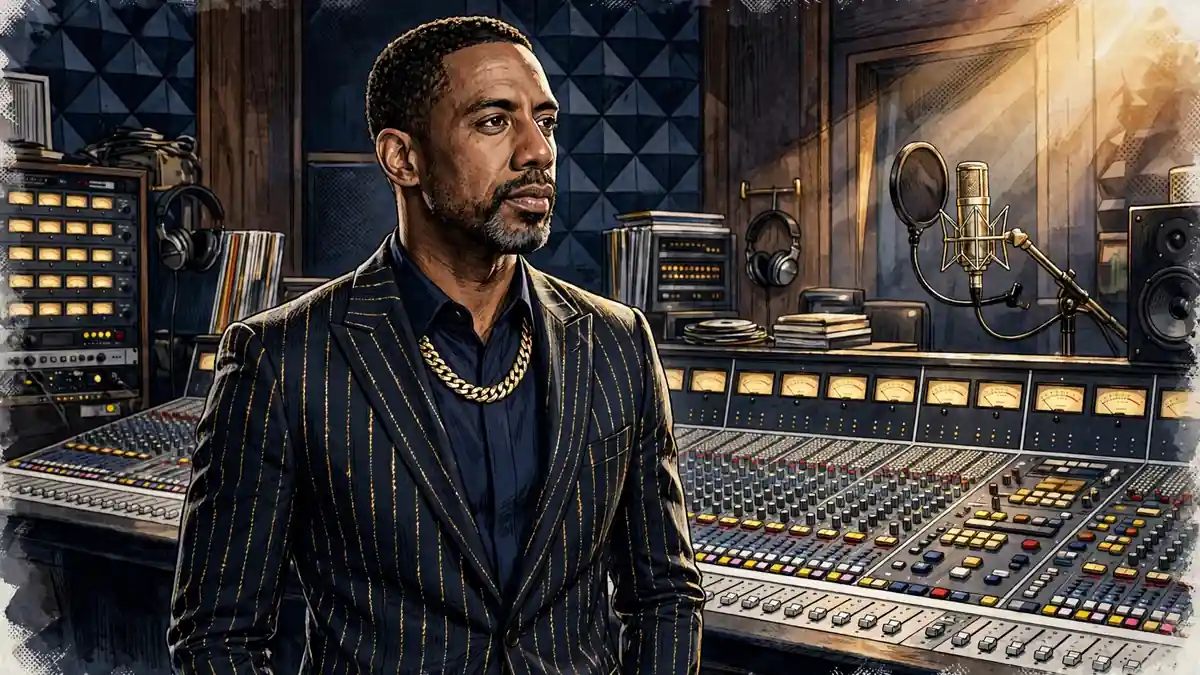
Ryan Leslie‘s net worth is estimated at $9 million to $15 million as of November 2026. Celebrity Net Worth puts the figure at $9 million in its most recent update, while several 2025 profiles land at $15 million — and the gap between those two numbers tells the real story of a career split between hit records and a tech company. Leslie produced Cassie’s chart-topping “Me & U,” wrote and produced for Beyoncé, Britney Spears, Usher and Kanye West, then taught himself to code and built SuperPhone, a text-message platform that turned roughly 17,000 loyal fans into a reported $2 million in direct album revenue. He graduated from Harvard at 19, offered a $1 million reward for a stolen laptop in 2010, and was ordered by a jury to pay it in 2012.
Ryan Leslie: Quick Facts
| Estimated net worth | $9 million–$15 million (range: $9 million to $15 million) |
|---|---|
| Profession | Record producer, singer-songwriter, rapper, entrepreneur |
| Nationality | American |
| Born | September 25, 1978 (age 48) |
| Height | 6 feet (183 cm) |
| Primary income sources | Music production and songwriting royalties, solo recording career, SuperPhone (text-message CRM platform), NextSelection Lifestyle Group, investments and mentorship |
| Active years | 2003–present |
| Last reviewed | November 2026 |
- Early Life and Background
- Education
- Career Journey
- Rise to Fame
- Main Sources of Income
- Salary and Earnings
- Businesses and Investments
- Brand Deals and Sponsorships
- Houses, Cars and Other Assets
- Awards and Achievements
- Net Worth Growth Over the Years
- Social Media Presence
- Personal Life
- Sources & Reporting
- Frequently Asked Questions
Early Life and Background
Anthony Ryan Leslie was born on September 25, 1978, in Washington, D.C., and grew up in a household where school came first and music was a serious discipline rather than a hobby. He started playing piano as a child and was writing and arranging music long before most teenagers pick up an instrument. The detail that follows him through every profile is the SAT score: Leslie scored a perfect 1600 before he was old enough to drive, a number AllMusic cites in its biography and one that set up the second act of his life as much as the first.
His family moved around during his school years, and he finished high school at Bear Creek High School in Stockton, California, graduating in 1994. He was 15 years old. That age matters because it frames everything that came next: a teenager arriving at Harvard, building a studio in a dorm basement, and leaving college at 19 with a degree and a plan to make records for a living. The early start gave him a head start on two careers at once, and the discipline of a household that prized education shows up again and again in how he later ran his businesses — spreadsheets, data, and a habit of measuring what most artists leave to feel.
Music was already a working skill by the time he reached college. Leslie played multiple instruments — piano, guitar, violin among them — and arranged and engineered his own sessions. That multi-instrumental fluency became his calling card as a producer: he could sit at a keyboard and build a track from a chord progression rather than looping someone else’s sample, which is part of why his productions for other artists sound polished and self-contained. The sound he developed in those years — clean R&B chords, crisp drums, space for a vocal — would define his commercial peak a decade later.
Education
Leslie entered Harvard College and studied government, concentrating in political science and macroeconomics, and graduated at 19. The macroeconomics concentration is easy to treat as a trivia detail, but it is the thread that connects his two careers. He has talked in interviews and on podcasts about holding four stocks since 2009, about the math of streaming payouts versus direct sales, and about building a company because he measured the numbers and did not like what he saw. A December 2025 appearance on the Money Talks with Jesse podcast was billed around exactly that instinct: “Ryan Leslie Reveals His Exact Playbook For Generational Wealth — I’ve Held These 4 Stocks Since 2009.”
Harvard also gave him his first studio. During his freshman year he built a recording setup in a basement studio on campus and started producing tracks while his classmates were still finding their way around the yard. By graduation he had a working skill, a small catalogue, and no job waiting for him in music — so he took out a $15,000 loan and built his own production studio. The loan is a useful anchor for his net worth story: he started his professional life in debt, on borrowed money, and the first several years of his career were spent paying that back while building a client list.
The Harvard credential has followed him into every business room since, and it is one of the reasons investors took his tech pitch seriously when he arrived in Silicon Valley with a product he had coded himself. It also explains the tone of his public persona: part musician, part founder, comfortable talking about cap tables and publishing splits in the same conversation. For a net worth profile, the education section is not background colour — it is the explanation for why a Grammy-nominated producer ended up running a software company instead of chasing another chart single.
Career Journey
Leslie’s professional break came in the summer of 2003, when he landed a production internship with Grammy-nominated producer Younglord. Within his first week he had produced a song, and the internship turned into real work fast. He started picking up sessions across Bad Boy Records’ orbit, working on projects for Britney Spears, Danity Kane, B5, Cheri Dennis and New Edition, and by the end of 2005 AllMusic records that he had written or produced tracks for 702, Beyoncé, Britney Spears, Carl Thomas and New Edition. That is a remarkable client list for a 27-year-old who had graduated from Harvard only four years earlier, and it was built on the back of the studio he had financed himself with that $15,000 loan.
He recorded his debut album Just Right in 2003, with singles “The Way That U Move Girl” and “Used 2 Be,” but the album was shelved and never released. The setback did not slow him down. In 2004 he founded the NextSelection Lifestyle Group, his own label and production company, and the same year he discovered a young R&B singer named Cassie. He signed her to NextSelection in a joint venture with Diddy’s Bad Boy Records two years later, and the partnership would produce the biggest record of his career.
As a recording artist in his own right, Leslie signed with Casablanca via Universal Motown and released his self-titled debut album Ryan Leslie in 2009, followed the same year by Transition. Both albums reached the Top Ten of Billboard’s Hot R&B/Hip-Hop Albums chart, and Transition earned him a Grammy nomination in 2011. His debut sold around 180,000 copies on a major label — a solid number that, as he later pointed out, paid him far less than his independent releases would. He parted ways with the label and went independent, releasing Les Is More in October 2012 on NextSelection, distributed through Sony’s RED, then Black Mozart in 2013 and MZRT in 2015. His most recent album, Fleurier, arrived in 2021.
His production résumé kept growing alongside his solo work. The artists he has written and produced for include Beyoncé, Britney Spears, Chris Brown, Diddy, Fabolous, LL Cool J, Kanye West, Usher, Mary J. Blige and Kid Cudi. The Fabolous connection is worth noting for readers tracking the money: Leslie produced and appeared on tracks with the Brooklyn rapper, whose own fortune we profiled separately, and the two have collaborated across both of their careers. His work with Kanye West — now known as Ye — sits in the same period, when Leslie was one of the most in-demand R&B producers in New York.
By the early 2010s Leslie had made a decision that defines his net worth story more than any single record: he stopped chasing the traditional label system. He watched streaming payouts shrink, watched his own audience get filtered through algorithms he did not control, and decided to build the tool he wished existed. He learned to code, moved between New York and Silicon Valley, and started building SuperPhone. The pivot looked like a disappearance from music to outside observers — one 2023 profile put it plainly, noting that he had been the number one voice in R&B, had been nominated for a Grammy, and then had seemingly vanished from the scene. He had not vanished. He had changed industries.
Rise to Fame
The single moment that made Ryan Leslie famous was “Me & U.” He wrote and produced the track for Cassie, whom he had discovered in 2004, and the song became a number one R&B single that climbed to number three on the Billboard Hot 100 and sold more than one million digital units. Cassie’s self-titled debut album, produced almost entirely by Leslie and released on Bad Boy, narrowly missed the top of both the Billboard 200 and the R&B/hip-hop albums chart. For a producer, that kind of result is the equivalent of a starring role: his name was on the record, his sound was the record, and every A&R in the business knew it.
His own breakthrough as a performer came with “Diamond Girl,” released in 2006 and premiered on BET’s 106 & Park, followed by “Addiction,” which featured Cassie and Fabolous. The singles put him on television and radio as an artist rather than a behind-the-scenes name, and the 2009 debut album consolidated that position. The two albums peaking in the Top Ten of the R&B/hip-hop albums chart gave him a platform, but the economics of the major-label deal were already bothering him. His debut sold about 180,000 copies, and the royalties he received from it were, by his own later account, a fraction of what he would earn selling directly to a much smaller audience.
Fame for Leslie has always been a two-sided coin. He was an early adopter of documenting his creative process on YouTube, filming his studio sessions and uploading them years before that became standard practice for artists. The videos built him a loyal following and, just as importantly, taught him who his real fans were — the people who watched every session, bought every release, and would later become the first customers of SuperPhone. That audience, measured in the tens of thousands rather than the millions, became the foundation of his second fortune.
The other episode that kept his name in the news had nothing to do with music. In October 2010, while on tour in Cologne, Germany, his laptop and an external hard drive were stolen from his Mercedes. The devices held unreleased productions he valued enormously. He first offered a $20,000 reward, then raised it in a YouTube video on November 6, 2010 to $1 million. The laptop was returned by Armin Augstein, a garage owner from Pulheim near Cologne, but Leslie maintained the intellectual property he valued was not on the returned drive, and he refused to pay. Augstein sued, and on November 28, 2012 a jury ordered Leslie to pay the $1 million reward; he was later also made to pay a further $180,000 in interest for the two years he had refused. The case, Augstein v. Leslie, is still cited in legal writing about rewards offered on social media. It cost him $1.18 million in total and remains the most expensive single episode of his financial life — a loss that belongs in any honest account of his wealth.
Main Sources of Income
Leslie’s money comes from four distinct streams, and the balance between them has shifted over time. The first is production and songwriting: fees, publishing royalties and producer points from records he made for Cassie, Beyoncé, Britney Spears, Usher, Chris Brown, Diddy, Fabolous, LL Cool J, Kanye West and others. “Me & U” alone, with more than a million digital units sold, generated publishing income for years, and catalogue royalties from his production work continue to pay. Production fees for a hitmaker of his standing in the mid-2000s typically ran into five figures per track, with backend points on successful albums, though no public filing breaks out his exact per-track rates.
The second stream is his own recording career: album sales, streaming royalties, touring and live performance. His major-label debut sold roughly 180,000 copies, and his independent releases after 2012 traded volume for margin — fewer copies, far more money per copy. The direct-to-fan model he built around SuperPhone is the clearest example: he removed his music from streaming platforms, gave his phone number to fans, and sold his album directly by text message. About 35,000 people texted him; around 17,000 bought the record, bringing in an initial $170,000, and the total direct revenue from that approach has been reported at $2 million from roughly 15,000 to 17,000 fans. Advertising Week reported a related figure of more than $570,000 in direct-to-consumer revenue from just 16,000 fans — four times the royalties he received on his major-label debut.
The third stream is SuperPhone itself, the company he founded and coded. SuperPhone is a text-message CRM that lets creators and small businesses message their audiences directly, track what each fan has spent, and sell to them without a middleman. The company raised a $1.5 million seed round led by Andreessen Horowitz’s Ben Horowitz, with Betaworks and a long list of angel investors participating, and grew to 2,700 private-beta clients including musicians such as Lil Wayne and Kevin Jonas. For a fee based on message volume plus a 5 percent cut of e-commerce payments, clients get a database of their own fans. Leslie’s own SuperPhone book held 40,000 fans, and he used it to sell 200 tickets at $1,700 each — $340,000 in 48 hours — for a New Year’s Eve concert at a castle in Vienna. His stake in the company is private, so its exact contribution to his net worth cannot be stated precisely, but it is the single largest swing factor in his fortune: if SuperPhone’s valuation ever matched its early promise, his wealth would sit well above the $15 million top of our range.
The fourth stream is investing and mentorship. On the December 2025 Money Talks with Jesse podcast, Leslie described turning $246,000 in debt into a $2.5 million-a-year business, holding four stocks since 2009, and building four multi-million-dollar companies from the ground up. He now runs WealthPlan, a private community offering financial education and mentorship, and he is a seasoned angel investor. He also joined New Wave Press as a strategic advisor, according to a 2025 company announcement. None of these ventures publishes revenue figures, so we treat them as meaningful but unquantified contributors rather than assigning them dollar values.
Salary and Earnings
There is no public salary figure for Ryan Leslie, and any site that prints one as fact is guessing. What the record does support is a clear picture of how his earnings changed shape. In the mid-2000s, his income was production-led: per-track fees, publishing, and backend points on records for major artists. One site, CineNetWorth, attributes to Forbes an estimated annual income of around $3 million for Leslie in 2021, but that attribution could not be verified against Forbes’ own reporting, so we treat it as unconfirmed rather than as fact. The honest statement is that his annual income varies sharply with his output — a year with a hit production or a SuperPhone growth spurt pays far more than a quiet year.
The most concrete earnings data comes from his own mouth and from the direct-to-fan numbers. His major-label debut sold about 180,000 copies and paid him royalties he later described as small next to what came after. By contrast, selling directly to 16,000 fans through SuperPhone brought in more than $570,000, according to Advertising Week — four times the royalties from the major-label debut. The full direct-to-fan story, as he has told it on podcasts including Earn Your Leisure in December 2025, is $2 million from an album that sold only 17,000 copies. The maths is the point: 17,000 buyers at an average of roughly $117 each, through bundles, VIP access and lifetime-album pledges of $1 to $100 per song, beat 180,000 buyers filtered through a label, a distributor and a streaming platform.
The Vienna concert is the sharpest single illustration of the model. Using SuperPhone, he invited his highest-spending European fans to a New Year’s Eve show at a castle in Vienna and sold 200 tickets at $1,700 each in 48 hours — $340,000 of ticket revenue with no promoter, no ticketing fees and no advertising spend. That is the kind of margin a traditional tour cannot match, and it explains why he has spent the last decade teaching other artists the same system rather than chasing radio singles.
On the December 2025 Money Talks appearance he framed his current business as a $2.5 million-a-year operation, built after climbing out of $246,000 in debt. That figure refers to his business revenue, not a personal salary, and it should not be read as take-home pay. Still, it is the freshest earnings signal in the public record, and it supports the top half of our $9 million to $15 million range: a founder running a multi-million-dollar-a-year business, holding a catalogue of hit productions, and sitting on equity in a venture-backed software company is unlikely to be worth less than $9 million, while the absence of any public liquidity event keeps the ceiling at $15 million.
Businesses and Investments
NextSelection Lifestyle Group, founded in 2004, was Leslie’s first company: a label and production house that signed Cassie and Bridget Kelly and operated a joint venture with Bad Boy Records. It gave him ownership of his masters and his artists’ development at a time when most producers worked for hire. The label’s business model — artist development, production and licensing under one roof — was unusual for an independent of its size, and it is the reason “Me & U” paid him as a label owner and publisher rather than only as a hired producer.
SuperPhone is the company that matters most to his net worth. He built the first version himself, learning to code because he wanted a way to text his fans directly and know exactly who they were. The insight was simple: social platforms rent an audience, and the rent keeps rising. A phone number, by contrast, is a direct line nobody can throttle. He put his own number — (646) 887-6978 — on Twitter and invited fans to text him, and 35,000 people did. The product grew from that experiment into a CRM used by 2,700 clients in its private beta, from musicians like Lil Wayne and Kevin Jonas to authors and small businesses. Andreessen Horowitz’s Ben Horowitz backed it, with Betaworks and dozens of angels joining a $1.5 million seed round into Leslie’s company Disruptive Multimedia. The seed round is documented in TechCrunch’s reporting on the company, and it is the only public valuation signal for SuperPhone: a $1.5 million seed implies a modest early valuation, and no later round has been publicly reported, so we do not assign the company a current value.
His investing story runs alongside the companies. He has said he has held four stocks since 2009 — a 16-year hold through multiple market cycles — and he describes himself as a seasoned angel investor. He also runs WealthPlan, a private community built around financial education and mentorship, and he appeared on the Invest Fest stage in August 2025 with DJ Hed, LaRussell and Symba to talk about music ownership and the creator economy. The panel’s theme was the same as his career: own the data, own the distribution, and do not let a platform sit between you and the people who pay you.
One more business line deserves a mention because it shows how he monetises attention: his documented studio process. He was filming his sessions and posting them to YouTube years before behind-the-scenes content became an industry standard, and that archive became both a marketing channel and a teaching tool. It is the reason a generation of producers cite him as an influence, and it fed directly into the mentorship and education products he sells today.
Brand Deals and Sponsorships
Leslie has never been a traditional endorsement artist, and there is no public record of a major brand ambassador deal in the style of a sneaker or beverage contract. His brand relationships have run through the technology and creator-economy world instead: speaking engagements, including Advertising Week in New York in 2017, where he presented SuperPhone as a case study, and the Invest Fest stage in 2025. He has also been booked through speaker agencies as a music-and-technology speaker, which is a paid line of work in itself.
The most commercially significant brand-adjacent relationship in his story is the investor one: Andreessen Horowitz and Betaworks backing SuperPhone put his name in front of the venture world, and the company’s client list — Lil Wayne, Kevin Jonas, author Bonin Bough — functioned as its own endorsement. For a net worth profile, the honest assessment is that brand deals are a minor line for Leslie. His money has come from owning the product, not from lending his face to someone else’s.

Houses, Cars and Other Assets
Public records offer almost nothing verifiable about Ryan Leslie’s property portfolio, and this section says so plainly rather than inventing a house. No reliable outlet has published a home purchase, a mortgage record or a property valuation for him, and the low-authority sites that claim a $20 million real estate portfolio provide no address, no record and no source. We do not repeat that figure as fact.
What is documented is narrower. His laptop theft in Cologne in 2010 involved a Mercedes, from which the laptop and hard drive were taken — a detail recorded in the court filings in Augstein v. Leslie. Beyond that, his known assets are the ones that generate income: his publishing catalogue, his masters and his equity in NextSelection and SuperPhone. Those are the assets that matter to his net worth, and they are also the hardest to value from outside, which is exactly why our estimate is a range rather than a single number.
The laptop episode also illustrates how he values his assets. He put a $1 million price on the unreleased music on that hard drive, and a jury ultimately agreed that the reward offer was binding. Whether or not the music was worth $1 million on the open market, the case shows a man who prices his intellectual property aggressively — and who learned, at a cost of $1.18 million including interest, that a public promise made on YouTube is a contract.
Awards and Achievements
Leslie’s most recognised honour is his Grammy nomination. In 2011 he was nominated for Best Contemporary R&B Album for Transition, his second album. He did not win, but a Grammy nomination is the industry’s clearest marker of peer respect, and it sits at the top of his awards record.
His commercial achievements are the stronger list. “Me & U” reached number one on the R&B chart, number three on the Billboard Hot 100, and sold more than one million digital units. Cassie’s debut album, produced almost entirely by Leslie, narrowly missed the top of both the Billboard 200 and the R&B/hip-hop albums chart. Both of his first two solo albums reached the Top Ten of Billboard’s Hot R&B/Hip-Hop Albums chart. He scored a perfect 1600 on the SAT and graduated from Harvard at 19 — achievements that belong in a different category from music awards but that shaped his career just as much.
On the business side, the achievements are the seed round from Andreessen Horowitz, the 2,700-client beta of SuperPhone, and the direct-to-fan numbers: $2 million from 17,000 album buyers, $570,000 from 16,000 fans, and $340,000 of concert tickets sold in 48 hours. Those are not awards, but they are the numbers that explain his net worth better than any trophy. A peer comparison puts them in context: among R&B producers and singers of his generation, Omarion is profiled on this site at $6 million and Al B. Sure! at $2 million to $4 million, while Michael Bivins sits at $10 million — Leslie’s $9 million to $15 million range places him at the top of that peer group, and the tech company is the reason why.
Net Worth Growth Over the Years
Year-by-year net worth tables for private individuals are almost always invented, so the table below uses only published figures, each tied to its source and date. The pattern it shows is not a smooth climb: Leslie’s estimated wealth has been reported in the same broad band for years, which fits a career built on catalogue royalties and a private company rather than on a single payday.
| Year | Published estimate | Source |
|---|---|---|
| 2021 | $12 million | Wealthy Persons, December 2021 |
| 2023 | $9 million | Celebrity Net Worth (figure carried into its 2025 update) |
| 2025 | $15 million | TrendingCelebs; CineNetWorth |
| 2025 | $35 million | TheMost10 — treated as an outlier, not supported by other sources |
| 2026 | $9 million–$15 million | NetWorthCraft estimate, November 2026 |
The early years tell a different story. He left Harvard at 19, borrowed $15,000 to build a studio, and spent his first professional years paying that back while building a client list. The Cassie breakthrough in 2006 — “Me & U” and the Bad Boy joint venture — was the first real wealth event, converting his production skill into label equity and publishing income. The 2010 laptop case then took $1.18 million out of his pocket in 2012, a genuine setback. The SuperPhone years after 2016 shifted the engine from music to technology, and the direct-to-fan revenue — $2 million from a single album cycle — showed that his audience, not a label, was now his most valuable asset. The December 2025 podcast appearance, in which he described a $2.5 million-a-year business built from $246,000 of debt, is the freshest evidence that the business engine is still running.
Peer comparison sharpens the picture. On this site’s own profiles, Fabolous is estimated at $8 million, Omarion at $6 million, Al B. Sure! at $2 million to $4 million, Michael Bivins at $10 million, and Ye at $400 million after the fall from his billionaire peak. Leslie sits above the working R&B producers of his generation and far below the stadium-scale stars — exactly where a hit producer with a venture-backed software company should sit.

Social Media Presence
Leslie’s relationship with social media is the story of his career in miniature: he used it early, used it well, and then decided he would rather own the connection than rent it. He was one of the first artists to document his studio process on YouTube, filming sessions and uploading them years before that became normal. Those videos built the audience that later became his SuperPhone customer base, and they remain the best public archive of how he works.
He is active on Instagram and X under his own name, where he posts about music, investing and mentorship, and he has appeared on podcasts — Money Talks with Jesse and Earn Your Leisure in December 2025, and the Invest Fest stage in August 2025 — that reach far larger audiences than his own accounts. We do not publish follower counts in this profile because they change daily and no reliable source pins them down; the meaningful number is the one he has given himself, which is 40,000 fans in his SuperPhone book and 35,000 people who texted him when he shared his number. Those are the followers who pay, and they are the audience that matters to his net worth.
Personal Life
Leslie keeps his private life out of the press, and there is no verified public record of a marriage or children. Profiles that claim a wife or girlfriend by name provide no source, so we do not repeat them. What is documented is his family background: he was born in Washington, D.C., and attended high school in Stockton, California, before Harvard. Some biographies list Richmond, Virginia as his birthplace, and the discrepancy is worth noting — the majority of sources, including his Wikipedia biography, give Washington, D.C.
Outside music and business, he is known for the intensity of his work habits: the studio sessions filmed around the clock, the decision to learn programming in his thirties, and the long-form podcast conversations in which he talks about stocks, debt and ownership with the fluency of a finance graduate. He has described his approach as building systems rather than chasing moments, and his career — a hit record, a lawsuit, a software company, a mentorship community — reads like a series of systems built one on top of the other.
Sources & Reporting
Every figure in this article traces to a named outlet or a primary record. Celebrity Net Worth supplied the $9 million estimate and the career summary, updated May 2025. AllMusic supplied the biography: the perfect 1600 SAT score, the Harvard graduation at 19, the 2003 Younglord internship, the Cassie breakthrough, and the chart peaks of his first two albums. Wikipedia supplied the birth date and place, the album discography, the 2011 Grammy nomination, and the laptop-theft timeline. Justia hosts the primary court record in Augstein v. Leslie, including the $20,000-to-$1 million reward escalation and the $180,000 interest award; CloudNine‘s case-law coverage supplied the jury date of November 28, 2012. TechCrunch‘s reporting, as cited in the SuperPhone coverage, supplied the $1.5 million seed round led by Ben Horowitz and the 2,700-client beta figure. Advertising Week supplied the $570,000 direct-to-consumer revenue figure and the 180,000-copy debut sales number. The $2 million from 17,000 album buyers figure comes from Leslie’s own accounts, most recently on the Earn Your Leisure podcast in December 2025 and in the ProducerLab newsletter, with corroboration from the A3C Festival blog. The December 2025 Money Talks with Jesse podcast supplied the $246,000 debt-to-$2.5 million-a-year business claim, the four stocks held since 2009, and the WealthPlan detail. The Underground Wave report supplied the August 2025 Invest Fest panel. Wealthy Persons supplied the $12 million 2021 figure and the $15,000 studio loan. TrendingCelebs and CineNetWorth supplied the $15 million 2025 figure and the 6-foot height. TheMost10 supplied the $35 million figure, which we treat as an outlier. Peer-comparison figures come from NetWorthCraft’s own published profiles, linked in the article. Reporting window: November 2026, with sources spanning 2012 court records to December 2025 podcast appearances. Where sources disagreed, we published a range and named who said what.
Frequently Asked Questions
What is Ryan Leslie’s net worth in 2026?
Ryan Leslie’s net worth is estimated at $9 million to $15 million as of November 2026. Celebrity Net Worth puts the figure at $9 million in its most recent update (May 2025), while several 2025 profiles land at $15 million. We publish the range because the sources disagree and his stake in SuperPhone, his private tech company, has no public valuation. A $35 million figure on one low-authority list is not supported by other sources and is treated as an outlier.
How did Ryan Leslie make his money?
Four streams: production and songwriting royalties from hits he made for Cassie, Beyoncé, Britney Spears, Usher and others; his own recording career, including the direct-to-fan sales that earned a reported $2 million from about 17,000 album buyers; SuperPhone, the text-message CRM company he founded and coded, which raised a $1.5 million seed round led by Andreessen Horowitz’s Ben Horowitz; and investing and mentorship, including his WealthPlan community.
Is Ryan Leslie a Harvard graduate?
Yes. He studied government at Harvard College, concentrating in political science and macroeconomics, and graduated at 19. He scored a perfect 1600 on the SAT before he was old enough to drive, and he graduated from Bear Creek High School in Stockton, California in 1994, at age 15.
What happened to Ryan Leslie’s laptop?
In October 2010, while on tour in Cologne, Germany, his laptop and external hard drive — holding unreleased productions — were stolen from his Mercedes. He first offered a $20,000 reward, then raised it to $1 million in a YouTube video. The laptop was returned by Armin Augstein, a garage owner from Pulheim, but Leslie said the music was missing and refused to pay. Augstein sued, and on November 28, 2012 a jury ordered Leslie to pay the $1 million, plus $180,000 in interest.
Who did Ryan Leslie produce for?
His production and songwriting clients include Beyoncé, Britney Spears, Chris Brown, Diddy, Fabolous, LL Cool J, Kanye West, Usher, Mary J. Blige and Kid Cudi. His biggest success was Cassie’s “Me & U” (2006), which he wrote and produced: it reached number one on the R&B chart, number three on the Billboard Hot 100, and sold more than one million digital units.
What is SuperPhone?
SuperPhone is a text-message CRM platform Ryan Leslie built after teaching himself to code. It lets creators and small businesses message their audiences directly, track what each fan has spent, and sell without a middleman. It raised a $1.5 million seed round led by Ben Horowitz of Andreessen Horowitz and grew to 2,700 private-beta clients. Leslie used it to sell 200 concert tickets at $1,700 each in 48 hours and to earn a reported $2 million from about 17,000 album buyers.
How old is Ryan Leslie?
Ryan Leslie was born on September 25, 1978, which makes him 48 years old as of November 2026. He was born in Washington, D.C., though some biographies list Richmond, Virginia as his birthplace.
What is Ryan Leslie doing now?
As of late 2025 and 2026, Leslie runs his businesses and mentorship work: SuperPhone, his WealthPlan financial-education community, and angel investing — he has said he has held four stocks since 2009. He appeared on the Money Talks with Jesse and Earn Your Leisure podcasts in December 2025, discussing how he turned $246,000 in debt into a $2.5 million-a-year business, and spoke at Invest Fest in August 2025 about music ownership. His most recent album, Fleurier, was released in 2021.
Final Thoughts
Ryan Leslie’s $9 million to $15 million fortune is really two fortunes layered on top of each other. The first was built the traditional way: a Harvard graduate with a perfect SAT score who borrowed $15,000, built a studio, and produced one of the defining R&B records of the 2000s in Cassie’s “Me & U.” The second was built by walking away from that system — learning to code, building SuperPhone, and proving that 17,000 fans who buy direct are worth more than 180,000 album buyers filtered through a label. The $1.18 million laptop judgment sits between those two acts as a reminder that his confidence has cost him real money, and the honest range in this article reflects a genuine unknown: nobody outside the company knows what SuperPhone is worth. What the record does prove is that Leslie understood the economics of his own career earlier than almost anyone in his generation, and he built the tool that let him keep the difference.
Published on 2026-11-15. Last reviewed November 2026. Found an error? See our corrections policy.