
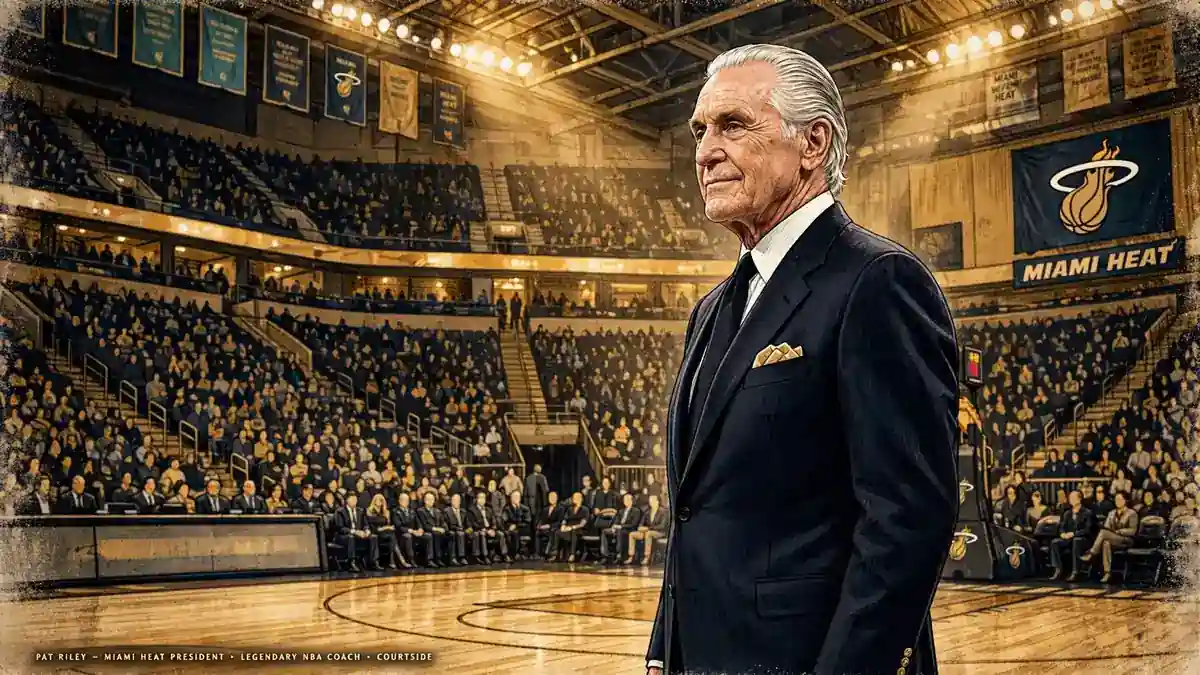
Pat Riley‘s net worth is estimated at $100 million to $120 million as of November 2026. The Miami Heat president has spent nearly six decades in the NBA — as a player, a championship coach, and the executive who built the Heat into a three-time champion — and his fortune rests on three pillars: a landmark 1995 Miami contract that came with a 10 percent ownership stake, three decades of top-tier coaching and executive pay, and the “three-peat” trademark that has paid him royalties every time another team has chased a third straight title.
Pat Riley: Quick Facts
| Estimated net worth | $120 million (range: $100 million–$120 million) |
|---|---|
| Profession | NBA executive, former head coach, former player |
| Nationality | American |
| Born | March 20, 1945 (age 81) |
| Height | 6 ft 4 in (1.93 m) |
| Primary income sources | Miami Heat presidency and equity stake, coaching contracts, “three-peat” trademark royalties, books and speaking |
| Active years | 1967–present |
| Last reviewed | November 2026 |
- Early Life and Background
- Education
- Career Journey
- Rise to Fame
- Main Sources of Income
- Salary and Earnings
- Businesses and Investments
- Brand Deals and Sponsorships
- Houses, Cars and Other Assets
- Awards and Achievements
- Net Worth Growth Over the Years
- Social Media Presence
- Personal Life
- Sources & Reporting
- Frequently Asked Questions
Early Life and Background
Patrick James Riley was born on March 20, 1945, in Rome, New York, and raised in Schenectady, a working-class city upstate where sport was the fastest way out and the fastest way in. His father, Leon Riley, played 22 seasons of minor league baseball as an outfielder and first baseman and appeared in four games for the 1944 Philadelphia Phillies. His mother, Mary Riley, kept the household steady while Leon chased a baseball career that never quite paid. The lesson landed early: talent alone did not guarantee security, and the men who lasted in professional sport were the ones who treated it as a business as well as a game.
Riley starred at Linton High School in Schenectady, where his coach, Walt Przybylo, opened every practice with a short talk about life and how the game related to it. Riley later counted Przybylo among the three biggest influences on his life, alongside his father and his college coach, Adolph Rupp. The discipline stuck. At six feet, four inches, Riley was a guard-forward with a shooter’s touch and a defender’s temperament, good enough to draw the attention of Kentucky — then the most demanding program in college basketball.
The Schenectady years also explain the style that later became his trademark. Riley’s teams were never the loosest or the most talented group on the floor by accident; they were conditioned, drilled, and dressed like professionals. The Armani suits and slicked-back hair that made him a fashion figure in 1980s Los Angeles were not a costume put on for Hollywood. They were the same code he had learned as a teenager in upstate New York: look like you belong, prepare like you intend to stay.
Education
Riley entered the University of Kentucky in 1962 and played under Adolph Rupp, whose practice regimen of hard work and discipline became the model for Riley’s own coaching. He spent one season on the freshman team and three on the varsity, and his junior year, 1965–66, put him on the national map. That Kentucky team, known as “Rupp’s Runts” because no starter stood taller than six feet, six inches, reached the 1966 NCAA championship game, where it lost to Texas Western in one of the most famous games in college basketball history.
Riley was named SEC Player of the Year in 1966, earned first-team All-SEC honours, made the NCAA All-Tournament team, and was picked as a third-team All-American by the Associated Press and United Press International. The USBWA named him a first-team All-American the same season. Kentucky later retired his No. 42 jersey, a distinction reserved for the program’s defining players.
His college career also produced a footnote that says plenty about the athlete he was: the Dallas Cowboys drafted him as a wide receiver in the 1967 NFL Draft, in the 11th round, even though he had not played college football. Riley chose basketball. The San Diego Rockets took him seventh overall in the 1967 NBA Draft, and the football offer stayed on the record as proof that professional sport in two codes had wanted him at once.
Career Journey
Riley’s playing career ran nine NBA seasons, from 1967 to 1976, and it was solid rather than spectacular — the distinction matters, because his wealth was built after his playing days, not during them. He opened with the San Diego Rockets, the team that drafted him, then spent five seasons with the Los Angeles Lakers from 1970 to 1975 and finished with the Phoenix Suns in 1975–76. Across his career he averaged 7.4 points per game. His one ring as a player came in 1972, when the Lakers — the team of Jerry West, Wilt Chamberlain and Gail Goodrich — won the championship. He was a reserve on that team, a role player who watched how a championship locker room worked from the inside.
A waterskiing accident early in his career left him with an injured disk that needed surgery and made his rookie season painful, a detail from Encyclopedia.com’s profile that fits the rest of his story: Riley’s career was never smooth, and he kept finding a way through. When the Suns cut him in 1976, his playing career ended at 31, with modest earnings by any modern measure. NBA salaries in the late 1960s and 1970s were a fraction of today’s money, and a reserve guard’s pay did not make anyone rich. What the playing career gave him was something else — nine years of relationships, a front-row education in how franchises were run, and a reputation as a worker.
He stayed in the game immediately. Riley worked as a Lakers broadcaster from 1976 to 1979, a job that kept him around the team and taught him to explain basketball in plain language, a skill that later made his books bestsellers. In 1979 he joined the Lakers as an assistant coach under Paul Westhead. The Lakers won the 1980 championship with Riley on the bench, his second ring and his first as a coach. Then, in November 1981, Westhead was fired after a clash with Magic Johnson, and Riley — 36 years old, with no head-coaching experience — was handed the job.
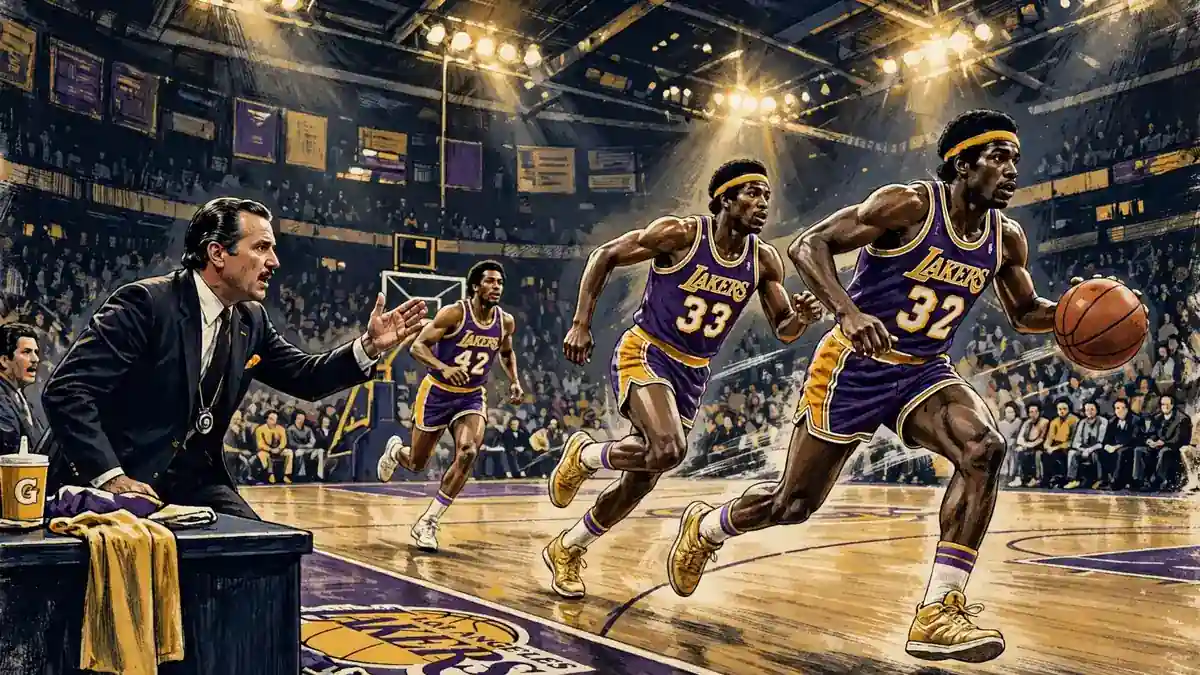
He won 11 of his first 13 games and the 1982 championship at the end of that season. The Lakers reached the Finals in seven of his nine seasons as head coach and won four titles: 1982, 1985, 1987 and 1988. In 1987, at the championship parade, he guaranteed a repeat; in 1988 the Lakers delivered, beating Detroit in seven games. He left Los Angeles in 1990 after nine seasons, a 533–194 regular-season record with the Lakers, and a reputation as the defining coach of the decade.
The New York Knicks hired him in 1991. He rebuilt the Knicks around Patrick Ewing, Charles Oakley, John Starks and Anthony Mason into a physical, defensive team that reached the 1994 NBA Finals, losing to Hakeem Olajuwon‘s Houston Rockets in seven games. The 1992–93 Knicks won 60 games, tied for the best regular-season record in franchise history, and Riley was named Coach of the Year for the second time. Then came the exit that became one of the most famous contract stories in sports. In June 1995, with a year left on his Knicks deal, Riley resigned by fax. The Knicks accused Miami of tampering. The settlement, reached that September, sent $1 million and the Heat’s 1996 first-round pick to New York, and Riley was free to become Miami’s head coach and team president.
Miami was the move that made his fortune. He coached the Heat from 1995 to 2003 and again from 2005 to 2008, winning the franchise’s first championship in 2006 with Shaquille O’Neal and a young Dwyane Wade, and he has been team president ever since. His career coaching record stands at 1,210 wins against 694 losses, a .636 winning percentage, across the Lakers, Knicks and Heat. In 2008 he was inducted into the Naismith Memorial Basketball Hall of Fame as a coach.
Rise to Fame
Riley’s fame arrived in two waves. The first was Showtime. The Lakers of the 1980s played the fastest, most entertaining basketball the league had seen, with Magic Johnson pushing the ball, Kareem Abdul-Jabbar scoring from the sky hook, James Worthy finishing on the break and Byron Scott and Michael Cooper filling the gaps. Riley, in his tailored suits with his hair slicked back, looked like he had been cast for the part. He became a celebrity in his own right, a fashion figure whose image matched the Hollywood team he coached, and he leaned into it rather than fighting it.
He also wrote about it while it was happening. In 1988 he published Showtime: Inside the Lakers’ Breakthrough Season, a New York Times bestseller that recapped the run to the 1987 championship. The book did two things at once: it paid him, and it turned a coach into an author with a public philosophy. His second book, The Winner Within: A Life Plan for Team Players, published in 1993 while he coached the Knicks, was also a New York Times bestseller and was aimed as much at business readers as at basketball fans. Its central line — “There are only two options regarding commitment. You’re either in or you’re out” — became one of the most quoted sentences in sports leadership.
The second wave of fame was Miami. When Riley arrived in 1995 he was not just a coach; he was the man who had demanded, and received, control of an entire franchise. The Heat had never won anything. By 2006 he had delivered a championship as coach. Then, as president, he drafted Dwyane Wade in 2003, traded for Shaquille O’Neal in 2004, hired Erik Spoelstra as head coach in 2008, and in July 2010 assembled the Big Three — LeBron James and Chris Bosh joining Wade — that won titles in 2012 and 2013 and reached four straight Finals. The 2013 title, sealed by Ray Allen’s corner three in Game 6 against San Antonio, is one of the most replayed sequences in NBA history.
By 2023, Riley had reached 19 NBA Finals across six different decades as a player, coach or executive — roughly a quarter of all NBA Finals ever played. He is the first person in North American professional sports to win a championship as a player, an assistant coach, a head coach and an executive. His nine championship rings break down as one as a player (1972), one as an assistant (1980), five as a head coach (1982, 1985, 1987, 1988, 2006) and two as an executive (2012, 2013). The honours kept coming late: in October 2024 the Heat unveiled Pat Riley Court at centre court of the Kaseya Center, and on February 22, 2026, the Lakers unveiled an eight-foot bronze statue of Riley in Star Plaza outside Crypto.com Arena, between the statues of Kareem Abdul-Jabbar and Magic Johnson. He became the first non-player in Lakers history to be honoured with a statue.
Main Sources of Income
Riley’s money comes from four streams, and their order matters: the Miami equity and presidency first, coaching contracts second, the three-peat trademark third, and books, speaking and media fourth. None of them looks like a modern player’s income. There was no $200 million playing contract, no shoe deal worth nine figures, no venture fund. Riley’s wealth is the slow compounding of three decades at the top of the coaching and executive pay scale, plus one piece of paper — a trademark filing from November 1988 — that has paid him for nearly forty years.
The Miami arrangement is the foundation. When Riley joined the Heat in 1995 he negotiated a deal reported at $15 million over five years plus a 10 percent ownership stake in the franchise, after initially asking for far more: a five-year, $50 million contract, 10 percent immediately and another 10 percent over the course of the deal, a loan to cover the taxes on the stake, his Los Angeles and New York homes bought by the owner, a limo, and $300 a day in expenses. The demands were revealed in Chris Herring’s book Blood in the Garden and reported by Sports Illustrated and Yardbarker. Owner Micky Arison agreed to enough of them to make the deal historic: no coach had ever been given an ownership stake and total control of basketball operations at once. Riley stepped down as head coach for good in 2008 but kept the presidency, and he has held it for more than 30 years — the longest run of its kind in the modern NBA.
Coaching pay is the second stream. Riley’s Lakers deal in December 1988 was reported as a four-year contract with a base salary of $600,000 to $650,000 and bonuses that could reach $900,000 a year — big money for a coach then, modest beside today’s figures. By the time he was the Knicks’ coach he was the highest-paid head coach in the league at a reported $1.5 million a year. His Miami coaching deal reset the market again. Across 29 seasons as a head coach, with 1,210 wins, his cumulative coaching earnings run into the tens of millions before the executive years are even counted.
The trademark is the third stream, and it is the one no competitor in his generation matched. In November 1988, with the Lakers chasing a third straight title, Riley filed through his company, Riles & Co., to trademark “three-peat” — a phrase Lakers guard Byron Scott had coined to inspire the team. The mark, registration number 1552980, was granted in 1989. From that point on, anyone who wanted to print the phrase on shirts, hats, posters or memorabilia commercially needed a licence from Riley’s company. When the Chicago Bulls, led by Michael Jordan and Scottie Pippen, won three straight titles in 1993, Riles & Co. collected an estimated $300,000 in royalties; when the Bulls did it again in 1998, the figure was about $600,000. The Yankees’ three straight pennants from 1998 to 2000 and the Lakers’ own three-peat from 2000 to 2002 paid again. Riles & Co. now holds at least six marks covering “three-peat”, “3-peat” and “ThreePeat” across goods from apparel to jewellery and sports drinks, and takes a reported 5 percent of revenue on licensed items. The cumulative total has never been disclosed, but conservative reporting puts it well past $1 million and possibly several million — and the cheques keep coming. Before Super Bowl LIX in February 2025, the Kansas City Chiefs reached out to Riley’s company about a deal in case they completed a three-peat; they lost the game, so no licence was needed, but the call itself showed the trademark still has live commercial value 36 years after it was filed. Riley told ESPN in 2005 that he donates most of the trademark earnings to his charity, the Pat Riley Family Foundation, which means the trademark’s contribution to his personal net worth is smaller than the gross royalties suggest — a point the $120 million estimates rarely mention.
The fourth stream is books and speaking. Both of Riley’s books were New York Times bestsellers, and The Winner Within has sold steadily for three decades as a business-leadership title, which is the kind of backlist that pays a little every year rather than a lot once. Media Referee reported that Riley has commanded around $50,000 for a speaking engagement in the NBA off-season, a figure consistent with a Hall of Fame coach who can fill a corporate room. His broadcasting stint with the Lakers in the late 1970s was the smallest of these streams, but it kept him visible between playing and coaching and sharpened the on-camera presence that later sold books.
Salary and Earnings
Here is the honest answer: nobody outside the Heat’s ownership group knows exactly what Pat Riley earns today, and any article that states a precise current salary as fact is guessing. The Heat is a private company, it does not file public salary disclosures for its president, and Riley has never confirmed a figure. What the record does show is a series of reported numbers from different eras, and they tell a clear story about direction even where they disagree on the exact amount.
As a player, Riley earned the modest salaries of the late 1960s and 1970s. A reserve guard on a nine-year career did not accumulate wealth from playing contracts; the 1972 championship ring was worth more to his future than his playing paycheques. As a coach, the numbers climbed with his reputation: $600,000 to $650,000 a year on his 1988 Lakers deal, $1.5 million a year with the Knicks in the early 1990s, and then the $15 million, five-year Miami deal in 1995 — $3 million a year plus the ownership stake, which was the real prize.
As president, the reporting gets murkier. Multiple outlets have repeated a figure of roughly $11 million a year, traced to reporting around the end of a four-year deal in 2016, when Riley was described as the best-paid general manager-type executive in the league. Media Referee’s 2023 profile estimated his salary at $11.2 million for 2024. A separate 2021 profile put his Heat president compensation at a reported $1 million a year — a figure that looks like a confusion with an older base salary or a partial disclosure, and one we do not rely on. The spread between $1 million and $11 million is a warning, not a data point: treat any single salary number for Riley as an estimate, and note that the equity stake, not the salary, is what separates his wealth from that of any other coach of his era.
What can be stated with confidence is the shape of his career earnings. Media Referee reported that Riley made $40 million from his Miami Heat contracts alone, a figure that covers the coaching and executive deals rather than the equity. Add the Lakers and Knicks coaching contracts, the trademark royalties, book advances and royalties, and speaking fees, and career cash earnings comfortably exceed $60 million before investments and property appreciation. The $100–$120 million net worth range reflects that cash, plus three decades of asset growth, minus the very real taxes on the ownership stake and a lifestyle that has never been extravagant by celebrity standards.
The ownership stake deserves a careful note. Riley’s 10 percent was granted in 1995, when the Heat were worth a fraction of today’s NBA franchises. Its present value is not public, and it may have been diluted, restructured or partially sold in the years since — none of that is on the record. We do not put a dollar figure on the stake in this article because no reliable source has published one, and inventing one would be exactly the kind of fabrication this site refuses to print. What is safe to say is that the stake is the single largest contributor to his wealth and the main reason his net worth kept climbing long after he stopped coaching.
Businesses and Investments
Riley has never been a serial entrepreneur, and that restraint is part of the story. He built one company, Riles & Co., around one asset, the three-peat trademark, and he has managed it with unusual patience — filing additional marks over the years, defending them against imitators (including a fight over “Three-Pete” merchandise during USC’s run under Pete Carroll), and collecting royalties whenever a team in any sport chases a third straight title. The company also filed for protection on jewellery, bedding and memorabilia, widening the trademark’s reach well beyond T-shirts. It is a small operation with an outsized return, and it is the closest thing Riley has to a business empire.
Beyond Riles & Co., his investment profile is private. He has not announced venture investments, does not appear as a founder or backer in the startup press, and has never promoted a fund. That silence is consistent with a man whose wealth came from employment contracts and equity rather than deal-making. The Pat Riley Family Foundation is his main public vehicle outside basketball; he has said he directs most of his trademark income to it, and the foundation supports youth and family causes in South Florida. Charitable giving of that scale reduces the fortune on paper while building the reputation that has kept him employable into his eighties.
The investment that matters most is the one he made in 1995: trading the security of a coaching salary for an ownership position in a franchise. At the time, coaches did not get equity. Riley’s demand for 10 percent — and Arison’s agreement — created the modern coach-executive role and gave Riley a claim on the franchise’s growth. The Heat have since won three championships, built the Kaseya Center, and grown into one of the league’s most valuable brands. Riley’s stake, whatever its current form, grew with all of it. It is the single decision that explains why a coach’s net worth can sit beside those of star players who earned far more in salary.
His other long-term investment is his own brand as a leadership voice. The Winner Within remains in print and in corporate reading lists more than thirty years after publication, and Riley’s speaking career draws on the same material: discipline, commitment, the danger of the “disease of me” — his phrase for the complacency that follows success. That brand does not produce venture-scale returns, but it has produced steady income for decades after his coaching career ended, which is more than most retired coaches can say.
Brand Deals and Sponsorships
Riley’s endorsement history looks nothing like a player’s. He never carried a shoe deal or a soft-drink campaign, and there is no record of a major personal sponsorship contract. What he had instead was something rarer: a look. The Armani suits, the slicked-back hair, the courtside presence — Riley became a style reference in 1980s Los Angeles without ever signing a fashion deal. The image sold books and speaking dates rather than products, and that suited a coach who was building authority rather than a personal brand.
The closest thing to a commercial deal in his record is the trademark itself, which works in reverse: instead of a brand paying Riley to wear its logo, other brands pay Riley for the right to print his phrase. The licence model has brought in money from the Bulls, the Yankees, the Lakers, and — through the Chiefs’ approach in 2025 — the NFL, without Riley ever having to appear in an advertisement. It is, in commercial terms, the most efficient endorsement deal in sports: one filing, decades of royalties, no appearances required.
His books were his other commercial product. Showtime (1988) and The Winner Within (1993) were both New York Times bestsellers, published by major houses, and both have stayed in circulation far longer than most sports books. The advances and royalties were meaningful but not fortune-making; their real value was in establishing Riley as a leadership author, which fed the speaking circuit. Speaking fees of around $50,000 per engagement, as reported by Media Referee, put him in the top tier of sports speakers, and a handful of engagements a year adds up to a solid six-figure income stream in retirement from coaching.
One more commercial thread is worth noting because it shows how Riley’s name still moves money: whenever a team approaches a three-peat, the sports press rediscovers the trademark, and Riles & Co. fields licensing enquiries. The Chiefs’ outreach before Super Bowl LIX, reported by McCarty Law, involved licensees including Fanatics, New Era, Wilson, Riddell and Wincraft — the biggest names in sports merchandising — all prepared to pay for the phrase if Kansas City had won. The deal died with the result, but the episode confirmed that Riley’s 1988 filing remains a live commercial asset in 2026.

Houses, Cars and Other Assets
Riley’s property record is documented in pieces rather than as a portfolio, and the pieces point to a man who bought well and held on. The best-reported holding is his Coral Gables estate, which he bought in 1996 for a reported $6.3 million, shortly after arriving in Miami, and which was later listed at around $16.7 million, according to NetWorthPost and Media Referee. Media Referee also reported a second residence valued at $11.75 million in the Apogee condominium in Miami Beach, and two Malibu properties bought in 2014 and listed for rent at $18,500 and $16,500 a month. The Malibu rentals are the clearest sign of a property investor at work: homes bought and put to work rather than left empty.
The Coral Gables numbers, if the reporting is right, tell a tidy story: a $6.3 million purchase in 1996, held through three decades of South Florida price growth, reaching a $16.7 million valuation — a gain of more than $10 million on a single property. That appreciation alone is a meaningful slice of his net worth, and it is the kind of quiet, unglamorous wealth-building that rarely makes headlines beside championship parades. The Apogee condominium, in one of Miami Beach’s most expensive towers, fits the same pattern: prime location, long hold, no flipping.
On cars, the public record is thin, and we will not invent a collection. Riley is not known as a car collector, and no verified reporting lists a fleet of exotic vehicles in his name. The limo service he demanded in his 1995 Miami negotiations — a car and driver to and from games — says more about his taste than any garage inventory: he has always preferred to arrive rather than to drive. His visible spending has always been on suits, not cars, and the suits were a professional investment as much as a personal one.
Other assets are equally understated. There is no public record of a yacht, a private jet, or a watch collection, and Riley’s lifestyle in South Florida is described by those around him as comfortable rather than lavish. His wife Chris keeps a low profile, and the couple’s public life centres on the Heat, the foundation, and family. The wealth, in other words, sits in the equity stake, the property, and the trademark — not in depreciating toys. That is a large part of why the $100–$120 million estimate has held up across several years of reporting while flashier fortunes have swung wildly.
Awards and Achievements
Riley’s honours list is the longest of any coach of his generation, and it spans every role he has held. As a player, he won the 1972 NBA championship with the Lakers, was SEC Player of the Year in 1966, a first-team All-American, and had his No. 42 retired by Kentucky. As an assistant coach, he won the 1980 championship. As a head coach, he won five championships — 1982, 1985, 1987, 1988 with the Lakers and 2006 with the Heat — and was named NBA Coach of the Year three times: 1990 with the Lakers, 1993 with the Knicks, and 1997 with the Heat. He coached the All-Star Game nine times, eight with the Western Conference and once with the East.
As an executive, he won two more championships, in 2012 and 2013, and was named NBA Executive of the Year in 2011 — the season before the first of those titles, when the Big Three roster he assembled reached the Finals. In 1996 he was named one of the 10 Greatest Coaches in NBA history; on the league’s 75th anniversary he was named to the Top 15 Coaches list. In 2008 he entered the Naismith Memorial Basketball Hall of Fame as a coach, and in 2012 he received the Chuck Daly Lifetime Achievement Award from the NBA Coaches Association.
The numbers behind the honours are what separate him from his peers. His 1,210 regular-season wins put him among the winningest coaches in league history, and his .636 winning percentage is the mark of a coach whose teams were almost never bad. The Lakers reached the Finals in seven of his nine seasons. The Knicks reached the Finals in 1994. The Heat reached the Finals in 2006, 2011, 2012, 2013, 2014, 2020 and 2023 under his presidency. Across six decades he has reached 19 NBA Finals — a figure no other individual in the sport’s history can match, and one that explains why his name still carries weight in every front office in the league.
Two honours from his final years as an active figure say the most about his standing. In October 2024, the Heat named the court at the Kaseya Center after him — Pat Riley Court — an honour franchises reserve for owners and founders, not employees. In February 2026, the Lakers gave him a statue, making him the first non-player in the franchise’s history to receive one, and placing him in Star Plaza between Kareem Abdul-Jabbar and Magic Johnson, the two players most associated with the Showtime teams he coached. A coach does not get a statue from a franchise he left 36 years earlier unless the place still feels like his.
Net Worth Growth Over the Years
Year-by-year net worth figures for Riley do not exist in any reliable source, and this table does not pretend otherwise. What follows is a phase-by-phase estimate built from the documented contracts and reporting, with the honest label on each row. The pattern is the point: slow growth as a player and young coach, a step-change in 1995, and steady compounding after that.
| Period | Estimated net worth | What drove it |
|---|---|---|
| 1967–1980 (player, broadcaster, assistant) | Under $1 million | Modest playing salaries; 1972 ring; broadcasting and assistant-coach pay |
| 1981–1990 (Lakers head coach) | $2 million–$5 million | Four championships; 1988 contract at $600,000–$650,000 a year; first book; three-peat trademark filed 1988 |
| 1991–1995 (Knicks head coach) | $8 million–$12 million | Highest-paid coach in the league at $1.5 million a year; The Winner Within bestseller; 1993 and 1998 trademark royalties begin |
| 1995–2008 (Heat coach and president) | $25 million–$50 million | $15 million Miami deal plus 10 percent equity; 2006 title; Coral Gables property bought 1996 for $6.3 million |
| 2009–2020 (Heat president) | $60 million–$90 million | Big Three titles 2012 and 2013; executive pay; property appreciation; speaking and book backlist |
| 2021–2026 (Heat president) | $100 million–$120 million | Continued presidency; equity and property growth; Celebrity Net Worth at $120 million in November 2026 |
The range in the final row is the range this article publishes, and the gap between the older $80 million trackers and the current $120 million figure is a useful check on how these numbers move. NetWorthPost and BounceMojo still carry $80 million, a figure that appears to date from earlier in the decade and has not been refreshed. EssentiallySports, writing in 2026, gives $100–$120 million. Celebrity Net Worth, updated on November 20, 2026, gives $120 million. We follow the freshest reporting, publish the range, and note the stale figure so readers can see why different sites disagree. The disagreement is not a mystery: it is the difference between a number updated this month and a number carried forward from years ago.
One more comparison puts the figure in context. Riley’s $100–$120 million sits well below the fortunes of the star players he coached — LeBron James’s net worth runs into the hundreds of millions, and Michael Jordan’s net worth is measured in billions — but it sits far above almost every other coach in history. Coaching, even at the top, never paid like playing. Riley closed the gap with the one thing no other coach thought to ask for: a piece of the team itself.
Social Media Presence
Pat Riley has no verified personal account on Instagram, X or Facebook, and he has never been a social media figure. At 81, he belongs to the last generation of sports leaders who built their reputation entirely offline, and he has shown no interest in changing that. The Heat’s official accounts cover his public appearances — the statue unveiling in February 2026, the Pat Riley Court ceremony in October 2024, and his end-of-season press conferences — and those are the reliable places to follow his current activity.
That absence is worth stating plainly because it answers a question readers ask: there is no “Pat Riley official” account selling anything, and accounts using his name to promote products or investments are not him. His public communication runs through the Heat’s media operation and his occasional press conferences, where he remains as blunt as ever. In April 2026, after the Heat missed the playoffs for the first time since the 2018–19 season, he told reporters he was not retiring as team president, a statement carried by Celebrity Net Worth’s November 2026 update and by ClutchPoints’ reporting on his end-of-season press conference. ClutchPoints also reported that Riley now answers to Heat chief executive Nick Arison as well as owner Micky Arison on team decisions — a detail that matters for anyone wondering how much longer the 30-year presidency runs, and one we report as ClutchPoints reported it rather than as confirmed fact.
Personal Life
Riley has been married to Christine “Chris” Rodstrom since June 26, 1970, when they wed in San Diego. They met in 1967, when Riley was fresh out of Kentucky and selling tickets door to door, and Chris was a graduate student. The marriage passed 56 years in June 2026, a run almost as long as his NBA career. Chris, a family therapist by training, has kept a low profile throughout, and her most visible recent appearance was on stage beside Riley at the statue unveiling in Los Angeles on February 22, 2026, as confetti fell in Star Plaza.
The couple adopted two children: a son, James Patrick Riley, in 1985, during the Lakers’ championship run, and a daughter, Elisabeth Marie Riley, in 1989. Both names appear in Riley’s official team biography. The family settled in South Florida after the 1995 move to Miami, and Riley is a practising Roman Catholic, a detail recorded in his biographical profiles. He turned 81 on March 20, 2026, and remains, by every current report, the Heat’s president — still working, still the final word on basketball decisions in Miami, and still the figure other franchises call when they want to know how a team is built to last.
Sources & Reporting
Celebrity Net Worth — the $120 million net worth figure, updated November 20, 2026; the freshest published estimate and our anchor. Also the April 2026 note that Riley said he was not retiring as Heat president after the team missed the playoffs.
EssentiallySports — the $100–$120 million range, plus biographical detail on Riley’s wife, parents and career span; the upper end of the range matches our anchor.
NetWorthPost and BounceMojo — the older $80 million figure, carried forward from earlier years; cited here to explain why some sites still show a lower number, and treated as stale.
Wikipedia — career record (1,210–694), nine championships by role, Coach of the Year years (1990, 1993, 1997), Hall of Fame induction (2008), books and publication years, and the 19 Finals across six decades.
Sports Illustrated and Yardbarker — the 1995 Miami demands (five-year, $50 million ask, 10 percent ownership, $300-a-day expenses, homes and limo) as revealed in Chris Herring’s Blood in the Garden.
Basketball Network — the 1995 settlement: $1 million and the Heat’s 1996 first-round pick to the Knicks for Riley’s release.
McCarty Law and ESPN — the three-peat trademark: filed November 1988, registration 1552980, about $300,000 in 1993 royalties and $600,000 in 1998, six marks held by Riles & Co., and Riley’s 2005 statement that he donates most trademark earnings to his foundation; the Chiefs’ pre-Super Bowl LIX approach.
Media Referee — the $11.2 million estimated 2024 salary, the $40 million Miami contracts figure, the $50,000 speaking fee, and the Coral Gables, Apogee and Malibu property reporting.
Encyclopedia.com — early life, Linton High School, Kentucky, the waterskiing injury, and the nine-season playing career at 7.4 points per game.
ClutchPoints — Riley’s April 2026 end-of-season press conference, the 2025–26 play-in exit, and the reporting that he now answers to chief executive Nick Arison as well as owner Micky Arison.
College Sports Network — the February 22, 2026 statue unveiling and the $120 million figure in 2026 reporting.
Reporting window: November 2026, with the freshest source updates dated November 20, 2026. Figures are estimates from public reporting, not audited statements; where sources disagree, this article publishes the range and names who says what.
Frequently Asked Questions
How much is Pat Riley worth in 2026?
Pat Riley’s net worth is estimated at $100 million to $120 million as of November 2026. Celebrity Net Worth, updated November 20, 2026, puts him at $120 million, and EssentiallySports reports a $100–$120 million range. Older trackers still showing $80 million are carrying a stale figure from earlier in the decade.
What is Pat Riley’s salary as Miami Heat president?
The Heat has never disclosed it, so no exact figure is confirmed. Reporting has put it at roughly $11 million a year, with Media Referee estimating $11.2 million for 2024. His 1995 Miami deal was reported at $15 million over five years plus a 10 percent ownership stake, and the equity — not the salary — is the largest part of his wealth.
How old is Pat Riley?
Pat Riley was born on March 20, 1945, in Rome, New York. He turned 81 in March 2026 and remains president of the Miami Heat, a role he has held since 1995.
Who is Pat Riley’s wife?
Pat Riley has been married to Christine “Chris” Rodstrom since June 26, 1970. They met in 1967 and have two adopted children, son James Patrick (adopted 1985) and daughter Elisabeth Marie (adopted 1989).
How many championships has Pat Riley won?
Nine. One as a player with the 1972 Lakers, one as an assistant coach in 1980, five as a head coach (1982, 1985, 1987, 1988 with the Lakers and 2006 with the Heat), and two as an executive (2012 and 2013 with the Heat). He has reached 19 NBA Finals across six decades.
How much money has Pat Riley made from the three-peat trademark?
Riley’s company, Riles & Co., collected an estimated $300,000 in royalties when the Chicago Bulls three-peated in 1993 and about $600,000 when they did it again in 1998, plus further royalties from the Yankees and Lakers. The cumulative total has never been disclosed, but reporting puts it well past $1 million. Riley told ESPN in 2005 that he donates most of the trademark earnings to the Pat Riley Family Foundation.
Is Pat Riley still the Miami Heat president?
Yes. As of November 2026, Riley remains the Miami Heat’s team president, a role he has held since 1995. In April 2026, after the Heat missed the playoffs, he said he was not retiring. He stepped down as head coach for good in 2008.
What is Pat Riley’s height?
Pat Riley is 6 feet 4 inches tall (1.93 m). He played guard-forward at Kentucky and in the NBA, where he averaged 7.4 points per game over nine seasons from 1967 to 1976.
Final Thoughts
Pat Riley’s $100–$120 million fortune is the least flashy fortune in basketball, and that is the point. He did not earn it in a single contract or a single deal. He earned it by staying in one league for 59 years, by winning in four different jobs, and by making one decision in 1995 that no coach before him had dared to make: demanding a piece of the franchise instead of just a salary. The coaching contracts paid him well. The books and the speaking paid him steadily. The three-peat trademark still pays him nearly forty years after he filed it. But the wealth, the part that kept growing after he stopped coaching, came from the 10 percent of the Miami Heat he negotiated when the team had never won anything.
The statue outside Crypto.com Arena and the court named after him in Miami are the public markers of that career, but the financial lesson is quieter. Riley’s net worth is what happens when bargaining power is used once, early, and held for thirty years. He asked for ownership when coaches did not get ownership, and he never sold the story short afterwards. That is why, at 81, he is still the president of the team he built — and why his fortune, unlike so many in sports, has never needed a comeback.
Published on November 24, 2026. Last reviewed November 2026. Found an error? See our corrections policy.