
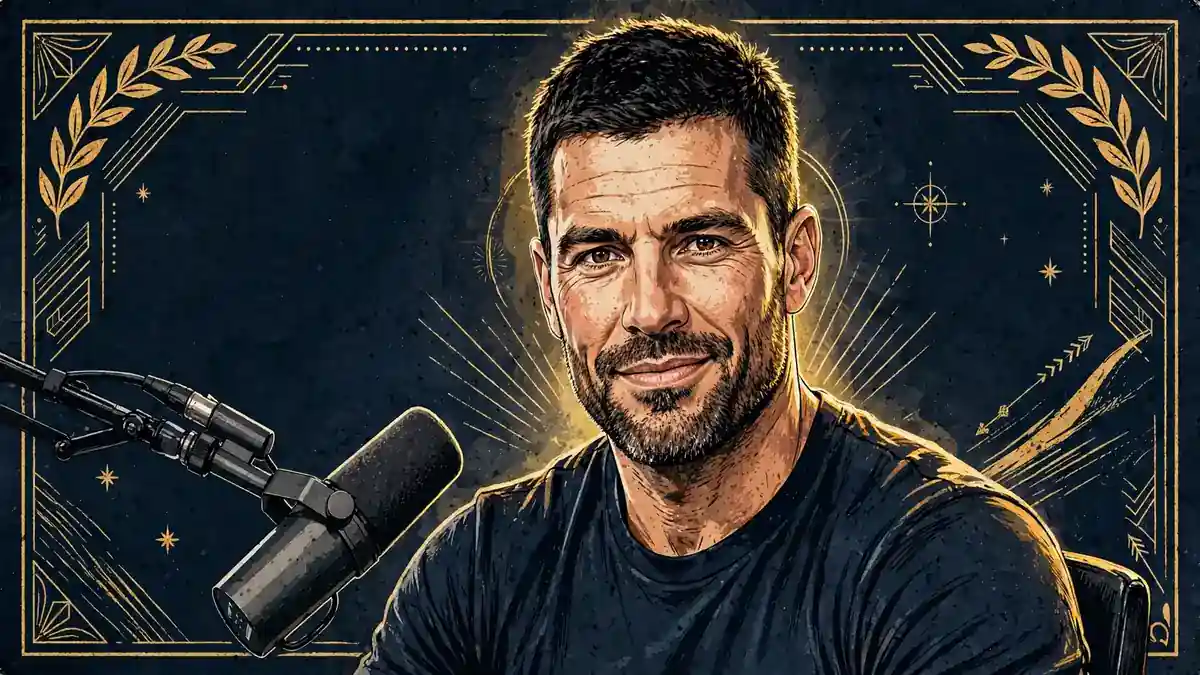
Shawn Ryan‘s net worth is estimated at $6–8 million as of October 2026. The former Navy SEAL turned one of America’s most-listened-to podcasts into a diversified media business — with roughly 5.7 million YouTube subscribers, a tactical training company, and a 2025 distribution and ad-sales partnership with Daylight Media. No official fortune has ever been disclosed, and published estimates run as wide as $4–10 million; this article anchors at the middle of that range and shows the math behind it.
Shawn Ryan: Quick Facts
| Estimated net worth | $6–8 million (reported range: $4–10M) |
|---|---|
| Profession | Podcaster, former Navy SEAL & CIA contractor, entrepreneur |
| Nationality | American |
| Born | 1982, Kansas City, Missouri (age 43–44) |
| Height | ~6 ft (183 cm), reported |
| Primary income sources | YouTube ad revenue, podcast sponsorships, Vigilance Elite training company, merchandise |
| Active years | 2015–present (media/business); military & contracting 2001–2015 |
| Last reviewed | October 2026 |
- Quick Facts
- Early Life and Background
- Education
- Career Journey: Navy SEAL Years
- The CIA Contractor Years
- Rise to Fame
- Main Sources of Income
- Salary and Earnings
- Businesses and Investments
- Brand Deals and Sponsorships
- Houses, Cars and Other Assets
- Awards and Achievements
- Net Worth Growth Over the Years
- Social Media Presence
- Personal Life
- Is He the Shawn Ryan Behind The Shield?
- Sources & Reporting
- Frequently Asked Questions
- Final Thoughts
Early Life and Background
Shawn Ryan was born Sean Ryan Palmisano in 1982 in Kansas City, Missouri, and raised in the small town of Chillicothe, Missouri. His father worked as a military pharmacist — a detail from a July 2025 Mother Jones profile that helps explain the discipline-first household Ryan grew up in. That same profile reports he is of quarter-Japanese heritage, a background he has acknowledged publicly.
Unlike many media figures who document their childhoods in detail, Ryan has kept his early years largely private. What is verified is the through-line: a modest Midwestern upbringing, a father in military service, and a teenager who decided at 18 that he wanted one of the hardest jobs in the armed forces. In 2001, straight out of high school, he enlisted in the United States Navy and volunteered for Basic Underwater Demolition/SEAL training — BUD/S — the selection pipeline with one of the highest attrition rates in the U.S. military. He graduated.
The early-life picture matters to the money story for a specific reason: Ryan’s entire brand — and therefore his earning power — rests on credentials that are unusually easy to verify. Navy service records, SEAL designations, and contracting history are documented in profiles by Soldier of Fortune (December 2022), Mother Jones (July 2025), and the Wall Street Journal (October 2025). In a podcast market where fabricated military claims have ended careers, Ryan’s verifiable record is itself a business asset.
Education
Ryan has not publicly detailed a traditional college education, and no university degree is listed in any of the major profiles of him. His documented training is military: high school completion, Navy boot camp, and graduation from BUD/S, followed by years of advanced SEAL qualification courses, close-quarters combat instruction, and later the tradecraft training that came with paramilitary contracting work.
This is worth stating plainly because it runs counter to the usual celebrity template. Ryan’s human capital — the thing his businesses monetize — is fourteen years of special-operations experience, not a diploma. Vigilance Elite sells the skills he learned in uniform; The Shawn Ryan Show sells the credibility those years bought him. For a net-worth analysis, that means his “education” line item is better understood as specialized training with direct commercial value in the tactical instruction market, where private-sector courses routinely charge hundreds to thousands of dollars per student.
Career Journey: Navy SEAL Years
Ryan served in the U.S. Navy from 2001 to 2006, earning the SEAL designation and serving with SEAL Team 2 and SEAL Team 8. His deployments included Haiti and Baghdad during the Iraq War, where he guarded Iraqi politicians — high-threat protective work that foreshadowed his later contracting career. He also served in the Afghanistan theater during the Global War on Terror.
The pay during these years was standard military compensation: meaningful as a foundation, but not wealth-building. An enlisted SEAL in the mid-2000s earned a base salary in the tens of thousands of dollars annually, plus special-duty and hazardous-duty pays. Ryan has been candid that he left the Navy in 2006 dissatisfied, and his next move — a brief foray into real estate back in civilian life — did not stick either.
What the SEAL years did build was the platform everything else stands on. The trident pin, the deployments, the BUD/S credential — these are the reasons strangers trust his tactical instruction and the reason a podcast audience of millions takes his interviews with generals, spies, and presidents seriously. In financial terms, the Navy years were an investment period: low cash flow, high brand equity.
One more detail with direct relevance to his later income: Ryan’s reputation inside the special-operations community gave him access to a guest roster no civilian podcaster could assemble. When your Rolodex includes people who ran covert programs, your show can book interviews that drive tens of millions of views — and views are the raw material of his revenue.
The CIA Contractor Years
After leaving the Navy, Ryan spent roughly a decade as a paramilitary contractor — first in work associated with the State Department, then with the Central Intelligence Agency’s Global Response Staff, the paramilitary security wing attached to the CIA’s Counterterrorism Mission Center. Wikipedia’s entry on Ryan, drawing on the Soldier of Fortune interview, describes him as a Blackwater-affiliated contractor for GRS; Mother Jones and the Wall Street Journal profiles confirm the CIA-contractor chapter of his career.
Contracting was Ryan’s first genuinely high-earning period. Paramilitary contractors with SEAL backgrounds and clearances commanded daily rates far above military pay — industry-wide, experienced operators in this tier could earn well into six figures annually during the peak war years. Ryan has never disclosed his contracting income, so we do not put a number on it; but it is reasonable to treat these years as the period when he accumulated his first serious capital, the seed money that later funded a company.
He completed his contracting service in mid-2015. Six months later, in December 2015, he founded Vigilance Elite. The timing is documented on his Wikipedia page and consistent across profiles. The contracting decade thus functions as both a savings period and a second credential layer: “former CIA contractor” carries weight in the training market and the media market alike, and it differentiates him from the many veteran-influencers whose service ended at discharge.
Rise to Fame
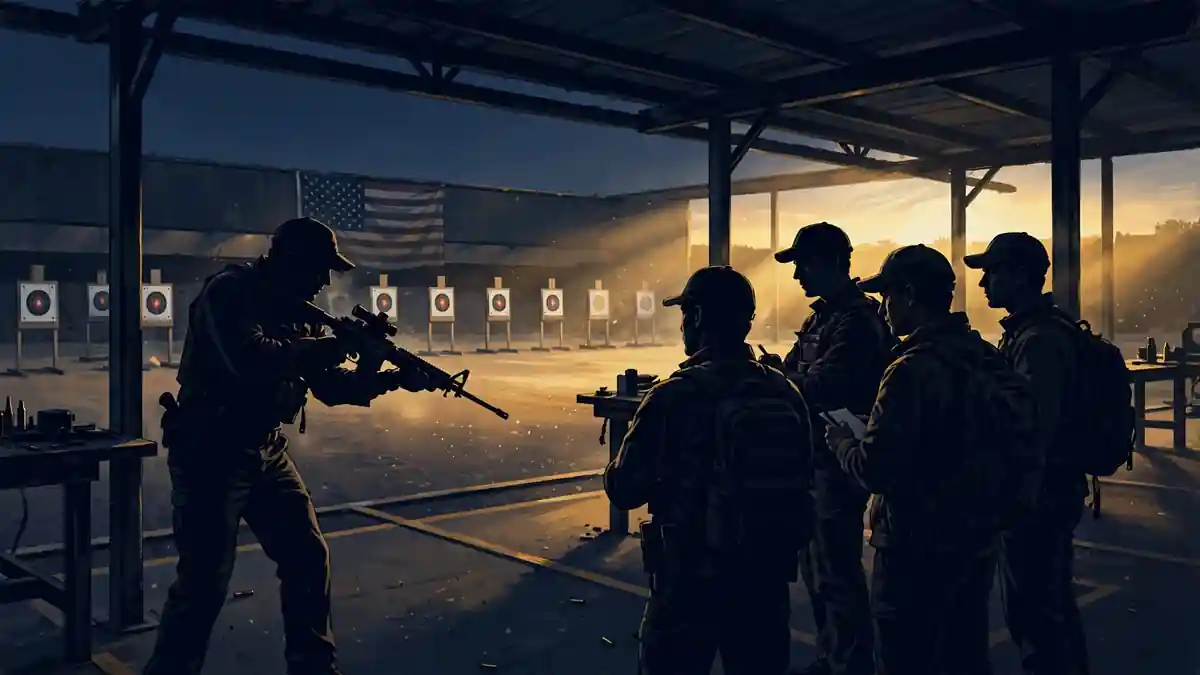
Vigilance Elite began as a tactical training company based in Florida, offering weapons-handling and tactical-skills courses to law enforcement and civilians. Ryan has said he was motivated to start it after watching footage of terror attacks and shootings in which bystanders had no idea how to respond — he wanted to train ordinary people for those moments. The company put out instructional and entertainment videos under the Vigilance Elite Productions banner, and some of them went big.
The breakout moment arrived ahead of the 2019 release of John Wick: Chapter 3 – Parabellum, when footage surfaced of Ryan personally training actor Keanu Reeves in close-quarters combat and room clearing for the film. Task & Purpose covered it in April 2019; GQ and AOL picked it up. For a small training company, a viral association with one of Hollywood’s most visible action stars was worth more than any ad budget — it put Vigilance Elite, and Ryan’s face, in front of a global audience.
Parallel to the training business, Ryan had launched a YouTube channel in February 2017. The long-form interview show that became The Shawn Ryan Show grew steadily through the late 2010s and then accelerated hard: raw, unfiltered conversations with veterans, intelligence operatives, journalists, and eventually sitting politicians and a U.S. president. By 2024 the show ranked among Spotify’s top 10 most-listened-to podcasts, per Variety‘s December 2024 chart report. A September 2024 appearance on The Joe Rogan Experience introduced him to Rogan’s massive audience, and an October 2025 Wall Street Journal profile — “The Former Navy SEAL Who Built a Powerhouse Podcast” — marked his arrival as a mainstream business story.
The October 2025 announcement that Daylight Media, a new venture from the team behind QCODE, would handle ad sales, distribution, audience development, and IP expansion for the show (under a revenue-share deal in which Ryan keeps full ownership and creative control) formalized what the numbers already showed: this was no longer a YouTube side project but a media company.
Main Sources of Income
Ryan’s income comes from five distinct streams, and understanding the mix is the key to the net-worth estimate. First is YouTube advertising on the main Shawn Ryan Show channel, which carries roughly 5.7 million subscribers and has accumulated well over 1.4 billion views. Net Worth Spot’s 2026 analysis estimates the channel earns about $1.5 million per year from ads alone; the analytics site youtubers.me puts monthly earnings near $206,000, which annualizes to roughly $2.5 million. The truth is probably somewhere in that band, and it fluctuates with view counts.
Second is podcast sponsorship and ad sales, now professionalized under the Daylight Media partnership. Episode sponsorships observed on podcast platforms include Mando (with a dedicated “SRS” promo code), Babbel, and Roka eyewear — the classic direct-response podcast advertiser mix. Long-form interview podcasts with loyal, high-trust audiences command premium CPMs, and a show of this scale typically runs multiple sponsor reads per episode across hundreds of episodes a year.
Third is Vigilance Elite, the training company: course fees from civilian and law-enforcement students, plus the Vigilance Elite Productions content arm. Tactical training is a high-margin business — small class sizes, premium pricing, and an instructor whose credentials justify the rates.
Fourth is merchandise and brand extensions sold through his online storefronts, a standard high-margin revenue line for creator businesses of this size.
Fifth, and hardest to quantify, is the enterprise value of the media brand itself: the channels, the audience, the IP, and the sponsorship infrastructure. Net Worth Spot values the main YouTube channel alone at about $6.1 million (with upside to $8.5 million counting multiple revenue streams) — a useful cross-check on the personal estimate, though a channel valuation is not the same thing as personal net worth.
What he does not appear to have, based on all public reporting: a book deal, a television contract, or a disclosed real-estate portfolio. His wealth is concentrated in the operating businesses and the audience — which also means it is less diversified than a typical celebrity fortune, and more sensitive to platform risk.

Salary and Earnings
Ryan draws no public “salary” in the conventional sense — he owns his businesses — so earnings are best understood as business profit plus ad revenue. Start with YouTube. The analytics site youtubers.me, tracking the Vigilance Elite/Shawn Ryan Show channel, recently estimated roughly $206,000 per month in ad earnings, with per-month figures swinging between about $15,000 and $380,000 depending on viral hits. Annualized, that is on the order of $2–2.5 million in a strong year. Net Worth Spot’s separate 2026 estimate lands lower, at about $1.5 million per year from YouTube ads on the main channel.
Why the gap between the two analytics estimates? They measure different windows and use different CPM assumptions, and YouTube revenue is genuinely volatile — a single blockbuster interview can add tens of millions of views in a week. For net-worth purposes, a reasonable working figure is $1.5–2.5 million per year in YouTube ad revenue across his channels, before YouTube’s revenue share and production costs.
Then there is the clips ecosystem. Net Worth Spot values the Shawn Ryan Clips channel — short segments cut from the main interviews, created in December 2019 — at about $11.7 million as a standalone channel, estimating it earns roughly $2.9 million per year. Some of that value accrues to Ryan’s enterprise; the exact ownership split of clip channels is not public, so we count it as supporting evidence of scale rather than a line item in his personal fortune.
Podcast sponsorship revenue is the least transparent line. Industry benchmarks for a top-10 Spotify show with this audience profile suggest annual sponsor revenue in the low-to-mid seven figures, especially after the Daylight Media deal professionalized ad sales in late 2025. We do not have a verified figure, and we do not invent one — but directionally, sponsorships are plausibly as large as YouTube ads for this business.
Vigilance Elite’s training revenue is similarly private. What can be said: the company has operated since December 2015, sells premium-priced instruction, and benefits from the founder’s fame as a marketing engine that costs nothing. Put together, a conservative read of the enterprise is $3–6 million in annual gross revenue across all lines — before staff, studio, production, and tax costs. That revenue scale is consistent with a personal net worth in the high single-digit millions after several years of compounding, which is exactly where the published estimates cluster.
Businesses and Investments
Vigilance Elite is the operating company at the center of Ryan’s business life. Founded in December 2015 and based in Florida, it trains law enforcement officers and civilians in weapons handling and tactical skills. The company’s public face is Vigilance Elite Productions, the content arm that publishes training footage, war-story interviews, and entertainment content — the videos that built Ryan’s first large audience before the podcast overtook them.
The business model has two attractive features for wealth-building. First, the founder is the product: every viral clip of Ryan training — most famously the Keanu Reeves sessions for John Wick 3 — functions as free advertising for paid courses. Second, the podcast now feeds the training business and vice versa. Guests and viewers discover Vigilance Elite through the show; show content is enriched by the company’s tactical credibility. It is a flywheel, and flywheels compound.
On investments, the public record is thin. Ryan has not disclosed a stock portfolio, startup stakes, or a real-estate empire, and unlike many celebrities he does not flaunt assets on social media. His known business footprint is the Vigilance Elite corporate family plus the media properties. The honest read: his “investments” appear to be overwhelmingly reinvestment in his own companies — studio infrastructure, production staff, and audience growth. That concentration is a risk factor (a platform ban or audience shift would hit hard), but it is also why the growth curve has been steep.
One structural point in his favor: under the Daylight Media agreement, Ryan retained full ownership and creative control of his intellectual property. In creator-economy deals, the IP is usually where the long-term value lives. Whoever owns the show library owns an asset that generates revenue for years — and Ryan kept it.
Brand Deals and Sponsorships
The headline deal is the October 2025 Daylight Media partnership, announced via Sounds Profitable and covered by Radio Online. Daylight — a new venture from the team behind the podcast studio QCODE — took over ad sales, distribution, audience development, marketing, and IP expansion for The Shawn Ryan Show under a revenue-share model. Daylight’s portfolio generates more than 150 million monthly views and downloads, and its roster includes The Weekly Show with Jon Stewart and The Chris Cuomo Project. For Ryan, the deal meant professional monetization infrastructure without surrendering ownership; for the net-worth picture, it signaled that sophisticated media operators saw eight-figure-plus annual revenue potential in the property.
Day-to-day sponsorships are the classic direct-response podcast mix. Recent episode sponsor reads, visible on podcast platforms like Castbox, include Mando (whole-body deodorant, with a dedicated “SRS” discount code), Babbel (language learning, “up to 55% off”), and Roka (eyewear, 20% off with code SRS). Dedicated promo codes are a tell: advertisers only issue them to shows whose audiences actually convert, and renewal of these deals is itself evidence of performance.
Ryan has been selective about brand associations in a way that protects long-term value. His sponsors skew toward products his audience of veterans, first responders, and outdoors-minded listeners plausibly buys — grooming, eyewear, education — rather than the crypto and gambling advertisers that have burned other creators. That discipline keeps audience trust high, and audience trust is the inventory he sells.
Earlier in his career, the most valuable “brand deal” was arguably unpaid: the viral Keanu Reeves training footage, covered by Task & Purpose, GQ, and AOL, functioned as a global credibility advertisement for Vigilance Elite. It is a useful reminder that in Ryan’s business, content and marketing are the same thing.
Houses, Cars and Other Assets
Here the honest answer is short: Ryan keeps his private assets private. Wikipedia and the Burchett congressional office place him living in Tennessee with his family. No property records, vehicle collections, or luxury purchases have been surfaced in reputable reporting, and his public persona — flannel, studio, straightforward talk — does not trade on visible consumption.
That restraint is consistent with the rest of the profile. A man who spent his twenties in war zones and his thirties in covert contracting tends not to build an identity around cars. For the estimate, we assume a primary residence consistent with a multi-millionaire in Tennessee — a meaningful asset, but not the driver of the net-worth figure. The driver is the business.
The most valuable assets he verifiably owns are intangible: the Shawn Ryan Show IP and back catalog (hundreds of long-form episodes, an appreciating library), the Vigilance Elite brand and customer base, and the audience itself — roughly 5.7 million YouTube subscribers and more than 2 million Instagram followers. In 2026, for a creator business, those intangibles are the balance sheet.
Awards and Achievements
Ryan’s trophy shelf looks different from an actor’s, but it is substantial. The commercial milestones: a top-10 Spotify podcast ranking in 2024 (Variety, December 2024), roughly 5.7 million YouTube subscribers, more than a billion YouTube views since the show’s late-2010s takeoff, and a Wall Street Journal profile in October 2025 — the kind of coverage that marks a creator’s transition from niche fame to business legitimacy.
The guest roster is its own achievement. Sitting down a U.S. president (Donald Trump), the leader of Afghanistan’s National Resistance Front (Ahmad Massoud), the founder of Blackwater (Erik Prince), and Taiwan’s vice president (Hsiao Bi-khim) in long-form conversation puts the show in rare company. Ryan traveled to Taiwan in 2025, underscoring the program’s geopolitical reach.
Institutional recognition includes an invitation to the March 2024 State of the Union address as the guest of Representative Tim Burchett, and a September 2024 appearance on The Joe Rogan Experience — podcasting’s biggest stage. Earlier, his tactical instruction earned industry-level validation when Keanu Reeves’ John Wick 3 preparation was built around Ryan’s training, covered by Task & Purpose and GQ in 2019.
Military service itself brought the standard decorations of his deployments, though Ryan does not foreground medals publicly. His public honors are better measured in audience and access — the currencies that convert directly into revenue.
Net Worth Growth Over the Years
No year-by-year financial disclosures exist for Ryan, so the table below reconstructs the trajectory from career milestones and the earliest published estimates. Treat the pre-2022 figures as informed approximations anchored to what he was doing at the time; the 2024–2026 figures reflect actual published estimates.
| Year | Estimated net worth | What was happening |
|---|---|---|
| 2015 | Under $1M (est.) | Contracting ends; Vigilance Elite founded in December |
| 2017 | ~$1M (est.) | YouTube channel launches; training videos gain traction |
| 2019 | ~$2M (est.) | Keanu Reeves training footage goes viral; podcast audience scales |
| 2021 | ~$3M (est.) | Show becomes a fixture in the veteran-media space |
| 2023 | $3–5M (est.) | CANSOFCOM episode controversy raises profile; steady sponsor growth |
| 2024 | $4–6M | Spotify top-10 ranking; Rogan appearance; Guestcollab publishes $4–6M estimate |
| 2025 | $5–8M (est.) | WSJ profile; Daylight Media deal; Net Worth Spot values channel at ~$6.1M |
| 2026 | $6–8M | Continued audience growth; Hove Magazine estimates $6–10M |
The shape of the curve tells the real story: a slow build through the training-company years, then a sharp inflection as the podcast scaled from 2019 onward. Media businesses compound — each viral interview adds subscribers who watch the back catalog, which lifts ad revenue, which funds better production, which lands bigger guests. Ryan’s net worth growth is that flywheel made visible.
One caution on the table: several low-quality net-worth sites publish a smooth “$5M → $10M → $15M → $20M” progression for Ryan. Those numbers are fabricated — they describe TV-production and real-estate income streams that belong to a different Shawn Ryan entirely (see the disambiguation section below). We excluded them.
Social Media Presence
Ryan’s distribution is concentrated where it monetizes best. His YouTube channel — the home of The Shawn Ryan Show — carries roughly 5.7 million subscribers and has accumulated well over 1.4 billion views across nearly 1,900 uploads, per third-party YouTube analytics. A dedicated clips channel (Shawn Ryan Clips, launched December 2019) repackages interview highlights for short-form discovery, and a Shorts channel adds further reach.
On Instagram, @shawnryan762 counts more than 2 million followers. The “762” is a nod to the 7.62mm rifle caliber — a small branding detail that signals exactly who the core audience is. His social presence is notably free of the luxury-flexing common among influencers; the feed is show clips, training content, and veteran-advocacy material.
The strategic point: Ryan owns direct relationships with millions of followers across platforms, which means he is not wholly dependent on any single algorithm. The Daylight Media partnership added professional distribution on top of that owned audience. For valuation purposes, a multi-platform audience of this size and engagement level is the single most valuable asset on his personal balance sheet.
Personal Life
Ryan lives in Tennessee with his family and keeps the details deliberately quiet. He is married — the entertainment press has reported his wife’s name as Katie Jean Williams, with a wedding in November 2019 — and he is a father. Beyond that, he has drawn a firm line between the public show and the private household, a boundary his audience appears to respect.
Two personal commitments surface repeatedly in his public conversations. He is a practicing Catholic who discusses faith openly on the podcast, and he has become an advocate for psychedelic-assisted therapy for traumatic brain injury and veteran mental health — a cause rooted in the invisible wounds of his own service years. That advocacy work, including his role in veterans’ outreach, rounds out a public profile built on service rather than celebrity.
He has largely avoided the scandals that trail many public figures, with one noisy exception: the late-2025/early-2026 public feud with former Navy SEAL and Congressman Dan Crenshaw, which began when Ryan accused Crenshaw of insider trading on the podcast and escalated when a planned Crenshaw appearance was canceled in January 2026 over a dispute about guest waiver terms. It generated headlines (Mediaite, Times of India, Sportskeeda) without, as far as public reporting shows, touching his business operations.
Is He the Shawn Ryan Behind The Shield?
No — and this confusion pollutes half the net-worth content about him, so it deserves a straight answer. Shawn Ryan the television writer, born October 11, 1966 in Rockford, Illinois, is the creator of The Shield (FX, 2002–2008), and an executive producer of The Unit, Timeless, S.W.A.T., and The Night Agent. He is married to actress Cathy Cahlin Ryan. His fortune comes from television — a completely different person and a completely different money story.
Shawn Ryan the podcaster — born Sean Ryan Palmisano in 1982 in Kansas City, Missouri — is the former Navy SEAL and CIA contractor this article covers. If a “Shawn Ryan net worth” page talks about TV production deals, showrunner salaries, or a $20 million fortune built on hit series, it has merged the two men. Several low-quality sites do exactly that; their figures should be disregarded for the podcaster.
The mix-up is understandable (same name, both in entertainment-adjacent industries) but it matters for accuracy: every figure in this article traces to the SEAL-turned-podcaster’s military, contracting, training, and media career, and none of it to Hollywood.
Sources & Reporting
Wikipedia — biographical spine: birth year and place (1982, Kansas City), birth name Sean Ryan Palmisano, Navy service 2001–2006 with SEAL Teams 2 and 8, CIA/Global Response Staff contracting, Vigilance Elite founding (December 2015), Keanu Reeves training, podcast guest roster, Spotify top-10 (2024), CANSOFCOM cease-and-desist (Feb 2023), Crenshaw feud (2025–2026), Tennessee residence. Reporting window: continuously updated; accessed October 2026.
The Wall Street Journal — October 12, 2025 profile “The Former Navy SEAL Who Built a Powerhouse Podcast” (Isabella Simonetti): mainstream business-press validation of the show’s scale and Ryan’s founder story.
Mother Jones — July 2025 profile “Pod of War” (Andrew Fedorov): quarter-Japanese heritage, father a military pharmacist, Chillicothe upbringing, contracting background.
Soldier of Fortune — December 7, 2022 interview “Inside the Mind of a CIA Contractor”: GRS/Counterterrorism Mission Center service details, Vigilance Elite founding motivation.
Sounds Profitable — October 12, 2025 press release: Daylight Media partnership terms (revenue-share; ad sales, distribution, audience development, IP expansion; Ryan retains ownership and creative control; 150M+ monthly portfolio views/downloads).
Variety — December 4, 2024 (Todd Spangler): The Shawn Ryan Show among Spotify’s top 10 most-listened-to podcasts of 2024.
Task & Purpose — April 3, 2019 (James Clark): Ryan’s tactical training of Keanu Reeves for John Wick: Chapter 3; February 2023 coverage of the CANSOFCOM cease-and-desist over the Dallas Alexander episode.
Mediaite — February 2023 (CANSOFCOM episode dispute) and January 2026 (Crenshaw feud escalation): controversy timeline.
Net Worth Spot — October 2026 analyses: Shawn Ryan Show channel valued at ~$6.1M (up to $8.5M with multiple revenue streams), ~$1.5M/year in YouTube ad earnings; Shawn Ryan Clips channel ~$11.7M (up to $16.4M), ~$2.9M/year. Channel valuations, not personal net worth — used as cross-checks.
Hove Magazine — 2026 net-worth profile: $6–10M estimate, ~5.68M YouTube subscribers, ~2M Instagram followers, Daylight Media deal context.
Guestcollab — 2026 biography: $4–6M estimate, ~6 ft height, career timeline.
youtubers.me — channel analytics: ~5.14M subscribers at last crawl, ~1.46B views, ~1,849 videos, ~$206K/month estimated ad earnings, channel created February 2017.
Castbox — podcast episode pages: observed sponsors (Mando with SRS code, Babbel, Roka) evidencing the direct-response sponsorship mix.
Radio Online — October 2025: Daylight Media partnership coverage (revenue-share structure, roster context).
GQ — 2019: Keanu Reeves training coverage, corroborating the Vigilance Elite viral moment.
Frequently Asked Questions
What is Shawn Ryan’s net worth in 2026?
Shawn Ryan’s net worth is estimated at $6–8 million as of October 2026. Published estimates span $4–10 million: Hove Magazine puts him at $6–10M, Guestcollab at $4–6M, and Net Worth Spot values his main YouTube channel alone at about $6.1M. No official figure has ever been disclosed, so the honest answer is a range anchored in the middle of independent estimates.
How does Shawn Ryan make his money?
Five streams: YouTube ad revenue (an estimated $1.5–2.5M per year across his channels), podcast sponsorships and ad sales (now handled by Daylight Media under a 2025 revenue-share deal), his Vigilance Elite tactical training company, merchandise, and the enterprise value of the Shawn Ryan Show brand and episode library itself.
Was Shawn Ryan really a Navy SEAL?
Yes. He enlisted in the U.S. Navy at 18 in 2001, graduated BUD/S, and served with SEAL Team 2 and SEAL Team 8 through 2006, deploying to Haiti, Baghdad, and Afghanistan. After the Navy he spent roughly a decade as a paramilitary contractor, including work with the CIA’s Global Response Staff. His service record is documented in profiles by Soldier of Fortune, Mother Jones, and the Wall Street Journal.
What is Vigilance Elite?
Vigilance Elite is the tactical training company Ryan founded in December 2015, based in Florida. It teaches weapons handling and tactical skills to law enforcement officers and civilians. Its content arm, Vigilance Elite Productions, publishes the training videos that first made Ryan famous online — including the viral footage of him training Keanu Reeves for John Wick: Chapter 3.
How many subscribers does the Shawn Ryan Show have?
The main YouTube channel has roughly 5.7 million subscribers and has accumulated well over 1.4 billion views across nearly 1,900 uploads. He also runs a clips channel (launched December 2019) and a Shorts channel, and his Instagram account @shawnryan762 has more than 2 million followers.
Who is Shawn Ryan’s wife?
Ryan is married and keeps his family life private. Entertainment press has reported his wife’s name as Katie Jean Williams, with a wedding in November 2019, and that the couple has a child. He lives with his family in Tennessee and rarely discusses them publicly beyond that.
How old is Shawn Ryan?
He was born in 1982 in Kansas City, Missouri, which makes him 43–44 years old in 2026. He enlisted in the Navy at age 18 in 2001, served until 2006, worked as a contractor until about 2015, and has been building his media businesses ever since.
Is Shawn Ryan the creator of The Shield?
No. The Shield (and S.W.A.T., The Night Agent) was created by a different Shawn Ryan — a television writer born in 1966 in Rockford, Illinois. The podcaster covered in this article was born Sean Ryan Palmisano in 1982 and is a former Navy SEAL and CIA contractor. Many low-quality net-worth sites merge the two men; their fortunes are entirely separate.
Final Thoughts
Shawn Ryan’s $6–8 million fortune is a case study in converting credibility into capital. Fourteen years of special-operations service bought him something money can’t buy — the trust of a hard-to-reach audience — and he monetized it patiently: first through a training company, then through content, then through a podcast that now ranks among America’s most-listened-to shows. The 2025 Daylight Media deal, which professionalized his ad sales while leaving him full ownership of the IP, was the moment the business grew up.
The estimate carries real uncertainty — no filings, no disclosures — but the directional evidence all points the same way: multi-million-dollar annual revenue across YouTube, sponsorships, and training, compounding over several years, with the IP library appreciating underneath. The risk is concentration: his wealth lives almost entirely inside businesses tied to his name and his platforms. As long as the audience keeps showing up for the long-form conversations, though, the flywheel keeps turning — and the next blockbuster interview is always one booking away.
Published on 2026-10-11. Last reviewed October 2026. Found an error? See our corrections policy.