
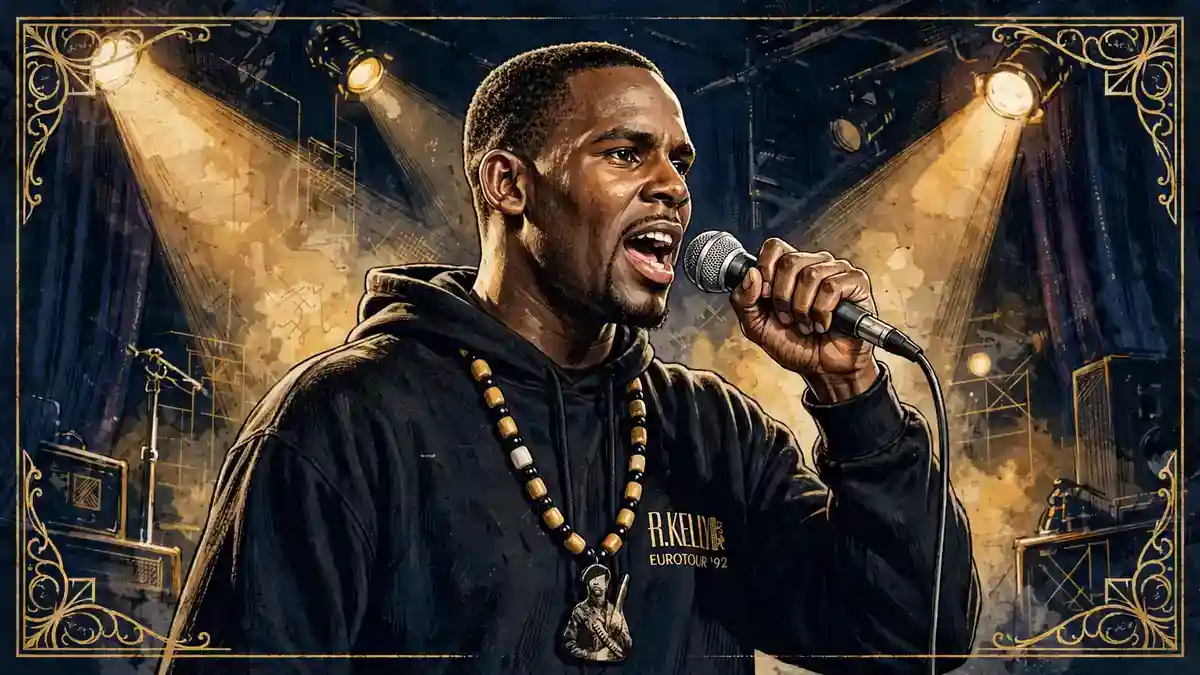
R. Kelly‘s net worth is estimated at negative $2 million as of November 2026. The R&B singer who once sold more than 75 million records worldwide and built a fortune Celebrity Net Worth places between $50 million and $100 million at its peak now owes more than he owns — and the money his songs still earn is intercepted by courts before it ever reaches him.
R. Kelly: Quick Facts
| Estimated net worth | Negative $2 million (range: negative $2 million to negative $4 million) |
|---|---|
| Profession | Singer, songwriter, record producer |
| Nationality | American |
| Born | January 8, 1967 (age 59) |
| Height | 6 feet 1 inch (1.85 m) |
| Primary income sources | Music royalties (garnished), songwriting and publishing catalog (largely sold), former touring and record sales |
| Active years | 1989–2019 |
| Last reviewed | November 2026 |
- Early Life and Background
- Education
- Career Journey
- Rise to Fame
- Main Sources of Income
- Salary and Earnings
- Businesses and Investments
- Brand Deals and Sponsorships
- Houses, Cars and Other Assets
- Awards and Achievements
- Net Worth Growth Over the Years
- Social Media Presence
- Personal Life
- Sources & Reporting
- Frequently Asked Questions
- Final Thoughts
Early Life and Background
Robert Sylvester Kelly was born on January 8, 1967, in Chicago, Illinois, and grew up on the city’s South Side. His mother, Joanne Kelly, worked as a schoolteacher and sang in the church choir; his father was absent from his life. Money was tight through his childhood, and Kelly has spoken in interviews about singing for coins in Chicago subway stations as a teenager — busking under the “L” tracks before he ever set foot in a recording studio. That street-corner start matters to the money story, because Kelly arrived in the music business with no family wealth, no college network and no safety net. Everything he later earned came from the songs themselves.
Kelly was raised in a Baptist household and sang in the church choir, where his gospel-trained voice first drew attention. The church gave him his earliest training in harmony and performance, and gospel phrasing stayed in his singing for the rest of his career — the soaring, melismatic delivery on “I Believe I Can Fly” is church music dressed as pop. He also played basketball through his school years and, by several accounts, was good enough to draw interest from scouts before music took over. A childhood marked by poverty and by abuse he later described in interviews shaped the adult he became, and it is part of the record any honest account of his life has to carry alongside the commercial success.
By his late teens Kelly was performing with a group called MGM (Musically Gifted Men) and entering local talent contests. In 1989 he auditioned for the television talent show Big Break and won a $100,000 prize with MGM — his first real payday and the break that put him in front of record executives. The group split soon after, and Kelly formed R. Kelly and Public Announcement, the outfit that would carry him to his first record deal. He signed with Jive Records in 1990, at 23, after years of singing for spare change in subway stations. The distance between those two points — subway busker to major-label signee in under three years — explains why the money, when it arrived, arrived without any of the financial guardrails that tend to protect it.
Education
Kelly attended Kenwood Academy High School on Chicago’s South Side, where he sang in the school choir and played on the basketball team. His music teacher there, Lena McLin, spotted his talent early and encouraged him to perform, including a school production of the musical A Raisin in the Sun in which he played the lead. McLin’s encouragement is one of the few bright, well-documented facts of his school years, and Kelly credited her in later interviews as the teacher who told him his voice could be a living.
He did not go to college. There is no university degree, no business-school training and no record of formal financial education in his background — a gap that shows up repeatedly in the money story that follows. Kelly left school to pursue music full time, and from 1990 onward his education was the record business itself: advances, recoupment, publishing splits and royalty statements, learned on the job while the checks were already large. His later tax problems — more than $4.8 million owed to the IRS by 2012, according to Celebrity Net Worth — fit a pattern familiar in the industry: an artist who earned fast, spent fast and left the paperwork to other people.
Career Journey
Kelly’s recording career ran from 1990 to 2019 and produced 18 studio albums, according to Wikipedia’s career summary. The arc splits cleanly into three acts: the climb (1990–1998), the peak (1998–2008) and the collapse (2009–2019). In the first act he went from Jive Records signee to the biggest male R&B star of the decade. In the second he stacked platinum albums, wrote hits for other artists and toured arenas. In the third, legal trouble that had shadowed him since the 1990s finally swallowed the career whole.
The first album with Public Announcement, Born into the 90’s, arrived in January 1992 and sold steadily on the strength of the single “She’s Got That Vibe.” It was a modest commercial start, and it established Kelly’s formula: smooth vocals over slow, explicit R&B grooves, with Kelly writing and producing nearly everything himself. Keeping the writing and production in-house mattered financially. An artist who writes his own hits collects the publishing income as well as the artist royalty, and Kelly built his fortune on both streams at once.
His solo debut, 12 Play, landed on November 9, 1993, and changed everything. The single “Bump N’ Grind” spent 12 weeks at number one on the Billboard Hot R&B Singles chart, a record run, and the album went on to six-times platinum certification. The self-titled follow-up, R. Kelly (1995), sold four million copies and earned a four-times platinum certification from the RIAA. By the mid-1990s Kelly was no longer a promising newcomer; he was Jive Records’ flagship R&B act and one of the best-selling artists in America.
The late 1990s brought the work that made him a household name beyond R&B. In 1996 he wrote “You Are Not Alone” for Michael Jackson, which became the first song ever to debut at number one on the Billboard Hot 100 and earned Kelly a Grammy nomination as a songwriter. The same year he released “I Believe I Can Fly” for the Space Jam soundtrack; it reached number two on the Hot 100, topped the UK chart for three weeks and won three Grammy Awards in 1998. His 1998 double album R. — the one with the Celine Dion duet “I’m Your Angel” — was certified eight-times platinum by the RIAA and sold more than six million copies. Wikipedia credits Kelly with over 75 million records sold worldwide and 40 million albums sold in the United States, making him the most commercially successful male R&B artist of the 1990s.
The 2000s kept the run going. TP-2.com (2000) delivered “I Wish” and the career-defining “Ignition (Remix)” followed on Chocolate Factory (2003), which debuted at number one on the Billboard 200. He recorded the joint album The Best of Both Worlds with Jay-Z in 2002, launched the multi-chapter hip-hopera “Trapped in the Closet” — a serial song cycle that became a cult phenomenon — and released albums steadily through Happy People/U Saved Me (2004), TP.3 Reloaded (2005), Double Up (2007), Untitled (2009), Love Letter (2010), Write Me Back (2012), Black Panties (2013) and The Buffet (2015). The chart positions slipped in the 2010s, but the catalog kept selling and the touring kept paying. Then the third act arrived all at once: the Lifetime docuseries Surviving R. Kelly aired in January 2019, RCA Records ended his contract the same month, and federal charges followed within weeks.
Rise to Fame
Kelly’s rise was fast by any measure. Three years separated his subway busking from a Jive Records deal, and three more separated the deal from a six-times-platinum debut album. The speed is the point: “Bump N’ Grind” did not climb slowly, it parked at number one on the R&B chart for 12 weeks in 1994 and made a 27-year-old from the South Side one of the most in-demand voices in pop music. Record labels, film studios and other artists all came calling at once.
What set Kelly apart from other R&B singers of the era was the double role. He was a hitmaker for himself and a hitmaker for hire. Aaliyah’s debut album, Age Ain’t Nothing but a Number (1994), was written and produced entirely by Kelly and went double platinum. “You Are Not Alone” put his name on a Michael Jackson record. He wrote and produced for Celine Dion, Toni Braxton and others, collecting songwriter and producer fees on top of his own artist income. Billboard named him the Top R&B/Hip-Hop Artist of the 1985–2010 period and the most successful R&B artist in history — a verdict built on chart data, not hype.
The “I Believe I Can Fly” moment in 1996–1998 is the clearest marker of his peak fame. The song played at graduations, sporting events and presidential inaugurations; it won three Grammys in a single night in 1998 and became one of the most licensed songs of the decade. A song like that pays for decades: every graduation ceremony, every film placement, every radio spin generates a royalty. That long tail is exactly why his catalog was still worth fighting over in court in 2023, years after his career had ended.
Fame also brought the money habits that later undid him. Kelly spent on the scale of a star who believed the checks would never stop: luxury cars, jewelry, large entourages and multiple homes around Chicago. He also spent heavily on legal defense from the 2000s onward, as accusations that had circulated since the 1990s turned into lawsuits, settlements and, eventually, criminal cases. The rise and the fall share a single cause: the income was real and enormous, and the outgoings — spending, taxes left unpaid, lawyers, settlements — ran faster than the income for more than a decade.
Main Sources of Income
Kelly’s fortune was built on four income streams, and each one tells a different part of the story. Record sales came first: more than 75 million records sold worldwide, with 40 million albums in the United States alone, according to the RIAA figures cited by Wikipedia. Across 18 studio albums and dozens of singles, the artist royalties from those sales were the foundation of the peak fortune. The biggest sellers — 12 Play at six-times platinum, R. at eight-times platinum, the self-titled album at four-times platinum — each generated millions in artist royalties before a single concert ticket was sold.
Songwriting and publishing paid second, and for Kelly it may have been the richest stream of all. Because he wrote his own hits, he collected publishing income on every sale, stream and radio play of his own songs. On top of that he wrote for others: “You Are Not Alone” for Michael Jackson, Aaliyah’s entire debut album, songs for Celine Dion and Toni Braxton. A songwriter’s share of a number-one hit pays for years, and Kelly held the composition and lyric rights to his catalog personally until August 2021 — when, prosecutors later said, he sold them for $5 million in the month his trial began.
Touring and live performance paid third. Kelly toured through the 1990s and 2000s, including arena runs and joint tours, and live shows were his largest single source of cash in the years when album sales began to fade. No audited tour grosses are public, so the honest statement is that touring added millions across two decades without a figure any outlet can verify to the dollar. The touring income stopped for good in 2019, when venues and promoters cut ties after the federal charges.
The fourth stream was production and features: producer fees for other artists’ records, guest appearances, and the Jay-Z joint album The Best of Both Worlds. These were smaller than the first three streams, but they kept cash coming in during the years between his own album releases. After 2019 every one of these streams either stopped or was seized: RCA dropped him, Sony withheld his master-recording royalties, and in August 2023 a federal judge ordered Universal Music Group to hand over the publishing royalties it was holding so victims could be paid.

Salary and Earnings
There is no single salary figure for R. Kelly, because a recording artist’s pay is not a salary — it is a stack of advances, royalties and fees that rises and falls with each release. What the record does show is the shape of the money. In the 1990s, a multi-platinum artist on a major label could expect advances in the millions per album, plus artist royalties of roughly $1–2 per album sold after recoupment. On an album that sold six million copies, like R., that arithmetic alone produces eight figures of gross artist income before touring and publishing are counted. Kelly’s total career earnings are reported by some outlets at more than $100 million; Celebrity Net Worth’s peak net worth range of $50 million to $100 million is the more careful number, because it nets the spending and debts against the gross.
The publishing side paid on a different clock and kept paying longer. “I Believe I Can Fly” has been licensed for films, commercials, graduations and sporting events since 1996, and each use generates a synchronization fee plus performance royalties. “You Are Not Alone” paid Kelly as a songwriter every time Michael Jackson’s record sold or played. These are the royalties that were still arriving in the 2020s — and the reason prosecutors moved to seize them. In August 2023, Universal Music Group disclosed to a federal judge that it was holding $567,444.19 in Kelly’s publishing royalties, according to Billboard’s reporting of the garnishment order. That single disclosure shows the scale of the long tail: years after his last release, one publisher’s account still held more than half a million dollars of his money.
The 2021 catalog sale is the sharpest single data point on what the rights were worth by then. Prosecutors told the sentencing court in June 2022 that Kelly had sold his composition and lyric rights for $5 million in August 2021, the month his trial began, and that the proceeds were being held by a childhood friend, Keith Halbert, who had also received hundreds of thousands of dollars in royalties from those rights. Sony, which owns the master recordings, told prosecutors it was withholding between $3.5 million and $4.5 million in master-recording royalties while facing $7 million in civil judgments against Kelly. Put together, those two numbers sketch the endgame: the catalog was still generating millions, and nearly all of it was already spoken for by courts and creditors.
By contrast, the money Kelly actually received in his final years was close to nothing. In 2019 he told a judge he owed more than $1.9 million in back taxes and that his income was effectively frozen. His label had dropped him, his touring had stopped, and his royalties were being withheld. The $100,000 he needed to post bail in February 2019 — on a $1 million bond — had to be raised by others, a humiliating detail for a man who had once believed, as Celebrity Net Worth reports, that he was worth $900 million because someone had told him so. The gap between that imagined $900 million and the reality of a $100,000 bail scramble is the whole financial story in miniature.
Businesses and Investments
Kelly never built a business empire in the sense that Jay-Z or Diddy did. There is no record of a clothing line, a spirits brand, a tech portfolio or a restaurant chain with his name on it, and that absence is itself a financial fact: the artists who kept their fortunes diversified their income, while Kelly’s money came almost entirely from music. His business activity stayed inside the record industry — his own label imprint, Rockland Records, which he founded in 1998 as a joint venture with Interscope, and which released records by Sparkle and others. Rockland was a real operation with real releases, but it never became a second fortune. It wound down in the early 2000s as Kelly’s own releases took priority.
His one durable business asset was the publishing catalog, and he held it personally rather than through a company structure that might have protected it. That choice cost him in the end. When the composition and lyric rights were sold in August 2021 for a reported $5 million, the money went to a friend’s hands, according to prosecutors, rather than into a trust or a corporate vehicle. The master recordings were never his to sell — Sony owns them — which is why Sony, not Kelly, controls that income stream today. An artist who owns his masters can sell them, license them or borrow against them; Kelly owned only half the value chain, and the half he owned is gone.
There is also no evidence of a serious investment portfolio. No property portfolio is documented beyond his homes, no stock holdings have ever surfaced in court filings, and no venture investments are on the record. The money went to spending, not to assets that compound. That is the quiet difference between Kelly and the peers in the comparison table below: Jay-Z turned music money into businesses, while Kelly turned music money into a lifestyle. When the music money stopped, there was nothing underneath it.
Brand Deals and Sponsorships
Kelly’s endorsement career was thin even at his peak, and it ended years before his record deal did. Unlike athletes and pop stars who carry shoe deals and soft-drink campaigns, Kelly’s brand work was limited to a handful of appearances and tie-ins in the 1990s and early 2000s. His image was never family-friendly enough for mass-market sponsors — his lyrics were explicit, and the allegations against him circulated in the press from the mid-1990s onward — so the big endorsement checks that padded other stars’ fortunes mostly passed him by.
What sponsorship value he had came from the music itself rather than from his face on a product. “I Believe I Can Fly” was licensed to advertisers and sports broadcasters for years, and those synchronization fees were, in effect, his brand income. The Space Jam placement in 1996 was the biggest of these: a song written for a Warner Bros. family film became one of the most licensed tracks of the decade. Film and television placements paid steadily, and they are part of why the publishing royalties were still worth seizing in 2023.
The end of his brand viability came in stages. Spotify removed his music from its playlists in May 2018 under a short-lived conduct policy, and although the policy was reversed, the signal to the industry was clear. After Surviving R. Kelly aired in January 2019, RCA ended his contract, radio stations pulled his records, and venues cancelled his shows. The #MuteRKelly campaign, which had pressed streaming services and promoters since 2017, achieved its aim: by 2019 there was no brand left to sponsor and no stage left to book. His endorsement income in 2026 is zero, and it has been zero since 2019.
Houses, Cars and Other Assets
At his peak Kelly lived like a star of his stature: a large home in Olympia Fields, Illinois, a Chicago-area mansion with a recording studio, luxury cars and jewelry. Almost none of it survives in his name today. The Olympia Fields property went into foreclosure proceedings, and his Chicago-area homes were lost to unpaid taxes and legal claims. A Chicago landlord claimed $3.5 million against him, according to Billboard’s reporting, and a separate civil judgment of $4 million went to one victim, with six accusers claiming in a later filing that he still owed more than $9.9 million from a prior judgment. Houses bought with music money were consumed by the legal bills that followed.
The car collection followed the same path. Kelly owned luxury vehicles through the 2000s — the kind of fleet that shows up in music videos and tabloid photographs — but no verified inventory of cars in his name exists today, and no outlet reports a current collection. The honest statement is that the cars, like the houses, were sold, seized or abandoned as the debts mounted. In early 2019 the owner of his rented Chicago recording studio sued him for more than $167,000 in unpaid rent, alleging seven months without payment — a small debt by celebrity standards, and a telling one, because it showed a man who could no longer cover the rent on the room where he made his music.
What he still owns, in a practical sense, is a diminished stake in the value of his songs. The composition rights were sold in 2021, the masters belong to Sony, and the royalties that still flow are garnished. In August 2023 a federal judge ordered Universal Music Group to hand over $520,549 in publishing royalties to Brooklyn federal prosecutors to cover restitution and criminal fines — $379,649.90 in restitution to victims, a $100,000 fine, a $40,000 Justice for Victims of Trafficking Act assessment and a $900 special assessment. After that order, the remaining balance in UMG’s account was about $47,000. His tangible assets in November 2026 amount to personal effects in a prison cell. That is not a metaphor; it is the literal state of a fortune that once ran to eight figures.
Awards and Achievements
The trophy case is real, and it is worth recording separately from the money, because it explains why the fortune was as large as it was. Kelly won three Grammy Awards in 1998, all for “I Believe I Can Fly”: Best Male R&B Vocal Performance, Best R&B Song and Best Song Written for a Motion Picture or Television. He earned a Grammy nomination as a songwriter for Michael Jackson’s “You Are Not Alone” in 1996. Across his career he collected American Music Awards, BET Awards, Billboard Music Awards, Soul Train Music Awards and NAACP Image Awards, and he holds a Guinness World Record tied to his chart run. Billboard named him the Top R&B/Hip-Hop Artist of the 1985–2010 period and the most successful R&B artist in history.
The commercial achievements are the ones that matter to a net worth article. More than 75 million records sold worldwide. Forty million albums sold in the United States, per the RIAA. The 55th best-selling music artist in American history, with over 32 million album sales by one count. A 12-week run at number one on the R&B singles chart for “Bump N’ Grind.” A song, “You Are Not Alone,” that debuted at number one on the Billboard Hot 100 — the first song ever to do so. An eight-times-platinum double album in R. A number-one album on the Billboard 200 in Chocolate Factory. These are the numbers that produced the $50–100 million peak, and they are also the reason the catalog still earns money today.
It is worth stating plainly that the awards have not been rescinded. The Grammys remain on the record, and the songs remain in the catalog. The Recording Academy has not stripped his wins, and the RIAA certifications stand. That creates the strange split at the heart of this story: the artistic record is intact and still generates income, while the man who made it is in federal prison and the income goes to his victims and creditors. The music industry has not erased R. Kelly; it has simply stopped paying him.
Net Worth Growth Over the Years
The table below traces the arc from subway busker to eight-figure fortune to negative net worth. The peak and current figures come from Celebrity Net Worth; the in-between years are estimates built from the public record — album certifications, the 2012 tax disclosure, the 2019 label split and the 2023 garnishment order — and are labeled as such.
| Year | Estimated net worth | What drove it |
|---|---|---|
| 1992 | Under $1 million | First album with Public Announcement; Jive Records deal |
| 1994 | $5–10 million | 12 Play goes six-times platinum; “Bump N’ Grind” dominates the R&B chart |
| 1998 | $40–50 million | Three Grammys; R. goes eight-times platinum; “You Are Not Alone” royalties |
| 2003 | $50–100 million (peak) | Chocolate Factory hits number one; “Ignition (Remix)”; touring at full strength |
| 2012 | Declining; $4.8 million tax debt public | IRS debt of $4,848,072.71 disclosed; legal fees mounting |
| 2019 | Near zero or negative | RCA drops him; touring ends; tells a judge he owes $1.9 million in back taxes |
| 2022 | Negative | 30-year sentence; catalog rights sold for $5 million; Sony withholding $3.5–4.5 million |
| 2023 | Negative $2 million | Judge garnishes $567,444 in UMG royalties; restitution balance $520,549 |
| 2026 | Negative $2 million (range to negative $4 million) | Current estimate; royalties still garnished; no new income |
Two things stand out in that table. The first is how long the peak lasted: roughly a decade of eight-figure wealth, from the late 1990s to the late 2000s. The second is how fast the fall came once the income stopped. A fortune built on one income stream — music — collapses quickly when the music stops and the bills do not. Kelly’s decline took about seven years from the first public tax disclosure to the point where he could not post a $100,000 bail bond.
For a sense of scale, here is how Kelly’s position compares with R&B peers who kept their money. The figures are reported estimates from the outlets named, not audited accounts.
| Artist | Reported net worth | Source |
|---|---|---|
| Jay-Z | $2.5 billion | Forbes (2025) |
| Bruno Mars | $175 million | Celebrity Net Worth |
| Mary J. Blige | $20 million | Celebrity Net Worth |
| R. Kelly | Negative $2 million | Celebrity Net Worth |
The comparison is instructive rather than cruel. Jay-Z and Bruno Mars turned music money into businesses, catalogs and touring machines that kept paying. Mary J. Blige, who recorded with Kelly in the 1990s, kept a working career and a positive balance. Kelly earned at their level in his prime and kept none of it, because the spending, the taxes and the legal judgments ran ahead of the income for fifteen years. The peer table is the clearest proof in this article that the collapse was a choice pattern, not bad luck: the same industry, the same era, very different endings.
Social Media Presence
R. Kelly has no active social media presence in 2026. His verified accounts fell silent when he was arrested in 2019, and the platforms that once carried his music took steps to distance themselves: Spotify removed his songs from its playlists in May 2018, and after the 2019 docuseries his music was pulled from radio rotation and his shows were cancelled. His songs still appear on streaming services — the catalog was never deleted — but they carry no new posts, no tour announcements and no promotional push. A handful of fan-run and support accounts post on his behalf, and in 2023 a post on his behalf drew attention for claiming he had been placed in solitary confinement; his legal team has used social media sporadically to publicize appeals. None of that is income. There are no brand deals, no sponsored posts and no monetized channels attached to his name today.
The streaming numbers tell a stranger story. His monthly listeners on Spotify remained in the millions even after his conviction, driven by listeners who kept playing “Ignition (Remix),” “I Believe I Can Fly” and “Step in the Name of Love.” Those streams generate real money — the $567,444 in publishing royalties UMG was holding in 2023 came largely from them — but the money goes to victims, fines and creditors under court order. In that sense Kelly’s social and streaming presence is still an asset, just not his anymore. The audience never fully left; the revenue did.
Personal Life
Kelly married Andrea Lee, a dancer who performed as Drea Kelly, in 1996. They had three children together — daughters Joann and Jaah and son Robert Jr. — and divorced in 2009 after a marriage that ended amid allegations of abuse. Andrea Kelly has spoken publicly since the divorce about the marriage and about the child support disputes that followed; Kelly was jailed briefly in March 2019 over unpaid child support, a week after his arrest on criminal charges. The divorce itself was expensive, as divorces after long marriages with large incomes tend to be, and it added to the stack of obligations that pulled his net worth down through the 2010s.
Before that marriage, Kelly married the singer Aaliyah in 1994, when she was 15 and he was 27. The marriage was annulled in 1995 after her family intervened, and the marriage certificate listed a false age for Aaliyah. The episode has been documented in court records and in the 2019 docuseries, and it was among the conduct later charged in his federal cases. Aaliyah died in a plane crash in 2001 at 22; Kelly has said little about her publicly in the years since, and the marriage remains one of the most scrutinized facts of his life.
Since June 2022 Kelly has been serving a 30-year federal prison sentence handed down in Brooklyn after his September 2021 conviction on nine counts, including racketeering and sex-trafficking violations. In February 2023 a Chicago judge added a 20-year sentence for child pornography and enticement convictions, with most of it running at the same time as the New York term — leaving an effective 31-year federal sentence, as Celebrity Net Worth records it. He is held in a federal prison in North Carolina, and his legal team has pursued appeals while he remains in custody. In 2026 he is 59, with no realistic prospect of release before old age and no income stream that is not already claimed by a court.
Sources & Reporting
Celebrity Net Worth — the current negative $2 million estimate, the $50–100 million peak range, the $4,848,072.71 federal tax debt, the $167,000 studio-rent suit, the $1 million bail figure, the $900 million self-belief anecdote and the effective 31-year sentence. Reporting reviewed November 2026.
Billboard — the August 2023 garnishment order: Judge Ann Donnelly’s writ, UMG holding $567,444.19 in publishing royalties, the $520,549 restitution and fines balance, Sony holding more than $1.5 million in royalties as of 2020, the $4 million civil judgment and the $3.5 million landlord claim. Reporting from August 2023.
Reuters — prosecutors’ statements at the June 2022 sentencing hearing: the $5 million August 2021 sale of Kelly’s composition and lyric rights, the proceeds held by childhood friend Keith Halbert, Sony withholding $3.5–4.5 million in master-recording royalties against $7 million in judgments, and the $140,000 in fines imposed with the 30-year sentence. Reporting from June 2022.
Wikipedia — career facts: 18 studio albums, more than 75 million records sold worldwide, 40 million albums sold in the United States, three Grammy Awards in 1998, the 12-week R&B chart run for “Bump N’ Grind,” the 1995 “You Are Not Alone” songwriting credit, and the R. album’s eight-times-platinum certification. Career summary reviewed November 2026.
TMZ Hip Hop — the August 2023 garnishment documents: the outstanding restitution balance of $506,950.26 and UMG’s $567,444.19 in held royalties. Reporting from August 2023.
HotNewHipHop — the August 2023 royalty garnishment and the 20-year Chicago sentence added to the 30-year New York term. Reporting from August 2023.
Forbes — the peer-comparison figure for Jay-Z ($2.5 billion, 2025). Figures for Bruno Mars and Mary J. Blige in the peer table come from Celebrity Net Worth.
Reporting window: November 2026. Where sources disagreed on the current figure — negative $2 million against a negative $2–4 million range — this article anchors at negative $2 million and shows the range. No audited statement of Kelly’s assets and liabilities exists; all figures are third-party estimates or court-record amounts, labeled as such.
Frequently Asked Questions
What is R. Kelly’s net worth in 2026?
R. Kelly’s net worth is estimated at negative $2 million as of November 2026, according to Celebrity Net Worth. Some 2026 trackers place the figure between negative $2 million and negative $4 million. Either way, his debts exceed his assets: unpaid taxes, legal fees, civil judgments and court-ordered restitution outweigh everything he still owns, and the royalties his songs still earn are garnished by the courts.
What was R. Kelly’s net worth at his peak?
At his peak in the late 1990s and early 2000s, R. Kelly’s net worth was likely between $50 million and $100 million, according to Celebrity Net Worth. He sold more than 75 million records worldwide, had an eight-times-platinum album in R., wrote Michael Jackson’s “You Are Not Alone” and collected publishing income on some of the most licensed songs of the decade.
How did R. Kelly lose his fortune?
The fortune was lost in layers over fifteen years: lavish spending, more than $4.8 million in unpaid federal income taxes by 2012, divorce costs and unpaid child support, millions in legal fees and settlements, and then the collapse of his income after the 2019 docuseries Surviving R. Kelly — RCA dropped him, touring ended and his royalties were withheld or garnished. The 30-year prison sentence in 2022 removed any chance of earning it back.
Does R. Kelly still earn money from his music?
His songs still generate money — his catalog is streamed by millions of listeners every month — but he does not receive it. In August 2023 a federal judge ordered Universal Music Group to hand over $520,549 in publishing royalties it was holding to pay restitution to victims and criminal fines. Sony, which owns his master recordings, withholds his share of those royalties while facing $7 million in judgments against him. The income exists; the courts claim it first.
Who owns R. Kelly’s music catalog now?
It is split. Sony owns the master recordings and withholds the royalties from them. Kelly sold his composition and lyric rights — the songwriting half of the catalog — for a reported $5 million in August 2021, the month his trial began, according to prosecutors at his sentencing. Reporting at the time linked the purchase to Primary Wave, which acquired a large stake in the catalog. The remaining royalty streams are largely garnished to pay restitution, fines and judgments.
How long is R. Kelly in prison for?
His effective sentence is 31 years. A Brooklyn jury convicted him in September 2021 on nine counts including racketeering and sex trafficking, and he was sentenced to 30 years in June 2022. A Chicago court then sentenced him to 20 years in February 2023 for child pornography and enticement convictions, with most of that term running at the same time as the New York sentence. He is 59, so the sentence keeps him in federal prison into old age.
Where is R. Kelly now?
R. Kelly is serving his federal sentence in a federal prison in North Carolina. His legal team has pursued appeals against the convictions and the restitution orders, but as of November 2026 he remains in custody with no release date in sight.
How much does R. Kelly owe in taxes?
By 2012 he owed $4,848,072.71 in unpaid federal income taxes covering several years, according to Celebrity Net Worth. In 2019 he told a judge he still owed more than $1.9 million in back taxes and that his income was effectively frozen. The tax debt is one of the oldest and largest single claims against him, and it has grown with interest and penalties since.
Final Thoughts
R. Kelly’s net worth in 2026 is negative $2 million — a figure that says less about one bad year than about fifteen years of spending, unpaid taxes, legal bills and judgments running ahead of an enormous income. He earned at the level of the richest R&B stars of his era: 75 million records sold, three Grammys, a songwriting credit on a Michael Jackson number one, and a catalog that still earns money today. The difference between him and the peers who kept their fortunes is not talent or sales; it is what happened after the checks arrived. Jay-Z built businesses. Kelly built a lifestyle, left his taxes unpaid and fought the law for two decades until the law took the catalog itself.
The most useful number in this article is not the negative $2 million. It is $567,444.19 — the sum Universal Music Group was holding in publishing royalties in August 2023, and the proof that the music still pays. Kelly’s songs outlived his career, his label deal and his freedom, and the money they make now goes to the people he harmed and the governments he owed. That is the shape of the story: a fortune that peaked between $50 million and $100 million, spent down to nothing, and a catalog that keeps earning for everyone except the man who wrote the songs.
Published on November 8, 2026. Last reviewed November 2026. Found an error? See our corrections policy.