
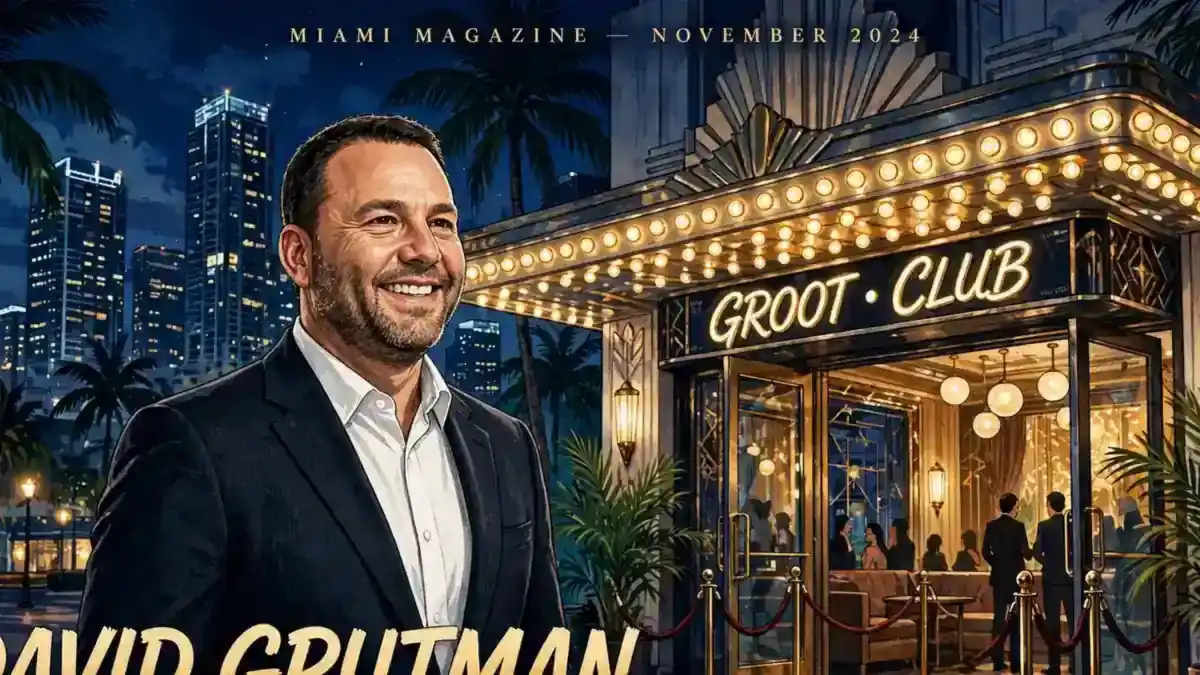
David Grutman‘s net worth is estimated at $50 million to $250 million as of November 2026. The wide spread is the story itself: the freshest major update, from Celebrity Net Worth in April 2026, puts him at $250 million, while other 2026 trackers still carry $50 million to $100 million — a gap that comes down to how much of Groot Hospitality he still owns after selling a majority stake to Live Nation, and how his Miami real estate is valued. What nobody disputes is the engine behind the money: LIV, the Fontainebleau nightclub he opened in 2008, has pulled in $45 million to $60 million a year at its peak, and the restaurant and hotel group he built around it now stretches from Miami Beach to Las Vegas, Dallas and Doha.
David Grutman: Quick Facts
| Estimated net worth | $50 million to $250 million (range: $50 million to $250 million) |
|---|---|
| Profession | Hospitality entrepreneur; founder and CEO of Groot Hospitality |
| Nationality | American |
| Born | July 3, 1974 (age 52) |
| Height | 5 ft 8 in – 5 ft 11 in (published reports differ) |
| Primary income sources | Nightclubs, restaurants, hotels, equity stakes in Groot Hospitality and consumer brands |
| Active years | 1996–present |
| Last reviewed | November 2026 |
- Early Life and Background
- Education
- Career Journey
- Rise to Fame
- Main Sources of Income
- Salary and Earnings
- Businesses and Investments
- Brand Deals and Sponsorships
- Houses, Cars and Other Assets
- Awards and Achievements
- Net Worth Growth Over the Years
- Social Media Presence
- Personal Life
- Sources & Reporting
- Frequently Asked Questions
Early Life and Background
David Grutman was born on July 3, 1974, in Naples, Florida, a quiet Gulf Coast retirement town about as far from South Beach nightlife as Florida gets. His parents divorced when he was six, and Grutman has said in interviews that growing up spending long stretches of time alone shaped the skill that later made him rich: he learned to talk to adults, read a room, and make strangers feel like the most important person in it. That instinct — part host, part salesman, part social engineer — runs through every venue he has built since.
Naples in the 1970s and 1980s was a small town where, as Grutman has joked, most of his childhood friends were in their nineties. He graduated from Barron G. Collier High School in Naples in 1993 and left for the University of Florida. Nothing in that upbringing pointed at nightclubs. The plan, by his own account, was a steady professional life: a finance degree, then back to Naples to sell title insurance. He gave himself one year in Miami first. That year never ended.
The Naples detail matters because it explains the chip on Grutman’s shoulder that shows up again and again in his story. He arrived in Miami with no family money, no connections in the club business, and no obvious path in. The first job he could get was pouring drinks in a mall restaurant. The mall owner’s son, Jeffrey Soffer, is now his partner in the nightclubs. Grutman tells that story often, and the point he draws from it is plain: the relationship that looked smallest at the time turned out to be the one that mattered most.
Grutman has also been open about an early failure that reset his approach. After several years running clubs for other people, he left to open a club of his own, driven in large part by a wish to prove his former employers wrong. The club failed, and the Opium Group — the company he had left — ended up buying it from him. He has described the episode as a lesson in humility: he had been building for his ego instead of for the guest. When the chance to open LIV came a few years later, he has said, he built it for the customer and stopped keeping score against anyone else.
Education
Grutman earned a finance degree from the University of Florida, graduating in the mid-1990s. The degree shows up in his career in a specific way: he talks about hospitality as a numbers business — revenue per square foot, table yield, the cost of a renovation against the bookings it produces — rather than as a party business. FSR Magazine’s 2026 profile of him notes that his Groot Hospitality venues rank among the highest-grossing-per-square-foot restaurants in the country, a metric that comes straight from that finance training.
He did not stop teaching what he learned. For five years Grutman taught a course on entrepreneurship at Florida International University’s Chaplin School of Hospitality & Tourism Management, and the material from that course became his book, Take It Personal. The book’s title is also his business philosophy in four words: remember names, remember orders, remember birthdays, and treat a regular like an owner. Inc. magazine, profiling the book, noted that Grutman built his career on bringing influential people to Miami before he owned any of the rooms they partied in — influence first, real estate second.
That teaching post is one of the few formal credentials in his story, and it is worth more than a line on a résumé. A nightclub owner who teaches at a hospitality school is selling a different product than a nightclub owner who only throws parties: he is selling a system. The system — personal relationships, obsessive service detail, celebrity partnerships — is what Live Nation bought into in 2019, and it is what the rest of this article prices.
Career Journey
Grutman’s working life started at 21 behind the bar at Biz Bistro, a restaurant in the Aventura Mall. He has said he was making about $100,000 a year in tips as a bartender — serious money for a 21-year-old in the mid-1990s — and that he turned down a manager job paying $33,000 because the pay cut made no sense. The mall was owned by real estate developer Don Soffer; Don’s son Jeffrey Soffer is now Grutman’s partner in LIV and Story. The job that looked like a one-year detour before title insurance became the whole career.
From Biz Bistro he moved to the Velvet Lounge in Fort Lauderdale, then to Tantra in South Beach, where he spent five years running one of the hottest rooms in the city. The Tantra years taught him the two skills that define his later venues: how to make a room feel electric, and how to make a high-spending guest feel personally looked after. He then joined the Opium Group, Miami’s dominant nightlife operator at the time, and ran its venues for six to seven years. The Opium Group gave him a platform — big rooms, big DJs, big spenders — and he used it to build a personal reputation with the city’s promoters, agents and celebrities.
The break came when the Opium Group would not make him a partner. He left, opened his own club, and failed. The Opium Group bought the failed club. Grutman has told the story many times, and the version he tells now is generous to his old employers: the failure taught him that a club built to settle a score will not last, and that the guest has to come before the owner’s pride. It is the only real failure in his public record, and it sits right before the run of successes that made him wealthy.
In 2008 he co-founded Miami Marketing Group with Brian Gordon. The company, which later became Groot Hospitality, was built to do what the Opium Group had done for him — market and operate nightlife — but under his own name and on his own terms. That same year he opened LIV at the Fontainebleau Miami Beach. The timing looked reckless: the financial crisis was breaking, credit was frozen, and Miami’s hotel scene was stale. It turned out to be the opening that defined his career, and the Fontainebleau partnership that defined his business model — a landlord with a landmark property, a celebrity crowd, and an operator who knew how to fill a room.
The years after LIV were a steady build rather than a single leap. Story, his second mega-club, opened in 2013 on Collins Avenue in South of Fifth. Komodo, his first restaurant, opened in 2015 in Brickell with partner Jeffrey Chodorow, the China Grill restaurateur. OTL followed in 2017, Planta South Beach and Swan and Bar Bevy in 2018, Papi Steak in 2019. In 2018 he pulled all of it under one umbrella, Groot Hospitality, a name that gave the collection a single brand, a single back office, and a single story to tell a buyer. A year later, that buyer arrived.
Rise to Fame
LIV made Grutman famous in the specific world that matters to him: the global nightlife industry. The club sits inside the Fontainebleau, the 1954 Morris Lapidus landmark on Miami Beach, and Grutman turned its vast main room into the room every DJ, athlete and actor wanted to be seen in. By 2013 and 2014, LIV was ranked the fifth highest-grossing nightclub in the United States, and the fifth most profitable, with annual revenue reported between $45 million and $60 million. Those rankings, repeated in profile after profile, are the closest thing nightlife has to a box-office chart — and they are the reason a $50 million net worth figure attached itself to Grutman for years.
Rolling Stone named him one of the 50 Most Important People in EDM in 2014, and Forbes dubbed him the “King of Miami Nightlife.” Both labels stuck because both were earned in public: LIV’s DJ bookings — the biggest names in electronic music, week after week — were the product, and Grutman’s gift for getting celebrities into the room was the marketing. He spent $10 million renovating LIV with design firm ICRAVE years after it opened, a decision that says a lot about his model: the room itself is the asset, and it has to feel new every few years or the crowd moves on.
Story cemented the pattern. Opened in 2013 with more than 60 VIP tables and five full-service bars, it gave Grutman a second mega-club on the opposite side of Miami Beach from LIV, so the two rooms never competed with each other. The pair — LIV for the Fontainebleau crowd, Story for South of Fifth — let him dominate both ends of the beach on the same night. Competitors could copy a club; copying two clubs, both full, on the same strip, was harder.
The fame then jumped from nightlife pages to business pages. In October 2019, Live Nation Entertainment bought a 51 percent stake in Groot Hospitality. The terms were never disclosed, and Grutman stayed on as CEO with a large minority stake. The deal turned a founder-led Miami nightlife company into a division of the world’s biggest live-entertainment company, and it turned Grutman from a club owner into a hospitality executive with a global platform. FSR Magazine’s 2026 profile describes the deal as a “magnifier” for his brand of theater — same rooms, same crowds, now with Live Nation’s touring, ticketing and artist relationships behind them.
Since the deal, the footprint has kept growing: LIV, LIV Beach, Komodo and Papi Steak at the Fontainebleau Las Vegas; Komodo in Dallas, opened in April 2023; venues in Doha; and a resort concept, Somewhere Else, planned with Pharrell Williams at Atlantis Paradise Island in the Bahamas. Grutman has told FSR he is also looking at Nashville and Scottsdale, while stressing that no deals are signed in either market. The arc is clear: a Miami club operator who became a national hospitality brand, and is now testing whether the brand travels.
Main Sources of Income
Grutman’s money comes from four streams, and the mix is what separates him from a nightclub owner with one good room. The first is the clubs themselves: LIV and Story generate revenue from ticket sales, table reservations, bottle service and VIP packages, with LIV alone reported at $45 million to $60 million a year at its peak. Bottle service is the margin engine — a table that costs a group thousands of dollars a night, with liquor bought at wholesale and sold at nightclub prices, in a room that holds thousands of people.
The second stream is restaurants. Komodo, Swan, Papi Steak, Gekkō, Casadonna, the Key Club, OTL and Planta South Beach are high-check, high-volume rooms where a table of four can spend what a nightclub table spends, and where the crowd comes seven nights a week rather than two. FSR Magazine reports that his restaurants rank among the highest-grossing per square foot in the country. That per-square-foot figure is the one to watch: a restaurant that grosses more per square foot than its neighbors is worth more to a landlord, a buyer and a partner, and it is the metric Grutman uses when he talks about his own success.
The third stream is hotels and the equity in Groot Hospitality itself. The Goodtime Hotel, opened in April 2021 with Pharrell Williams, added a 266-room property at 601 Washington Avenue in South Beach, with Groot operating the Strawberry Moon restaurant and rooftop pool club inside it. More important is the equity: after the Live Nation deal, Grutman kept a significant minority stake in a company that now operates across Miami, Las Vegas, Dallas and Doha. That stake, not any single night’s door takings, is the largest single line in his net worth — and also the hardest to value, because Groot is private and the deal terms were never published.
The fourth stream is outside hospitality: brand and consumer investments, a book, a teaching post, and creative-director work. He is co-owner and creative director of Prince, the heritage tennis brand; an investor in SkinnyDipped, Vacation sunscreen and Goodles, the boxed mac-and-cheese company co-founded by Gal Gadot; and founder of DGN Studios, a production company built around entrepreneurship and culture. He has even designed menus and cocktail pairings for Space Perspective, a carbon-neutral space-travel company — a small project, but a telling one about how far the Grutman brand now reaches beyond a nightclub door.

Salary and Earnings
There is no published salary for David Grutman, and that absence is normal: Groot Hospitality is private, Live Nation does not break out his compensation, and he has never disclosed it. What the record does show is a series of earnings snapshots that trace the climb. As a 21-year-old bartender at Biz Bistro, he has said he made about $100,000 a year in tips. He turned down a $33,000-a-year manager job at the same age — a decision that looks obvious now and looked stubborn then.
The nightclub years are where the numbers get large. LIV’s reported $45 million to $60 million in annual revenue at its peak is gross venue revenue, not Grutman’s personal income — the club pays rent to the Fontainebleau, pays DJs, staff, security and insurance, and splits profit with partners including Jeffrey Soffer. But even a modest margin on $50 million of revenue, across two clubs and a dozen restaurants, is a fortune, and it is the reason the earliest net-worth trackers settled on $50 million for him years ago. The 2019 Live Nation deal likely changed the math again: selling 51 percent of a company at a private valuation converts paper equity into cash and a continuing stake, though the size of that cash payment has never been reported.
Annual income estimates in the low-quality corners of the web put him at about $5 million a year. Treat that figure with care: it appears in pages that copy each other, and no named outlet has published an audited annual income for him. The honest statement is that his income is lumpy — big years when a deal closes or a venue opens, quieter years when a renovation or an expansion absorbs cash — and that the equity stake, the real estate and the brand are worth more than any single year’s pay.
One earnings detail deserves a note because it shows how Grutman thinks about money. When LIV needed a refresh, he spent $10 million on a renovation by ICRAVE rather than banking the profit. The logic is the same as a hotel owner refurbishing rooms: the asset has to feel new, or the high-spending crowd drifts to the next new room. That $10 million was not a cost in his mind; it was the price of keeping a $50-million-a-year room at the top of the rankings.
Businesses and Investments
Groot Hospitality is the holding company, formed in 2018 to put every Grutman venture under one roof. The portfolio, as described by FSR Magazine in 2026 and by Florida International University’s own profile of him, runs to two mega-clubs (LIV and Story), a string of restaurants (Komodo, Swan and Bar Bevy, Papi Steak, Gekkō, Casadonna, the Key Club, OTL, Planta South Beach), and hotels — with venues in Miami, Miami Beach, Dallas, Las Vegas and Doha. The company is headquartered in Miami Beach. Grutman remains CEO after the Live Nation deal, which is unusual: founders who sell control usually leave within a few years. He stayed, and the company kept growing under him.
The venue-by-venue record is worth setting out, because it is the actual asset list behind the net worth figure. LIV opened in 2008 at the Fontainebleau Miami Beach and remains the flagship. Story opened in 2013 at 136 Collins Avenue. Komodo, a three-story Southeast Asian restaurant in Brickell, opened in 2015 in partnership with Jeffrey Chodorow. OTL, a café in the Design District, opened in 2017. Planta South Beach, a plant-based restaurant, and Swan and Bar Bevy, his first project with Pharrell Williams, both opened in 2018. Papi Steak, a Golden Era Hollywood-themed steakhouse built with partner David “Papi” Einhorn, opened in 2019. Gekkō, a Japanese-inspired steakhouse built with Bad Bunny, opened in 2022. Casadonna, a coastal Italian restaurant on the water in Edgewater, opened in 2023 in partnership with Tao Group Hospitality. The Goodtime Hotel, a 266-room lifestyle hotel at 601 Washington Avenue, opened in April 2021.
Outside the venues, the investment list is deliberately eclectic. Prince, the tennis and lifestyle brand, is the most surprising: Grutman is co-owner and creative director, working to reposition a heritage brand for a modern audience. The consumer bets — SkinnyDipped (chocolate-covered nuts), Vacation (sunscreen sold as a lifestyle brand), Goodles (better-for-you boxed mac and cheese) — follow the same logic as his restaurants: a familiar product, a strong brand, and a crowd that will pay for the experience around it. DGN Studios, his production company, makes content about entrepreneurship and culture, and his book Take It Personal extends the same material into print.
Two points about this portfolio are often missed by the net-worth pages that simply list his clubs. First, almost nothing in it is a solo bet: nearly every venue has a partner — Soffer on the clubs, Chodorow on Komodo, Pharrell on Swan and the Goodtime, Bad Bunny on Gekkō, Einhorn on Papi Steak, Tao Group on Casadonna. Partnerships split the profit, but they also split the risk, the capital cost and the marketing, and they put a celebrity name on the door. Second, the portfolio is designed so the customer never leaves his world: dinner at Komodo, drinks at Swan, a night at LIV, a stay at the Goodtime. Each venue feeds the next, and the customer who spends at one is the most likely customer for the others.
The Live Nation deal deserves its own paragraph because it is the single most important transaction in Grutman’s financial life. In October 2019, Live Nation Entertainment bought 51 percent of Groot Hospitality. The price was not disclosed, and neither side has ever confirmed a number. What is known: Grutman kept a large minority stake and stayed as CEO; Live Nation got a hospitality arm with proven venues and a founder who knows how to fill them; and Groot got access to Live Nation’s artists, tours and global footprint. One often-repeated claim — that the deal valued Groot at $50 million — appears in low-quality aggregator pages without a named source, and we do not repeat it as fact. The valuation matters to his net worth, and the honest position is that it is unknown: if Groot was worth $50 million, his remaining stake is worth tens of millions; if it was worth several times that, his stake is worth far more. That uncertainty is a large part of why published net worth estimates for him range from $50 million to $250 million.
Brand Deals and Sponsorships
Grutman does not do endorsement deals in the usual celebrity sense — he does not appear in ads for watches or cologne. His version of a brand deal is a partnership: a celebrity puts their name and audience on a venue, Grutman builds and runs it, and both sides share the result. The model has produced some of the most talked-about rooms in Miami. With Pharrell Williams he built Swan and Bar Bevy, then the Goodtime Hotel and its Strawberry Moon restaurant, and the pair are planning Somewhere Else, a resort at Atlantis Paradise Island in the Bahamas. With Bad Bunny he built Gekkō, a Japanese-inspired steakhouse that trades on the singer’s global audience. With David “Papi” Einhorn he built Papi Steak, where a theatrical beef case — prime cuts presented tableside from a custom briefcase — became the restaurant’s signature.
The design partnerships matter as much as the celebrity ones. Ken Fulk designed the Goodtime Hotel’s botanical, tropical interiors; ICRAVE handled the $10 million LIV renovation; Rockwell Group has worked on his rooms. In hospitality, design is marketing: a room that photographs well fills itself, because every guest with a phone is an advertiser. Grutman’s venues are built to be photographed — the dome at LIV, the garden at Swan, the beef case at Papi Steak — and that is not an accident. It is the same instinct that made him a good bartender: give people a moment they want to tell their friends about.
His own brand has become a deal in itself. The book, the FIU course, the DGN Studios content and the Space Perspective space-travel menus are all versions of the same product: Grutman’s name attached to an experience. None of these pays what a nightclub pays, but they do something a nightclub cannot: they carry his name to people who will never set foot in Miami Beach. That reach is part of why Live Nation wanted him, and part of why his net worth keeps being revised upward by the trackers that follow him.
Houses, Cars and Other Assets
Real estate is the most visible part of Grutman’s wealth, and the numbers are better documented than his business equity. In November 2020 he paid $10.25 million for a historic 1933 waterfront villa on Sunset Island IV in Miami Beach, buying it out of foreclosure. The house had belonged to Spanish singer Alejandro Sanz, who had lost it to foreclosure. Around the same time, Grutman sold his previous Sunset Islands home for $8.3 million. He then spent several years renovating and expanding the 1933 villa, and Celebrity Net Worth reported in its April 2026 update that the finished home is now worth $30 million to $50 million — a gain of roughly three to five times the purchase price, driven by the renovation and by Miami Beach waterfront prices.
The house got a public unveiling in April 2026, when Grutman gave Architectural Digest a video tour of it. The property has been covered by Elle Decor and The New York Times, and the original villa was built in 1933 for suffrage pioneer Jessie Adler. Earlier, in 2013, he had bought a two-story Mediterranean-style home for $5.15 million and spent about $1 million renovating it. He and his wife also listed a Zaha Hadid-designed condo at One Thousand Museum in downtown Miami, with an asking price reported at $7.2 million in 2024.
Put together, the property record tells a consistent story: Grutman buys Miami real estate the way he buys nightclubs — a distressed or underused asset, a large renovation, and a long hold. The Sunset Island villa is the clearest example, and it is also the reason his net worth looks different depending on when it is measured: a house bought for $10.25 million and now worth $30 million to $50 million adds tens of millions to the total by itself.
Cars and boats are a smaller part of the picture, and the reporting is thinner. Lifestyle pages report a VanDutch boat worth about $1.7 million, a sleek vessel that fits the Miami Beach image, but no named outlet has confirmed the purchase price or the model. He is not known for a public car collection in the way some hospitality figures are, and we do not invent one. The honest summary: the real estate is documented and substantial; the toys are reported, not verified.
Awards and Achievements
Grutman’s shelf holds the kind of recognition that matters in his industry rather than the kind that comes with a televised ceremony. Rolling Stone named him one of the 50 Most Important People in EDM in 2014, when LIV was at its peak as a dance-music destination. Forbes called him the “King of Miami Nightlife,” a label that has followed him into nearly every profile since. Florida International University’s Chaplin School lists him on its executive advisory board, and his five-year teaching run there is a credential few nightclub owners can claim.
The achievements that matter more than the labels are the business ones: opening LIV in 2008 and keeping it at the top of the US nightclub rankings for more than a decade; building Story into a second mega-club rather than a one-hit room; moving from clubs into restaurants without losing the crowd; selling a majority stake to Live Nation while keeping the CEO job; and taking the brand to Las Vegas, Dallas and Doha. Each of those steps is harder than the one before it, and each one is documented in the trade press rather than claimed on a website.
There is one more achievement worth naming because it frames the rest: he did it twice. The first career — bartender, Tantra, Opium Group — ended in a failed club and a buyout by his old employers. The second career — Miami Marketing Group, LIV, Groot Hospitality, Live Nation — is the one that made him wealthy. The gap between the two is the lesson he teaches at FIU, and the reason his story reads less like a lucky break and more like a system that was learned the expensive way.
Net Worth Growth Over the Years
The table below collects the published estimates for Grutman year by year. These are not audited figures — they are what named outlets and trackers published at the time, and the jumps say as much about the quality of the reporting as about his wealth. The pattern is still clear: a long flat period around $50 million while he was a club owner, then a sharp upward revision once the Live Nation deal and the real estate gains entered the picture.
| Year | Published estimate | What drove it |
|---|---|---|
| 2013 | $50 million | Early net-worth trackers, after LIV ranked among the top-grossing US clubs |
| 2019 | $50 million | Pre-deal estimates; Live Nation bought 51% of Groot Hospitality in October 2019 on undisclosed terms |
| 2021 | $100 million | Goodtime Hotel opened; trackers revised upward as the portfolio grew |
| 2023 | $55 million | Lower-end trackers still carrying the older figure |
| 2026 | $50 million – $250 million | Celebrity Net Worth updated to $250 million in April 2026; other 2026 pages still list $50 million – $100 million |
Three things explain why the range is so wide. First, the Live Nation deal price was never disclosed, so nobody outside the deal knows what 51 percent of Groot Hospitality was worth in 2019 — and nobody knows what the remaining minority stake is worth now. Second, his real estate has appreciated sharply: a house bought for $10.25 million in 2020 is now reported to be worth $30 million to $50 million, and that gain alone moves the total by tens of millions. Third, the trackers copy each other, so an old $50 million figure keeps reappearing in new pages long after the facts behind it have changed. Our range — $50 million to $250 million — is the honest spread of the published record, and the $250 million top end is the freshest named update.
How does he compare with the music stars he partners with? The comparison is instructive, because it shows what kind of fortune hospitality builds. Bad Bunny, his partner in Gekkō, is profiled on this site at $100 million; J Balvin at $30 million; ASAP Rocky at $35 million. Grutman’s range sits above all three at the top end, even though none of those artists needs a nightclub to get rich. The difference is equity: a singer’s wealth is tied to tours and recordings, while Grutman’s is tied to rooms and buildings that keep earning after the night is over.
Social Media Presence
Grutman is active on Instagram as @davidgrutman, where he posts a mix of venue openings, DJ bookings, family moments and behind-the-scenes shots from his restaurants and clubs. The account doubles as a marketing channel for Groot Hospitality: a new room, a new menu or a celebrity guest appears there first, and the crowd that follows him is the crowd his venues are built for. He also appears regularly in the trade and business press — FSR Magazine, Hospitality Design, Inc. — and on podcasts about entrepreneurship, where he talks about the FIU course and the book rather than about partying.
His wife Isabela is a visible presence in the same world, posting about design, family and the Sunset Island home, and the couple’s home tour for Architectural Digest in April 2026 was covered as a design story as much as a celebrity story. We do not publish follower counts in this article because they change daily and no reliable count was verified at the time of writing; the point that matters is the function of the accounts. For Grutman, social media is not a hobby. It is the top of the funnel: the posts fill the rooms, and the rooms pay for everything else.
Personal Life
Grutman married Brazilian model Isabela Rangel in April 2016, at a ceremony at Wynwood Walls in Miami in front of a star-filled crowd that included Kanye West and Kim Kardashian. He had proposed in October 2015. Isabela, born in Belo Horizonte, Brazil, modeled for Gap, Polo Ralph Lauren, Pantene and L’Oréal, studied fashion design in Cape Town, South Africa, and now works as a designer and influencer. The couple met in a nightclub — a detail Grutman has never been shy about.
They have two daughters: Kaia Sof Grutman, born on September 21, 2017, and Vida Grutman, born on May 5, 2019. The family lives in the Sunset Island home in Miami Beach, and Isabela gave Architectural Digest the tour of it in April 2026 alongside her husband. Grutman has said that fatherhood changed how he works — earlier nights, fewer late finishes — though the venues still keep Miami hours.
Outside work, he plays tennis — a genuine interest, not a photo opportunity, given his co-ownership and creative-director role at Prince — and he practices on a private court in the Sunset Islands. He has also spoken about health and biohacking on podcasts, including a long interview on The Ultimate Human with Gary Brecka, where he talked about going from a finance graduate who planned to sell title insurance to a hospitality owner who treats his body like an asset. The personal picture that emerges is consistent with the business one: a man who turned a one-year detour into a thirty-year career, and who now runs his life with the same attention to detail he brings to a dining room.
Sources & Reporting
Celebrity Net Worth — the $250 million estimate and the April 2026 update; the Sunset Island villa purchase ($10.25 million, 2020), the $8.3 million sale of the prior home, the $30 million–$50 million current value, and the April 2026 Architectural Digest home tour. Reporting window: updated April 30, 2026.
FSR Magazine — the 2026 feature “How ‘The King of Miami Nightlife’ Is Building a 360-Degree Global Lifestyle Empire”: the 51 percent Live Nation sale, LIV’s peak revenue above $45 million a year, the highest-grossing-per-square-foot claim, the venue list across Miami, Dallas and Las Vegas, and the Nashville and Scottsdale expansion plans. Reporting window: 2026.
Hospitality Design — the 2023 profile: the Biz Bistro start, the $100,000 bartending year against the $33,000 manager job, the six-to-seven-year Opium Group run, the failed club bought back by Opium, the $10 million ICRAVE renovation of LIV, the 22 projects on the boards, and the Space Perspective menus. Reporting window: February/March 2023 issue, updated March 2026.
Florida International University — Chaplin School profile: the venue timeline (LIV 2008, Story 2013, Komodo 2015, OTL 2017, Planta and Swan 2018, Papi Steak 2019) and the 2018 formation of Groot Hospitality.
Commercial Observer — the $164 million JPMorgan Chase bridge loan on the Goodtime Hotel in September 2021, and the hotel’s April 2021 opening with Pharrell Williams at 601 Washington Avenue.
Bisnow — the January 2026 foreclosure suit against the Goodtime Hotel’s owner, the $150 million claim by a CIM Group affiliate, the loan’s reduction from $164 million to $152 million, and the report that Grutman and Pharrell Williams have not been involved with the hotel since 2024. Reporting window: March–July 2026.
Inc. — the profile of his book Take It Personal and the five-year FIU entrepreneurship course it grew from.
Famous People Today — the June 2026 update: the $100 million estimate, LIV’s fifth-place US ranking, the Story details, the 2016 wedding, and the daughters’ birth dates.
Where sources disagreed — most visibly on the net worth figure itself ($50 million, $100 million and $250 million across 2026 pages) and on his height (5 ft 8 in to 5 ft 11 in) — this article publishes the range and names who says what, rather than picking the number that looks best.
Frequently Asked Questions
What is David Grutman’s net worth?
David Grutman’s net worth is estimated at $50 million to $250 million as of November 2026. Celebrity Net Worth updated its figure to $250 million in April 2026, while other 2026 trackers still list $50 million to $100 million. The range reflects the undisclosed terms of the 2019 Live Nation deal and the sharp rise in his Miami real estate values.
How did David Grutman make his money?
He made it in Miami nightlife and hospitality. He opened LIV at the Fontainebleau in 2008, followed by Story, then a string of restaurants including Komodo, Swan, Papi Steak and Gekkō. In 2019 he sold a 51 percent stake in his company, Groot Hospitality, to Live Nation Entertainment while staying on as CEO, and his Sunset Island home bought for $10.25 million in 2020 is now reported to be worth $30 million to $50 million.
Who is David Grutman’s wife?
David Grutman is married to Isabela Rangel, a Brazilian model and fashion designer. They married in April 2016 at Wynwood Walls in Miami after he proposed in October 2015. They have two daughters, Kaia Sof (born 2017) and Vida (born 2019).
How old is David Grutman?
David Grutman was born on July 3, 1974, in Naples, Florida, which makes him 52 years old as of November 2026.
What does David Grutman own?
Through Groot Hospitality, he owns or co-owns LIV and Story nightclubs, restaurants including Komodo, Swan and Bar Bevy, Papi Steak, Gekkō, Casadonna, the Key Club, OTL and Planta South Beach, and a stake in the Goodtime Hotel venture. He is also co-owner and creative director of the tennis brand Prince, and an investor in SkinnyDipped, Vacation sunscreen and Goodles.
Did Live Nation buy Groot Hospitality?
Live Nation Entertainment bought a 51 percent majority stake in Groot Hospitality in October 2019. The financial terms were never publicly disclosed, and Grutman kept a significant minority stake and remained CEO.
What happened to the Goodtime Hotel?
The Goodtime Hotel, which Grutman opened with Pharrell Williams in April 2021, was hit with a $150 million foreclosure suit in January 2026 by a CIM Group affiliate over a loan that had been reduced from $164 million to $152 million. Grutman and Williams were not named as defendants, and reports say neither has been involved with the hotel since mid-to-late 2024.
How tall is David Grutman?
Published reports disagree on David Grutman’s height, listing him anywhere from 5 feet 8 inches to 5 feet 11 inches. No verified measurement has been published, so this article reports the range rather than a single figure.
Final Thoughts
David Grutman’s fortune is best understood as three assets stacked on top of each other: a set of rooms that print money, a minority stake in a company that Live Nation thought was worth buying control of, and a Miami Beach house that has roughly tripled in value since he bought it out of foreclosure. The $50 million to $250 million range is wide because two of those three assets — the Groot stake and the real estate — are private and hard to price from the outside. The $250 million top end, from the freshest major update, is the number to watch, and the direction of travel is clear: every new venue, from Las Vegas to Dallas to Doha, adds rooms to a machine that already works. The man who started by pouring drinks in a mall restaurant now owns the rooms where Miami goes out — and the most interesting question is not what he is worth today, but whether the brand he built in one city can hold its value in five more.
Published on 2026-11-06. Last reviewed November 2026. Found an error? See our corrections policy.