
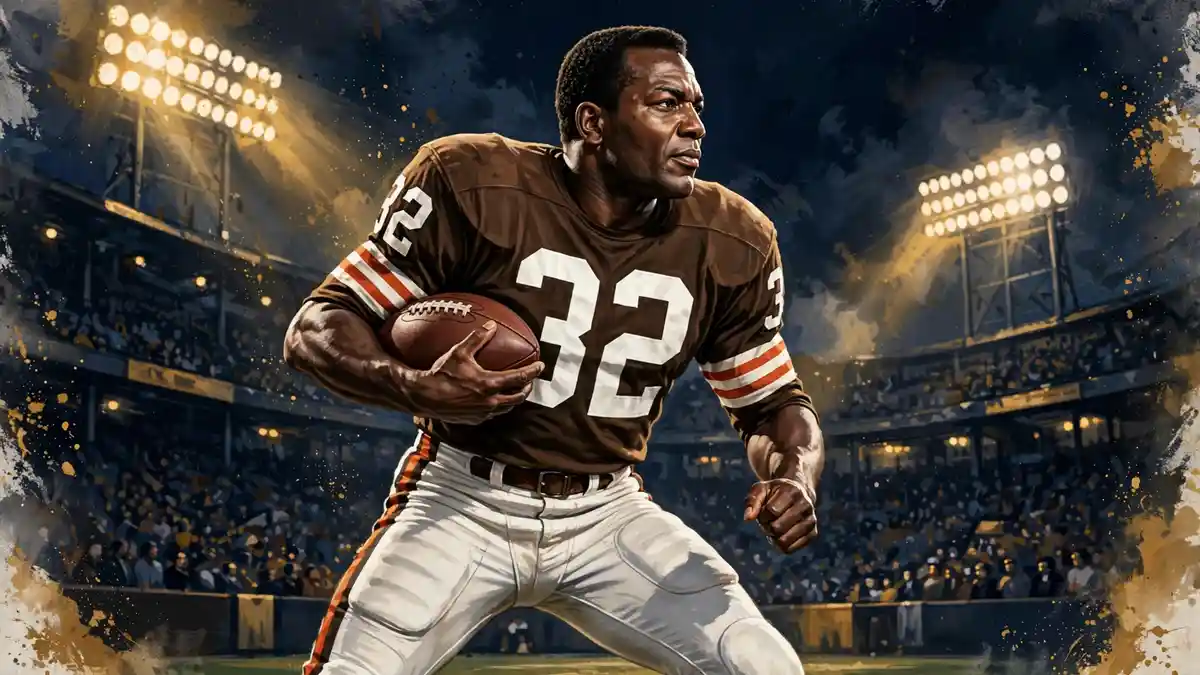
Jim Brown‘s net worth is estimated at $30 million to $55 million as of November 2026. Brown died on May 18, 2023, at the age of 87, so this is his estimated wealth at death rather than a live fortune: Celebrity Net Worth, the most widely cited source on his money, puts the figure at $30 million, while several smaller outlets report $50 million to $55 million. His money came from three distinct careers stacked on top of each other — nine seasons as the most feared running back in NFL history, more than 30 films as a Hollywood leading man, and decades of business and community work that included founding the Black Economic Union and the Amer-I-Can Program. The gap between the two estimates says something real about how hard his fortune is to pin down: his playing pay was modest by modern standards, his acting pay was never made public, and no probate filing ever put a single number on his estate.
Jim Brown: Quick Facts
| Estimated net worth | $30 million at death (Celebrity Net Worth) (range: $30 million to $55 million) |
|---|---|
| Profession | Former NFL running back, actor, civil rights activist |
| Nationality | American |
| Born | February 17, 1936, St. Simons Island, Georgia (age 87 at death on May 18, 2023) |
| Height | 6 ft 2 in (1.88 m) |
| Primary income sources | NFL salary, acting fees, film residuals, appearances, real estate |
| Active years | 1957–1965 (NFL); 1964–2000s (acting) |
| Last reviewed | November 2026 |
- Early Life and Background
- Education
- Career Journey
- Rise to Fame
- Main Sources of Income
- Salary and Earnings
- Businesses and Investments
- Brand Deals and Sponsorships
- Houses, Cars and Other Assets
- Awards and Achievements
- Net Worth Growth Over the Years
- Social Media Presence
- Personal Life
- Sources & Reporting
- Frequently Asked Questions
Early Life and Background
James Nathaniel Brown was born on February 17, 1936, on St. Simons Island, Georgia, a small barrier island off the state’s Atlantic coast. His father, Swinton Brown, was a professional boxer, and his mother, Theresa Brown, worked as a maid. When Jim was still a small child, his parents moved north to New York in search of work, and he was raised largely by his grandmother on St. Simons before joining them on Long Island. The move shaped everything that followed: the island gave him a rural, self-reliant childhood, and Long Island gave him the stage where his talent became impossible to ignore.
At Manhasset High School on Long Island, Brown played five sports and earned 13 varsity letters — football, lacrosse, baseball, basketball, and track. Coaches who saw him then used the same word opponents would use for the next decade: unstoppable. He was fast enough to run track, strong enough to dominate on the lacrosse field, and graceful enough to play basketball at a high level. That range mattered later, because it made him more than a football player in the eyes of college recruiters and, eventually, Hollywood casting directors.
The racial climate of the 1940s and 1950s ran through his childhood like a fault line. St. Simons Island was segregated Georgia; Manhasset was a mostly white Long Island suburb. Brown learned early to hold his ground in rooms where he was the only Black person present, a skill he would use again and again — in Syracuse dormitories, in Southern hotels on NFL road trips, and in the meeting rooms where he organized Black athletes in the 1960s. His grandmother’s discipline and his mother’s work ethic show up in every account of his youth: he was polite, stubborn, and allergic to being told what he could not do.
Money was tight. His mother cleaned houses; his father boxed for purses that were small even by the standards of the day. Brown has said in interviews over the years that watching his mother work long hours for little pay fixed his attitude toward money for life — he wanted to be paid what he was worth, and he wanted Black people around him to own something rather than rent their labor forever. That attitude explains a lot of what came later: the contract fights with the Browns, the decision to leave football at his peak, and the economic organizations he built after retirement.
Education
Brown’s path to Syracuse University ran through a single relationship. Kenneth Molloy, a Syracuse lacrosse star turned lawyer who coached at Manhasset, saw Brown play and pushed his alma mater to admit him. Syracuse was not an easy place for a Black athlete in 1953 — Brown was the only African-American player on the freshman football team — but Molloy believed the school’s lacrosse program and its coaches would give him room to grow. Brown arrived in the fall of 1953 and stayed through 1956, lettering in four sports and winning ten letters in total.
His senior year, 1956, was one of the great single seasons in college football history. Brown was a unanimous All-American, finished fifth in the Heisman Trophy voting, set a school record with a 6.2-yard rushing average, and scored six touchdowns in a single game. He finished the season with 986 rushing yards, third in the nation, and the College Football Hall of Fame’s account of his career notes games of 197, 162, 155, 154, and 151 rushing yards in that final year. The numbers were impressive on their own; the fact that he produced them while also starring in lacrosse and basketball made them look unreal.
Lacrosse may have been the sport where he was most dominant. As a senior he was a first-team All-American in lacrosse, scoring 43 goals in 10 games to rank second in the nation, and he shared the national scoring championship in 1957. His control of the ball was so complete that the sport changed its rules — players were required to keep their sticks in constant motion while carrying the ball, instead of cradling it tight to the body the way Brown did. He was inducted into the National Lacrosse Hall of Fame in 1984, and the Premier Lacrosse League named its Most Valuable Player award after him in 2019. Many lacrosse historians still call him the greatest player the sport has ever seen.
Basketball and track filled out the picture. He averaged 11.3 points per game as a junior and 14 points in one season on the basketball team, and in 1954 he placed fifth in the decathlon at the national AAU track meet. One spring day in 1957, recorded by the College Football Hall of Fame, he won the high jump and javelin, placed second in the discus, and helped Syracuse beat Colgate in a track meet — then changed into his lacrosse uniform and led Syracuse to an 8-6 win over Army. The Cleveland Browns drafted him sixth overall in the 1957 NFL Draft. The Syracuse Nationals of the NBA drafted him too, a footnote that tells you how complete an athlete he was.
Career Journey
Brown’s professional career breaks cleanly into three acts, and the money followed the same shape. Act one was football: nine seasons with the Cleveland Browns, 1957 to 1965, during which he became the most productive running back the league had ever seen. Act two was Hollywood: more than 30 films from 1964 into the 2000s, starting while he was still an active player and becoming his full-time work the moment he retired. Act three was activism and community economics: the Black Economic Union, the Cleveland Summit, and the Amer-I-Can Program, work that paid little in salary and a great deal in influence.
He made his Browns debut in 1957 and rushed for 89 yards against the defending champion New York Giants, 31 of them on the game-winning drive. By season’s end he had led the league with 942 rushing yards and nine touchdowns, earned Rookie of the Year and MVP honors from the Associated Press and The Sporting News, and made the first of nine Pro Bowls in nine seasons. The Browns’ own timeline of his life records that debut as the start of a run that would not slow down for the better part of a decade.
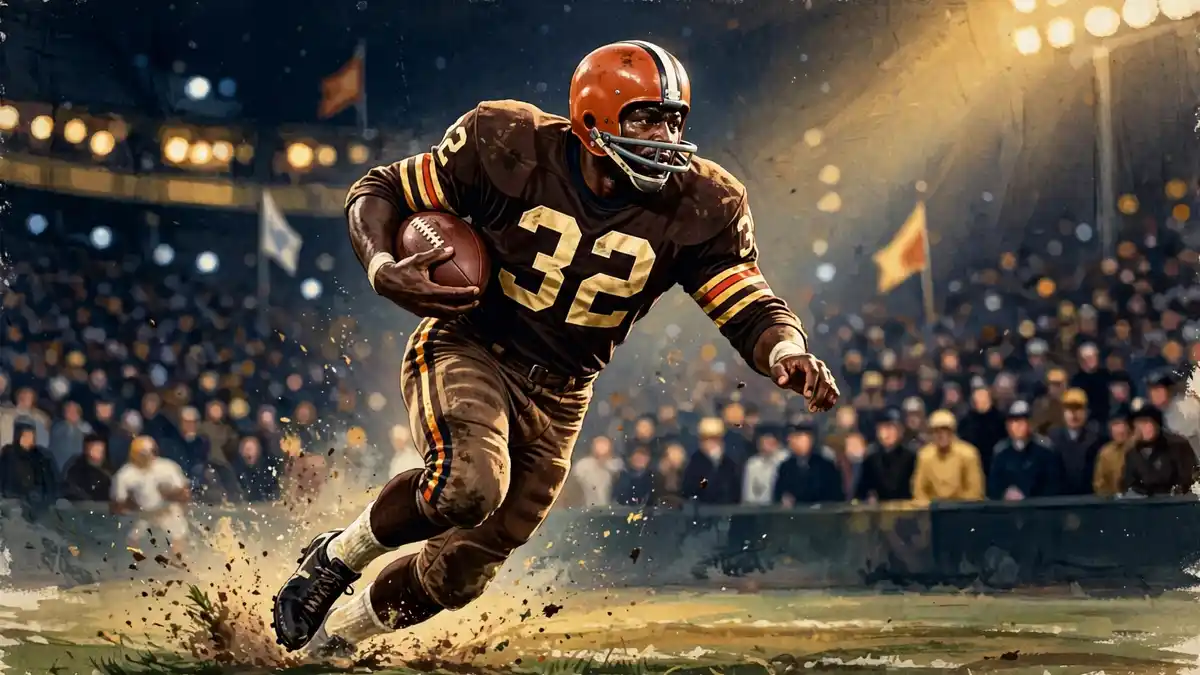
The middle years were a blur of records. Brown led the NFL in rushing eight times in nine seasons. He won the MVP award three times — 1957, 1958, and 1965 — and was a first-team All-Pro eight times. His career totals, confirmed by the Browns’ official timeline, were 12,312 rushing yards and 106 rushing touchdowns in 118 games, plus 2,499 receiving yards and 20 more touchdowns. His career average of 104.3 rushing yards per game still stands as an NFL record, the only player in league history to average more than 100 yards a game over a full career. He set the single-season rushing record with 1,863 yards, a mark that stood until O.J. Simpson broke it in 1973.
The 1964 season gave him the one prize his individual brilliance had not yet delivered: a championship. On December 27, 1964, Brown ran for 114 yards and caught three passes in Cleveland’s 27-0 win over the Baltimore Colts in the NFL Championship game. It was the Browns’ fourth title in franchise history and their first since 1955, and it remains the franchise’s last championship. Brown had already made his film debut that year, in the western Rio Conchos, playing Sergeant Ben Franklyn — a sign of where his attention was drifting.
He retired on July 13, 1966, at the age of 30, by letter and long-distance phone call from London, where he was filming The Dirty Dozen. Owner Art Modell had threatened to fine him $1,500 for every week of training camp he missed because of production delays on the film. Brown chose the film. In his final game, the 1965 NFL Championship loss to Green Bay, he had finished his third MVP season. He left the game holding nearly every rushing record that existed, in his prime, on his own terms. The Pro Football Hall of Fame inducted him in 1971, in his first year of eligibility, alongside Vince Lombardi and Y.A. Tittle.
Rise to Fame
Brown’s fame arrived fast and stayed for sixty years, but it changed shape. In the late 1950s he was famous as a football player — the best runner alive, a man who seemed to break tackles by deciding not to fall down. By the late 1960s he was famous as a movie star, one of the first Black actors to carry action films as a leading man rather than a sidekick. By the 1970s and beyond he was famous as something rarer: an athlete who had walked away from the game and become a political force.
The Dirty Dozen, released in 1967, was the hinge. The film was the fifth-highest-grossing movie of the year, received four Academy Award nominations, and ranked No. 65 on the American Film Institute’s list of the most thrilling American films. Brown played Jefferson, a soldier on a suicide mission, holding his own in an ensemble led by Lee Marvin. The film proved he could act in a major studio picture, and it gave him the standing to keep choosing roles instead of begging for them.
What made his rise different from other athletes-turned-actors was that he never treated Hollywood as a hobby. He worked steadily for four decades, through the blaxploitation era of the early 1970s — Slaughter in 1972 was his first of a handful of films aimed squarely at Black audiences — and into prestige parts late in life, including Mars Attacks! in 1996 and Any Given Sunday in 1999, where he played a headstrong football coach named Montezuma Monroe. Television kept him visible between films, with cameos on CHiPs, Knight Rider, and T.J. Hooker.
His activism gave his fame a second engine. In 1967 he organized the Cleveland Summit, bringing together Muhammad Ali, Bill Russell, Kareem Abdul-Jabbar (then Lew Alcindor), and other leading Black athletes to support Ali’s refusal to enter the military draft for the Vietnam War. The National Museum of African American History and Culture calls the summit one of the most important meetings of athletes in American history. Brown’s role as organizer — not just attendee — put him at the center of the era’s defining sports protest, and it tied his name to Ali’s for the rest of both men’s lives. Readers who want the full picture of that friendship can look at Muhammad Ali’s net worth and career story, which covers the other half of that partnership.
Main Sources of Income
Brown’s income came from five streams, and their balance shifted sharply over his life. Football paid first and paid least in absolute terms. Acting paid second and carried him for the longest stretch. Appearances, speaking engagements, and residuals filled the gaps in later years. Real estate gave him a slow, quiet store of value. And his community organizations, while never profit centers for him personally, kept his name in front of audiences that sustained the other streams.
Football was the foundation but not the fortune. His NFL contracts, documented in auction records, show a rookie deal worth $12,000 a year in 1957 and a peak salary of $100,000 in his final season of 1965. Across nine seasons his total playing pay sat in the low hundreds of thousands of dollars — serious money in the 1960s, when a typical American household earned under $7,000 a year, but a fraction of what a star running back earns in a single season now. The fortune came from what football made possible, not from the paychecks themselves.
Acting was the longest-running income stream. More than 30 films across four decades meant more than 30 paydays, plus residuals that trickled in for years after each release. His per-film fees were never reported publicly, and that silence is part of why his net worth is so hard to pin down — but the volume and the span of the work tell their own story. A working actor with leading-man billing in studio films from the 1960s through the 1990s, plus television guest spots, earned a comfortable living even without a single blockbuster salary.
Later in life, Brown’s name itself became an income source. He was paid for appearances, interviews, documentaries, and speaking engagements, and his memorabilia carried real market value — his original 1957 rookie contract was put up for auction in 2015 with an estimated value of up to $35,000, and his unsigned 1966 contract, the one he walked away from, sold at auction for $3,674.40. Those numbers are small next to a $30 million net worth, but they show a man whose signature and story retained commercial value into his eighties.
The honest picture is that no single stream explains the estimate. Football gave him fame and a modest base. Acting gave him decades of steady pay. Real estate gave him appreciation over half a century. And the activism gave him a public standing that kept the phone ringing long after the film roles slowed down. Anyone who tries to assign his fortune to one of those streams alone is guessing.
Salary and Earnings
The paper trail on Brown’s NFL pay is unusually good for a player of his era, because two of his contracts survive as auction items. His 1957 rookie contract, auctioned by SCP Auctions in 2015, shows an annual salary of $12,000 handwritten in blue ink, plus a $3,000 signing bonus and a payment schedule of 75 percent in weekly installments during the season and 25 percent at the end of the final game. The document was signed by NFL Commissioner Bert Bell. For a 21-year-old from St. Simons Island in 1957, $12,000 was more than double the average American wage — and it was the starting point for the steepest pay climb in football at the time.
His pay rose every year as his production piled up. By 1965, his final season, his salary had reached $100,000, the figure reported by Players Bio and consistent with the era’s top-end pay for a star player. The 1966 contract he never played under — auctioned later by Lelands — agreed to pay him $70,000 for the season, a figure that looks odd next to the $100,000 peak until you remember that NFL contracts in the 1960s were negotiated year to year, and the 1966 number was a base figure before bonuses and incentives. Brown signed that contract in October 1964, when he had just won a championship; he retired in July 1966, weeks before it was due to start.
Adding up the known figures gives a career total in the low hundreds of thousands of dollars. That sounds small until you convert it: $100,000 in 1965 carried the buying power of roughly $1 million in 2026 dollars, and his nine-season total of a few hundred thousand dollars would be worth several million today. Still, the comparison with modern running backs is stark. Today’s top backs earn $15 million or more per season; Brown earned less across his entire career than a modern star earns in a single month. His fortune was built after football, not during it.
Acting pay is the blank space in the record. Studios did not publish salaries for supporting and leading players in the 1960s and 1970s the way they do now, and Brown never discussed his fees in interviews. What can be said with confidence is that he worked constantly — Rio Conchos in 1964, The Dirty Dozen in 1967, Ice Station Zebra in 1968, 100 Rifles in 1969, Slaughter in 1972, and on through Any Given Sunday in 1999 — and that steady employment over 35 years in a unionized industry with residuals adds up. Film historians who study the era put working leading men of his standing in the tens of thousands per picture in the 1960s, rising into six figures by the 1980s and 1990s. Applied across 30-plus films, that range supports a multi-million-dollar acting career, though the exact total is not documented anywhere public.
One more earnings detail is worth noting because it shows how Brown thought about money. When Modell threatened the $1,500-a-week fines for missing training camp in 1966, Brown did the arithmetic and walked away — not because the fines would ruin him, but because the film paid more and the principle mattered. He was, by every account, the first football star to treat his athletic career as a negotiating position rather than a life sentence. That instinct — get paid what you are worth, and leave when the price is wrong — runs through his whole financial story.
| Year / Deal | Reported Figure | Source |
|---|---|---|
| 1957 rookie contract | $12,000 salary + $3,000 signing bonus | SCP Auctions contract document |
| 1965 peak NFL salary | $100,000 | Players Bio |
| 1966 contract (never played) | $70,000 | Lelands auction listing |
| Career NFL pay (9 seasons) | Low hundreds of thousands (nominal) | Calculated from reported contracts |
| Net worth at death (2023) | $30 million (Celebrity Net Worth); $50M–$55M (other outlets) | See Sources & Reporting |
Businesses and Investments
Brown’s business life was inseparable from his activism. In 1965 he founded the Negro Industrial and Economic Union, later renamed the Black Economic Union, to help Black-owned businesses get capital, advice, and contracts. A Mississippi Senate resolution honoring him in 2003 recorded that more than 100 African-American businesses benefited from the Union’s capital support and expertise. The Union was not a personal money machine — it was a vehicle for moving money to other people — but it established Brown as a businessman in the eyes of corporate America, and it gave him a network of executives and entrepreneurs that lasted the rest of his life.
The Amer-I-Can Program, founded in 1988, was his longest-running organization. Built around a life-skills curriculum teaching responsibility and self-determination, it operated in schools, prisons, and communities across more than a dozen states, and a Mississippi resolution noted that tens of thousands of inmates, students, officers, and residents had been trained through it. The program drew real public money: Youth Today reported in 2005 that Amer-I-Can had received $1.7 million in congressional earmarks over the previous four years, and that a Cleveland partnership with Mayor Jane Campbell carried a $300,000 budget from the city’s Empowerment Zone fund. That funding went to the program, not to Brown personally, but running an organization of that size for 35 years required the same skills as running a business — fundraising, payroll, partnerships, and public accountability.
His earlier community work followed the same pattern. In 1980 he became involved with the Coor Golden Door and Barriers programs, job-creation efforts aimed at helping ex-convicts re-enter society. During the 1992 Los Angeles uprising he worked to keep peace between warring gang sets, work that later grew into Amer-I-Can’s gang-intervention programs. None of this generated personal profit in the conventional sense. It generated something else: a reputation as a man who could walk into any room in America — a boardroom, a prison yard, a film set — and be taken seriously. That reputation was the asset that kept his later income streams alive.
As an investor, Brown left almost no public record. There are no filings, no company directorships, and no venture stakes attached to his name the way there are for modern athletes. What he owned, as far as the public record shows, was property and his own name. The Hollywood Hills home he bought in 1968, reported by Players Bio at a later value of about $10 million, was likely his largest single asset. Beyond that, the honest statement is that his investments are undocumented — and any article that invents a portfolio for him is fabricating.
Brand Deals and Sponsorships
Brown played and acted before the endorsement era existed in its modern form. In the 1950s and 1960s, NFL players did not sign shoe deals worth millions or appear in national ad campaigns as a matter of course; the league’s commercial machine was a fraction of its current size, and Black athletes in particular were rarely offered the national campaigns that went to white stars. Brown’s name appears in no major endorsement archive from his playing days, and that absence is itself a data point: a share of his fortune that a modern star would earn from sponsors simply was not available to him.
What he did have, later in life, was the paid-appearance circuit. Hall of Famers of his stature are paid for autograph shows, memorabilia conventions, corporate events, and documentary interviews, and Brown’s memorabilia market was active into his final years — the auction prices for his contracts show collectors paying thousands for his signature on paper. He also lent his name to charitable events, including a 2015 Super Bowl-week Legends of Football fundraiser for Amer-I-Can that featured donated electric bicycles from EVantage USA. Those appearances raised money for the program rather than for Brown, but they kept his public profile high enough to support the appearance fees he did collect.
The comparison with today’s athletes is instructive. A modern running back with Brown’s profile would earn more from endorsements in a year than Brown earned from football in his whole career. That is not a judgment on Brown’s business sense — it is a measure of how much the market changed after he left it. His wealth came from work, property, and longevity, not from a sponsor’s logo.

Houses, Cars and Other Assets
Brown’s best-documented asset was his home in the Hollywood Hills, which he bought in 1968, two years after retiring from football and one year after The Dirty Dozen made him a movie star. Players Bio reports the property was later valued at about $10 million. That figure comes from a single outlet and should be treated as reported rather than verified — no property record with a matching valuation has been published — but the purchase itself is well documented, and a Hollywood Hills home bought in 1968 and held for 55 years would have appreciated enormously under any reasonable assumption. He died at his home in Los Angeles in 2023, and the house was the center of his life for more than half a century.
He kept a low profile about cars and other luxury purchases, and the public record reflects that. Unlike modern athletes whose car collections are catalogued on social media, Brown’s vehicles were rarely mentioned in reporting. What is known is that he lived comfortably but not ostentatiously in his later years, and that his spending habits were shaped by the lean years of his childhood. Friends and interviewers described a man who was generous with his time and his money when it came to his programs, and careful with both when it came to himself.
His memorabilia had market value of its own. Game-worn items, signed footballs, and contracts bearing his signature traded at auction for thousands of dollars, and the 2015 auction of his rookie contract — with a pre-sale estimate of up to $35,000 — showed that collectors treated his paper trail as history worth paying for. Those items were assets in the literal sense, though small ones next to the house.
One thing the record does not support is a large property portfolio. There is no evidence Brown owned multiple homes or a string of rental properties, and the $30 million estimate is best understood as the sum of a long acting career, a valuable Los Angeles home held for decades, residuals, and savings — not a real-estate empire. The $50 million to $55 million figures from weaker outlets would require either a much larger property holding or a much larger acting fortune than the documented record supports, which is why this article anchors on the lower figure and shows the range.
Awards and Achievements
Brown’s trophy case is one of the fullest in American sports. In the NFL he was a nine-time Pro Bowler — every season he played — an eight-time first-team All-Pro, a three-time MVP, the 1957 Rookie of the Year, and an NFL champion in 1964. He led the league in rushing eight times and in rushing touchdowns five times. He was inducted into the Pro Football Hall of Fame in 1971, the College Football Hall of Fame in 1995, and the National Lacrosse Hall of Fame in 1984. Syracuse retired his number 44.
The honors outside football mattered as much to him. He won the Hickok Belt as the top professional athlete of 1964. Sports Illustrated gave him the Muhammad Ali Legacy Award in 2016, recognizing athletes who use their platform for social change. He received the Muhammad Ali Lifetime Humanitarian Achievement Award in 2014. In 2019 the Premier Lacrosse League named its MVP award after him, a rare honor for a man who had not played the sport in six decades — and a sign of how completely he had owned it.
The most durable achievement may be the one that has no trophy: the Cleveland Summit of June 4, 1967. Twelve men — eleven athletes and one politician — met in an office on Euclid Avenue in Cleveland and issued a unified statement supporting Muhammad Ali’s refusal to be drafted. The meeting is now taught in history courses and cited in museum exhibitions, and Brown’s role as its organizer is the reason his name appears in civil-rights histories as well as sports histories. He was 31 years old, a year out of football, and already shaping a second legacy.
Net Worth Growth Over the Years
Brown’s wealth grew in the opposite pattern to most modern athletes. Modern stars earn their biggest paydays first and then try to hold on to the money; Brown earned his smallest paydays first and built the fortune slowly, over six decades, from work that kept coming. The table below tracks the arc with the figures the record actually supports, rather than inventing a year-by-year net worth that no source has published.
| Period | What Happened | Financial Picture |
|---|---|---|
| 1957–1965 | NFL career, Cleveland Browns | Salary rose from $12,000 to $100,000; career pay in the low hundreds of thousands |
| 1964–1972 | Film debut, The Dirty Dozen, leading-man run | Acting fees replace football pay; Hollywood Hills home bought in 1968 |
| 1970s–1980s | 30+ films, television work, Black Economic Union | Steady acting income plus residuals; community organizations founded |
| 1988–2000s | Amer-I-Can founded; Mars Attacks!, Any Given Sunday | Program funding of $1.7M in earmarks (2001–2005); late-career film and appearance income |
| 2010s–2023 | Appearances, documentaries, memorabilia market | Property appreciation; estimated wealth at death $30M–$55M |
The slow-build pattern explains why the two published estimates differ so widely. Celebrity Net Worth’s $30 million reflects the documented record: modest football pay, a solid but never blockbuster acting career, and one valuable home. The $50 million to $55 million figures from sites like GossipGist, WikiCelebs, and Gudstory appear to assume larger acting earnings and larger property holdings than any public record supports — and none of those outlets shows its working. Readers should treat $30 million as the best-supported figure and $50 million to $55 million as the optimistic end of the range.
Inflation adds useful context. Brown’s $100,000 peak salary in 1965 would be worth about $1 million in 2026 dollars. His $12,000 rookie salary would be about $135,000 today. And his entire nine-season NFL pay, converted to today’s dollars, would be worth several million — a comfortable sum, but not a fortune. The fortune came from the 58 years after he stopped playing football, which is the part of the story most net-worth pages skip.
For comparison, the NFL’s economics have moved so far that the contrast is almost comic. The league’s current commissioner, whose pay is covered in our profile of Roger Goodell’s net worth, earns in a single year many times what Brown earned in his whole playing career. Running backs of the modern era, like Adrian Peterson, whose net worth we profiled separately, built their fortunes on contracts Brown’s generation could not have imagined. Brown’s story is a reminder that the athletes who built the league’s value were paid a tiny fraction of it.
Social Media Presence
Brown belonged to the generation before social media, and he never built a personal following on it. He had no verified Instagram, X, or TikTok account of his own, and he did not post about his life or his money. What social media record exists comes from the people around him: his wife Monique announced his death on Instagram on May 19, 2023, writing, “It is with great sadness that I announce the passing of my husband, Jim.” The post was shared thousands of times and became the primary source for the death announcement carried by the Browns, the NFL, and every major outlet.
His public presence in his final decades came through interviews, documentaries, and public appearances instead. He gave long-form interviews into his eighties, including a 2013 conversation with NFL Network and a 2020 fireside chat about the Amer-I-Can Program with his wife, and he appeared in documentaries about the Cleveland Summit and the history of Black athletes. The absence of a social media footprint is worth stating plainly, because many net-worth pages invent follower counts for dead celebrities. Brown had none to report, and his fame never needed them.
Personal Life
Brown married twice. His first marriage, to Sue Brown (née Jones), began in September 1959 and ended in divorce in 1972. They had three children together, including twins born in 1960 and a son born in 1962. The divorce settlement, reported at the time, required Brown to pay $2,500 a month in child support plus $100 a week — substantial sums in the early 1970s, and a reminder that his post-football income was already supporting a family well before his acting career peaked.
He married his second wife, Monique Brown, in 1997, and they had two children together, a son named Aris and a daughter named Morgan. Monique was with him when he died at their Los Angeles home on May 18, 2023, and she announced his death publicly. Reporting on the full family is inconsistent — some outlets count six children, others seven — because Brown had children from relationships outside his two marriages as well. The six most commonly named are Jim Jr., Kimberly, Karen, Kevin, Aris, and Morgan.
His personal life included serious trouble that any honest profile has to record. He was arrested several times over the decades, including assault allegations, and in 1999 he was convicted of vandalism after an incident involving his wife’s car. A later filing by a family member alleged that he suffered cognitive decline, dementia, and Parkinson’s disease linked to chronic traumatic encephalopathy from his football career. His family has said he died of natural causes at home, surrounded by family, and no official cause beyond natural causes has been published.
Those difficulties cost him money and reputation at various points — legal fees, settlements, and lost work all cut into earnings that might otherwise have compounded. They also form part of why the $30 million figure is more plausible than the higher ones: a career interrupted by court cases and controversy earns less than a smooth one. The full picture of Brown is a man of extraordinary talent and willpower who made choices, on and off the field, that had real financial consequences.
Sources & Reporting
Celebrity Net Worth — the $30 million at-death estimate and the core biographical facts (born February 17, 1936; died May 18, 2023, age 87; marriages to Sue Brown and Monique Brown; 30-plus films). Reporting window: profile updated October 25, 2024.
Cleveland Browns (official team site) — the career timeline: 1957 debut and Rookie of the Year honors, the 1964 championship, the 1966 retirement by letter and phone call from London, career totals of 12,312 rushing yards and 106 touchdowns, the 104.3 yards-per-game record, and The Dirty Dozen’s box-office and awards record. Reporting window: timeline published at his death, May 2023.
SCP Auctions — the 1957 rookie contract document: $12,000 annual salary, $3,000 signing bonus, payment schedule, Commissioner Bert Bell’s signature, and the $35,000 pre-sale estimate. Reporting window: April 2015 auction.
Lelands Auctions — the 1966 pre-retirement contract: $70,000 for the season he never played, signed October 1964, and the $1,500-a-week fine threat from Art Modell. Reporting window: auction listing, accessed November 2026.
Players Bio — the $100,000 peak salary in 1965, the Hollywood Hills home purchased in 1968 and reported at about $10 million, and the $30 million net-worth figure. Reporting window: article published November 4, 2024, updated November 19, 2024.
Wikipedia (Jim Brown; Cleveland Summit) — Syracuse career details (unanimous All-American 1956, fifth in Heisman voting, lacrosse rule change, Premier Lacrosse League MVP award named for him), the Cleveland Summit date of June 4, 1967, and its twelve participants. Reporting window: pages accessed November 2026.
College Football Hall of Fame — the 1956 season (986 rushing yards, third in the nation), ten letters in four sports, the fifth-place AAU decathlon finish in 1954, and the single-day track-and-lacrosse double against Colgate and Army in 1957. Reporting window: inductee profile, accessed November 2026.
National Museum of African American History and Culture — the Cleveland Summit’s significance, the Ali support statement, and Brown’s post-NFL focus on Black economic development. Reporting window: profile accessed November 2026.
Youth Today — Amer-I-Can’s $1.7 million in congressional earmarks over four years and the $300,000 Cleveland Empowerment Zone partnership with Mayor Jane Campbell. Reporting window: March 2005.
EisnerAmper — the 2020 fireside chat with Jim and Monique Brown on the Amer-I-Can Program, the Black Economic Union’s founding, and the program’s life-skills curriculum. Reporting window: November 23, 2020.
Mississippi Legislature — Senate Resolution No. 62 (2003) honoring Brown: the Negro Industrial and Economic Union’s support for more than 100 Black businesses, Amer-I-Can’s founding in 1988, and its reach across more than a dozen states. Reporting window: 2003 session.
GossipGist, WikiCelebs, and Gudstory — the higher $50 million to $55 million estimates, cited here only to show the range and flagged as lower-authority outlets that do not show their working. Reporting window: 2023–2025.
All figures were checked against at least one named source before publication. Where sources disagreed, the article reports the range and names who says what. Jim Brown died in 2023, so no new net-worth reporting is expected; the estimate reflects his wealth at death.
Frequently Asked Questions
What was Jim Brown’s net worth when he died?
Jim Brown’s net worth was estimated at $30 million at the time of his death on May 18, 2023, according to Celebrity Net Worth, the most widely cited source. Some smaller outlets report $50 million to $55 million, so the honest range is $30 million to $55 million, with $30 million the best-supported figure.
How much did Jim Brown make in the NFL?
His documented contracts show a rookie salary of $12,000 in 1957 plus a $3,000 signing bonus, rising to a peak of $100,000 in his final season of 1965. Across nine seasons his total NFL pay was in the low hundreds of thousands of dollars — modest by modern standards, though $100,000 in 1965 carried the buying power of about $1 million today.
Why did Jim Brown retire at 30?
Brown retired on July 13, 1966, while filming The Dirty Dozen in London. Production delays made him miss the start of Browns training camp, and owner Art Modell threatened to fine him $1,500 for every week he missed. Brown chose the film over the fines and announced his retirement by letter and phone call, walking away in his prime with nearly every rushing record in the book.
What movies was Jim Brown in?
He appeared in more than 30 films, starting with Rio Conchos in 1964. His best-known roles were in The Dirty Dozen (1967), Ice Station Zebra (1968), 100 Rifles (1969), Slaughter (1972), Mars Attacks! (1996), and Any Given Sunday (1999), where he played coach Montezuma Monroe. He also made television appearances on CHiPs, Knight Rider, and T.J. Hooker.
How did Jim Brown die?
Brown died of natural causes at his home in Los Angeles on May 18, 2023, at the age of 87, with his wife Monique by his side. Monique announced his death on Instagram the next day. A later family filing alleged he had suffered cognitive decline, dementia, and Parkinson’s disease linked to football-related head injuries, but the family has said he died of natural causes.
Who was Jim Brown’s wife?
Brown was married twice. His first wife was Sue Brown (née Jones), whom he married in September 1959; they divorced in 1972 and had three children. His second wife was Monique Brown, whom he married in 1997; they had two children, Aris and Morgan, and remained married until his death in 2023.
How many children did Jim Brown have?
Reporting differs, with most outlets counting six children: Jim Jr., Kimberly, Karen, and Kevin from his first marriage and earlier relationships, plus Aris and Morgan with his second wife Monique. Some outlets count seven, reflecting children from relationships outside his two marriages.
Was Jim Brown the greatest running back of all time?
Many historians and players say yes. He led the NFL in rushing eight times in nine seasons, won three MVP awards, made the Pro Bowl every year he played, and still holds the career record of 104.3 rushing yards per game. He was inducted into the Pro Football Hall of Fame in 1971 in his first year of eligibility, and he is also in the College Football and Lacrosse Halls of Fame.
Final Thoughts
Jim Brown’s money story is the opposite of the modern athlete’s. He was the best football player alive and got paid like a well-paid professional of his day — $12,000 as a rookie, $100,000 at his peak — then built a fortune slowly, over 58 years, from acting fees, residuals, and a Los Angeles home bought in 1968 and held until his death. The $30 million figure from Celebrity Net Worth is the one the documented record supports; the $50 million to $55 million numbers floating around weaker sites would need earnings or property that no public record shows.
What makes the number interesting is not its size but what it leaves out. No salary figure captures the Cleveland Summit, the Black Economic Union, or the tens of thousands of people trained through Amer-I-Can. Brown spent his second and third acts building things that paid other people, and he did it after walking away from football at 30 because a team owner tried to fine him for being late to camp. He was, in the end, a man who understood his own value better than the market did — and who charged accordingly, whether the buyer was the Cleveland Browns, a Hollywood studio, or history itself.
Published on November 10, 2026. Last reviewed November 2026. Found an error? See our corrections policy.