
Jimmy Connors‘s net worth is estimated at $30 million as of November 2026. The figure comes from Celebrity Net Worth, the most widely cited tracker of his fortune, and it sits in the middle of a published range that runs from $12 million at the low end to $50 million at the high end. The money traces back to a 24-year playing career that produced a men’s record 109 singles titles, eight Grand Slam singles crowns and $8,641,040 in official prize money — a record total when he retired in 1996 — followed by endorsements, a 2013 memoir, coaching fees, a long-running podcast and California real estate.
Jimmy Connors: Quick Facts
| Estimated net worth | $30 million (range: $12 million–$50 million) |
|---|---|
| Profession | Retired professional tennis player, coach, author, podcaster |
| Nationality | American |
| Born | September 2, 1952 (age 74) |
| Height | 5 ft 10 in (1.78 m) |
| Primary income sources | Tournament prize money, endorsements, exhibitions, memoir royalties, coaching, podcasting, real estate |
| Active years | 1972–1996 (playing career) |
| Last reviewed | November 2026 |
- Early Life and Background
- Education
- Career Journey
- Rise to Fame
- Main Sources of Income
- Salary and Earnings
- Businesses and Investments
- Brand Deals and Sponsorships
- Houses, Cars and Other Assets
- Awards and Achievements
- Net Worth Growth Over the Years
- Social Media Presence
- Personal Life
- Sources & Reporting
- Frequently Asked Questions
- Final Thoughts
Early Life and Background
James Scott Connors was born on September 2, 1952, in East St. Louis, Illinois, and grew up across the river in Belleville, a working-class town where tennis was a country-club game and he was very much an outsider to it. His mother, Gloria Connors, was a tennis teacher who had played the sport herself, and she put a racket in her son’s hands when he was a small child. She coached him, drilled him, travelled with him and, by his own later account in his memoir, shaped almost every part of his game and his will. His father, James Connors Sr., ran a business and, like his wife, backed the boy’s tennis from the start. Jimmy had an older brother, John, who also played and later became his business partner in ventures that did not all end well.
The family set-up was unusual for American tennis in the 1960s. Gloria did not send her son to a distant academy and wait for results. She stood on the court with him, hitting balls, correcting his grip, and teaching him the two-handed backhand that became his signature shot. At a time when most top players hit one-handed backhands, Connors hit his with two hands off both sides — flat, hard and early, taking the ball on the rise and giving opponents no time to breathe. His mother also taught him to return serve standing almost on top of the baseline, another habit that looked reckless and turned out to be a weapon.
By his early teens Connors was winning junior titles and drawing notice as a player who fought for every point in a way that made crowds either love him or hate him. He played with a snarl, argued with officials, pumped his fist and talked to the crowd. The tennis establishment of the day, built around quiet manners and white clothing, did not know what to do with him. That friction became the defining story of his career: a working-class kid from Belleville who treated the sport’s polite traditions as something to be kicked over, and who backed the attitude up by winning more matches than any man before him.
Money was not part of the family’s early tennis life. The Connors household was comfortable but not rich, and the boy’s route to the top ran through public courts and his mother’s lessons rather than through a private academy. That background matters to the money story because Connors never had the cushion of family wealth. Every dollar of the fortune he later held came from the game itself, from the deals the game brought him and from the investments he made with the winnings. It also explains the chip on his shoulder that made him such a draw: crowds paid to see a player who looked and sounded like he needed the win more than the man across the net.
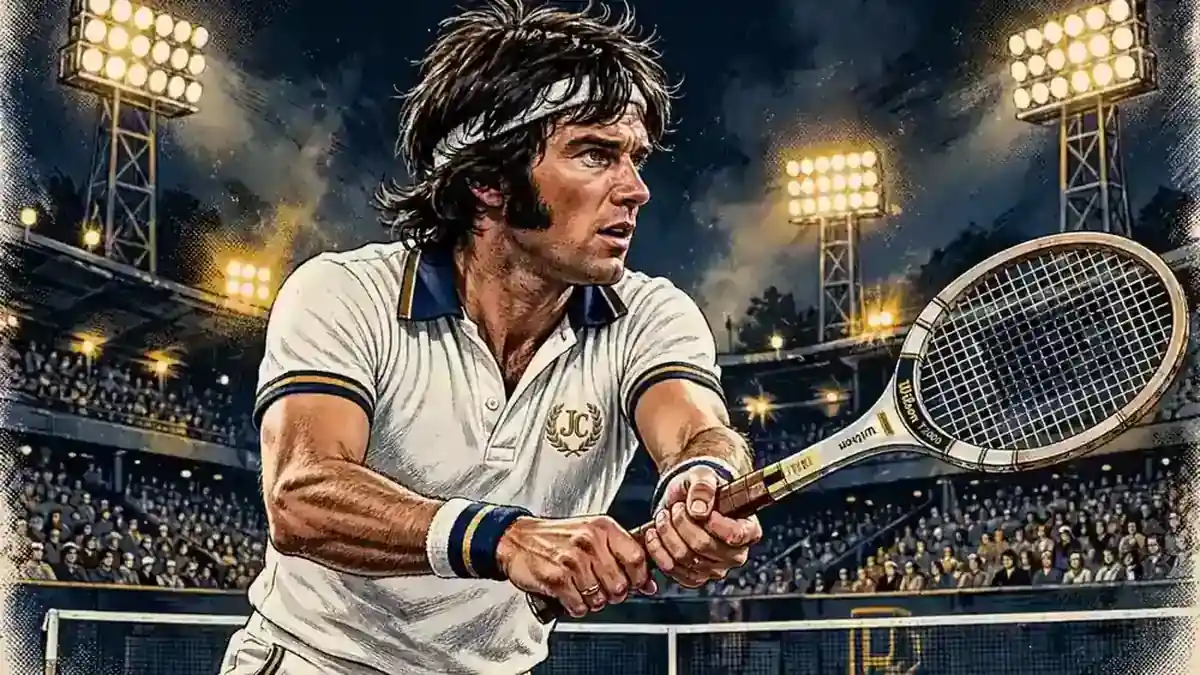
As a teenager he moved to California to work with Pancho Segura, the former champion who had become one of the game’s great coaches. Segura refined the raw aggression Gloria had built, teaching Connors how to construct points and how to use his flat groundstrokes on faster surfaces. The move put him in the heart of the California tennis scene, close to the tournaments and the sponsors that would soon matter. By the time he turned professional in 1972, at 19, he was already marked as the next American star — and already playing with the steel Wilson T2000 racket that became as much a part of his image as the headband and the snarl.
Education
Connors did not follow the college-tennis path that many American players of his generation took. He attended school in Belleville and finished his formal education there, but the record shows no university degree and no college tennis career. His schooling was the junior circuit, the practice court with his mother and, from his mid-teens, full-time work with Pancho Segura in California. In that sense his education was a tennis education, paid for in hours on court rather than in tuition.
It is worth saying plainly because it shapes the earnings story. Connors turned pro at 19 with no fallback career and no degree to lean on. The gamble was total: if the tennis did not pay, there was no second profession waiting. The gamble paid off beyond anything he could have imagined in Belleville, but the same all-or-nothing wiring showed up later in his financial life too, most clearly in the riverboat casino investment he made with his brother John, which cost him millions. He learned the game on court and learned money the hard way, in public, with real losses attached.
Later in life Connors became a student of the sport in a different sense, as a coach and a broadcaster and, with his son Brett, as a podcaster. The Advantage Connors podcast, which he has recorded for years, is essentially a weekly tennis seminar: he breaks down modern players, tells stories from his own career and argues about the state of the game. It is the closest thing he has to a classroom, and it keeps his name in front of a new generation of tennis fans who never saw him play.
Career Journey
Connors turned professional in 1972 and won his first titles almost at once. The early 1970s were a fractured time in tennis: rival circuits, competing promoters and arguments over who could play where. Connors, managed in those years by Bill Riordan, was at the centre of the disputes. He played where the money was, skipped events when it suited him and sued his way into tournaments when organisers tried to keep him out. In 1974, at 21, he won three of the four Grand Slam singles titles — the Australian Open, Wimbledon and the US Open — and missed the French Open only because he was barred from it for playing World Team Tennis, a rival league the French federation refused to recognise. No man has won three majors in a season under stranger circumstances, and the ban cost him a shot at the calendar Grand Slam.
His 1974 season remains one of the great single years in tennis history. He won 99 matches and lost 4, took 15 titles, and finished the year as world No. 1, a ranking he would hold for 160 consecutive weeks from July 1974 to August 1977. The streak stood as a record for decades. He reached No. 1 in a period when the ranking system was still young, and he stayed there by playing more and winning more than anyone else on tour. Between 1974 and 1978 he won five US Open titles and two Wimbledons, and his rivalries with Bjorn Borg and John McEnroe turned tennis into appointment television.
The Borg rivalry was a study in contrast. Borg was cool, silent and metronomic from the baseline; Connors was loud, combative and flat-hitting. Their 1977 Wimbledon final, which Borg won in five sets, is still shown in highlight reels, and their matches filled stadiums and pushed television ratings to levels tennis had never seen. The McEnroe rivalry, which peaked in the early 1980s, was even hotter: two Americans who argued with officials, argued with each other and played some of the most ferocious tennis ever seen on a court. Their 1982 Wimbledon final, won by Connors in five sets, came when he was 29 and supposedly past his best. He won the US Open again that year and once more in 1983, at 31.
What set Connors apart from almost every other great player was longevity. He won his first Grand Slam singles title in 1974 and his last in 1983, and he was still reaching Grand Slam semi-finals at the end of the decade. In 1991, at 39, he made a run to the US Open semi-finals that remains one of the most famous fortnights in the sport’s history. He came from two sets down against Aaron Krickstein in the fourth round, a match that ended near midnight with the New York crowd on its feet, and beat Paul Haarhuis in the quarter-finals before losing to Jim Courier in the semis. The run turned a player many had written off into a folk hero for a second time, and it sold out Louis Armstrong Stadium night after night. He retired in 1996, at 43, with 109 singles titles — still the men’s record, ahead of Roger Federer on 103 — and a singles win-loss record of 1,274–283.
Connors also won 16 doubles titles, including two Grand Slam doubles crowns — Wimbledon in 1973 and the US Open in 1975, both with Ilie Nastase — taking his total of Grand Slam titles to ten. He was inducted into the International Tennis Hall of Fame in 1998, two years after he stopped playing. The Hall of Fame citation noted the 109 titles, the 268 total weeks at No. 1 and the eight singles majors — numbers that still sit near the top of every all-time list. For a player who started as a working-class outsider from Belleville, the Hall of Fame plaque closed the argument about where he belonged in the sport’s history.
Rise to Fame
Connors became famous fast, and not only for winning. In 1974 he won the Australian Open, Wimbledon and the US Open in the same season, and his engagement to Chris Evert — the women’s star of the moment, then 19 — made the two of them the golden couple of American tennis. The tabloids called them the sport’s sweethearts. The romance itself was the story, and it was covered like a royal wedding. The engagement ended in 1974 before the wedding, and Connors wrote about the break-up with unflinching candour in his memoir nearly forty years later. The episode made him a celebrity beyond tennis, a player whose private life was news in a way no tennis player’s had been before.
His fame also came from the way he played the crowd. Connors talked to the stands, pumped his fist, stared down opponents and argued line calls with a fury that umpires found exhausting and crowds found thrilling. He was nicknamed “the Brash Basher of Belleville” by the late broadcaster Bud Collins, a label that stuck because it was accurate. In an era when tennis still expected players to behave like gentlemen, Connors behaved like a prizefighter, and the crowds grew because of it. His matches with Borg and McEnroe were the sport’s first true box-office rivalries, and the television money that flowed into tennis in the late 1970s and early 1980s — the money that eventually paid the purses he collected — followed the noise he made.
The 1991 US Open run gave him a second wave of fame. At 39, an age when almost every tennis player is years into retirement, he beat players half his age and turned the night sessions at Flushing Meadows into a nightly party. The Krickstein match, which he won 3–6, 7–6, 1–6, 6–3, 7–6, is still replayed as the defining match of his career. The run ended in the semi-finals, but it made him a star to a generation that had never seen him in his prime. It also mattered commercially: the run revived his market value, led to exhibition offers and kept his name in the sport’s conversation for years after he finally retired.
After retirement, fame came in quieter forms. His memoir, The Outsider, published by Harper in May 2013, put him back on the bestseller lists and back on television. Coaching Andy Roddick from 2006 to 2008 and a one-match stint with Maria Sharapova in 2013 put him back in the coaching box at majors. The Advantage Connors podcast, which he records with his son Brett, has given him a steady modern audience. At 74, he is still a working voice in tennis — and still, to many fans, the most entertaining one the sport ever produced.
Main Sources of Income
Connors earned money in six distinct ways across his life, and the mix changed as he aged. The first was prize money: $8,641,040 across his career, according to the ATP’s official records, a figure that was the all-time record when he retired in 1996. The second was endorsements: racket, clothing, shoe and watch deals that ran through the 1970s and 1980s, when he was one of the most marketable athletes in America. The third was exhibitions and appearance fees, a large and often under-reported income stream in his era, when promoters paid top players five- and six-figure guarantees to play one-off matches outside the tour. The fourth was coaching, most notably the 19-month stint with Andy Roddick from 2006 to 2008. The fifth was writing: The Outsider, his 2013 memoir, and the media work around it. The sixth was real estate, anchored by his Montecito home in California, which he listed for $9.5 million in June 2021.
The prize money number needs context. $8.6 million sounds small next to the sums modern players collect — Jannik Sinner earned $12 million from two exhibition events in Saudi Arabia, more than Connors earned in his whole career, a comparison Tennishead drew in 2026 — but the figure is not adjusted for inflation, and the purses of the 1970s were a fraction of today’s. In 1974, the year Connors won three majors, the US Open champion’s cheque was $22,500. By the end of his career, major winners were collecting hundreds of thousands. The $8.6 million he banked was earned in a sport that paid its stars far less than it does now, and it was the biggest total anyone had earned when he stopped. Adjusted for inflation, his prize money alone would be worth several times its face value in today’s dollars, and his endorsement income was at least as large again.
Exhibitions deserve a closer look because they were a serious income line for Connors and his rivals. In the 1970s and 1980s, promoters staged made-for-TV matches and one-night stands that paid guarantees far above what a tournament round was worth. Connors, Borg and McEnroe could command large fees for a single evening’s work, and Connors played plenty of them. No reliable public ledger of those fees exists — promoters did not publish them — but the tennis press of the era reported guarantees in the tens of thousands of dollars per match, and Connors was the most reliable box-office draw of the three. It is fair to say exhibitions added a substantial sum to his career earnings, likely in the low millions, though the exact figure is not documented and we do not invent one.
After 1996 the income mix flipped. The prize money stopped, and the money came from his name instead: coaching fees, the memoir advance and royalties, broadcasting and commentary work, the podcast, personal appearances and the slow appreciation of the Montecito property. None of these streams has the documentation of his ATP prize money, which is why the net worth range is as wide as it is. The $30 million anchored estimate assumes his post-career income and his property holdings more than tripled his documented prize money; the $12 million low-end estimate assumes his losses — above all the riverboat casino investment — ate deeply into it. Both stories are consistent with the public record, which is why the range, not a single number, is the honest answer.

Salary and Earnings
Tennis players do not draw a salary, so Connors never had a pay cheque in the ordinary sense. His earnings came match by match, tournament by tournament, and the ATP’s official career prize-money total of $8,641,040 is the one number in his financial story that is beyond dispute. Salary Sport, which republishes ATP earnings data, lists the same total, and Tennishead repeated it in 2026. He won 109 singles titles and 16 doubles titles across 22 seasons on tour, and his best single season for prize money came late in his career, when purses had grown: his 1980s seasons were far more lucrative than his record-breaking 1974, a quirk of how fast tennis money grew while he was still playing.
The year-by-year picture shows the sport’s money exploding around him. In 1974 he won 15 titles and 99 matches, but the cheques were small by modern standards: the Wimbledon champion’s prize that year was £10,000, about $24,000 at the exchange rate of the day. By the early 1980s, when he won his last two US Opens, the winner’s cheque at Flushing Meadows had risen past $100,000. By his final seasons, tournament winners at the biggest events were collecting several hundred thousand dollars. Connors earned most of his prize money in the back half of his career, not the front, even though his best tennis was in the 1970s.
There is a useful comparison inside his own record. His 109 titles are the men’s record; his 1,274 match wins are also a record. No player in history has won more matches or more titles, and those numbers came with the prize money attached to each win. But the purses he played for were the purses of a sport still growing into its television money. Rafael Nadal, whose career overlapped the modern money era, earned more than $130 million in prize money alone — a figure that shows how much the sport changed after Connors stopped. Our profile of Rafael Nadal’s net worth traces how the modern prize-money boom rewrote the economics of the same job Connors did for a fraction of the pay.
Endorsement income filled much of the gap. Connors’s deal with Wilson, built around the steel T2000 racket he used for most of his career, was one of the most famous equipment partnerships in tennis, and his clothing and shoe deals — with Fila and others at various points — paid him through the peak years. Velontia, in its 2026 profile, put his endorsement earnings at $15–$20 million across his career and named Wilson, Fila and Rolex among the brands; PlayersBio names Nike, Wilson, Reebok, Nestlé and Slazenger among his sponsors. The lists differ because the deals changed over 24 years and because neither outlet shows its workings, so we report the brand names with their sources and treat the $15–$20 million total as Velontia’s estimate, not a verified figure. What is certain is that his endorsement income was large: he was the most recognisable tennis player in America for a decade, and brands paid for that.
Coaching fees came later and were smaller but real. His 19 months with Andy Roddick, from July 2006 to March 2008, were a formal paid coaching role, and Roddick’s results under him — a US Open final in 2006, a rise from No. 10 to No. 3 in the world, five ATP titles — made the partnership visible enough that the fee was widely assumed to be substantial. No figure was ever published, and we do not guess one. The Sharapova engagement in July 2013 lasted a single match, so whatever fee was attached to it was brief. Broadcasting and commentary work in the 2000s, and the Advantage Connors podcast in the 2020s, added steady smaller income. None of these streams is documented in public filings, which is why the net worth range stays wide.
Businesses and Investments
The investment that defines Connors’s business record is the one that went wrong. In the 1980s he and his brother John put money into a riverboat casino venture, a floating gambling operation on the Mississippi that was meant to cash in on the riverboat gaming boom. It failed, and Connors lost millions — a loss he wrote about openly in The Outsider and has discussed since. DailyWikiBio, summarising his financial history, points to the casino loss as the main reason some estimates of his wealth sit as low as $12 million. The episode is the single most important fact for anyone trying to understand why published estimates of his net worth disagree by a factor of four: a man who earned at least $8.6 million in prize money and millions more in endorsements also lost millions in a single bad bet.
Connors’s own account of his gambling is candid. He has said he loved to gamble — on horses, on cards, on sports — and that the habit cost him money across his career. In The Outsider he describes the pull of the action and the discipline it took to keep it from swallowing him. The riverboat casino was the biggest single loss, but it was part of a pattern: a player who trusted his instincts on court also trusted them at the tables, and the tables were less forgiving. For a net worth profile, the honest way to handle this is to show the loss in the maths. Start with $8.6 million of prize money, add endorsement income that Velontia puts at $15–$20 million, add exhibitions, coaching, book income and property appreciation, then subtract several million in casino and gambling losses and decades of living costs and tax. The $30 million anchored figure survives that maths comfortably; the $12 million figure survives it too if the losses were larger than reported. The range is the story.
On the other side of the ledger, Connors’s best investment was property. He and Patti bought in Montecito, near Santa Barbara, California, where the family has lived for decades. The house — a mansion in the hills above the coast — was listed for sale at $9.5 million in June 2021, according to Celebrity Net Worth, and the listing was later withdrawn. The same outlet notes that the home is likely worth north of $12 million today. Montecito is one of the most expensive housing markets in America, and a property held there for decades has appreciated enormously. If the house is owned outright or with a small mortgage, it may be the single largest asset in his portfolio, worth more than a third of the anchored net worth figure.
Beyond property, Connors has invested in himself as a media property. The Advantage Connors podcast, recorded with his son Brett, is a real business: it has sponsors, a regular audience and a back catalogue of hundreds of episodes, and it keeps his name current in a sport that forgets retired players quickly. His memoir was a commercial publishing project with a major house, Harper, and a hardcover, paperback, ebook and audio life. Neither venture has published revenue figures, and we do not invent them, but both are income-producing assets that most retired athletes of his generation never built. His coaching work, too, was a business decision: lending his name and his eye to a top-ten player for a fee, and doing it well enough that Roddick’s ranking rose from No. 10 to No. 3 while they worked together.
What Connors did not do is also worth recording. He never launched a clothing line, a racket brand or a tennis academy under his own name, the kinds of ventures that built nine-figure fortunes for players who came after him. He never took an equity stake in a team or a league that became public. His business record is a player who earned his money on court, spent some of it badly, held prime California property for decades and, late in life, turned his voice and his stories into a modest media business. That is a very different profile from the modern tennis billionaire, and it is why his net worth sits at $30 million rather than $300 million.
Brand Deals and Sponsorships
Connors’s signature brand relationship was with Wilson. He played almost his entire career with the Wilson T2000, a steel racket that looked like it had been built in a workshop rather than a factory and became one of the most recognisable pieces of equipment in sport. The T2000’s steel frame gave his flat groundstrokes their pace, and Wilson sold the racket to millions of club players who wanted to hit like Connors. The partnership ran for years and was the centrepiece of his endorsement income. When players of his generation talk about equipment deals, they talk about Wilson and Connors the way later generations talk about Federer and his racket sponsor: the player and the product were inseparable.
His clothing and footwear deals changed across the decades. Velontia’s 2026 profile names Fila and Rolex among his major endorsements and puts his career endorsement total at $15–$20 million. PlayersBio lists a wider set — Nike, Wilson, Reebok, Nestlé and Slazenger — and names Jet-X as well. The two lists overlap on Wilson and differ elsewhere, which is exactly what you would expect from a 24-year career in which deals started, ended and were replaced. A player of Connors’s fame in the 1970s and 1980s could command fees that look modest next to today’s shoe deals — the modern endorsement market, in which a top tennis player can earn eight figures a year from a single apparel contract, did not exist yet — but the deals were the best available in his era, and he held them for years at a time.
The most important thing about his endorsement career is its timing. He was the most marketable American tennis player of the late 1970s, a period when the sport was exploding on television and brands were learning to pay athletes. He caught the first wave of tennis endorsement money, before the market matured and before the sums became enormous. A player with his profile ten years later would have earned far more from the same deals. That timing gap is part of the reason his fortune is measured in tens of millions rather than hundreds of millions, and it is a theme that runs through this whole profile: Connors earned his money in a sport that paid its stars far less than it does now.
His later brand work was quieter. The memoir’s publication in 2013 came with a promotional tour, television appearances and a paperback and audiobook life, all of which paid. The podcast carries sponsors in the usual way. He has never been a pitchman in the modern sense — no long-running advertising campaign, no product line with his name on it — and his public image has always been that of a competitor rather than a salesman. That is consistent with the man: he sold tickets and television ratings, not merchandise, and the money followed the tennis.

Houses, Cars and Other Assets
The Montecito house is the anchor asset. Connors and his wife Patti have lived in the Santa Barbara area for decades, and the mansion they listed for $9.5 million in June 2021 is the property most often cited in coverage of his wealth. Celebrity Net Worth, which first reported the listing, notes that the home is likely worth north of $12 million today, after the listing was withdrawn. Montecito’s market has risen sharply in the years since, driven by buyers who want the same things Connors wanted when he moved there: privacy, space and the California coast. A house bought decades ago in that market and held ever since is the kind of asset that quietly does more for a net worth than any single year’s prize money.
Details of the house itself are thin in public reporting — the listing was withdrawn, and the family has never publicised its floor plans or its furnishings — so we do not invent any. What is documented is the listing price, the withdrawal and the location, and those three facts are enough to place the property among the most valuable single assets in his portfolio. Velontia’s 2026 profile puts his real estate holdings at roughly $10 million, a figure consistent with the Montecito valuation, and we report it as Velontia’s estimate.
On cars, the public record is almost empty. Connors has never been photographed with a famous collection, never spoken about a garage of exotic cars and never used a vehicle as part of his public image. That silence is itself informative: unlike athletes who convert fame into cars, Connors’s visible spending was on property and, in his younger years, on gambling. We do not list cars he has never been reported to own. The same restraint applies to boats, planes and art — no public record, no claim.
His other assets are the intangible ones: the rights to his memoir, the podcast and its back catalogue, and his name and likeness as a Hall of Fame tennis player. The memoir’s royalties continue in paperback, ebook and audio, and the podcast generates sponsor income. These are modest next to the house, but they are real, and they are the reason his income did not stop when the prize money did. A retired athlete with a book, a podcast and a house in Montecito is in a very different position from one with only memories.
Awards and Achievements
The numbers are the achievement, and they are extraordinary. Connors won 109 ATP singles titles, more than any man in history, and 1,274 singles matches, also a men’s record. He won eight Grand Slam singles titles: the Australian Open in 1974, Wimbledon in 1974 and 1982, and the US Open in 1974, 1976, 1978, 1982 and 1983. He added two Grand Slam doubles titles, at Wimbledon in 1973 and the US Open in 1975, both with Ilie Nastase. He spent 268 weeks as world No. 1, including a run of 160 consecutive weeks from July 1974 to August 1977 that stood as a record for decades. He won the US Open on three different surfaces — grass, clay and hard courts — a feat no other man has matched. He finished the year as world No. 1 five times.
The individual season that defines him is 1974: 99 wins against 4 losses, 15 titles, three majors. It is one of the great seasons any tennis player has ever produced, and it came in his third year as a professional. His longevity is the second achievement: 24 years on tour, a Grand Slam semi-final at 39, retirement at 43. His 1991 US Open run, from the fourth round against Krickstein to the semi-final against Courier, is remembered as one of the great sporting comebacks, and it is the match footage that new fans still find first.
Formal recognition followed. He was inducted into the International Tennis Hall of Fame in 1998. He was named in the sport’s all-time lists by every serious outlet that keeps them, and the ATP’s own records still carry his name at the top of the titles and match-wins tables. He never won the French Open — the one gap in his record, caused in part by the 1974 ban and in part by his dislike of the Paris clay — and he never won an Olympic medal, because tennis was not an Olympic sport for most of his career. Those gaps are part of the record, and they do not change the verdict: by titles and by match wins, Jimmy Connors is the most successful male tennis player who ever played the tour.
For the money story, the awards matter because they are what the endorsements paid for. Wilson did not pay him for being polite; it paid him for winning 109 titles with its racket. The memoir sold because the record was real. The podcast has an audience because the man telling the stories won more matches than anyone else who ever played. In tennis, the record is the brand, and Connors’s record is the best in the sport’s history by the two measures that count most.
Net Worth Growth Over the Years
No audited financial statements exist for Connors, and no outlet publishes a year-by-year ledger of his wealth, so the table below is our reconstruction from the documented record: prize money as it accumulated, endorsement income as reported, the casino loss, the memoir and the Montecito property’s appreciation. The figures are estimates, labelled as such, and the range widens in the years where the record is thinnest.
| Period | Estimated net worth | What drove it |
|---|---|---|
| 1974 (after three majors) | $1 million–$2 million | First big prize-money years plus the Wilson deal; purses still small |
| 1983 (last major title) | $5 million–$8 million | Peak earning years; five US Opens and two Wimbledons behind him |
| 1996 (retirement) | $10 million–$15 million | Career prize money $8.6M banked; endorsements and exhibitions added on top |
| 2000s | $8 million–$12 million | Riverboat casino and gambling losses bite; coaching Roddick adds income |
| 2013 (memoir published) | $12 million–$20 million | The Outsider sells; Montecito property appreciates |
| 2021 (house listed at $9.5M) | $20 million–$30 million | Property value surges; podcast and media work steady |
| November 2026 | $30 million (range $12M–$50M) | Anchored to Celebrity Net Worth; property likely above $12M |
The shape of the curve is the point. His wealth grew slowly in the 1970s because the sport paid slowly; it peaked in prize-money terms in the 1980s; it dipped in the 2000s when the casino losses landed; and it recovered in the 2010s and 2020s on the back of property, not tennis. The modern comparison is stark: Cristiano Ronaldo’s net worth runs into the hundreds of millions, and Michael Jordan’s net worth into the billions, because their sports and their endorsement markets paid at a scale Connors’s tennis never did. Connors earned the most of any tennis player of his era; his era simply paid less.
How his fortune compares with the men he played against and the players who followed him:
| Player | Estimated net worth | Career prize money | Grand Slam singles titles |
|---|---|---|---|
| Jimmy Connors | $30 million | $8,641,040 | 8 |
| Bjorn Borg | $40 million (reported) | $3,655,751 | 11 |
| John McEnroe | $100 million (reported) | $12,547,797 | 7 |
| Pete Sampras | $150 million (reported) | $43,280,489 | 14 |
| Rafael Nadal | $220 million (reported) | $134,000,000+ | 22 |
The table shows the sport’s money curve better than any paragraph could. Borg won more majors than Connors and earned less prize money, because he played earlier and retired at 26. McEnroe earned more prize money and built a far larger fortune from broadcasting. Sampras, a decade younger than Connors, played for purses an order of magnitude bigger. Nadal’s prize money alone is fifteen times Connors’s. The peer figures for Borg, McEnroe, Sampras and Nadal are the widely reported estimates for those players and are shown for comparison; they are not our estimates. What the comparison proves is that Connors’s $30 million was earned in the cheapest era of the sport’s modern history — and that he still came out of it with more titles than any of them.
Social Media Presence
Connors is not a heavy social media user by modern athlete standards, and he has never built the kind of following that today’s players treat as a second career. He is active on X (formerly Twitter), where he has posted for years — announcing the Sharapova coaching job there in 2013, offering to mentor Nick Kyrgios in 2016, and arguing about the modern game in the voice his fans recognise. His posts are plainly written by him: blunt, funny and unfiltered, the same voice as the memoir. He does not run a polished Instagram brand or a TikTok channel, and he has never tried to.
His main modern platform is the podcast. Advantage Connors, recorded with his son Brett, is published across the usual podcast platforms and has run for years, with new episodes through 2026. The show mixes match analysis with stories from his career, and it is where he has spoken most candidly about coaching Roddick — including his remark that he wanted Roddick to win more than Roddick wanted to win himself. The podcast is also a commercial asset: it carries sponsors and keeps his name in the tennis conversation without him having to play a match. For a 74-year-old retired athlete, a weekly podcast is a better media position than most of his contemporaries hold.
Television and commentary work has been intermittent rather than a full-time second career. He has appeared as a guest analyst and interviewee around majors, and his memoir tour in 2013 put him on the main talk shows. He has never held a permanent broadcast chair in the way John McEnroe has, and that difference shows in the money: McEnroe’s broadcasting career is a large part of why his reported fortune is several times Connors’s. Connors chose the podcast and the book over the broadcast booth, and the choice fits the man — he talks about tennis on his own terms, with his son, rather than on a network’s schedule.
Personal Life
Connors married Patti McGuire on October 2, 1979. McGuire was Playboy’s Playmate of the Year in 1977, and their marriage has lasted more than 45 years — a run of stability that stands in sharp contrast to the turbulence of his early career. They have two children, a son, Brett, and a daughter, Aubree. Brett works with his father on the Advantage Connors podcast, a collaboration that has become one of the most visible parts of Connors’s later life. The family lives in the Santa Barbara area, in the Montecito home discussed above, and has kept a low profile there for decades.
His mother Gloria, the coach who shaped his game and his will, remained a central figure in his life until her death, and his memoir is in large part an account of their complicated bond. His father, James Sr., died in 1992. His brother John, his partner in the riverboat casino venture, died in 2011; the two had a difficult relationship in later years, and Connors has written about the strain the casino losses put on it. These are not footnotes to the money story: the family was his first coaching team, his first business partner and, in the casino deal, his costliest mistake.
Before Patti, the defining relationship of his public life was the engagement to Chris Evert in 1974. They were the sport’s golden couple for a season, and the break-up was front-page news. Connors wrote about it in The Outsider with a candour that surprised even his fans, describing the pressures that ended the engagement. Evert went on to her own Hall of Fame career, and the two have spoken of each other with respect in the years since. The episode matters to the money story only in the sense that it made him a celebrity beyond tennis, and celebrity beyond tennis was what the endorsement deals paid for.
Health-wise, Connors has been open about the wear and tear of a 24-year career, and he has spoken about living with obsessive-compulsive disorder and dyslexia, both of which he discusses in his memoir. At 74 he is active, recording the podcast weekly and appearing at tennis events, and there is no public record of serious illness. He remains, by every account, the same competitor he was at 21: impatient with the modern game’s politeness, proud of his record and certain that his way of playing — flat, early, and without fear — would still win matches today.
Sources & Reporting
Celebrity Net Worth — the $30 million net worth estimate and the Montecito house listing ($9.5 million, June 2021, later withdrawn, likely worth north of $12 million today); the most widely cited source for his fortune, updated March 2025. ATP Tour — official career prize money of $8,641,040, 109 singles titles, 1,274–283 win-loss record, 268 weeks at No. 1, as republished by Salary Sport and Tennishead. PlayersBio — the $12 million low-end net worth estimate and the sponsor list (Nike, Wilson, Reebok, Nestlé, Slazenger). Velontia — the $50 million high-end estimate, the $15–$20 million endorsement total and the ~$10 million real estate figure, published July 2026. Tennishead — the 2026 comparison showing Jannik Sinner earned $12 million from two Saudi exhibitions, more than Connors’s whole career prize money. Sportsnet (Associated Press, July 2013) and BBC Sport — the Sharapova coaching appointment, the one-match stint, and the Roddick coaching record (2006–2008, US Open final 2006). The Tennis Gazette — Roddick’s account of being coached by Connors and Connors’s own remarks on the Advantage Connors podcast. HarperCollins — The Outsider: A Memoir, published May 2013, and its account of the Gloria Connors relationship, the Evert engagement, the gambling and the riverboat casino loss. DailyWikiBio — the $30 million estimate with the $12 million low-end figure and the casino loss as the reason for the gap. Explosion — Patti McGuire’s biography and the October 2, 1979 wedding date. Reporting window: sources published 2013–2026, reviewed November 2026. Where sources disagree on the net worth total, we publish the range and name who says what.
Frequently Asked Questions
What is Jimmy Connors’ net worth in 2026?
Jimmy Connors’ net worth is estimated at $30 million as of November 2026, according to Celebrity Net Worth. Published estimates range from $12 million (PlayersBio) to $50 million (Velontia), with the gap largely explained by how much weight each outlet gives to his riverboat casino losses and his Montecito property value.
How much prize money did Jimmy Connors earn in his career?
Jimmy Connors earned $8,641,040 in official ATP prize money across his 24-year career, a record total when he retired in 1996. The figure is not adjusted for inflation; in 1974, the year he won three majors, the US Open champion’s cheque was $22,500.
How many Grand Slam titles did Jimmy Connors win?
Jimmy Connors won eight Grand Slam singles titles: the Australian Open in 1974, Wimbledon in 1974 and 1982, and the US Open in 1974, 1976, 1978, 1982 and 1983. He also won two Grand Slam doubles titles, at Wimbledon in 1973 and the US Open in 1975, both with Ilie Nastase. His 109 singles titles are still the men’s record.
Is Jimmy Connors still alive?
Yes. Jimmy Connors is alive and, at 74, still active in tennis. He records the Advantage Connors podcast weekly with his son Brett and appears at tennis events. He lives in the Santa Barbara area of California with his wife Patti.
Who is Jimmy Connors’ wife?
Jimmy Connors has been married to Patti McGuire since October 2, 1979. McGuire was Playboy’s Playmate of the Year in 1977. They have two children, Brett and Aubree, and have been married for more than 45 years.
How old is Jimmy Connors?
Jimmy Connors was born on September 2, 1952, in East St. Louis, Illinois, which makes him 74 years old as of November 2026. He turned professional in 1972 at 19 and retired in 1996 at 43.
What is Jimmy Connors doing now?
Connors co-hosts the Advantage Connors podcast with his son Brett, makes media and personal appearances, and follows the modern game closely. He previously coached Andy Roddick from 2006 to 2008 and had a one-match coaching stint with Maria Sharapova in 2013.
Did Jimmy Connors write a book?
Yes. His memoir, The Outsider, was published by Harper in May 2013. It covers his childhood with his mother Gloria, his engagement to Chris Evert, his rivalries with Borg and McEnroe, his gambling, and his marriage to Patti McGuire.
Final Thoughts
Jimmy Connors’s $30 million fortune is a record of two eras at once. The tennis part of it — $8.6 million in prize money, the Wilson deal, the exhibitions — was earned in a sport that paid its stars a fraction of what it pays now, and the fact that he still holds the men’s records for titles (109) and match wins (1,274) tells you how much winning he had to do to earn it. The property part of it — a Montecito house likely worth more than $12 million — is the quiet half of the story, the asset that kept growing long after the last match was played. And the loss part of it — the riverboat casino, the gambling — is why the honest estimate is a range from $12 million to $50 million rather than a single clean number.
What endures is the record. No man has won more singles titles or more singles matches than Jimmy Connors, and no player of his generation did more to turn tennis into a television sport. He was the working-class kid from Belleville who kicked over the sport’s polite traditions and then outlasted everyone who objected, winning his last major at 31 and reaching a Grand Slam semi-final at 39. The money followed the winning, and the winning never stopped. At 74, with a podcast, a memoir and a house on the California coast, he is still cashing the cheques that record wrote.
Published on November 11, 2026. Last reviewed November 2026. Found an error? See our corrections policy.