
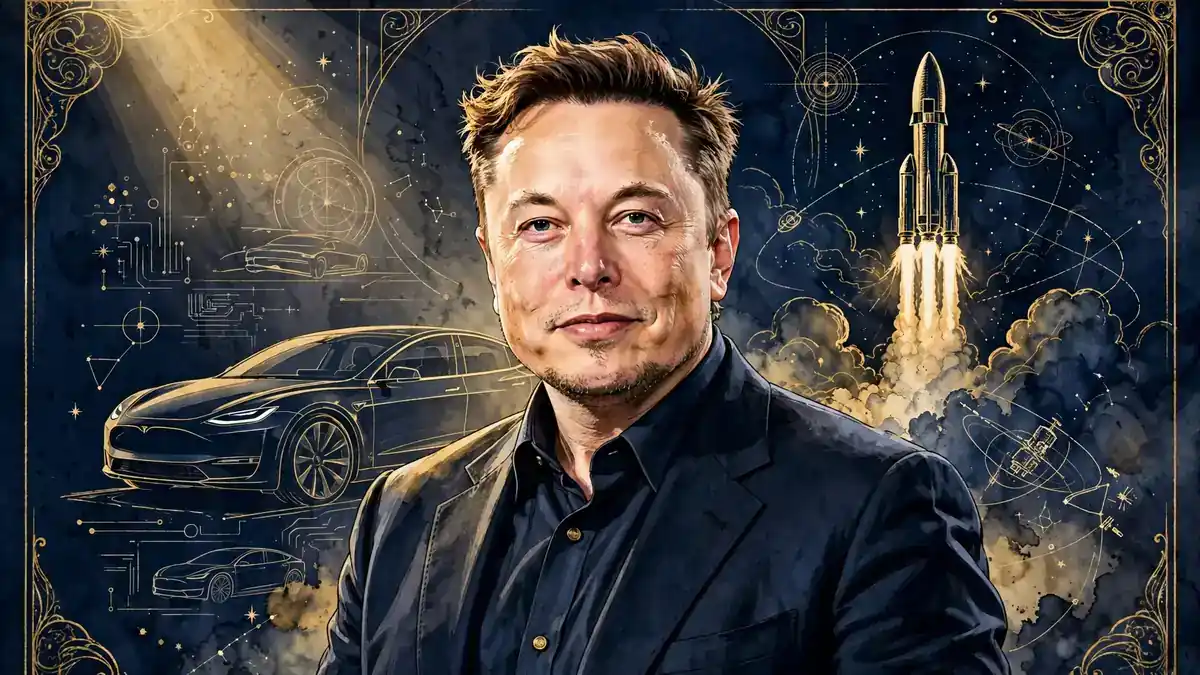
Elon Musk‘s net worth is estimated at $850 billion to $1.01 trillion as of November 2026. Elon Musk’s net worth today sits on two pillars — a roughly 48 percent stake in SpaceX and a roughly 13 percent stake in Tesla — and it can swing by tens of billions in a single trading session: on November 5, 2026, it fell by about $80 billion in one day. He became the first person in history to pass $1 trillion after SpaceX listed on the Nasdaq in June 2026, then lost $750 billion in a single month when SpaceX shares collapsed that July, and by November he was back near the trillion mark again.
Elon Musk: Quick Facts
| Estimated net worth | about $900 billion (range: $850 billion to $1.01 trillion) |
|---|---|
| Profession | Entrepreneur, CEO of Tesla and SpaceX, founder of xAI, Neuralink and The Boring Company, owner of X |
| Nationality | South African-born American |
| Born | June 28, 1971 (age 55) |
| Height | 6 feet 1 inch to 6 feet 2 inches (1.85–1.88 m), depending on the listing |
| Primary income sources | Tesla shares and stock awards, SpaceX shares and options, xAI, Neuralink, The Boring Company |
| Active years | 1995–present |
| Last reviewed | November 2026 |
- Early Life and Background
- Education
- Career Journey
- Rise to Fame
- Main Sources of Income
- Salary and Earnings
- Businesses and Investments
- Brand Deals and Sponsorships
- Houses, Cars and Other Assets
- Awards and Achievements
- Net Worth Growth Over the Years
- Social Media Presence
- Personal Life
- Sources & Reporting
- Frequently Asked Questions
Early Life and Background
Elon Reeve Musk was born on June 28, 1971, in Pretoria, South Africa, to Maye Musk, a model and dietitian, and Errol Musk, an engineer. He grew up in Pretoria with his younger brother Kimbal and sister Tosca, and the household mixed books, engineering talk and business from an early age. Musk has described a lonely school childhood, and he found his footing in computers: he taught himself programming and, at 12, sold a simple video game he had coded, called Blastar, to a computer magazine for about $500. That small sale is the first documented money Musk ever made from software, and it points straight at the pattern of the next three decades — build the thing, sell the thing, put the money into a bigger thing.
In 1989, at 17, Musk left South Africa for Canada, where his mother held citizenship. He spent time working odd jobs and studying before moving to the United States in 1992. The move was deliberate: the money, the universities and the internet companies he wanted to build were all in America. He arrived with little, and within three years he was sleeping in the office of his first startup because he could not afford both rent and a business. That detail matters because it frames everything that follows — Musk’s fortune was not inherited. His father has disputed that account in interviews, and the record is contested, but the documented paper trail starts with Zip2, not with family money.
Pretoria also shaped the other half of the story. Musk has said the science-fiction books he read as a boy — Isaac Asimov’s Foundation series among them — fixed his attention on space travel and on the idea that a single person could change the direction of a civilization. SpaceX, founded in 2002, is the adult version of that childhood reading list, and it is now the single largest piece of his fortune.
Education
Musk studied at Queen’s University in Kingston, Ontario, for two years after arriving in Canada, then transferred to the University of Pennsylvania. There he earned two bachelor’s degrees in 1997, one in economics from the Wharton School and one in physics from the College of Arts and Sciences. The pairing is the whole Musk method in miniature: money on one side, physics on the other, and a habit of treating business problems as engineering problems.
He was accepted into a PhD program in applied physics at Stanford University in 1995 and left after two days. The internet was exploding, and he decided the degree could wait. It never came back into the picture. Musk has no graduate degree, no MBA and no formal engineering qualification beyond his physics bachelor’s — a fact that makes his record as the chief engineer of a rocket company all the more unusual, and one his critics return to whenever a SpaceX or Tesla deadline slips. His education, in the end, was the two degrees plus three companies built from scratch in his twenties.
For readers who want the full timeline of those early years, Elon Musk’s full biography and career timeline on our sister site GuideNetWorth covers the Pretoria childhood, the Canadian years and the Zip2 founding in one place.
Career Journey
Musk’s career breaks into three acts, and each one funded the next. In 1995 he and Kimbal founded Zip2, a company that sold online city guides and mapping software to newspapers. They built it on borrowed computers and slept in the office. In February 1999, Compaq bought Zip2 for $307 million in cash and stock. Musk, who owned about 7 percent, walked away with roughly $22 million at 27 years old. He put almost all of it into his next company.
That company was X.com, an online bank founded in March 1999. It merged with a rival called Confinity in 2000, and the combined business became PayPal. Musk was ousted as CEO in a boardroom fight in October 2000 while he was on honeymoon, but he kept his shares — about 11.7 percent. When eBay bought PayPal for $1.5 billion in October 2002, Musk received roughly $165 million after tax, by most accounts closer to $180 million before tax. He was 31, and he had turned $22 million into a war chest of more than $160 million in three years.
He spent it fast. In 2002 he founded SpaceX with about $100 million of his own money, convinced that rockets cost too much because nobody had tried to reuse them. In 2004 he led Tesla’s Series A round with a $6.5 million investment and became chairman of the board; he took over as CEO in 2008. Both companies nearly died in 2008 — SpaceX had three failed Falcon 1 launches and Tesla was weeks from bankruptcy — and Musk split his remaining money between them in December 2008. SpaceX’s fourth launch succeeded, NASA awarded the company a $1.6 billion cargo contract days later, and Tesla closed a financing round the same month. The two bets that nearly wiped him out became the two pillars of a fortune that would pass $1 trillion.
The 2010s added the rest of the portfolio. Musk co-founded Neuralink in 2016 to build brain-computer interfaces, founded The Boring Company the same year to dig transport tunnels, and bought Twitter for $44 billion in October 2022, renaming it X. In 2023 he founded xAI, his artificial-intelligence lab, and in March 2025 xAI acquired X in an all-stock deal that Musk said valued xAI at $80 billion and X at $33 billion. Then, on February 2, 2026, SpaceX acquired xAI in an all-stock merger that valued the combined company at $1.25 trillion — the single deal that pushed Musk past $800 billion and set up the trillionaire milestone four months later.
Rise to Fame
Musk was rich before he was famous. The fame arrived in stages: first as the PayPal millionaire who wanted to go to Mars, then as the Tesla chief who made electric cars desirable, then as the SpaceX founder who landed rockets upright on drone ships. Each stage had a signature moment. For Tesla it was the Model S in 2012, a sedan that won MotorTrend’s Car of the Year and proved an electric car could beat petrol cars on their own terms. For SpaceX it was December 2015, when a Falcon 9 first stage landed vertically at Cape Canaveral — a sight no one had seen before, and the moment reusable rockets stopped being a fantasy.
The fame turned into something else in the 2020s. Musk’s Twitter account, with more than 200 million followers, became a market-moving force of its own: a single post could lift or sink Tesla’s share price, and his public backing of political candidates in the 2024 and 2026 election cycles made him one of the most consequential private political donors in American history. In 2026 he spent at least $446 million supporting Republican candidates and groups ahead of the midterm elections, according to campaign finance reporting cited by Business Insider — a figure that became a story in itself when Tesla and SpaceX shares slid the week of the vote.
Through it all, the wealth milestones kept a steady drumbeat. Forbes first listed Musk in 2012 at $2 billion. His fortune passed $300 billion in 2021, $400 billion in December 2024, $500 billion in October 2025, $600 billion and $700 billion in December 2025, $800 billion in February 2026 and $900 billion in June 2026, the month SpaceX went public. No other person has ever crossed $500 billion, let alone $1 trillion. The gap to the world’s second-richest person — Amazon founder Jeff Bezos, worth about $375 billion in early November 2026 — stood near $490 billion, the widest lead in the history of the rich lists.
Main Sources of Income
Musk takes no salary from Tesla and no salary from SpaceX. His income, in the ordinary sense of a paycheck, is close to zero. His wealth comes from owning large slices of companies that grew enormously, and from stock awards tied to hitting targets. TheStreet’s filing-based count from early November 2026 put the shape of it plainly: Musk owned 699.58 million Tesla shares as of September 30, 2026, according to the company’s proxy statement, worth about $251 billion at early-November prices — and 6.4 billion SpaceX shares, about 48.4 percent of the company, according to an August 2026 filing with the SEC, worth about $859 billion. Together the two stakes were worth about $1.1 trillion in early November, before the counting rules are applied.
The counting rules are where the published estimates split. Forbes, at $849.7 billion on November 7, 2026, leaves out the 286.4 million restricted Tesla shares from Musk’s 2018 award, because they cannot be sold until January 19, 2028 and are forfeited if he leaves Tesla before then. Bloomberg, at $845 billion in early November, applies a similar exclusion to restricted stock in both companies. DaveManuel.com, which counts the restricted shares because they are issued, carry votes and have no performance condition left, put Musk at $957.2 billion on November 7, with a range of $854.6 billion to $957.2 billion. A live tracker that marks both stocks to market put him at $1.01 trillion on November 10, with Forbes at $903.4 billion and Bloomberg at $971 billion the same day. None of these is wrong. They are the same pile of shares counted under different rules, and the honest number is the range: $850 billion to $1.01 trillion.
Everything else is small by comparison. Neuralink, The Boring Company and his remaining cash are real assets, but their values are private and undisclosed, and the filing-based trackers count little or nothing for them. A breakdown published in November 2026 put Neuralink at about $4.6 billion of Musk’s wealth and The Boring Company at about $13.8 billion, against $681.8 billion in SpaceX shares and $47.1 billion in SpaceX options. SpaceX and Tesla together make up roughly 98 percent of the total. That concentration is the whole story of Musk’s fortune: it rises and falls with two share prices, and nothing else he owns moves the needle.
The table below shows how the fortune is divided, using the filing-based counts reported in November 2026.
| Holding | What it is worth | Share of the fortune |
|---|---|---|
| SpaceX shares | about $682 billion | roughly 67 percent |
| SpaceX options | about $47 billion | roughly 5 percent |
| Tesla shares | about $157 billion | roughly 15 percent |
| Tesla restricted shares (2018 award) | about $109 billion | roughly 11 percent |
| Neuralink | about $5 billion | under 1 percent |
| The Boring Company | about $14 billion | roughly 1 percent |
One more number matters more than the rest: only about 14 percent of the disclosed holdings can be sold today. The SpaceX shares are locked up until about June 12, 2027, a year after the IPO, and the restricted Tesla shares cannot be touched until January 2028. Musk is the richest person alive, and almost none of it is spendable cash.
Salary and Earnings
Musk’s pay history is the strangest of any chief executive alive, because the numbers on paper and the money in his pocket have almost nothing to do with each other. Tesla pays him no salary, no bonus and no cash of any kind. What it pays him is stock, and only if the company hits targets that look absurd when they are set. The 2018 CEO Performance Award gave him options on 304 million shares at a strike price of $70.01, vesting in 12 tranches as Tesla’s market value climbed from $100 billion to $650 billion and hit operating goals. He hit the targets. A Delaware judge, Kathaleen McCormick, voided the award in 2024, calling the process flawed; the Delaware Supreme Court reinstated it on December 19, 2025. In June 2026 Musk exercised the award and received 286.4 million restricted shares, which is why they now sit at the center of the Forbes-versus-everyone-else argument.
The 2025 award is bigger by an order of magnitude. Tesla shareholders approved it on November 6, 2025, with more than 75 percent of shares cast in favor, after board chair Robyn Denholm warned in a letter to shareholders that Musk could leave Tesla if it was rejected. The package covers 423,743,904 shares of restricted stock in 12 equal tranches, and Musk earns a tranche only when Tesla hits a market-value milestone — $2 trillion for the first, $8.5 trillion for the twelfth — plus one of 12 operating milestones, from 20 million vehicles delivered to 1 million Optimus humanoid robots shipped and 1 million robotaxis in commercial operation, with adjusted EBITDA targets running from $50 billion to $400 billion. The headline value is about $1 trillion; the real economic value, after subtracting the value of Tesla stock on the day the board approved the plan, is closer to $878 billion. The clock runs to September 2035.
Tesla’s own proxy statement, filed in October 2026, puts Musk’s 2025 compensation at $158,359,009,867 — all of it in stock awards, none of it in salary, bonus or cash. The same filing’s realized-pay table puts what he actually collected for the year at $0, against the $62,786 earned by Tesla’s median employee. The $158.4 billion is an accounting value: it counts the grant-date fair value of awards that have not been earned, including a $26.06 billion interim award of 96 million shares that Musk forfeited on April 21, 2026. Of the 12 tranches in the 2025 award, none has been earned, and Tesla’s management calls only one operating milestone probable — 20 million vehicles delivered. The first tranche also needs a $2 trillion market value; Tesla was worth about $1.45 trillion when the proxy was filed.
SpaceX pays him in a similar way. The August 2026 SEC filing shows 350 million vested SpaceX options with a strike price of about $8.40, worth about $47.1 billion at November prices, plus performance awards tied to the company’s own milestones. The pattern is consistent across both companies: Musk gets rich only if the companies get much bigger, and the pay figures that make headlines are promises, not paychecks. For comparison, fellow entrepreneur Mark Cuban’s net worth was built the opposite way — a single cash sale of a company, Broadcast.com, rather than a decade of stock awards.
Businesses and Investments
Tesla is the public half of the fortune. Musk joined in 2004, became CEO in 2008, and owns about 13 percent of the company including the restricted 2018 award shares, or about 10.5 percent outright. Tesla reported $94.83 billion in total revenue in its 2025 annual report, and in the first quarter of 2026 it produced more than 408,000 vehicles and delivered more than 358,000. The Model 3 and Model Y remain the volume sellers, with the Model S, Model X, Cybertruck and Semi rounding out the range, and the company’s energy storage and solar businesses growing alongside the cars. The bet now is not cars at all: it is autonomy and humanoid robots. Tesla’s market value of about $1.4 to $1.6 trillion in November 2026 already prices in a future in which robotaxis and Optimus robots matter more than vehicle deliveries, and the 2025 pay package is built on exactly that future arriving.
SpaceX is the private-turned-public half, and the bigger one. Founded in 2002, it builds Falcon rockets, the Starship system and the Starlink satellite network, and it is the leading launch company in the world by flight count. Musk owns about 48.4 percent of the shares and about 85 percent of the voting power, because his SpaceX shares carry 10 votes each. The February 2026 merger with xAI folded Musk’s AI lab — and with it, the X social platform — into SpaceX, valuing the combined company at $1.25 trillion. Four months later, on June 12, 2026, SpaceX listed on the Nasdaq as SPCX in the largest IPO in history, and Musk became the first trillionaire. In the first half of 2026, SpaceX spent $7.1 billion on research and development, mostly on Starship, and $28.5 billion on property and equipment. It is a company that burns cash at a scale few businesses ever have, and the market has so far been willing to fund it.
xAI and X now live inside SpaceX. xAI, founded in 2023, builds the Grok chatbot and large AI models; X, bought for $44 billion in 2022, gives those models a distribution platform with hundreds of millions of users and a live feed of human conversation to train on. The logic of the merger is that the AI business, the social platform and the satellite network feed each other — Grok trains on X, Starlink carries the traffic, and SpaceX launches the satellites. Whether that logic is worth $1.25 trillion is the question the share price answers every day.
Neuralink, founded in 2016, builds implantable brain-computer interfaces and is in human clinical trials, with patients using implants to control computers. The Boring Company, also founded in 2016, digs transport tunnels and runs the Vegas Loop in Las Vegas; it raised money at a $5.7 billion valuation in 2022, and Musk owns more than 90 percent of it. Both are small next to Tesla and SpaceX, and both are valued on promise rather than revenue. Musk also co-founded OpenAI in 2015 and left its board in 2018; he holds no current stake of consequence there, and his public break with the company is now a long-running legal and personal feud.
The newest question hanging over all of it is whether Tesla and SpaceX will combine. On SpaceX’s third-quarter earnings call on October 20, 2026, Musk said each board had formed a special committee of independent directors to study a merger, and no terms had been agreed. A Reuters analysis published November 3, 2026, found that if SpaceX bought Tesla, Musk would own about 37 percent of the merged company but hold about 56 percent of its voting power, thanks to his 10-vote SpaceX shares — control without having to hit the milestones in his Tesla pay package. Under the change-of-control terms, a deal at a $2 trillion Tesla valuation would pay him only about $20 billion from the award, a fraction of the full package. The combined company would be worth about $3.5 trillion, the largest corporate deal on record. Nothing is agreed, and the merger remains a possibility, not a fact.
Brand Deals and Sponsorships
Musk has no endorsement deals, no sponsorships and no paid brand partnerships, and that absence is itself a data point. Most celebrities at his level of fame monetize attention directly — a watch deal, a clothing line, a paid post. Musk monetizes attention indirectly: his posts on X are advertising for Tesla and SpaceX, and they cost the companies nothing. Tesla famously spends nothing on traditional advertising, and Musk’s account is the reason it can afford to. The arrangement cuts both ways — a post that moves Tesla’s share price by a few percent moves Musk’s fortune by billions — but no money changes hands for the posts themselves.
The closest thing to a brand deal in Musk’s record is the opposite of one: he has turned down the usual celebrity economy entirely. He does not appear in ads, does not license his name to products and does not take speaking fees. His public appearances — a Saturday Night Live hosting gig in 2021, podcast interviews, product launch events — are marketing for his own companies, not paid work for someone else’s. The income section of this article is therefore short on deals and long on stock, because that is where the money actually is. Investors such as Patrick Bet-David’s net worth story shows the more conventional path — media, education products and equity stakes — while Musk’s version runs entirely through the two public tickers.
Houses, Cars and Other Assets
Musk’s real estate story runs backwards from every other billionaire’s. He used to own a portfolio of California houses worth more than $100 million. Starting in 2020 he sold them off, saying he wanted to own no houses, and he meant it. His primary residence is now a $50,000 prefabricated Boxabl Casita — a small modular home — in Boca Chica, Texas, near SpaceX’s Starbase facility, rented from his own company. The man worth close to a trillion dollars lives in a house that costs less than a mid-range car. It is a deliberate image, and it is also true: the property records and the reporting agree that the mansions are gone.
He does keep one house of a different kind. In 2025 he bought a property in the Washington area reported to be used during his time working with the federal government, and he maintains homes near Tesla facilities in Texas. But there is no portfolio to value in the way other billionaires’ property holdings are valued. The filing-based trackers count no meaningful real estate for Musk, and the honest estimate for his property is a rounding error next to the stock.
The cars are the same story. Musk drives Teslas — that is the point. There is no garage full of Bugattis or vintage Ferraris, no collection to auction. The most famous car attached to his name is a 2008 Tesla Roadster that is not on Earth at all: it has been in heliocentric orbit since the Falcon Heavy test flight of February 2018, with a mannequin called Starman in the driver’s seat. He has also owned a Lotus Esprit submarine car from a James Bond film, bought at auction for close to $1 million, and a McLaren F1 he crashed early in his career. The Roadster in orbit is the better symbol of the fortune: the wealth is real, it is enormous, and almost none of it is parked in a driveway.
What Musk does own, beyond the shares, is influence over assets he does not personally hold: Starlink’s satellite constellation, the Starship program, the Grok models and the X platform. They belong to his companies, and his wealth is the claim on their future earnings. That is why the fortune is so volatile. A rocket failure, a missed delivery quarter or a bad election week does not dent a property portfolio. It reprices the claim.
Awards and Achievements
Musk’s shelf of honors is long, and the ones that matter are the ones tied to engineering rather than celebrity. Time magazine named him Person of the Year in 2021, citing his role in electric vehicles and private spaceflight. He was elected a Fellow of the Royal Society in 2018, a rare honor for someone without a doctorate. The Royal Aeronautical Society gave him its Gold Medal, and he has received the Heinlein Prize for Advances in Space Commercialization and the Axel Springer Award for his work across technology and media.
The achievements behind the awards are easier to list than the awards themselves. SpaceX built the first privately developed liquid-fuel rocket to reach orbit (Falcon 1, 2008), the first commercial spacecraft to dock with the International Space Station (Dragon, 2012), the first reusable orbital rocket (Falcon 9, 2015) and the largest flying object ever built (Starship). Tesla built the first mass-market premium electric car, the Model S, and then the best-selling car of any kind in the world, the Model Y. Starlink became the largest satellite constellation in history. No single person has led all of those programs before, and that is the substance behind the “genius” label — a record of shipped hardware at a scale nobody else has matched.
The record has a shadow side that belongs in any honest account. Tesla has missed deadlines for the Cybertruck, the Semi, full self-driving and the Optimus robot, sometimes by years. SpaceX’s Starship program has had spectacular test failures. Musk’s public statements have repeatedly drawn action from regulators, including a settlement with the SEC in 2018 over a tweet about taking Tesla private. The fortune survived all of it, because the companies kept shipping. The awards tell one half of the story; the missed deadlines tell the other.
Net Worth Growth Over the Years
The growth table is the most dramatic in the history of personal wealth, and it is worth reading slowly, because the speed of it is the point. Musk went from $2 billion to $1 trillion in fourteen years, and most of that climb happened in the last eighteen months.
| Year | Estimated net worth | What drove it |
|---|---|---|
| 2012 | $2 billion | First Forbes billionaires listing; Tesla and SpaceX still private bets |
| 2017 | $14 billion | Tesla Model 3 launch; SpaceX reusable landings |
| 2020 | $170 billion | Tesla joins the S&P 500; shares rise more than 700 percent in a year |
| 2021 | $300 billion | First person past $300 billion; Tesla passes $1 trillion in value |
| 2023 | $180 billion | Tesla shares fall; fortune halves from the 2021 peak |
| December 2024 | $400 billion | Post-election Tesla rally; first person past $400 billion |
| October 2025 | $500 billion | SpaceX private valuation climbs; first person past $500 billion |
| December 2025 | $600–700 billion | SpaceX–xAI merger value recognized; pay package approved |
| February 2026 | $800 billion | SpaceX–xAI combined value at $1.25 trillion |
| June 2026 | $900 billion–$1 trillion | SpaceX IPO on June 12; first trillionaire in history |
| July 2026 | under $1 trillion | SpaceX shares collapse; fortune falls $750 billion, the largest loss ever recorded |
| October 2026 | $1 trillion and above | Shares recover; Bloomberg records $1.04 trillion on October 5 |
| November 2026 | $850 billion–$1.01 trillion | Midterm-week slide, then recovery; Forbes $849.7 billion, Bloomberg $971 billion |
Two lessons sit in that table. First, the fortune is younger than it looks: Musk was worth $2 billion in 2012, and 99 percent of the current figure was created after 2020. Second, the losses are as historic as the gains. The $750 billion lost in July 2026 is the largest net worth loss in history, and the $113 billion lost across November 4 and 5, 2026, is one of the largest two-day drops ever recorded. A fortune built on two share prices can be rebuilt by two share prices, and it can be cut the same way. For scale, MacKenzie Scott’s net worth — one of the largest philanthropic fortunes in the world — is a fraction of what Musk gained or lost in a single week of November 2026.
Social Media Presence
Musk owns the platform he is famous on, which makes his social media presence a business asset as much as a personal one. He has more than 200 million followers on X, making his account one of the most followed on the platform, and he posts constantly — memes, company news, political commentary, replies to users at all hours. The account is the most powerful free marketing channel in the car industry and the most volatile: a single post has moved Tesla’s share price, drawn SEC scrutiny and started news cycles that last for days.
X itself is part of the fortune now, folded into SpaceX through the xAI merger of February 2026. Musk said the deal valued X at $33 billion and xAI at $80 billion, a steep fall from the $44 billion he paid for Twitter in 2022, and a recovery from the lower valuations reported in between. The platform’s advertising business has struggled since the acquisition, but its value to Musk is strategic rather than financial: it is the training data and distribution channel for Grok, and it is the megaphone for everything else he does.
His presence elsewhere is minimal. He has no meaningful Instagram or TikTok presence, and his public appearances happen on X, on podcasts and at his own product events. The social media story is therefore a short one: one platform, one account, owned by the same person who posts on it, and a fortune that rises and falls with what that account does to two share prices. The contrast with creators who built wealth from social media itself is sharp — MrBeast’s net worth comes from the platforms, while Musk’s comes from the companies the platform advertises.
Personal Life
Musk has been married three times, twice to the same person: to author Justine Wilson from 2000 to 2008, and to actress Talulah Riley from 2010 to 2012 and again from 2013 to 2016. He was in a long-term relationship with musician Grimes from 2018 to 2022. Public reporting in 2025 put the count of his children at 14, with four partners. The first of his children, a son named Nevada, died of sudden infant death syndrome at 10 weeks old in 2002 — a loss Musk has spoken about rarely and briefly.
His family is also his business in one visible way: his brother Kimbal sits on Tesla’s board and runs his own food businesses, and his sister Tosca runs a streaming romance-film company. His mother Maye, a model and dietitian, has become a public figure in her own right. Musk’s relationship with his father is strained and publicly contested, including a dispute over the origins of his early money.
He is 55 years old — for the exact figure and how it is calculated, how old Elon Musk is today on our sister site CelebAmerica keeps the running count. He lives mostly in Texas now, near Starbase and Tesla’s Austin headquarters, and he has said he works extremely long hours, sometimes sleeping at the factory during production crises. The personal life is, by the standards of billionaires, unusually public: the relationships, the children, the feuds and the tweets are all part of the record, and they all feed back into the valuation of the companies, because the market prices the man as much as the machines.
Sources & Reporting
Forbes — Real-Time Billionaires tracker: $849.7 billion on November 7, 2026; $903.4 billion on November 10, 2026; the first $500 billion, $800 billion and $900 billion milestones; the SpaceX–xAI merger valuation and the $1 trillion pay package reporting. Reporting window: October–November 2026.
Bloomberg — Bloomberg Billionaires Index: $845 billion in early November 2026; $865 billion after the November 4 midterm slide; $971 billion on November 10, 2026; $1.04 trillion on October 5, 2026; the $750 billion July 2026 loss. Reporting window: October–November 2026.
TheStreet — Filing-based share counts: 699.58 million Tesla shares as of September 30, 2026, worth $251 billion; 6.4 billion SpaceX shares, about 48.4 percent, worth $859 billion; combined stakes of $1.1 trillion in early November 2026. Published November 9, 2026.
Reuters — November 3, 2026 analysis of a possible SpaceX–Tesla combination: 56 percent voting control, $20 billion change-of-control payout, $3.5 trillion combined value, special committees formed October 20, 2026. Reporting window: November 2026.
DaveManuel.com — Independent filing-based estimate: $957.2 billion on November 7, 2026, range $854.6 billion to $957.2 billion; SpaceX at $134.27 and Tesla at $358.22 on the November 6, 2026 closes; the restricted-share accounting gap with Forbes. Published November 7, 2026.
Wikipedia — “Wealth of Elon Musk”: milestone history from the first $2 billion listing in 2012 through the June 2026 SpaceX IPO, the $1.45 trillion intraday peak and the July 2026 collapse; updated November 8, 2026.
Business Insider — Midterm-week reporting: Bloomberg’s $33 billion single-day drop on November 4, 2026, and Musk’s $446 million in spending on Republican candidates and groups, as reported by UNILAD on November 6, 2026.
U.S. Securities and Exchange Commission — Tesla proxy statement (September 30, 2026 share counts; 2025 compensation of $158.36 billion, realized pay $0); SpaceX Schedule 13G filed August 13, 2026; Tesla Form 4 filed June 17, 2026. Filings window: June–October 2026.
Reporting window for this article: October 20 to November 11, 2026. Figures move daily with Tesla and SpaceX share prices; the range published here is dated November 11, 2026, and the live trackers at Forbes and Bloomberg carry the current number.
Frequently Asked Questions
What is Elon Musk’s net worth today?
Elon Musk’s net worth is estimated at $850 billion to $1.01 trillion as of November 11, 2026. Forbes’ real-time tracker put him at $849.7 billion on November 7, 2026, Bloomberg’s Billionaires Index had him at $845 billion in early November and $971 billion on November 10, and a filing-based count put him at $957.2 billion on November 7. The range exists because Forbes and Bloomberg exclude restricted shares Musk cannot sell yet, while other counters include them.
How did Elon Musk become a trillionaire?
SpaceX listed on the Nasdaq as SPCX on June 12, 2026, in the largest IPO in history. The listing gave Musk’s roughly 48 percent stake a public market price for the first time, and his fortune passed $1 trillion that day — the first time any person had done so. It peaked at about $1.45 trillion in the week after the IPO, then fell back below $1 trillion in July 2026 when SpaceX shares collapsed.
How much of Elon Musk’s wealth is in Tesla and SpaceX stock?
Almost all of it. Musk owned 699.58 million Tesla shares worth about $251 billion and 6.4 billion SpaceX shares worth about $859 billion in early November 2026, according to TheStreet’s filing-based count — about $1.1 trillion combined. SpaceX and Tesla together make up roughly 98 percent of his fortune, with Neuralink and The Boring Company accounting for the rest.
What is Elon Musk’s salary at Tesla?
He takes no salary, no bonus and no cash from Tesla. His pay is entirely in stock awards tied to performance. Tesla’s proxy statement filed in October 2026 reported his 2025 compensation at $158.36 billion — all in stock awards — while the realized-pay table put what he actually collected at $0. He earns the stock only if Tesla hits targets including an $8.5 trillion market value, 20 million vehicles delivered, 1 million robotaxis and 1 million Optimus robots.
Is Elon Musk still the richest person in the world?
Yes, by a very wide margin. Even after losing about $113 billion across November 4 and 5, 2026, Musk remained the world’s richest person, roughly $490 billion ahead of the second-richest person, Amazon founder Jeff Bezos, who was worth about $375 billion in early November 2026. He has held the number one spot continuously since 2021, apart from brief stretches when Tesla shares fell sharply.
How much did Elon Musk spend on the 2026 midterms?
At least $446 million supporting Republican candidates and groups ahead of the 2026 midterm elections, according to campaign finance reporting cited by Business Insider in November 2026. The spending became a market story when Tesla and SpaceX shares slid the week of the vote, cutting his fortune by about $33 billion on November 4 and about $80 billion on November 5, 2026.
How much of SpaceX and Tesla does Elon Musk own?
He owns about 48.4 percent of SpaceX shares and about 85 percent of its voting power, because his SpaceX shares carry 10 votes each, according to an August 2026 SEC filing. At Tesla he owns about 13 percent of the shares including the restricted 2018 award shares, or about 10.5 percent outright, and holds roughly 20 percent of the voting power. His Tesla voting power could rise to about 29 percent if he hits every target in the 2025 pay package.
What companies does Elon Musk own?
He is CEO of Tesla and SpaceX, founder of xAI, Neuralink and The Boring Company, and owner of the X social platform, which now sits inside SpaceX after the February 2026 SpaceX–xAI merger. He co-founded PayPal and sold it to eBay in 2002, and co-founded OpenAI in 2015 before leaving its board in 2018. Tesla and SpaceX hold nearly all of his wealth; the other companies are small by comparison.
Final Thoughts
Elon Musk’s net worth today — $850 billion to $1.01 trillion as of November 11, 2026 — is the largest fortune ever recorded, and also the most fragile at the top. It is built on two share prices, and the last five months prove how fast those prices can move: past $1 trillion in June, down $750 billion in July, back above $1 trillion in October, down $113 billion in two days in November. The honest way to read the number is as a range with a date on it, not a single figure, because Forbes, Bloomberg and the filing-based counters disagree by more than $150 billion on one accounting choice alone.
What is not in dispute is the shape of it. SpaceX is the fortune now — a rocket company that became a satellite network, an AI lab and a social platform in a single merger — and Tesla is the second pillar, a car company priced as a robotics company. The $1 trillion pay package, the possible SpaceX–Tesla merger and the lock-up on his SpaceX shares until June 2027 are the three facts that will decide where the number goes next. If Tesla hits an $8.5 trillion market value, Musk’s fortune doubles. If SpaceX shares slide again, it halves. Either way, the gap to the rest of the rich list is so wide that no one else is in the conversation. The first trillionaire is a fact of the record now, even on the days the fortune sits below a trillion.
Published on November 11, 2026. Last reviewed November 2026. Found an error? See our corrections policy.