
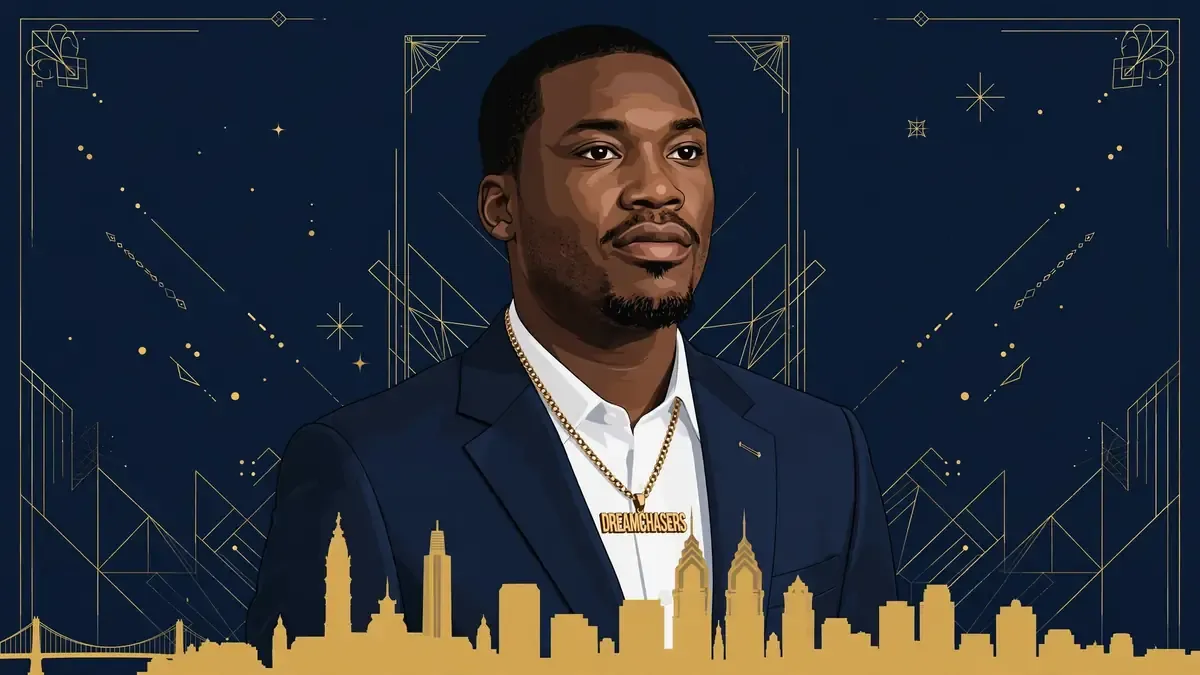
Meek Mill‘s net worth is estimated at $20 million as of November 2026. The Philadelphia rapper built that fortune from a catalog that includes two Billboard 200 chart-toppers, his Dream Chasers label — launched as a Roc Nation joint venture in 2019 and run independently since that partnership ended in 2022 — a co-owner stake in the sports retailer Lids, and a criminal-justice reform platform that turned his own probation case into a national movement. Forbes put his pre-tax earnings at $21 million in 2019 alone — a figure Meek himself publicly disputed — and the most widely cited estimates have held near $20 million ever since, even as newer reporting in 2026 keeps his touring and label business moving.
Meek Mill: Quick Facts
| Estimated net worth | $20 million (range: $15 million – $30 million) |
|---|---|
| Profession | Rapper, songwriter, record executive, criminal justice reform advocate |
| Nationality | American |
| Born | May 6, 1987 (age 39) |
| Height | About 6 ft 2 in (188 cm), as reported by Philadelphia magazine |
| Primary income sources | Music sales and streaming, touring, Dream Chasers Records, Lids equity, endorsements |
| Active years | 2003 – present |
| Last reviewed | November 2026 |
- Early Life and Background
- Education
- Career Journey
- Rise to Fame
- Main Sources of Income
- Salary and Earnings
- Businesses and Investments
- Brand Deals and Sponsorships
- Houses, Cars and Other Assets
- Awards and Achievements
- Net Worth Growth Over the Years
- Social Media Presence
- Personal Life
- Sources & Reporting
- Frequently Asked Questions
Early Life and Background
Robert Rihmeek Williams was born on May 6, 1987, in South Philadelphia, Pennsylvania. The name on his birth certificate is the one his mother, Kathy Williams, gave him; the stage name came later, shortened from a childhood nickname. His father was killed when Meek was five years old, a loss that shaped the household he grew up in and the lyrics he would write for the next two decades. Kathy raised Meek and his sister Nasheema on her own, working long hours while the family lived in a part of the city where poverty and street violence were daily facts rather than headlines.
South Philadelphia in the late 1990s and early 2000s was a hard place to be a teenager with ambition. Meek found his outlet in rap battles. He started trading verses on street corners and in local cyphers, building a reputation for speed, breath control and a delivery that sounded like a man in a hurry. The battle circuit taught him the two skills that still define his music: an ability to rhyme under pressure and an instinct for turning his own life into material without softening it. He formed a short-lived group called the Bloodhoundz with friends from the neighborhood, and the group gave him his first taste of recording and performing beyond his block.
By his mid-teens, Meek was a fixture of Philadelphia’s underground scene. The mixtape circuit was the only distribution system that mattered for a rapper without a label, and Meek worked it relentlessly. His Flamers mixtape series — raw, self-released tapes that circulated through the city — carried his name out of South Philly and into the wider East Coast rap conversation. The tapes were not polished, and that was the point: listeners heard a young rapper describing the streets he lived on in real time, and the authenticity stuck. Philadelphia magazine would later describe him, in a March 2019 profile, as a six-foot-two presence whose stature matched the size of his story — a detail that has become the standard height listing for him, about 6 ft 2 in (188 cm).
What the early years explain about the money story is simple: Meek Mill did not inherit wealth, buy his way into the industry or arrive through a television contest. He earned his first real income the slow way, selling mixtapes and winning battles, and the habits of that period — relentless output, loyalty to his Philadelphia circle, and a willingness to bet on himself — still show in how he runs his business today. The Dream Chasers imprint he founded in 2012 began as a name for his mixtape series before it became a company. That progression, from street tapes to a Roc Nation joint venture, is the spine of his financial story.
Education
There is no college degree in Meek Mill’s story, and no public record of a graduation ceremony. He attended school in Philadelphia, including time at Strawberry Mansion High School in North Philadelphia, but his formal education ended early as music took over. By his late teens he was spending his days writing, recording and battling rather than sitting in classrooms, and the mixtape economy was already paying him in a way school could not.
That gap in formal schooling matters for understanding his career, because it explains both his strengths and his vulnerabilities. Meek learned business on the job — negotiating label deals, building a brand, hiring a team — rather than in a classroom, and he has been open about the cost of learning that way. His probation case, which kept him under court supervision for more than a decade, was in part a story about a young man without the legal or financial infrastructure that a more established artist would have had. The education he did receive came from the industry itself: from T.I., who signed him to Grand Hustle in 2008; from Rick Ross, who signed him to Maybach Music Group in 2011; and from Jay-Z, who became a business partner and mentor after Meek’s release from prison in 2018.
It is worth stating plainly that the absence of a degree has not limited his earning power. The music industry rewards catalog, touring and ownership, and Meek has built all three. His later work with the REFORM Alliance also shows a different kind of education — the practical knowledge of how probation and parole actually work, gained from living inside the system for eleven years, which he has turned into a policy platform that reaches governors and state legislatures.
Career Journey
Meek Mill’s professional career began in the Philadelphia battle scene in the early 2000s and reached the national stage in stages that each added a new income stream. The first break came in 2008, when T.I. signed him to Grand Hustle Records as a solo act. The deal put Meek on a major-label roster for the first time, but it produced no album — he left the label in 2011 without releasing a record there — and the experience taught him a lesson he has repeated since: a signing is not a career, and an artist without ownership is renting his own future.
The turning point arrived in 2011, when Rick Ross signed Meek to Maybach Music Group (MMG). The timing was perfect. Ross was at the peak of his run as a label boss, MMG had distribution muscle through Warner Bros., and Meek’s mixtape buzz had reached a pitch that a label could monetize. His debut studio album, Dreams and Nightmares, arrived in October 2012 through the MMG and Warner Bros. joint venture and debuted at number two on the Billboard 200. The title track, with its quiet piano intro exploding into a full-throated victory lap, became something bigger than a song: the Philadelphia Eagles adopted it as their anthem during their run to the Super Bowl in the 2017 season, and it has been played at Eagles home games ever since. A single album cut turned into a permanent piece of Philadelphia sports culture — and a durable source of licensing and performance income.
His second album, Dreams Worth More Than Money, arrived in June 2015 and debuted at number one on the Billboard 200, powered by the singles “Ima Boss” energy of the MMG era and collaborations with Drake and Nicki Minaj. The album’s success coincided with his most visible public relationship — a high-profile romance with Nicki Minaj — and with the first real money of his career. But the same period also brought the legal trouble that would nearly end it. In November 2017, a Philadelphia judge sentenced Meek to two to four years in prison for minor violations of his probation conditions in a decade-old gun and drug case. The sentence, widely seen as disproportionate, made him a symbol of broken probation systems and set in motion the activism that now defines his public identity as much as his music does.
Meek was released in April 2018 after the Pennsylvania Supreme Court ordered his release, and he returned to music within months. The EP Legends of the Summer landed in the Top 10 that July, and in November 2018 he released his fourth album, Championships, which debuted at number one on the Billboard 200 with 229,000 album-equivalent units in its first week, including 42,000 in pure sales, according to Billboard’s chart reporting. The album’s lead single, “Going Bad” featuring Drake, peaked at number six on the Billboard Hot 100 and remains his highest-charting song. Championships was the comeback record in every sense: it was nominated for Best Rap Album at the 2020 Grammy Awards, it restored his commercial standing, and it gave him the platform to launch his business ventures from a position of strength rather than desperation.
His fifth studio album, Expensive Pain, followed on October 1, 2021, debuting at number three on the Billboard 200 with 95,000 equivalent units. It extended his streak of Top Five albums to five. In 2023 he released a collaborative album with Rick Ross, Too Good to Be True, which peaked at number 23 — a modest chart result that nonetheless showed the MMG relationship still producing work twelve years after it began. Through all of it, Meek has kept releasing singles and mixtape-style projects, including new 2026 singles such as “Wanna Be Free” and “600 Racks”, keeping his catalog fresh for streaming services that pay out month after month.
Rise to Fame
Meek Mill’s rise did not happen in a single moment. It happened in three waves, and each wave changed how he earned money. The first wave was the mixtape era, from roughly 2006 to 2011, when the Flamers tapes and the Bloodhoundz made him the hottest underground rapper in Philadelphia. The second wave was the MMG era, from 2011 to 2015, when Dreams and Nightmares and Dreams Worth More Than Money put him on the Billboard charts and on arena stages. The third wave began in 2018, when his release from prison turned him from a rapper with a legal problem into a national figure whose story was covered by every major news outlet in the country.
The prison sentence in 2017 was, paradoxically, the event that made Meek Mill famous beyond hip-hop. The #FreeMeek campaign drew support from Jay-Z, Beyoncé, the Philadelphia Eagles, the 76ers and a string of politicians and activists who saw his case as proof that probation could function as a trap. The Amazon Prime Video documentary series Free Meek, released in August 2019 across five episodes, carried that story to a global streaming audience and gave Meek a second career as a reform advocate. The documentary was a media asset that paid in its own right, and it cemented the platform he would use to co-found the REFORM Alliance in January 2019.
Fame also brought the feud that defined his public image for a time. His 2015 dispute with Drake — a Twitter-era beef that produced Drake’s diss track “Back to Back” and a flood of memes — was a commercial low point and a cultural high point at once: it hurt his standing in the moment, but it kept his name at the center of hip-hop conversation for months. The two men later reconciled, and their 2018 collaboration “Going Bad” became Meek’s biggest hit, a neat illustration of how quickly fortunes reverse in rap. The reconciliation also paid: “Going Bad” went multi-platinum, and the Championships tour that followed was one of the most profitable runs of his career.
By 2019, Meek’s fame had a different shape. He was no longer just a rapper; he was a label president, a retail co-owner and a reform advocate whose phone held the numbers of billionaires and governors. That transformation is the reason his net worth held at $20 million through years when he released relatively little new music. The music made the name, but the businesses and the platform are what kept the money coming in when the album cycle slowed.
Main Sources of Income
Meek Mill’s money comes from five places, and understanding the mix explains why his net worth has stayed flat at around $20 million rather than climbing steeply or collapsing. Music is the foundation: album sales, streaming royalties, publishing and licensing from a catalog that includes five Top Five albums and a string of platinum singles. Touring is the second pillar: Meek has headlined arena tours and co-headlined with Future, and his 2026 Dream Chasers Nights run — six dates announced in October 2026, opening November 24 at Philadelphia’s Xfinity Mobile Arena — shows live performance is still a live income stream. The third pillar is Dream Chasers Records, the label he founded in 2012, relaunched as a Roc Nation joint venture in July 2019 and run independently since the two sides dissolved the partnership in July 2022, which pays him as an owner and executive rather than as a hired artist. The fourth is equity: his co-owner stake in Lids and other private investments. The fifth is endorsements, led by Puma, Monster Energy and Amazon.
The balance between those pillars has shifted over time. In 2018 and 2019, touring and album sales dominated; Forbes recorded $15 million in pre-tax earnings from June 2017 to June 2018 and $20 million from June 2018 to June 2019. In the 2020s, the catalog and the businesses have carried more of the weight. Streaming pays steadily but slowly — a catalog of Meek’s size generates reliable monthly royalties without the costs of a tour — while the label and the Lids stake are bets on future value that may or may not pay off in a single year. That is why the $20 million figure has been so stable across sources: it is a snapshot of a career that earns steadily across several channels rather than a single windfall.
Readers comparing Meek with other rappers in our musicians category should note the difference between income and net worth. Forbes’ $21 million figure for 2019 was pre-tax earnings for one year, not money in the bank; after taxes, management, touring costs and the legal bills from his probation case, the amount he kept was far smaller. Net worth is what remains after all of that, plus the value of his equity stakes, minus any debts. That distinction is the reason a rapper can earn $20 million in a year and still be worth $20 million in total — and it is the reason honest estimates use ranges.

Salary and Earnings
The best-documented numbers in Meek Mill’s financial record come from Forbes, which tracked his annual pre-tax earnings for two consecutive measuring periods. Between June 2017 and June 2018, Forbes recorded $15 million in earnings; between June 2018 and June 2019, Celebrity Net Worth summarises the window at $20 million, while Forbes’ own 2019 list of highest-paid hip-hop acts ranked him number 15 and credited him with roughly $21 million in pre-tax earnings for the year — the small gap is rounding and list methodology, not a different year. Those numbers cover the Championships era — the album, the tour, the endorsements and the streaming surge that followed his release from prison — and they represent the peak earning years of his career so far.
Meek’s own reaction to the Forbes numbers is part of the record, and it is instructive. He publicly pushed back on Twitter, saying Forbes had his accounts wrong, and the dispute tells readers something useful about how celebrity earnings lists work: they are built from touring data, streaming estimates, endorsement reporting and label economics, not from a look at anyone’s bank statements. Forbes was estimating gross income before taxes and expenses; Meek was talking about what he actually kept. Both can be right at the same time, and the gap between them is where most celebrity net worth arguments live.
Outside the Forbes windows, his earnings are harder to pin down, which is why this article uses a range. His album advances from the MMG and Warner Bros. era were never disclosed, and his streaming income is private. What can be said with confidence is that his per-year earnings have been lower since 2020 than they were in 2018 and 2019, because he has released less new music and toured less often. The 2026 Dream Chasers Nights tour, presented with Live Nation Urban, is his most visible live run in years and should lift his 2026 earnings, but a six-date run is a supplement to his income, not a reinvention of it.
A realistic picture of his annual take-home looks like this: in a strong touring year, gross earnings in the high single millions to low tens of millions; in a quiet year, catalog streaming, publishing and label income in the low single millions. After taxes at top marginal rates, management and agent fees, touring costs and the ongoing costs of running a label, the amount retained is a fraction of the gross. That is the arithmetic behind a $20 million net worth after a career that has generated far more in gross revenue.
Businesses and Investments
Dream Chasers Records is the centerpiece of Meek Mill’s business life. He founded the imprint in 2012, named it after his mixtape series, and in July 2019 turned it into a joint venture with Roc Nation, taking the role of label president. The structure matters: as a joint venture partner, Meek is an owner and operator who signs and develops artists, rather than an artist working under someone else’s contract. The label’s roster has included Yung Bleu, with Vory among its former signees, and its value sits in its roster and catalog rather than in any single release. The Roc Nation joint venture itself ended on July 11, 2022, when Meek and Roc Nation dissolved the partnership, so Dream Chasers has operated independently since — a detail many net worth profiles still get wrong by presenting the 2019 joint venture as current. How much the venture is worth to Meek personally has never been disclosed, and this article does not guess at a number — but the ownership stake is the single most important difference between Meek’s finances and those of a rapper who only records.
His best-known equity investment is Lids, the sports-apparel retailer. In June 2019, Meek announced he had become a co-owner of Lids, the largest retail seller of hats and licensed sports products in North America, selling more than 28 million hats a year, and that he would lead the company’s creative strategy with a limited-edition hat line. The deal came through his friendship with Jay-Z and the billionaire businessman Michael Rubin, who had helped engineer the retailer’s revival after the holding company Ames Watson acquired Lids Sports Group for about $100 million. Meek has credited Rubin and Jay-Z directly with pulling him into the deal, and the Lids stake is the clearest example of his post-prison business model: use fame and relationships to buy into real companies rather than renting his name to them.
Several profiles also list a minority stake in the Philadelphia 76ers, the NBA team of his home city, reportedly acquired around the same period. The size of any such stake has never been publicly disclosed, and no filing confirms it, so this article treats it as reported rather than verified and assigns it no value in the estimate. Readers should treat any article that prices the 76ers stake as speculation.
The third pillar of his business identity is the REFORM Alliance, the criminal-justice reform organization he co-founded in January 2019 with Jay-Z, Michael Rubin, Robert Kraft, Robert F. Smith, Clara Wu Tsai, Laura Arnold, Michael Novogratz and Van Jones. The founders pledged a combined $50 million to the organization, which lobbies for changes to probation and parole laws. REFORM is a nonprofit, not a personal asset — it does not add to Meek’s net worth — but it is a business asset of a different kind: it gives him access to rooms, relationships and media platforms that a rapper alone could not reach, and those relationships have produced the Lids deal and the Roc Nation partnership. In the economics of modern celebrity, that network is worth as much as any single check.
Meek has also been linked to smaller ventures, including an investment in the Pennsylvania cannabis company Cure Pennsylvania, reported in some profiles, and his own merchandise and apparel lines tied to the Dream Chasers brand. None of these has a publicly disclosed valuation, and this article does not price them. The honest summary of his investment portfolio is that it is real, diversified across music, retail and reform, and modest in disclosed value — the Lids stake is the only one with a documented corporate context, and even there the size of Meek’s holding is private.
Brand Deals and Sponsorships
Meek Mill’s endorsement portfolio has been built on authenticity rather than volume. His longest-running brand relationship is with Puma, the sportswear company that has released Meek Mill collections and collaborated with him on community work in Philadelphia. The Puma partnership included a collection that raised more than $100,000 for Philadelphia Freedom Schools, a youth organization in his home city, tying the commercial deal to the reform work that defines his public image. That alignment is the reason the deal has lasted: Puma gets credibility with a Philadelphia audience that trusts Meek, and Meek gets a global brand behind his name.
Monster Energy is the second long-standing name on his endorsement list, a fit with his high-energy stage persona and his dirt-bike culture — Meek is a well-known rider in Philadelphia’s dirt-bike scene, and the Monster association reads as genuine rather than bought. Amazon has also worked with him, and Celebrity Net Worth’s profile notes deals involving Amazon and Puma among his brand income. Skullcandy, the headphone brand, has appeared in his endorsement history as well.
What Meek has not done is chase every deal that came his way. Compared with rappers who attach their names to dozens of products, his endorsement list is short and consistent: sportswear, energy drinks, headphones and retail. That restraint is a deliberate choice, and it protects the value of the deals he does sign — a brand that hires Meek Mill is buying a specific identity, the Philadelphia rapper who survived the system and came back to run a label, not a generic celebrity endorsement. The deals pay in the low-to-mid six figures each in most years, a meaningful but secondary income stream next to music and touring.

Houses, Cars and Other Assets
Meek Mill’s property record is thinner than the tabloids suggest, and the honest version is more interesting than the fantasy one. The best-documented purchase is a two-story mansion in the Atlanta area, reported at around $3.2 million, a black-and-white themed home with a resort-style pool, a large kitchen and an expansive master suite. It was the first major property purchase of his career and a marker of arrival after years when legal bills consumed much of his income. Other profiles list a Hollywood Hills home at around $3 million and a downtown Philadelphia apartment at about $1.6 million, but those figures come from aggregator sites rather than property records, and this article treats them as reported rather than verified.
One property story is documented in detail: in 2016, Meek and Nicki Minaj rented a Beverly Hills mansion for $35,000 a month. The house, built in 2008 on the lot of Frank Sinatra’s former mansion, had eight bedrooms, a formal dining room, a wood-lined library and panoramic views of the city. It was a rental, not a purchase — a distinction that matters, because rented luxury is an expense, not an asset, and many celebrity net worth articles blur the two.
His car collection is better documented, because Meek shows it. The garage holds roughly eight luxury vehicles, led by a customized Mercedes-Maybach S600 and an Aston Martin Rapide fitted with 24-karat gold-plated Forgiato wheels reported to cost around $11,000 for the rims alone. The rest of the fleet includes a Bentley Mulsanne, Bentley Flying Spurs, a Mercedes G63 and a classic Mercedes S-Class, plus a Rolls-Royce Ghost. Published price guides put the Maybach near $170,000, the Aston Martin Rapide near $239,000, the Mulsanne from about $311,000 and the Ghost from about $312,000 — so the collection is worth well over $1 million at retail, before depreciation. In 2020 he donated a 2018 Rolls-Royce to the All-In Challenge charity drive, a gesture that doubled as philanthropy and as a public reminder of how much the cars were worth.
Jewelry is the other visible asset class, and it is the hardest to value. Meek’s chains, including his Dream Chasers pendants, are custom pieces whose resale value is a fraction of their cost. This article counts jewelry as a lifestyle expense rather than an investment, which is how the tax authorities would see it too. The same applies to his dirt bikes — including a Yamaha 450 — which are central to his Philadelphia identity and worth little in net worth terms. The real assets are the house, the cars and the equity stakes; the jewelry is the marketing.
Awards and Achievements
Meek Mill’s trophy shelf is thinner than his chart record, and that gap is part of his story. His most significant industry recognition is the Grammy nomination for Championships as Best Rap Album at the 62nd Grammy Awards in 2020. He did not win — the award went to Tyler, the Creator’s Igor — but the nomination was the Recording Academy’s recognition that his comeback album belonged in the year’s best rap conversation. He has also been nominated at the BET Awards and the BET Hip Hop Awards across his career, and Championships won critical praise that his earlier albums had not always received.
The chart achievements are more concrete. Two albums at number one on the Billboard 200 (Dreams Worth More Than Money in 2015 and Championships in 2018), a number-two debut for Dreams and Nightmares, and number-three debuts for Wins & Losses and Expensive Pain give him five Top Five albums across nine years — a run of consistency that few rappers of his generation can match. “Going Bad” remains his highest-charting single at number six on the Hot 100, and the song is multi-platinum. His mixtape-era work earned him the street credibility that no award can confer: in Philadelphia, he is a hometown hero whose songs are played at Eagles games, and that local standing has lasted longer than any chart position.
The achievements that matter most to his net worth are not the awards but the business milestones: the Roc Nation joint venture in 2019, the Lids co-ownership the same year, and the founding of the REFORM Alliance. Those three moves, all made within months of his release from prison, repositioned him from an artist who earned fees into an owner who holds equity. The Grammy nomination is a line on a resume; the label and the retail stake are lines on a balance sheet.
Net Worth Growth Over the Years
The table below traces Meek Mill’s estimated net worth across his career. These are illustrative estimates built from reported earnings, chart performance and the public record — not audited figures — and they show the shape of his financial life: slow growth through the mixtape years, a sharp rise during the MMG peak, a plateau during the legal years, and a recovery after 2018 that has held steady.
| Year | Estimated net worth | What drove it |
|---|---|---|
| 2012 | $1 million | Debut album Dreams and Nightmares reaches number two; first major-label income |
| 2015 | $5 million | Dreams Worth More Than Money tops the Billboard 200; touring income grows |
| 2017 | $10 million | Forbes records $15 million in pre-tax earnings for June 2017 – June 2018 |
| 2019 | $20 million | Championships tops the chart; Forbes records $20 million in earnings; Lids and Roc Nation deals close |
| 2021 | $20 million | Expensive Pain debuts at number three; catalog streaming sustains income |
| 2023 | $20 million | Collaborative album with Rick Ross; some profiles float $25 million to $30 million |
| 2026 | $20 million | Range $15 million – $30 million; Dream Chasers Nights tour announced for late 2026 |
The flat line from 2019 to 2026 is the most important thing in that table, and it deserves an explanation. Meek has not released a solo studio album since Expensive Pain in 2021, and his touring has been lighter than in the Championships era. Catalog streaming pays steadily, but it does not grow a fortune the way a hit album and a world tour do. At the same time, his equity stakes have not produced a public exit or valuation event, so there is no new money to add to the estimate. A $20 million net worth that holds steady for seven years is not a failure — it is a fortune being maintained rather than multiplied, and the 2026 tour is the first sign in years that the music income could rise again.
Peer comparison puts that $20 million in context. Jay-Z, Meek’s business partner and mentor, is valued by Forbes at about $2.5 billion — a different universe, built on liquor, art and streaming equity. 50 Cent, who made a similar journey from street mixtapes to business ownership, is estimated at around $40 million by Celebrity Net Worth. Kendrick Lamar, the critical conscience of Meek’s generation, sits far above him on touring income alone. And 21 Savage, a younger Atlanta rapper with a comparable catalog, is estimated in the same broad range as Meek. The comparison shows that Meek’s fortune is respectable but not exceptional by rap’s top tier — and that his path to a bigger number runs through ownership, not through another hit single.
Social Media Presence
Meek Mill’s social media is his direct line to his audience, and it is also a business asset. His Instagram account, @meekmill, has around 23 million followers, a number that has held steady through his quieter years because his feed mixes music, Philadelphia culture, dirt bikes and reform work in a way that feels personal rather than managed. His YouTube channel has more than 5.6 million subscribers, and his music videos — “Going Bad” alone has hundreds of millions of views — generate streaming income every month without any new work from him.
His relationship with social media has been volatile, which is part of the story. He has deactivated his accounts after backlash, feuded in public, and used Twitter to dispute Forbes’ earnings figures — the same platform where he announced his business deals. That volatility is a double-edged sword: it keeps him in the conversation, which is valuable for an artist whose album cycle has slowed, but it also creates the kind of headlines that make brands cautious. His 2026 activity has been steadier, focused on the Dream Chasers Nights tour announcement and new singles, and on his REFORM Alliance work alongside Pennsylvania Governor Josh Shapiro, who makes a cameo appearance in the music video for his 2026 single “Nightmares To Dreams”.
For a net worth article, the social numbers matter in one specific way: they are the audience that makes his catalog and his tour dates valuable. A rapper with 23 million Instagram followers can sell out six arenas on a month’s notice, as the Dream Chasers Nights run aims to do. The followers are not money in the bank, but they are the reason the money keeps coming.
Personal Life
Meek Mill has never married, and he keeps his current romantic life private. His most public relationship was with Nicki Minaj, whom he dated from 2015 to 2017, a pairing that put both of them at the center of hip-hop gossip for two years and produced some of the most photographed moments of his career. Before that, he was in a long relationship with Fahimah Raheem, the mother of his two eldest sons. He later had a relationship with fashion designer Milan Harris, known as Milano, from 2017 to 2020; the two separated a few months after their son was born but have continued to co-parent. As of 2026, there is no reliable public confirmation of a current serious relationship, and this article does not repeat speculation about one.
He is a father of three sons. His eldest sons, Rihmeek and Murad, are from his relationship with Fahimah Raheem. His third son, Czar, was born in May 2020 — on Meek’s 33rd birthday — to Milan Harris. Meek has spoken about fatherhood as the reason his priorities changed after prison, and his children appear in his social media in the way that suggests a father who is present rather than performative about it.
The legal case that defined his public life deserves a clear summary, because it is also the foundation of his reform work. In 2007, Meek was arrested on gun and drug charges in Philadelphia. He pleaded guilty, served time, and spent the next decade on probation. In November 2017, a judge sentenced him to two to four years in prison for violating his probation conditions — a sentence that drew national criticism for its severity. He was released in April 2018 after the Pennsylvania Supreme Court ordered his release, and in 2019 the Pennsylvania Superior Court overturned his original conviction, citing credibility issues with the arresting officer. The case is now the reason he co-founded the REFORM Alliance, and it is the reason his name appears in policy discussions that have nothing to do with music.
Outside music and reform, Meek’s life is anchored in Philadelphia. He gives back to the city regularly — donating thousands of backpacks to Philadelphia students in 2018, funding youth programs through his Puma partnership, and hosting community events — and he has kept his base there even as his business interests have spread to New York and Los Angeles. That loyalty is not sentiment; it is strategy. Philadelphia is where his audience lives, where his story is believed, and where his brand is strongest.
Sources & Reporting
How this article was reported. Every money figure above traces to a named outlet or a primary record. Where sources disagree, the article publishes a range and names who says what. No figure in this article comes from an unnamed “report” or an anonymous estimate.
- Celebrity Net Worth — the $20 million headline estimate, its November 6, 2026 snapshot, and the Forbes earnings windows of $15 million (June 2017 – June 2018) and $20 million (June 2018 – June 2019). Reporting window: profile updated through November 2026.
- Forbes — the 2019 highest-paid hip-hop list, ranking Meek Mill number 15 with roughly $21 million in pre-tax earnings, and Meek’s public dispute of those figures. Reporting window: 2019 list, cited in 2026 profiles.
- Wikipedia — biographical spine: birth date and place, the Bloodhoundz and Grand Hustle history, album chart positions, Championships first-week sales of 229,000 units and Expensive Pain first-week sales of 95,000 units, the Free Meek series and the REFORM Alliance founding. Cross-checked against Billboard chart reporting and the outlets below.
- Billboard — chart positions for Dreams and Nightmares, Dreams Worth More Than Money, Wins & Losses, Championships and Expensive Pain, and the “Going Bad” Hot 100 peak at number six. Reporting window: 2012 – 2021 chart history.
- SHOOT Online / Associated Press — the July 2019 launch of Dream Chasers Records as a Roc Nation joint venture, Meek’s role as label president, and his Lids co-ownership and creative-strategy role. Reporting window: July 2019.
- HotNewHipHop — the June 2019 announcement of Meek’s Lids investment and co-owner status, including his hat line and creative-strategy role. Reporting window: June 2019.
- Ames Watson — the Lids corporate context: more than 28 million hats sold a year, and the holding company’s roughly $100 million acquisition of Lids Sports Group. Reporting window: 2019 – 2020.
- BounceMojo — the September 2026 profile covering the Dream Chasers joint venture, the Lids stake, the REFORM Alliance’s $50 million founder pledge, the Atlanta mansion at about $3.2 million, and the car collection including the gold-wheeled Aston Martin Rapide. Reporting window: September 2026.
- The Industry Cosign — the October 27, 2026 announcement of Dream Chasers Nights, the six-date Live Nation Urban run, and Meek’s roles as REFORM Alliance co-chair, Lids co-owner and Dream Chasers chief executive. Reporting window: October 2026.
- Net Worth Spot — the lower-bound estimate of about $9.4 million to $13.1 million, a YouTube-centric calculation that explains the bottom of our range. Reporting window: updated November 1, 2026.
- Wikipedia — Dream Chasers Records — the label’s history, including the July 2019 Roc Nation joint venture launch and the July 11, 2022 dissolution of that partnership. Reporting window: label history through 2022.
- Philadelphia magazine — the March 2019 profile describing Meek as six-foot-two, the source of the height figure used here. Reporting window: March 2019.
- Capital FM — the $20 million Celebrity Net Worth figure as reported in its profile, and the May 6, 1987 birth date. Reporting window: profile updated February 2026.
Reporting window: primary reporting spans 2012 – November 2026, with the estimate anchored to November 2026. Figures are estimates from public reporting, not audited financial statements. Where a figure could not be verified against a named source — notably the size of the Lids stake and any 76ers holding — this article says so rather than inventing a number.
Frequently Asked Questions
What is Meek Mill’s net worth in 2026?
Meek Mill’s net worth is estimated at $20 million in 2026, according to Celebrity Net Worth’s November 2026 snapshot. Because his private equity stakes have never been publicly valued and other estimates range from about $9 million to $30 million, we publish a $15 million to $30 million range around that $20 million anchor.
How does Meek Mill make his money?
His income comes from five sources: music sales and streaming from a catalog of five Top Five albums; touring, including the 2026 Dream Chasers Nights arena run; Dream Chasers Records, the label he runs independently since its Roc Nation joint venture ended in July 2022; equity, led by his co-owner stake in the retailer Lids; and endorsements with Puma, Monster Energy and Amazon.
How much did Meek Mill earn in his best year?
Forbes’ 2019 highest-paid hip-hop list ranked Meek Mill 15th and credited him with roughly $21 million in pre-tax earnings for the year, covering the Championships era; Celebrity Net Worth summarises the June 2018 to June 2019 window at $20 million. The year before, Forbes recorded $15 million. Meek publicly disputed the Forbes figures, saying the outlet had his accounts wrong.
What is Dream Chasers Records?
Dream Chasers Records is the record label Meek Mill founded in 2012 and turned into a joint venture with Jay-Z’s Roc Nation in July 2019. That joint venture ended in July 2022, and Meek has run the label independently since. He serves as the label’s president, signing and developing artists including Yung Bleu, with Vory among its former signees. As the label’s owner and operator, he earns as an executive as well as a recording artist.
Is Meek Mill a co-owner of Lids?
Yes. In June 2019 Meek Mill announced he had become a co-owner of Lids, the largest retail seller of hats and licensed sports products in North America, and that he would lead the company’s creative strategy with a limited-edition hat line. The size of his stake has never been publicly disclosed.
What is the REFORM Alliance?
The REFORM Alliance is the criminal-justice reform organization Meek Mill co-founded in January 2019 with Jay-Z, Michael Rubin, Robert Kraft, Robert F. Smith and others, after his own probation case made him a national symbol of the system’s flaws. The founders pledged a combined $50 million, and the organization lobbies for changes to probation and parole laws.
How old is Meek Mill and how tall is he?
Meek Mill was born Robert Rihmeek Williams on May 6, 1987, in South Philadelphia, making him 39 years old in November 2026. His height is reported at about 6 ft 2 in (188 cm), based on a March 2019 Philadelphia magazine profile.
Does Meek Mill have children?
Yes, Meek Mill has three sons. His eldest sons, Rihmeek and Murad, are from his relationship with Fahimah Raheem. His third son, Czar, was born in May 2020 to fashion designer Milan Harris. Meek has never married.
Final Thoughts
Meek Mill’s $20 million net worth is a story about what happens after the comeback. The music made him famous — five Top Five albums, a number-one record in Championships, and a song in “Going Bad” that still pays every month — but the fortune has held steady since 2019 because of what he built next: a label he owns a piece of, a retail stake in Lids, and a reform platform that keeps him in rooms where business gets done. The Forbes years showed he could earn $20 million in twelve months; the years since have shown he can keep it.
The honest caveat is that $20 million is an estimate with wide error bars, and the range of $15 million to $30 million is the truer picture. His equity stakes have never been valued in public, his catalog income is private, and the lower estimates from YouTube-based trackers remind readers that nobody outside his accountant’s office knows the exact number. What is certain is the shape of the story: a rapper from South Philadelphia who lost his father at five, survived a probation case that became a national cause, and turned that survival into ownership. The 2026 Dream Chasers Nights tour is the next chapter, and if it sells out six arenas, the flat line in his net worth growth may finally start to climb again.
Published on November 12, 2026. Last reviewed November 2026. Found an error? See our corrections policy.