
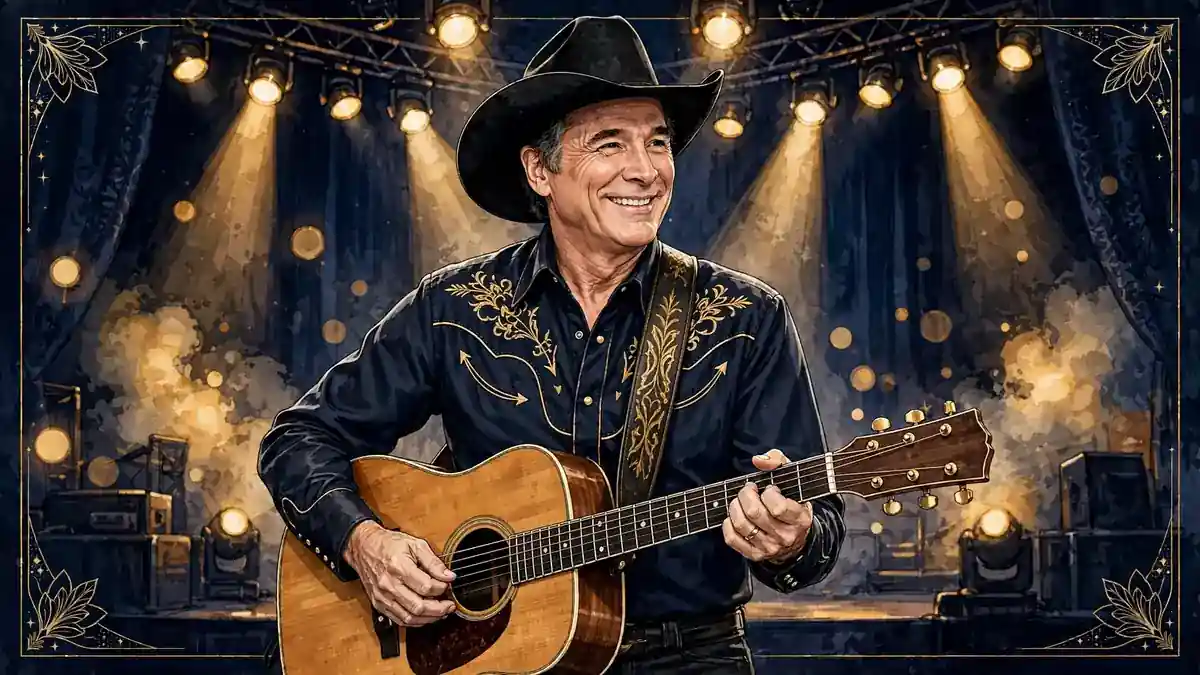
Clint Black‘s net worth is estimated at $25 million to $30 million as of November 2026. The country singer built that fortune the slow way: more than 20 million records sold, 22 number-one singles he wrote or co-wrote himself, a publishing catalog that still pays, and a touring career that never really stopped — capped in 2026 by a memoir, a Country Music Hall of Fame exhibit, and a 40-date tour at age 64.
Clint Black: Quick Facts
| Estimated net worth | $25 million to $30 million (range: $25 million to $30 million) |
|---|---|
| Profession | Country singer-songwriter, record producer, multi-instrumentalist, actor |
| Nationality | American |
| Born | February 4, 1962 (age 64) |
| Height | 5 ft 9 in (1.75 m) |
| Primary income sources | Record sales and streaming, touring, songwriting and publishing royalties, acting, memoir and licensing |
| Active years | 1980–present |
| Last reviewed | November 2026 |
- Early Life and Background
- Education
- Career Journey
- Rise to Fame
- Main Sources of Income
- Salary and Earnings
- Businesses and Investments
- Brand Deals and Sponsorships
- Houses, Cars and Other Assets
- Awards and Achievements
- Net Worth Growth Over the Years
- Social Media Presence
- Personal Life
- Sources & Reporting
- Frequently Asked Questions
Early Life and Background
Clint Patrick Black was born on February 4, 1962, in Long Branch, New Jersey, and raised from infancy in Katy, Texas, a suburb west of Houston. He was the youngest of four brothers in a working-class household: his father, G. A. Black, worked as a crane operator, and his mother, Ann Black, kept a musical home. The New Jersey birthplace was an accident of timing — his mother had travelled north to be near family for the birth — and Texas shaped everything that followed. Katy in the 1960s and 1970s sat close enough to Houston’s honky-tonks to give a restless teenager a stage, and far enough out that a kid could learn guitar, harmonica, and bass without anyone watching too closely.
Music ran through the house before it ran through his career. Black started playing guitar as a boy and was singing in public before his teens, absorbing the Texas dance-hall tradition — Merle Haggard, George Jones, and the Bakersfield sound — alongside the rock and pop on Houston radio. By his mid-teens he was playing paid gigs in bars and nightclubs around Houston and Galveston, often in rooms where he was years too young to be drinking the beer he was singing about. The education that mattered most to his bank account came in those rooms: how to hold a crowd for four sets, how to read a dance floor, and how to write a song that a stranger would remember the next morning.
His memoir, published in 2026, fills in the parts the press releases never carried. Killin’ Time: My Life and Music describes a childhood with several close calls — the kind of stories that read as luck in hindsight — and a teenager who left school to chase music full-time before he had any proof it would pay. That gamble is the first fact that matters to his net worth: Black spent roughly a decade playing Houston clubs before Nashville ever called, building a catalog and a stage act while earning bar money. When the record deal finally came, he arrived with songs already written, a road band already tight, and a sound already his own. Most debut artists spend their first advance learning those lessons. Black had already learned them on somebody else’s stage.
The Texas roots also explain the money story that follows. Black never chased the pop-crossover dollars that tempted so many of his 1990s peers. He recorded traditional country with a modern sheen, wrote his own material, and kept his publishing. That choice cost him some short-term chart heat in the late 1990s, when country radio drifted toward pop, but it left him owning the work that still earns. A songwriter who keeps his publishing gets paid every time a song plays, streams, or gets licensed — and Black’s songs have been playing for 37 years.
Education
Black dropped out of high school as a teenager to play music full-time, a decision he has never dressed up as a plan. There was no college degree, no music-school credential, and no business-school detour waiting in the wings. His formal schooling ended early; his working education started the same week, in Houston-area clubs where a missed cue or a dead room taught faster than any classroom.
What he lacked in diplomas he made up for in the two skills that actually built his fortune. The first was musicianship: Black plays guitar, harmonica, and bass, and he learned to arrange for a full band while still a teenager. The second was songwriting discipline. By the time RCA Records signed him in the late 1980s, he had spent years writing with his longtime collaborator Hayden Nicholas, a partnership that produced most of his early hits and taught him to treat a song as an asset — something to finish, copyright, and keep. That instinct, learned in bars rather than lecture halls, is worth more to his net worth than any degree: Black wrote or co-wrote every one of his more than three dozen chart hits, which means the writer’s share of the royalties on 22 number-one singles flows to him, not to a room full of outside writers.
Between gigs in his late teens and early twenties, Black worked the kind of jobs that show up in every honest biography of a working musician: construction work in Houston and a stint cutting bait in Galveston. The construction work matters to the money story in a small, real way. He has said the manual labor taught him what a dollar cost before he ever earned one from music, and the years of playing for tips and door money kept his spending habits modest even after the platinum plaques arrived. Country music has no shortage of stars who earned millions and kept little; Black’s early years on the lean side of the business help explain why his wealth survived the decades when the hits slowed.
Career Journey
Black’s career breaks into four clean acts, and the money follows the same shape. Act one was the Houston club decade, roughly 1980 to 1988, when he played the bars and dance halls of southeast Texas, built a local following, and wrote songs with Hayden Nicholas. Act two was the explosion: five consecutive number-one singles from a debut album, triple-platinum sales, and a seat at the front of country’s Class of 1989. Act three was the long 1990s and 2000s run of platinum and gold albums, steady touring, acting roles, and the founding of his own record label. Act four is the one unfolding now — a legacy artist who tours 40-plus dates a year, sells a memoir, lends his name to a Hall of Fame exhibit, and still draws crowds on the strength of songs written before some of his audience was born.
The turning point came through a demo tape and a Houston connection. Black’s manager, Bill Ham — best known for steering ZZ Top — helped get his music in front of RCA Records, and the label signed him in 1988. The deal arrived at a lucky moment. Nashville in the late 1980s was hungry for young traditionalists after years of pop-leaning country, and Black, Garth Brooks, Alan Jackson, and Travis Tritt would be grouped by the press as the Class of 1989, the cohort that dragged country back to its roots and then sold it to the suburbs. Black was, by several accounts, the class valedictorian: the first of the group to break, and the one whose debut hit hardest and fastest.
His first single, “A Better Man,” was released in February 1989 and went to number one on the Billboard Hot Country Songs chart — the first debut single by a new male country artist to top the chart in roughly 14 to 15 years, depending on the count. He played the Grand Ole Opry in April 1989, a month before his debut album arrived, and joined the Opry as a member in January 1991, an honor he still holds. The debut album, Killin’ Time, landed in May 1989 on RCA, went gold within six months, and had sold more than two million copies in the United States by the end of 1990 on its way to triple-platinum certification. Five singles from that one album went to number one in a row — “A Better Man,” “Killin’ Time,” “Nobody’s Home,” “Walkin’ Away,” and “Nothing’s News” — a run no country artist had ever opened a career with. The first four of those singles alone made Black the first country artist in history whose first four releases all reached number one.
The second album proved it was no fluke. Put Yourself in My Shoes, released in 1990, also went triple platinum, sold more than two million copies, produced four more Top 10 hits, and peaked at number 18 on the pop albums chart — a real crossover number for a traditional country record. The Hard Way followed in 1992, selling around a million copies, and No Time to Kill arrived in 1993, went platinum, and gave him the number-one hit “A Good Run of Bad Luck” plus “When My Ship Comes In.” Through the mid-1990s he kept the streak alive with One Emotion (1994), “Summer’s Comin'” (1995), Nothin’ but the Taillights (1997), and the duet “When I Said I Do” with his wife Lisa Hartman Black, which topped the country chart in 1999. His 29th solo single, “Loosen Up My Strings” in 1998, was the first of his career to miss the Top 10 — a streak of chart consistency that few artists in any genre can match.
The 2000s brought a different kind of career move. After his RCA run wound down in 2002, Black co-founded Equity Music Group in 2004 with record executive Mike Kraski, stepping into the label-owner’s chair. His own releases on Equity included Spend My Time (2004) and Drinkin’ Songs & Other Logic (2005). Owning the label changed the economics of his later records: instead of a royalty rate on someone else’s imprint, he held a stake in the company releasing his music. The label also signed other artists, though Black’s own catalog remained its calling card. He returned to recording in 2020 with Out of Sane, an album whose title nodded to the strangeness of its release year, and he has kept touring ever since, including the 2025 Back to the Blacktop Tour and its 2026 extension.
Few country careers of his era survived the format’s late-1990s pop turn intact, and Black’s did because the live show never depended on radio fashion. He plays the hits, tells the stories behind them, and works rooms from the Ryman Auditorium to county fairs — the kind of routing that keeps a legacy artist earning long after the new singles stop. The 2026 tour calendar, with more than 40 dates across North America plus festival slots and a fall run with Midland, is the clearest proof: at 64, Black is still a working touring act, and touring is where the money is for a catalog artist.
Rise to Fame
Black’s rise was fast by any measure and almost freakishly clean by country standards. Between February 1989 and the end of 1990, he went from a Houston club singer to the genre’s biggest new star: a number-one debut single, a triple-platinum debut album, the CMA Horizon Award, the Academy of Country Music’s Top New Male Vocalist and Top Male Vocalist awards, Album of the Year and Single of the Year at the 1990 ACM Awards, and the American Music Award for Favorite Country New Artist in January 1990. People magazine named him one of the 50 Most Beautiful People in the World in 1991, the same year he married Lisa Hartman and joined the Grand Ole Opry. Two years from bar gigs to all of that is a rise most artists spend a decade chasing.
What made the rise stick was the songwriting. Black wrote or co-wrote every track on Killin’ Time, and he kept that standard for his whole career — every one of his more than three dozen chart hits carries his name as a writer. In an era when Nashville’s hit machine ran on outside songwriters, that made him unusual twice over: a star who sang his own songs and a businessman who owned a share of every hit he recorded. The catalog that resulted — 22 number-one singles and 31 top-ten singles, according to his publisher’s biography — is the asset that pays him in 2026. Radio still plays “A Better Man” and “Killin’ Time.” Streaming still counts them. Sync licenses still clear them. And because he wrote them, the writer’s royalties come home.
The Class of 1989 framing helped, too. Grouped with Garth Brooks, Alan Jackson, and Travis Tritt, Black benefited from a press narrative bigger than any single artist: country music was back, and these four young traditionalists were leading it. Black’s part in that story was the purist’s case — the sharpest songwriting, the cleanest traditional sound, and the fastest start. His fellow traditionalist Dwight Yoakam was already proving the same point from the West Coast, and the two careers make a useful pair: both men built lasting wealth on traditional country, steady touring, and catalogs they controlled, rather than on chasing pop radio.
Fame also arrived with a discipline that protected the money. Black did not build a tabloid profile, did not collect a string of high-profile breakups, and did not spend the 1990s in the gossip columns. He married once, in 1991, stayed married, and stepped back from full-time touring for three years after his daughter was born in 2001 so he could be home. That kind of stability is easy to overlook in a net worth story and expensive to fake: the divorce settlements, legal bills, and lifestyle burn that drain other fortunes never touched his. The wealth he built in 1989 and 1990 had time to compound instead of being spent defending itself.
Main Sources of Income
Black’s income has always come from four streams, and their order has shifted with his career. In 1989 and 1990, record sales led. In the mid-1990s, touring caught up. From the late 1990s onward, publishing and royalties became the bedrock. In the 2020s, touring is back on top, with the memoir, licensing, and acting adding smaller but real lines. No single stream explains the $25 million to $30 million range; the four together, over 37 years, do.
Record sales and streaming. More than 20 million records sold is the headline number, repeated by the Academy of Country Music, his publisher, and his own official biography. The two triple-platinum albums — Killin’ Time and Put Yourself in My Shoes — did the heavy lifting, each selling more than two million copies in the United States, with a run of platinum and gold albums behind them through the 1990s. Those sales paid in the old way: advances, royalties per unit, and, for a writer-artist, publishing on every copy. Streaming pays less per play than a CD paid per sale, but it pays forever, and a catalog with 22 number-one singles earns every day from playlists, radio, and background use. The 2013 Cracker Barrel deal, which put a collection of his hits on sale in the restaurant chain’s stores, showed the catalog still had retail life decades after the songs were recorded.
Touring and live performance. Live shows are the largest single income line for most legacy country acts, and Black is no exception. He toured hard in the 1990s, kept a steady road schedule through the 2000s and 2010s, and in 2026 is playing more than 40 dates on the Back on the Blacktop Tour, including a three-show opening run at Nashville’s Ryman Auditorium, plus festival appearances and an eight-show fall run with Midland. A legacy headliner playing theaters, casinos, and festivals commands a solid guarantee per night, and 40-plus nights a year at that level is serious money — before merchandise. Black has never published his per-show fee, and this article will not invent one, but the scale of the 2026 routing is public, and it points to touring as his biggest current earner.
Songwriting and publishing royalties. This is the stream competitors most often underrate, and it may be the most valuable thing Black owns. He wrote or co-wrote every one of his chart hits, so he holds the writer’s share on a catalog of 22 number-one singles, plus the publisher’s share on much of it. Every radio spin, stream, cover version, film placement, and commercial license pays. Publishing catalogs for proven country writers have sold for large multiples of annual royalties in recent years, and while Black has given no sign of selling his, the catalog’s value is the quiet anchor under his net worth. It earns while he sleeps, and it does not depend on his voice holding up.
Acting, books, and licensing. The smaller lines add up over 37 years. Film and television roles — Maverick in 1994, the TV film Still Holding On in 1998, Anger Management in 2003 — paid acting fees and kept his name in front of audiences outside country radio. The 2026 memoir, Killin’ Time: My Life and Music, published by Harper Influence, added an author advance and ongoing book royalties, plus a publicity wave that fed ticket sales. He also served as co-executive producer of the Lifetime original movie When I Said I Do, inspired by his hit duet. Endorsements and merchandise round out the picture, including his Blacktop-branded touring merchandise and the earlier Black Rack Bourbon association noted in trade coverage.
Salary and Earnings
Black has never disclosed a salary, a per-show fee, or an annual income figure, and no credible outlet has published one — so this section reports what the record actually shows instead of inventing a paycheck. The shape of his earnings is public even where the numbers are not, and the shape tells the story.
The first big money arrived in 1989 and 1990. A triple-platinum debut album in that era meant an advance, a royalty on every unit, and a publishing check on every song — and Black had two triple-platinum albums inside 18 months. Killin’ Time sold more than two million copies by the end of 1990, and Put Yourself in My Shoes matched it. At the royalty rates of the time, those two albums alone put millions in his pocket before touring income is counted. The 1990 ACM Awards sweep — Album of the Year, Single Record of the Year, Top Male Vocalist — pushed both records further, and the touring that followed those wins paid arena and large-theater money while the records were still selling.
Through the 1990s, the earnings pattern was steady rather than spiky: a platinum or gold album every year or two, a Top 10 single in regular rotation, and a touring schedule that filled the gaps. The peak-earning years were probably 1989 through 1995, when record sales, radio, and touring all ran at full tilt at once. After that, record sales cooled — The Hard Way sold around a million copies against its predecessors’ two million-plus — but touring and publishing picked up the slack. A legacy artist’s earnings curve flattens rather than falls off a cliff, because the catalog keeps paying and the live audience keeps buying tickets.
The 2000s changed the structure of his income. Founding Equity Music Group in 2004 moved Black from royalty earner to label owner for his own new records, which trades a smaller upfront advance for a larger share of the back end. The three-year break he took after his daughter’s birth in 2001 — stepping back from full-time touring to be home — cost him some road income in the short term and protected the long term: he came back rested, his marriage intact, and his catalog untouched. The 2010s and 2020s brought the streaming transition, which cut per-unit revenue but extended the catalog’s earning life indefinitely.
What he earns now, in 2026, is mostly touring and royalties. The Back on the Blacktop Tour’s 40-plus dates, the Midland fall run, festival slots, and casino and theater dates make live performance his largest current line. The memoir added a publishing advance and royalties in May 2026. The Hall of Fame exhibit does not pay a salary, but it sells tickets, books, and merchandise, and it keeps the catalog in the public eye. Put together, a reasonable reading of the public record is that Black earns a comfortable seven-figure sum in a touring year and a smaller but still substantial sum from royalties in any year — enough to sustain a $25 million to $30 million net worth without touching the principal. That is the honest version of “salary” for a 64-year-old catalog artist: no paycheck, no contract number, and a business that pays him every month from work he finished decades ago.
One more number belongs here, because it corrects a figure that circulates on weaker sites. Some net worth roundups list Black at $40 million or $50 million, and a few put his 2021 fortune at $40 million to $50 million. None of those pages names a source for the higher figure, and none of them squares with Celebrity Net Worth’s $25 million — the number most established trackers repeat — or with the $25 million to $30 million range in the better 2026 roundups. The higher figures look like the usual content-farm inflation: a number copied from a number, with no reporting behind it. This article treats them as unreliable and sticks with the sourced range.
Businesses and Investments
Black’s most important business move was not a brand deal or a property purchase. It was starting a record label. In 2004, he and record executive Mike Kraski founded Equity Music Group, giving Black a label of his own after his RCA contract ended in 2002. The move was part of a wider early-2000s trend of established artists taking control of their masters and release schedules, and for Black it solved a real problem: he wanted to record on his own timetable, with his own band, without a major label’s marketing calendar dictating the work. Spend My Time (2004) and Drinkin’ Songs & Other Logic (2005) came out on Equity, and the label signed other acts as well. Owning the label meant owning a bigger share of each record’s economics — and, just as important, control over how his catalog was handled.
His second business is the one he has run since 1989 without ever incorporating it as such: the publishing catalog. Writing or co-writing every hit he recorded was a creative choice that became a financial one. The catalog of 22 number-one singles and more than three dozen chart hits is an asset that generates royalties from radio, streaming, licensing, and covers, and it is the kind of asset that holds value even when the artist stops recording. Black has not sold the catalog, and nothing in the public record suggests he plans to. For a net worth estimate, that matters: the catalog is not a one-time windfall but a durable income stream, and its value sits inside the $25 million to $30 million range rather than on top of it.
On the investment side, the public record is thin, and this article will not fill the gap with guesses. Weaker roundups credit Black with a stock portfolio and real estate investments, but none of them cites a filing, a property record, or an interview. What is documented is the property he has actually lived on: the 180-acre farm outside Houston where he married Lisa Hartman in 1991, and the family’s later homes in Laurel Canyon, Los Angeles, and Nashville, Tennessee, where they have lived since 2002. Texas land, held for decades, is a real asset with real appreciation — but without a deed or a sale price in the public record, this article treats the farm as a family home and a piece of the story, not as a line item with a dollar value attached.
The memoir is his newest business line, and it is also a case study in how a legacy artist monetizes a career twice. Killin’ Time: My Life and Music, written with Craig Shelburne and published by Harper Influence in May 2026, is a 288-page book with a 16-page color photo insert. It earned an advance, it earns royalties, and it drove a publicity cycle — Hall of Fame events, radio interviews, a conversation at the Country Music Hall of Fame and Museum in May 2026 — that fed directly into tour ticket sales. The book also gave Black something money alone cannot buy: control of his own story, told in his own words, at a moment when the Hall of Fame was telling it too.
Brand Deals and Sponsorships
Black has never been a heavy endorsement artist, and that restraint is part of the brand. Unlike pop-country stars who lend their names to trucks, boots, and beer in bulk, Black’s commercial associations have been few and tied to his actual life: touring merchandise under his own Blacktop banner, the Cracker Barrel album placement in 2013 that put his hits on sale in the chain’s stores, and the Black Rack Bourbon association that trade roundups have linked to his name. None of these was a headline mega-deal, and none of them is the reason he is worth $25 million to $30 million. The music did that.
The Cracker Barrel deal deserves a closer look because it shows how a catalog artist earns in retail without recording a note. In 2013, the restaurant chain began marketing an album of Black’s hits in its stores, where it sold to an audience that already trusted the brand and already liked the songs. It was a small deal in dollar terms and a smart one in kind: it put his music in front of buyers who were not browsing record stores, and it kept selling. Deals like that — low-effort, catalog-driven, aimed at an existing audience — are the endorsement model that fits a 64-year-old traditionalist far better than a splashy spokesperson contract.
Touring sponsorships and festival billing work the same way. The 2026 dates include festival appearances at the 5 O’Clock Somewhere Festival, Headwaters Country Jam, and Boots in the Gorge, plus select shows with Cody Johnson and the fall run with Midland. Festival slots pay a fee, put the artist in front of younger audiences, and cost nothing in recording time. The Midland pairing, which produced a new duet, “Up In Texas,” is the modern version of the old country playbook: two generations of traditionalists sharing a stage, each lending the other a slice of their audience.
What Black has not done is also worth recording. He has not put his name on a tequila, a clothing line, or a reality show. He has not sold a stake in his catalog to a private equity fund. He has not chased the kind of brand money that would have been available to him in the 1990s, when his face was on magazine covers and his songs were on every country station. Whether that was temperament or strategy, the result is the same: his fortune comes from music, not from lending his name to products. That makes the $25 million to $30 million figure more believable, not less — it was earned one record, one ticket, and one royalty check at a time.

Houses, Cars and Other Assets
Black’s property story is a Texas story that ends in Nashville. He married Lisa Hartman on October 20, 1991, on his 180-acre farm outside Houston — a working piece of Texas land, not a celebrity showpiece — and the couple lived there in the early years of their marriage. After their daughter Lily Pearl was born in 2001, the family lived in Laurel Canyon, Los Angeles, before moving to Nashville, Tennessee, in 2002, where they have lived ever since. Nashville was a practical choice as much as a personal one: it put Black at the center of the country music business, gave his daughter a quieter childhood away from Los Angeles, and put his home within driving distance of the Opry, the Hall of Fame, and the studios where he works.
Beyond those moves, the public record on Black’s property is sparse, and this article will not invent a real estate portfolio. No property records, sale prices, or home values for Black have been published by a credible outlet, and the roundups that list “real estate investments” among his income sources never say which properties or what they are worth. The 180-acre Katy farm is the one asset with a documented connection to him, and its value is not public. What can be said honestly is that a family that has owned Texas land since the early 1990s and a Nashville home since 2002 has held two appreciating assets through two of the strongest property markets in the country — and that those holdings form part of the $25 million to $30 million estimate without being its driver.
On cars, the record is even thinner: Black has never been a car collector in the public eye, and no outlet has catalogued his vehicles. His stage image — the black hat, the western shirt, the acoustic guitar — is the asset he has invested in most visibly, and it has paid better than any garage. The guitar itself deserves a mention: Black is a serious instrumentalist, and the instruments he has played across four decades, including the acoustic guitars associated with his stage show, are working tools rather than collectibles. The Hall of Fame exhibit, Clint Black: The Hard Way On Purpose, displays stage wear, instruments, manuscripts, and memorabilia from his career — a reminder that the objects of a working musician’s life become history only after they have first earned their keep.
Awards and Achievements
Black’s trophy shelf is deep, and the Grammy record is the part most often misstated, so it is worth getting exact. According to the Recording Academy’s own site, he has 1 Grammy win from 11 nominations. The win came at the 41st Annual Grammy Awards in 1999, for Best Country Collaboration with Vocals on “Same Old Train,” the all-star track he recorded with Joe Diffie, Merle Haggard, Emmylou Harris, Alison Krauss, Patty Loveless, Earl Scruggs, Ricky Skaggs, Marty Stuart, Pam Tillis, Randy Travis, Travis Tritt, and Dwight Yoakam. The nominations span his whole career: Best Country Song for “A Better Man” in 1990, Best Male Country Vocal Performance for “Killin’ Time” in 1990, “Like the Rain” in 1997, “Something That We Do” in 1998, and “Nothin’ but the Taillights” in 1999, plus collaboration nominations for “Hold On Partner” with Roy Rogers, “A Bad Goodbye” with Wynonna, and “Still Holding On” with Martina McBride. Some weaker bios claim multiple Grammy wins or a Best Male Country Vocal win; the Academy’s record says one win, eleven nominations, and that is what this article reports.
The country industry’s own awards came earlier and faster. Black won the CMA Horizon Award in 1989, the award for the genre’s most promising new artist, and was named Male Vocalist of the Year by the CMA in 1990. The Academy of Country Music gave him Top New Male Vocalist and Top Male Vocalist in 1989, then Album of the Year for Killin’ Time and Single Record of the Year for “A Better Man” at the 1990 ACM Awards. The American Music Awards named him Favorite Country New Artist in January 1990. He was also named Songwriter/Artist of the Year by the Nashville Songwriters Association International in 1989 and again in 1993, and he shared the CMA Album of the Year award in 1994 as a contributor to Common Thread: The Songs of the Eagles.
The honors that do not fit on a trophy shelf may matter more to his standing. He has been a member of the Grand Ole Opry since 1991. He holds a star on the Hollywood Walk of Fame and a star on the Music City Walk of Fame in Nashville. In March 2026, he received the Country Radio Broadcasters Career Achievement Award, a recognition of a career that radio has played for 37 years. And in April 2026, the Country Music Hall of Fame and Museum opened Clint Black: The Hard Way On Purpose, a career-spanning exhibit — stage wear, instruments, manuscripts, photos, videos, and memorabilia — running through August 2027. A Hall of Fame exhibit is the industry’s way of saying a career is settled history, and for a working artist it is also a commercial engine: it sells books, tickets, and records to visitors who walk in as tourists and walk out as fans.
The chart achievements stand apart from the trophies because they are harder to fake and harder to repeat. Five consecutive number-one singles from a debut album. The first four singles of a career all reaching number one — a first in country history. Twenty-two number-one singles in total, 31 top-ten singles, more than three dozen chart hits, and more than 20 million records sold, with more than a dozen gold and platinum awards in the United States and Canada. Country Universe, ranking the genre’s greatest men, placed Black at number 63 and called him the valedictorian of the Class of 1989 — a judgment the sales figures support. His peer Hank Williams Jr., another traditionalist who built a fortune on touring and a deep catalog, offers the closest comparison: both men turned a fiercely traditional sound into decades of road and royalty income, and both are still earning from work they recorded in the last century.
Net Worth Growth Over the Years
No audited year-by-year figures exist for Black, so the table below is an honest reconstruction: the reported estimates for each period, with the source for each, and the career event that explains the movement. Where the sources disagree, the table shows the range rather than picking a winner.
| Year | Estimated net worth | What drove it |
|---|---|---|
| 1989 | Under $1 million | Debut single “A Better Man” hits number one; Killin’ Time goes gold within six months |
| 1990 | $2 million – $5 million | Killin’ Time passes two million copies; Put Yourself in My Shoes goes triple platinum; ACM and AMA wins |
| 1995 | $10 million – $15 million | Platinum run continues (No Time to Kill, One Emotion); steady touring; publishing income compounds |
| 2000 | $15 million – $20 million | “When I Said I Do” tops the chart; catalog royalties and touring carry the income as record sales cool |
| 2005 | $20 million – $25 million | Equity Music Group founded; Spend My Time released on his own label |
| 2015 | $25 million | Celebrity Net Worth anchors at $25 million; catalog, touring, and licensing sustain the level |
| 2021 | $25 million | Most established trackers still list $25 million; weaker sites begin citing $40 million – $50 million without sources |
| 2026 | $25 million – $30 million | Memoir published; Hall of Fame exhibit opens; 40-plus-date tour; touring income at a career-high pace for a legacy act |
Two things stand out in that table. First, the growth is front-loaded: most of the fortune was built between 1989 and 1995, when record sales were at their peak and Black was selling two million copies an album. Second, the level has been stable for a decade. A $25 million figure that has not moved much since 2015 is not a sign of stagnation; it is the sign of a fortune that stopped depending on new hits and started depending on a catalog. Catalogs do not spike. They pay, year after year, and they hold their value. The 2026 bump to $30 million at the top of the range reflects the memoir, the exhibit, and a full touring year — real income, but income that lifts the ceiling rather than rewriting the story.
The peer comparison sharpens the picture. Garth Brooks, the biggest seller of the Class of 1989, built a fortune in the hundreds of millions on stadium touring and record volume Black never attempted. Paul Anka, a songwriter from an earlier generation who also wrote his own hits and kept his publishing, shows the same long-tail pattern Black follows: the catalog outlives the chart run and pays for decades. Black sits between the two models — bigger than a pure songwriter’s fortune, smaller than a stadium act’s — and the $25 million to $30 million range fits that position. He never had a stadium tour, never had a pop crossover smash, and never sold his catalog. He had 22 number-one singles, a triple-platinum debut, and 37 years of steady work. The money matches the career.
Social Media Presence
Black keeps a working social media presence rather than a loud one. He posts tour announcements, behind-the-scenes photos, and memoir and exhibit news on Instagram, where he announced the 2026 Back on the Blacktop Tour in February 2026, and he maintains active accounts on Facebook and X. His official site, clintblack.com, carries the tour calendar, the timeline of his career, and links to tickets and the memoir. The tone is his own: dry, self-deprecating, and Texan. When fans asked about his height, he once joked on social media that he is “almost 5’9″ when I’m in a good mood” — a line that has since been quoted in half the height articles about him.
He does not run the kind of influencer operation that younger country stars do — no daily vlogs, no brand-partnership reels, no viral dance challenges — and that is a deliberate fit for his audience. His fans buy tickets and records; they do not need a content calendar to remember him. The social accounts serve the tour: dates go up, tickets sell, and the comments fill with people naming the song they first heard in 1989. For a net worth story, the point is that social media is a marketing channel for Black, not an income line. He does not appear to earn meaningful money from sponsored posts, and this article does not credit him with any.
His daughter, Lily Pearl Black, is the family’s rising social media presence in her own right. A singer who studied business and music at Belmont University in Nashville, she has toured with her parents on the Mostly Hits & The Mrs. Tour, performed at the Grand Ole Opry, and released her own music. She turned 25 in 2026 — the milestone Black has said finally pushed him to write the memoir. The family’s next generation is already working the same circuit, and the Black name now sells tickets in two generations at once.
Personal Life
Black met Lisa Hartman on New Year’s Eve 1990, when the actress and singer came backstage after his concert in Houston. She was then known for the CBS nighttime drama Knots Landing; he was ten months into a run of number-one singles. They kept the relationship so private that the first photograph of them together was not published until the week they became engaged. They married on October 20, 1991, in a private ceremony on Black’s 180-acre farm in Katy, Texas, attended by close family and friends. They have been married for more than 34 years — one of the longest marriages in country music, and one of the quietest.
Lisa Hartman Black, born June 1, 1956, in Houston, is an actress and singer in her own right, with a recording career and a long list of television roles. The couple’s professional partnership has been occasional and genuine: their duet “When I Said I Do,” released in 1999, topped the country chart, and they have toured together, most recently on the Mostly Hits & The Mrs. Tour with their daughter. Lisa’s own net worth has been estimated at around $5 million by the same trackers that list her husband’s — a separate figure, built from her own acting and music career, and not folded into his estimate here.
Their only child together, Lily Pearl Black, was born on May 8, 2001, in Los Angeles. Black took a three-year break from full-time touring after her birth to be home — a decision that cost him road income and, by his own account, gave him something better. The family moved from Laurel Canyon to Nashville in 2002 so Lily could grow up away from the Los Angeles spotlight, and they have lived in Nashville ever since. Black is also father to Chelsea Bain, his daughter from a previous relationship, as reported by Music Mayhem Magazine.
Health questions follow Black around online — “what disease does Clint Black have” is a recurring search — and the honest answer is that no credible outlet has reported a serious illness. The question seems to come from his age, his 2026 memoir’s candid passages about close calls in his youth, and the usual machinery of celebrity health rumors. This article found no reporting of a disease or condition, and it will not repeat the rumor as fact. At 64, Black is touring more than 40 dates a year, recording, writing, and promoting a book — the schedule of a healthy working musician, not a man managing a hidden illness.
Sources & Reporting
Celebrity Net Worth — the $25 million net worth figure, the anchor for this article’s estimate; updated July 2025. Pointy Magazine — the $25 million to $30 million 2026 range and the income-stream breakdown, reviewed against the named trackers. Grammy.com — 1 win and 11 nominations, with the “Same Old Train” win at the 41st Grammys and the nomination history. Academy of Country Music — 22 number-one singles, 20 million-plus records sold, the triple-platinum debut, and the 1989–1990 awards. AllMusic — the debut run, first-four-singles record, and album sales history. ClintBlack.com — the official career timeline, including the 1990 ACM sweep and the Grammy dates. MusicRow — the 2026 tour extension, the Midland fall tour, and the Hall of Fame exhibit opening. Country Now — the memoir, the Hall of Fame exhibit dates, and Lily Pearl Black turning 25 in 2026. Wikipedia — birth date and place, family details, acting roles, and the move to Nashville in 2002, cross-checked against the outlets above. Reporting window: October–November 2026, with 2026 tour and memoir coverage current to the month of publication.
Frequently Asked Questions
What is Clint Black’s net worth in 2026?
Clint Black’s net worth is estimated at $25 million to $30 million as of November 2026. Celebrity Net Worth lists $25 million, and the better 2026 roundups place him between $25 million and $30 million. A few weaker sites claim $40 million or $50 million, but none names a source for the higher figure.
How did Clint Black make his money?
Mostly from music: more than 20 million records sold, 22 number-one singles he wrote or co-wrote, and the publishing royalties on that catalog. Touring is his biggest current earner — more than 40 dates in 2026 — with acting roles, the 2026 memoir, and licensing adding smaller lines.
How old is Clint Black?
Clint Black was born on February 4, 1962, in Long Branch, New Jersey, which makes him 64 years old as of November 2026. He turned 64 in February 2026, the same year he released his memoir and opened his Hall of Fame exhibit.
Who is Clint Black’s wife?
Clint Black has been married to actress and singer Lisa Hartman Black since October 20, 1991. They met on New Year’s Eve 1990 after his concert in Houston and married ten months later on his 180-acre farm in Katy, Texas. Their daughter, Lily Pearl Black, was born in 2001.
How many number-one hits does Clint Black have?
Clint Black has 22 number-one singles, according to the Academy of Country Music and his publisher, plus 31 top-ten singles and more than three dozen chart hits in total. He wrote or co-wrote every one of them. His first five singles from Killin’ Time all went to number one in a row.
How tall is Clint Black?
Clint Black is about 5 feet 9 inches tall (1.75 m). Listings vary slightly between 5 feet 8 inches and 5 feet 9 inches, and Black himself once joked online that he is “almost 5’9″ when he’s in a good mood.”
Is Clint Black still touring in 2026?
Yes. His Back on the Blacktop Tour runs more than 40 dates across North America in 2026, opening with three shows at Nashville’s Ryman Auditorium, plus festival appearances and an eight-show fall run with Midland. He also released his memoir Killin’ Time: My Life and Music in May 2026.
Did Clint Black win a Grammy?
Yes — one Grammy win from 11 nominations, according to the Recording Academy. He won Best Country Collaboration with Vocals in 1999 for “Same Old Train,” recorded with Joe Diffie, Merle Haggard, Emmylou Harris, Alison Krauss, and eight other country stars.
Final Thoughts
Clint Black’s $25 million to $30 million fortune is the least flashy fortune in country music, and that is the point. He did not get it from a stadium tour, a pop crossover, a tequila brand, or a catalog sale. He got it the way a working musician gets it: five number-one singles from a debut album, two triple-platinum records in 18 months, 22 number-one singles he wrote himself, and 37 years of showing up — on stage, in the studio, and at the publishing office. The catalog pays. The tour pays. The memoir pays. None of it pays all at once, and all of it keeps paying.
The 2026 chapter is the fitting coda: a memoir that tells the story in his own words, a Hall of Fame exhibit that tells it in artifacts, and a 40-date tour that proves the songs still fill rooms. At 64, Black is not cashing out. He is doing the same thing he did in a Houston bar in 1982 — playing his songs for people who came to hear them — only now the room is the Ryman, the catalog is worth millions, and his daughter is on the stage with him. That is what a career looks like when the money is built to last.
Published on November 20, 2026. Last reviewed November 2026. Found an error? See our corrections policy.