
Doug Flutie‘s net worth is estimated at $10 million to $15 million as of November 2026. The 1984 Heisman Trophy winner banked $21.765 million in NFL salary according to Spotrac, signed a reported $7 million USFL deal as a rookie, became the highest-paid player in Canadian football, and later turned a breakfast cereal into a charity that is closing in on $50 million raised for autism families.
Doug Flutie: Quick Facts
| Estimated net worth | $10 million – $15 million (range: $10 million to $15 million) |
|---|---|
| Profession | Former professional football quarterback; college football broadcaster |
| Nationality | American |
| Born | October 23, 1962 (age 64) |
| Height | 5 ft 10 in (1.78 m) |
| Primary income sources | NFL, CFL and USFL playing contracts; broadcasting with NBC Sports, ESPN and ABC; endorsements; Flutie Flakes; speaking engagements |
| Active years | 1981–2006 (playing career); 2006–present (broadcasting) |
| Last reviewed | November 2026 |
- Quick Facts
- Early Life and Background
- Education
- Career Journey
- Rise to Fame
- Main Sources of Income
- Salary and Earnings
- Businesses and Investments
- Brand Deals and Sponsorships
- Houses, Cars and Other Assets
- Awards and Achievements
- Net Worth Growth Over the Years
- Social Media Presence
- Personal Life
- Sources & Reporting
- Frequently Asked Questions
Early Life and Background
Douglas Richard Flutie was born on October 23, 1962, in Manchester, Maryland, to Dick and Joan Flutie. His father worked as an aerospace engineer, and the job moved the family south to Florida while Doug was still a boy. When the American space program slowed down in the mid-1970s, the family moved again, this time to Natick, Massachusetts, about 20 miles west of Boston. Natick became home, and it stayed home: Flutie still has deep ties to the town, where he starred at Natick High School and where his foundation later put down roots.
Flutie grew up in a house full of athletes. He was the second son of Richard and Joan Flutie, with an older brother, Bill, an older sister, Denise, and a younger brother, Darren, who went on to become one of the most productive receivers in Canadian Football League history — the CFL’s fourth all-time receptions leader. The Flutie brothers rarely left the field at Natick High, playing football, basketball and baseball, and Doug once won a high school game with a 38-yard field goal, an early hint that his right leg would matter as much as his right arm. His paternal great-grandparents were Lebanese immigrants, a piece of family history Flutie has spoken about with pride.
The money story of Flutie’s childhood was ordinary middle-class America, not wealth. His father engineered aerospace systems; his mother kept the household running. Nothing in his early years suggested a multimillion-dollar career, and that gap between his background and his later earnings is part of why his story still gets told. He was small for a quarterback even then — listed at 5 ft 10 in and 180 pounds during his playing days — and the question that followed him from high school through the NFL draft was always the same: could a quarterback that size survive professional football?
At Natick High, Flutie answered it the only way he could, by winning. He was an All-League performer in football, basketball and baseball, and his high school sweetheart, Laurie Fortier, sat in the stands. The two married in 1985, weeks after Flutie signed his first professional contract, and they have been together for more than 40 years. That stability matters to the financial story too: unlike many athletes whose wealth leaked away through divorce settlements and entourage spending, Flutie’s money stayed inside one household, managed by one family, for four decades.
Two family facts shaped everything that came after his playing career. His son, Doug Jr., was diagnosed at age three with childhood disintegrative disorder, a rare and severe late-onset form of autism spectrum disorder. And on November 18, 2015, both of his parents, Dick and Joan, died of heart attacks within an hour of each other in Florida, after 56 years of marriage. The first fact built a charity. The second closed a chapter on the family that had raised him.
Education
Flutie attended Natick High School in Natick, Massachusetts, where he played quarterback and earned All-League honours in three sports. College recruiters were not impressed. Boston College was the only NCAA Division I-A school — today’s Football Bowl Subdivision — to offer him a scholarship. Every other major program passed on a 5 ft 10 in quarterback, and that single offer became the hinge of his life.
He enrolled at Boston College in 1981 and became the Eagles’ starting quarterback during his freshman season, an almost unheard-of jump for a true freshman at the time. By his sophomore year he had guided Boston College to its first postseason bowl appearance in 40 years. The school’s investment paid off far beyond the field: the “Flutie Effect” — a surge in applications to Boston College after his senior season — became a case study in how one athlete can change a university’s profile, and it is still cited in sports marketing courses today.
His senior season, 1984, produced numbers that still sit in the record books. Flutie threw for 3,454 yards and 27 touchdowns, won the Heisman Trophy, the Maxwell Award and the Davey O’Brien Award, and was named a unanimous All-American. He left Boston College as the NCAA’s all-time passing yardage leader with 10,579 yards, and the school retired his No. 22 jersey. He was the first quarterback to win the Heisman since Pat Sullivan in 1971.
Flutie graduated from Boston College in 1985. He did not need a fallback career plan in the usual sense — professional football was already paying him — but the degree and the Boston College network mattered later, when broadcasting and business opportunities came through New England connections. His nephew Troy Flutie later played quarterback and wide receiver at Boston College from 2015 to 2017, and another nephew, Billy Flutie, played wide receiver and punter there from 2007 to 2010, keeping the family name on the same campus for a second generation.
Career Journey
Flutie’s professional career ran 21 seasons across three leagues, a span almost no modern quarterback can match. It started in the United States Football League, detoured through the NFL, rebuilt itself in Canada, and then came back to the NFL for a second act that ended with one of the strangest plays in league history.
The USFL came first. In January 1985, before the NFL draft, the New Jersey Generals selected Flutie in the USFL’s territorial draft. The Generals, then owned by Donald Trump, needed a star for a league in financial trouble, and they paid for one. Flutie signed on February 4, 1985, on a deal reported at $7 million over five years, which made him the highest-paid rookie in any sport at the time and the highest-paid player in professional football. One record lists the contract at $5 million, and the gap between the two figures is a reminder that USFL paperwork from a collapsing league was never clean — the $7 million figure is the one Wikipedia and The Spun report, and it is the figure we use, with the $5 million version noted as a competing record. Either way, a 22-year-old who had been offered one college scholarship was suddenly the best-paid rookie in sports.
Because he had already signed with the Generals, NFL teams passed on him in the 1985 draft. The Los Angeles Rams finally took him in the 11th round, 285th overall, making him the lowest-drafted Heisman Trophy winner among players who were drafted. The USFL folded after the 1985 season, and Flutie’s NFL career began in earnest in 1986, when he signed with the Chicago Bears. He played for the Bears in 1986 and 1987, then for the New England Patriots from 1987 to 1989, becoming the Patriots’ starting quarterback in 1988. The money in those years was modest by modern standards — his Bears deal was a three-year contract worth $425,000, per TheRichest’s earnings table — and the NFL of the late 1980s had little patience for a 5 ft 10 in scrambling quarterback.
In 1990, Flutie left the NFL for the Canadian Football League, and the move remade his career. He signed with the BC Lions on a two-year deal reportedly worth $350,000 a season, making him the highest-paid player in the CFL at the time. His first season was his only losing season in Canada. Over the next seven years he went 99–27 as a starter. With the Lions he threw for a record 6,619 yards in 1991. Traded to the Calgary Stampeders, he won the Grey Cup in 1992 and was rewarded with a reported million-dollar salary. In 1994 he threw a record 48 touchdown passes. With the Toronto Argonauts he won back-to-back Grey Cups in 1996 and 1997. Across eight CFL seasons he won three Grey Cups, was named Grey Cup MVP in all three, and was voted the CFL’s Most Outstanding Player a record six times.
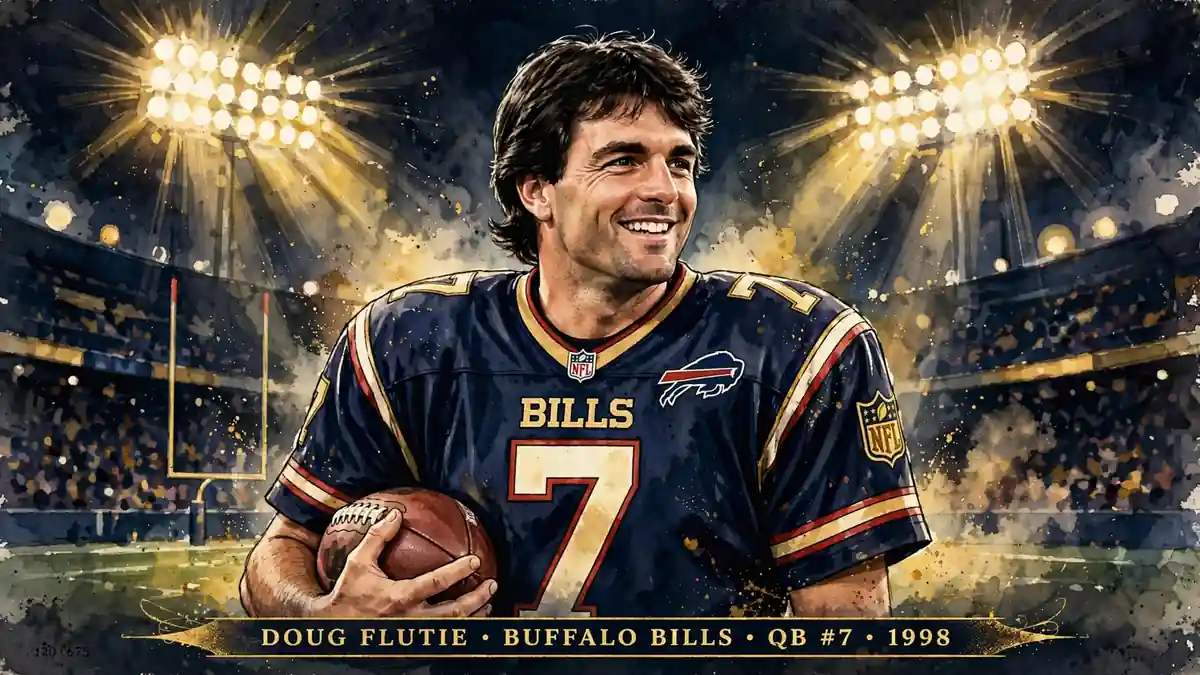
The NFL came calling again in 1998. The Buffalo Bills signed the 35-year-old Flutie to a deal that promised a $50,000 signing bonus and the NFL minimum salary of $275,000, with no promise of a starting job. He took it anyway. When starter Rob Johnson was injured early in the season, Flutie took over and became a fan favourite in Buffalo, leading the Bills to a 7–3 record in his 10 starts and earning Pro Bowl and NFL Comeback Player of the Year honours. After the 1999 season he signed a four-year, $22 million extension with Buffalo, including a $6 million signing bonus, per Sports JRank’s contemporary account — a figure that lines up with TheRichest’s $21.8 million contract listing for 1998.
Buffalo traded him to the San Diego Chargers in 2001, where he signed a six-year contract worth $30.3 million, per TheRichest. In San Diego he started ahead of rookie Drew Brees, then competed with Brees for the job as the younger quarterback developed. He finished his career with the New England Patriots in 2005, and on January 1, 2006, in his final NFL game, he converted a drop-kick extra point against the Miami Dolphins — the first successful drop kick in the NFL since the 1941 championship game. He announced his retirement on May 15, 2006, at age 43, after 21 professional seasons. The Patriots’ own announcement put his final NFL totals at 14,715 passing yards and 86 touchdowns.
Rise to Fame
Flutie became famous on a single play, and he has never pretended otherwise. On November 23, 1984, Boston College travelled to the Orange Bowl to face the Miami Hurricanes, then ranked 10th in the country and led by quarterback Bernie Kosar under head coach Jimmy Johnson. The game was televised nationally by CBS and became the highest-rated college football broadcast of 1984.
Miami took a 45–41 lead with 28 seconds left. Boston College started its final drive at its own 20-yard line with two timeouts. Flutie hit Troy Stradford for 19 yards, then tight end Scott Gieselman for 13 more, moving the Eagles to the Miami 48 with 10 seconds to play. Coach Jack Bicknell called “Flood Tip” — every receiver sprinting for the end zone, ready to tip the ball up for a teammate. Flutie scrambled right to escape the rush, reached his own 37-yard line, and threw the ball at least 63 yards into a 30 mph wind. Wide receiver Gerard Phelan caught it in the back of the end zone as time expired. Boston College won 47–45.
The play became known as “Hail Flutie” and the “Miracle in Miami.” Flutie finished the game 34 of 46 for 472 yards and three touchdowns, without an interception, and became the first major-college quarterback to pass 10,000 career yards. Heisman voting closed days after the game, and he won the trophy. As Flutie himself later said, without that pass he could easily have been forgotten — the voting was already in, the bowl destination would have been the same, and the direction of his career would have been unchanged. The pass changed only one thing: everybody knew his name.
His second rise came 14 years later, in Buffalo, and it was worth far more money. The CFL years had made him a legend in Canada — in 2006 he was ranked No. 1 on the list of the top 50 CFL players of all time — but American audiences had filed him away as a college star who never made it in the NFL. The 1998 Bills season fixed that. A 35-year-old quarterback who had been out of the league for eight years took a minimum-salary deal, won the starting job, made the Pro Bowl, and turned Buffalo into “Flutie-mania”: the city embraced him, a cereal was named after him, and his salary jumped from $275,000 to a $22 million extension in the space of two seasons. No other quarterback of his era had two separate peaks a decade apart.
The third act was the drop kick. On January 1, 2006, with the Patriots already locked into their playoff seeding and starter Tom Brady resting, backup quarterback Matt Cassel threw a touchdown pass to make it 25–19 against Miami. What looked like a two-point conversion attempt turned into history: Flutie took the snap, dropped the ball and kicked it through the uprights for the extra point. It was the first successful drop kick for points in the NFL since 1941, and it was Flutie’s last play in an NFL uniform. ESPN’s Chris Berman had planted the idea with head coach Bill Belichick months earlier, after learning Flutie could still drop-kick, and Belichick — a student of football history — saved it for Flutie’s farewell. The clip still circulates every January, and it keeps Flutie’s name in front of audiences who never saw him play.
Main Sources of Income
Flutie’s wealth came from four streams, in order of size: playing contracts, broadcasting, endorsements, and the charity-linked businesses he built around his name. The playing contracts dominate — Spotrac’s $21.765 million in NFL earnings alone is roughly double the low end of his estimated net worth, which tells its own story about taxes, agent fees, living costs across 21 seasons, and the fact that his biggest contract years came late, when he was already in his late 30s.
Broadcasting is the second stream and the longest-running. Flutie moved into television immediately after retiring, working as a college football analyst for ESPN and ABC from 2006 to 2008, then covering United Football League games for Versus in 2009 and 2010. NBC Sports hired him in 2011, and in 2014 he became the colour commentator for Notre Dame Football on NBC, a role that kept him on one of the most-watched regular-season college broadcasts in America. The Flutie Foundation’s own biography notes that he works as a commentator for NBC today. Broadcaster pay is not public, and one outlet’s claim of a $39,589 average for sports broadcasters is a generic industry figure, not Flutie’s salary — his Notre Dame role sits well above that average, but no outlet has published his NBC contract, so we do not guess at a number.
Endorsements form the third stream. During his Buffalo years he appeared in commercials for Pepsi and Nissan, and after retirement he signed a deal in 2011 to endorse Instaflex, a joint-support supplement. In 2018 he partnered with the Maximum Football video game. OpenSponsorship lists his sponsored social media posts from around $4,000 and personal appearances from around $6,000, with brand ambassador campaigns from around $36,000 — marketplace asking prices, not confirmed deals, and useful mainly as a floor for what his name still commands.
The fourth stream is the one most competitors under-report: the businesses and charity ventures. Flutie founded Flutie Entertainment in 1995. Flutie Flakes, the cereal launched in 1998, sent a large share of its profits to the Doug Flutie Jr. Foundation for Autism. The foundation itself is a charity, not a personal income source — its money goes to autism families — but the brand value it created feeds back into speaking fees, appearances and endorsement rates. Speakers’ agencies list him for keynote talks on leadership, teamwork and neurodiversity, with recent engagements including corporate events in 2025. He also plays drums in the Flutie Brothers Band with his brother Darren on guitar, a sideline that earns performance fees and keeps his public profile warm between football seasons.

Salary and Earnings
The cleanest number in Flutie’s financial record comes from Spotrac, the sports contract database. Per Spotrac, as reported by The Spun, Flutie earned $21,765,000 over 12 NFL seasons. That figure covers NFL salary only. It excludes his USFL deal, his eight CFL seasons, endorsements and broadcasting, which is why his career earnings and his net worth are different numbers — and why some low-quality outlets confuse the two, with one site publishing a “$21 million net worth” that is really just his NFL salary total with the label changed.
The contract table below uses TheRichest’s earnings data, cross-checked against Sports JRank’s contemporary reporting and Wikipedia’s career history. Two cautions apply. First, contract face value is not cash collected: the six-year, $30.3 million Chargers deal from 2001 was restructured before it ran its course, and the five-year USFL deal died with the league after one season. Second, the USFL figure itself is disputed — $7 million over five years per Wikipedia and The Spun, $5 million per some player databases — so the table flags it.
| Year | Team / League | Deal |
|---|---|---|
| 1985 | New Jersey Generals (USFL) | $7 million over 5 years reported ($5 million in some records); league folded after one season |
| 1986 | Chicago Bears (NFL) | 3-year contract, $425,000 |
| 1990 | BC Lions (CFL) | 2-year deal, reported $350,000 per season — highest-paid player in the CFL |
| 1992 | Calgary Stampeders (CFL) | Reported million-dollar salary after the 1992 Grey Cup win |
| 1998 | Buffalo Bills (NFL) | $50,000 signing bonus + $275,000 minimum salary; no starting job promised |
| 1999 | Buffalo Bills (NFL) | 4-year extension, $22 million including a $6 million signing bonus |
| 2001 | San Diego Chargers (NFL) | 6-year contract, $30.3 million (face value; restructured before completion) |
| 2003 | San Diego Chargers (NFL) | 3-year contract, $3.775 million |
| 2005 | New England Patriots (NFL) | 1-year contract, $790,000 |
The shape of that table is the story. Flutie earned almost nothing by modern quarterback standards in his 20s, then earned the bulk of his career money between ages 35 and 42 — the opposite of a normal NFL pay curve. His 1998 Bills salary of $275,000 was the league minimum for a veteran; two seasons later he was on a $22 million extension. His Chargers deal carried a $30.3 million face value at a time when $30 million quarterback contracts were rare, though the cash he actually collected was far less once the deal was restructured and his playing time shrank behind Drew Brees.
His CFL earnings are the least documented part of the record. One outlet puts his total CFL salary and endorsements at around $3 million across eight seasons, a figure we report with caution because no contract database publishes CFL salaries from that era in full. What is documented is the direction: he arrived in Canada as the league’s highest-paid player at $350,000 a year, and by Calgary he was on a reported million-dollar salary, a figure that was extraordinary in a league where most players earned a fraction of NFL money.
How does that compare with his peers? The table below sets Flutie against quarterbacks of his era whose profiles we have published, using published net-worth estimates. The gap is the point: Flutie’s $21.765 million in NFL salary is a fraction of what the era’s biggest stars banked, because he spent his prime years in Canada and his NFL peak arrived at 35. Joe Montana, John Elway and Brett Favre all spent their primes as NFL starters; Flutie spent his winning Grey Cups.
| Quarterback | Era | Published net-worth estimate |
|---|---|---|
| Joe Montana | 1979–1994 | ~$80 million |
| John Elway | 1983–1998 | ~$145 million |
| Brett Favre | 1991–2010 | ~$100 million |
| Dan Marino | 1983–1999 | ~$50 million |
| Troy Aikman | 1989–2000 | ~$65 million |
| Doug Flutie | 1985–2005 | $10 million – $15 million |
Peer figures are published estimates from celebrity net-worth outlets and vary by source; they are shown for scale, not as audited wealth. The modern comparison is starker still: Aaron Rodgers and Patrick Mahomes signed deals worth hundreds of millions, in a salary-cap era Flutie never played in. His $21.765 million in NFL earnings would not cover a single season of a top quarterback’s pay today — a measure of how much the market moved after he retired, not of how little he achieved.
Businesses and Investments
Flutie’s best-known business is a cereal box. Flutie Flakes launched in 1998, during his first season as the Bills’ starter, when his scrambling comebacks made him the most popular player in Buffalo. PLB Sports and Entertainment of Pittsburgh handled marketing, product development, packaging and sales. A large share of the profits went to the Doug Flutie Jr. Foundation for Autism, founded the same year in honour of his son. The cereal became a cultural object in Buffalo — fans bought it by the case, opposing fans mocked it, and Miami Dolphins head coach Jimmy Johnson poured a box on the ground and invited his team to stomp on it after beating Flutie in a January 1999 playoff game, a stunt Flutie called out publicly because the product funded autism work.
The cereal’s first year raised over $1 million for the foundation, according to the Boone Center, which distributes the cereal’s 2026 return. That first-year figure is the kind of hard number most Flutie coverage skips, and it explains why the brand lasted: it was a working fundraiser, not a novelty. In October 2026, Flutie Flakes returned for a final collector’s-edition run with a new box design, sold online in two-packs, cases of 12 and bundles with hats and shirts, with proceeds again going to the foundation. Wikipedia’s Flutie Flakes entry notes that once the final run sells through there is no restock and no second edition.
The foundation is the centre of Flutie’s post-football life. He and Laurie created the Doug Flutie Jr. Foundation for Autism in 1998, after Doug Jr. was diagnosed with autism at age three. The foundation’s stated mission is to help people and families with autism live life to the fullest, funding programs across New England and beyond. Its fundraising totals have climbed steadily in public reporting: speakers’ agencies have cited figures over $14 million and over $18 million in different years, and the Boone Center reported in October 2026 that the foundation was approaching a $50 million milestone as the cereal returned. The spread is not a contradiction — it is growth over time, with the $50 million figure the most recent. The foundation also runs an annual 5K in Natick and fields charity teams at the Boston Marathon; Flutie himself ran the 2014 Boston Marathon on two days’ notice, finishing in 5:23:54, and ran again in 2023.
Beyond the foundation, Flutie’s business footprint is modest and deliberately low-key. He founded Flutie Entertainment in 1995, during his Calgary years, as a vehicle for his media and appearance work. He hosts the Flutie Flakescast podcast, where he has interviewed figures including Chris Berman. He is represented by speakers’ agencies for keynote talks on leadership, teamwork and neurodiversity, with corporate engagements listed as recently as 2025. He has also worked as a spokesman for Eastern Bank in Massachusetts and for Metrowest Medical Center in the Natick and Framingham area — local, long-running relationships rather than national campaigns.
What Flutie does not appear to have is a portfolio of the kind modern athletes assemble: no published record of venture-capital stakes, restaurant chains, or real-estate funds. That absence is consistent with his era — players of the 1980s and 1990s rarely had the investment infrastructure around them that today’s stars do — and with his own priorities, which channelled his most valuable asset, his name, into a charity rather than a holding company. Anyone promising a detailed breakdown of Flutie’s stock portfolio is inventing it; no such record exists in public reporting.
Brand Deals and Sponsorships
Flutie’s endorsement career has three phases, and each one maps to a different peak. In the 1980s, as a young USFL and NFL quarterback, he appeared in commercials for Pepsi and Nissan during his New Jersey Generals season — the kind of national spots that came with being the highest-paid rookie in sports. The USFL’s collapse cut that phase short, and his Canadian years, however decorated, offered little American endorsement money.
The Buffalo years rebuilt it. The Flutie Flakes launch in 1998 was itself a brand deal — a licensed food product carrying his name and likeness, managed by PLB Sports — and it arrived alongside renewed local endorsement work in western New York. His everyman image, small quarterback, scrambling comebacks, devoted family man, sold well to regional advertisers who wanted authenticity rather than glamour.
The third phase is the post-retirement health and lifestyle lane. In 2011 he signed to endorse Instaflex, a joint-support supplement, a natural fit for a 48-year-old former quarterback with 21 seasons of wear on his knees. In 2018 he partnered with the Maximum Football video game. Today, OpenSponsorship lists his marketplace rates at roughly $4,000 for a sponsored social media post and $6,000 for a personal appearance, with brand ambassador campaigns from around $36,000. Those are asking prices on a sponsorship marketplace, not confirmed contracts, but they show his name still carries a price nearly 20 years after retirement — driven, in large part, by the foundation story and the Hail Mary highlight that never stops replaying.
He has also monetised his story in smaller ways: acting appearances in television shows including Arli$$, Spin City, The Game and Boston Public; a run on Dancing with the Stars in 2016; and appearances at WWE events. None of these paid quarterback money, but together they kept his name in circulation through the 2010s and 2020s, which is what makes a 64-year-old former player still bookable for speeches and sponsorships.

Houses, Cars and Other Assets
Flutie’s property record is thin but documented, and the two homes that appear in public reporting tell a tidy story about his career geography. The first is the family’s six-bedroom home in Natick, Massachusetts, the town where he went to high school and where his foundation is based. TheRichest’s earnings table lists the home at a $1.7 million asking price in 2012. One outlet reports he bought the Natick property in 1994 for $212,000 — a figure we include only as reported, since the purchase price comes from a single low-quality source — but the 2012 listing price is solid, and the gap between the two numbers, if the purchase price is right, would represent a large gain on a home held for nearly two decades.
The second is a five-bedroom home in Melbourne Beach, Florida, which one outlet reports Flutie bought in 2007 for $2.1 million, with a pool and Jacuzzi and views over the ocean and rivers. Melbourne Beach is where OpenSponsorship currently locates him, and the Flutie Foundation’s biography notes that Laurie cares for her mother at their home in Florida, which fits a family that split its later years between Massachusetts roots and a Florida base. Both property figures should be read as reported prices, not confirmed sale records — neither transaction has a deed-level paper trail in the sources we reviewed.
On cars, the public record offers one colourful detail and little else. PlayersWiki reports that Flutie owns a 1989 Batmobile — the movie-prop style replica car, not a team vehicle — a purchase that fits a man whose public image has always mixed football with showmanship. We could not confirm the Batmobile from a second source, so treat it as reported rather than established. There is no published record of a large car collection, a yacht, or a private jet, and that absence is itself informative: Flutie’s visible spending has always run toward the foundation, not toward toys.
The asset that matters most to his net worth is not a house or a car. It is the value of a name that still books work at 64: the NBC broadcasting role, the speaking circuit, the Flutie Flakes brand, and the foundation’s donor network. Those are intangible assets, and they do not show up in a net-worth table, but they are the reason his income did not stop in 2006. A retired quarterback with no broadcasting deal and no charity brand would be living off savings; Flutie is still earning.
Awards and Achievements
Flutie’s trophy case spans three leagues and two countries, and it is longer than most NFL-only quarterbacks can claim. The college honours came first: the Heisman Trophy, the Maxwell Award and the Davey O’Brien Award in 1984, unanimous All-American honours the same year, and second-team All-American in 1983. Boston College retired his No. 22.
The Canadian honours are the heart of the list. He won three Grey Cups — with Calgary in 1992 and with Toronto in 1996 and 1997 — and was named Grey Cup MVP in all three games. He was voted the CFL’s Most Outstanding Player a record six times (1991–1994, 1996, 1997), won the Jeff Nicklin Memorial Trophy four times and the Terry Evanshen Trophy twice, and was a CFL All-Star six times. His CFL records still stand out: 6,619 passing yards in a single season (1991) and 48 touchdown passes in a single season (1994). His career CFL numbers — 41,355 passing yards, 270 touchdowns against 155 interceptions, a 103.9 passer rating — are the statistical backbone of his case as the greatest CFL player ever. In 2006 he was ranked No. 1 on the CFL’s list of its top 50 players of all time.
The NFL honours came late and mean more for that: a Pro Bowl selection in 1998 and NFL Comeback Player of the Year the same season, at age 36, after eight years out of the league. His career NFL numbers were 14,715 passing yards, 86 touchdowns against 68 interceptions, a 76.3 passer rating, and 1,634 rushing yards with 10 rushing touchdowns — modest totals that hide how much of his prime was spent in Canada.
The halls of fame followed in a rush. In 2007 he was inducted into the College Football Hall of Fame and Canada’s Sports Hall of Fame — the first non-Canadian inducted into the latter — and into the Boston College Varsity Club Hall of Fame. In 2008 he entered the Canadian Football Hall of Fame. In 2009 he was inducted into the Ontario Sports Hall of Fame. Few athletes hold hall-of-fame memberships in two countries; Flutie holds them in both, plus a place in Boston College’s own hall.
Net Worth Growth Over the Years
Flutie’s wealth did not grow in a straight line. It spiked early, flattened through his Canadian years, spiked again in Buffalo and San Diego, and has held roughly steady since retirement, supported by broadcasting and the foundation economy. The table below collects the published estimates by year. These are outlet estimates, not audited figures, and the range in any given year reflects how little hard data the outlets had — the $10 million figure has barely moved since 2019, which says more about the outlets copying each other than about Flutie’s bank balance.
| Year | Published estimate | What was happening |
|---|---|---|
| 1985 | ~$1 million – $2 million | USFL rookie deal signed; league folded after one season |
| 1990 | ~$2 million – $3 million | CFL’s highest-paid player at $350,000 a season |
| 1998 | ~$3 million – $5 million | Bills comeback on a $275,000 minimum salary; Flutie Flakes launched |
| 2001 | ~$8 million – $10 million | Six-year, $30.3 million Chargers contract signed |
| 2006 | ~$10 million | Retirement; broadcasting career begins at ESPN and ABC |
| 2019 | $10 million | Celebrity Net Worth and TheRichest converge on $10 million |
| 2024 | $12 million | One outlet’s higher estimate; NBC Notre Dame role ongoing |
| 2026 | $10 million – $15 million | Range across outlets; Flutie Flakes final run; foundation nears $50 million raised |
The honest reading of that table is that Flutie’s net worth has been flat for two decades, and that is not a criticism. He earned his money before the quarterback salary explosion, paid taxes on it across three countries and two currencies, and spent the retirement years giving his time — and his name — to a charity rather than chasing new income. A flat $10 million to $15 million at 64, with a broadcasting job and a foundation approaching $50 million raised, is a comfortable position by any measure except the modern NFL’s.
Social Media Presence
Flutie keeps a modest social media footprint for a man with his highlight reel. His Instagram account, @dougflutie, has around 58,000 followers according to OpenSponsorship’s audience data, with content built around football, family, fitness, food and drink, and the foundation. His X account runs under the handle @DougFlutie, listed in Britannica’s facts file, and his Facebook page has roughly 51,000 followers per older outlet reporting. The follower counts move slowly and the posting is infrequent — he is not a daily content creator, and his feed reads like a retired athlete’s personal account rather than a brand channel.
That modesty has a commercial consequence: his sponsored-post rate, around $4,000 per post per OpenSponsorship, is a fraction of what active NFL stars command. But it also protects the asset. Flutie’s feed is not cluttered with paid promotions, which is why the foundation’s posts and the Flutie Flakes return in October 2026 landed with real attention instead of being scrolled past as another ad. For readers looking for him online, the Flutie Foundation’s own accounts are often more active than his personal ones, and they are the better source for his current charity work.
Personal Life
Flutie married his high school sweetheart, Laurie Fortier, on August 10, 1985, weeks after he signed his first professional contract. They have two children: a daughter, Alexa, who was a New England Patriots cheerleader and later a San Diego Chargers cheerleader, and a son, Doug Jr. The marriage has lasted more than 40 years, through three leagues, two countries, and the long aftermath of their son’s diagnosis — a run of stability that is rare in professional sport and central to understanding how his money stayed intact.
Doug Jr. was diagnosed with autism at age three, with childhood disintegrative disorder, a rare and severe late-onset form of autism spectrum disorder. The Fluties built their public life around that fact rather than hiding it: they founded the Doug Flutie Jr. Foundation for Autism in 1998, Laurie became Doug Jr.’s primary caregiver, and Flutie has spent his retirement years as the foundation’s public face, running marathons for it and lending his name to its fundraising. The foundation’s biography notes that Laurie also cares for her mother, who lives with them in Florida.
His younger brother, Darren Flutie, played alongside him briefly in the CFL and became one of the league’s great receivers; his older brother Bill’s son Billy played at Boston College, and Darren’s son Troy played quarterback and wide receiver there too. The family is, in the literal sense, a football family across two generations and two countries.
November 18, 2015, is the darkest date in the family story. Dick and Joan Flutie, married 56 years, both died of heart attacks within an hour of each other in Florida — his father first, his mother an hour later. Flutie has spoken about the loss rarely and plainly, and the foundation’s work took on a sharper edge afterwards: the generation that raised him was gone, and the charity became the family project that remained.
Outside football, Flutie plays drums in the Flutie Brothers Band, with Darren on guitar — a hobby that dates back to their Natick years and still gets them on stage together. He lives between Massachusetts and Melbourne Beach, Florida, works Notre Dame games for NBC, hosts the Flutie Flakescast podcast, and turns up at Boston College events as the school’s most famous living football alumnus. At 64, he is not chasing a comeback. He is managing the second half of a career that already had two peaks.
Sources & Reporting
Wikipedia — career history, contract figures including the $7 million USFL deal, CFL records (6,619 yards in 1991; 48 touchdowns in 1994), Hall of Fame inductions, broadcasting timeline, Flutie Flakes history and the October 2026 final run. Reporting window: career 1981–2006, page reviewed November 2026.
Britannica — birth date and place, Heisman Trophy 1984, the 48-yard Hail Mary against Miami, 21-year professional career, six CFL Most Outstanding Player awards, 1998 Pro Bowl season. Reporting window: biography reviewed 2026.
Spotrac (via The Spun) — $21,765,000 in NFL career earnings over 12 seasons; USFL and CFL contract context; $10 million net-worth estimate. The Spun’s reporting also supplied the New Jersey Generals $7 million deal and the $350,000 CFL contract figures.
TheRichest — $10 million net-worth estimate and the contract-by-contract earnings table (Bears $425,000; Bills $21.8 million; Chargers $30.3 million; Patriots $790,000; Natick home listed at $1.7 million in 2012).
Celebrity Net Worth — $10 million net-worth estimate, the anchor for the low end of our range, as cited across competitor coverage.
Sports Illustrated — “Doug Flutie’s Football Odyssey”: the Hail Mary game detail (November 23, 1984, 47–45, 472 yards), the one-scholarship recruitment story, and the 10,579-yard NCAA record on leaving Boston College.
Boston College Athletics — 30th-anniversary account of the Hail Mary: 34 of 46 for 472 yards, the Flood Tip play call, the highest-rated college broadcast of 1984, and the Heisman voting that followed.
New England Patriots — retirement announcement (May 15, 2006): 21-year career, 14,715 NFL passing yards, 86 touchdowns, and the first drop kick for an extra point since 1941.
Flutie Foundation — foundation founded in 1998 after Doug Jr.’s autism diagnosis at age three; Flutie’s current work as an NBC commentator; family details.
Boone Center — Flutie Flakes return in October 2026; first-year fundraising over $1 million; foundation approaching $50 million raised.
Pro Football Reference (via Wikipedia’s career statistics) — NFL totals: 14,715 passing yards, 86 touchdowns, 68 interceptions; CFL totals: 41,355 yards, 270 touchdowns.
OpenSponsorship — roughly 58,000 Instagram followers; sponsored-post pricing from around $4,000; appearance pricing from around $6,000.
Net-worth range note: the $10 million figure is published by Celebrity Net Worth, TheRichest and NetWorthPost; $15 million by TheMusiciansNetWorth; $12 million by a 2024 estimate. The $35 million figure on one low-quality site and the $21 million figure on another are not used — the first has no sourcing, the second repeats Spotrac’s salary total as net worth. Where sources conflict on the USFL deal ($7 million vs $5 million), both figures are named in the career section.
Frequently Asked Questions
What is Doug Flutie’s net worth in 2026?
Doug Flutie’s net worth is estimated at $10 million to $15 million as of November 2026. Most outlets, including Celebrity Net Worth and TheRichest, publish $10 million; TheMusiciansNetWorth publishes $15 million, and a 2024 estimate put him at $12 million. No audited financial statement exists, so the honest figure is a range. His documented NFL career earnings were $21.765 million per Spotrac, before taxes, agent fees and living costs across 21 professional seasons.
How much did Doug Flutie make in his NFL career?
According to Spotrac, Flutie earned $21,765,000 over 12 NFL seasons. His biggest NFL deals were a four-year, $22 million extension with the Buffalo Bills in 1999, including a $6 million signing bonus, and a six-year, $30.3 million contract with the San Diego Chargers in 2001, which was restructured before it ran its course. Those figures exclude his USFL deal, reported at $7 million over five years, and his eight CFL seasons, where he was the league’s highest-paid player.
What does Doug Flutie do now?
Flutie works as a college football broadcaster for NBC Sports, where he became the colour commentator for Notre Dame Football on NBC in 2014, and he hosts the Flutie Flakescast podcast. He is also the public face of the Doug Flutie Jr. Foundation for Autism, which he founded with his wife Laurie in 1998 and which was approaching $50 million raised as of October 2026. In October 2026 he brought back Flutie Flakes for a final collector’s-edition run to benefit the foundation.
How old is Doug Flutie?
Doug Flutie is 64 years old. He was born on October 23, 1962, in Manchester, Maryland, and turned 64 on October 23, 2026. He retired from professional football in May 2006 at age 43, after a 21-year playing career across the USFL, the NFL and the CFL.
How tall is Doug Flutie?
Doug Flutie is 5 ft 10 in (1.78 m) tall and weighed about 180 pounds during his playing days. His height was the defining question of his career — Boston College was the only Division I-A school to offer him a scholarship, and he was drafted 285th overall, the lowest draft position of any Heisman Trophy winner — and his success at that size is a large part of why his story is still told.
Who is Doug Flutie’s wife?
Doug Flutie is married to Laurie Fortier, his high school sweetheart from Natick, Massachusetts. They married on August 10, 1985, and have been together for more than 40 years. They have two children: a daughter, Alexa, who was a cheerleader for the New England Patriots and later the San Diego Chargers, and a son, Doug Jr., who has autism and is the namesake of the couple’s foundation.
What was Doug Flutie’s Hail Mary pass?
On November 23, 1984, playing for Boston College against the Miami Hurricanes, Flutie threw a 48-yard touchdown pass to Gerard Phelan as time expired, giving Boston College a 47–45 win. He scrambled to his own 37-yard line and threw the ball more than 63 yards into a 30 mph wind. The play, known as the “Hail Flutie” or “Miracle in Miami,” sealed his Heisman Trophy win days later and remains one of the most famous plays in college football history.
What is Flutie Flakes and the Doug Flutie Jr. Foundation?
Flutie Flakes is a frosted corn flakes cereal launched in 1998 during Flutie’s first season as the Buffalo Bills’ starter, with a large share of profits going to the Doug Flutie Jr. Foundation for Autism. The foundation was created by Doug and Laurie Flutie in 1998 after their son Doug Jr. was diagnosed with autism at age three. It funds programs helping people and families with autism live life to the fullest, raised over $1 million in its first year through the cereal, and was approaching $50 million raised in total as of October 2026, when the cereal returned for a final collector’s-edition run.
Final Thoughts
Doug Flutie’s $10 million to $15 million net worth is smaller than the fortunes of the quarterbacks he is usually compared with, and that gap is the most honest thing about it. He earned his money the hard way: a USFL deal that died with its league, eight seasons in Canada at CFL wages, and an NFL peak that did not arrive until he was 35. The $21.765 million Spotrac counts in NFL salary is real money, but it came late, in a cheaper era, and across three countries’ tax systems.
What makes the figure interesting is what he did with the fame that produced it. The Hail Mary made him famous at 22. The Buffalo comeback made him rich at 36. The drop kick gave him a farewell no scriptwriter would dare write at 43. And the cereal box gave him something none of those moments could: a charity approaching $50 million raised, built in his son’s name, that will outlast every contract he ever signed. That is the part of Doug Flutie’s wealth that does not fit in a net-worth table — and it is the part that will still be growing when the estimates are forgotten.
Published on November 22, 2026. Last reviewed November 2026. Found an error? See our corrections policy.