
The Edge‘s net worth is estimated at $340 million to $400 million as of November 2026. David Howell Evans, the guitarist who built U2’s sound one delayed note at a time, sits on a fortune assembled across five decades of stadium tours, a songwriting catalogue that has sold more than 170 million records, a Dublin hotel he owned for over thirty years, and a Malibu land purchase that turned into one of the longest planning fights in California history.
The Edge: Quick Facts
| Estimated net worth | $340 million to $400 million (range: $340M–$400M) |
|---|---|
| Profession | Guitarist, keyboardist, songwriter and record producer |
| Nationality | Irish and British (became an Irish citizen in June 2025) |
| Born | 8 August 1961, Barking, Essex, England (age 65) |
| Height | 5 feet 10 inches (1.78 m) |
| Primary income sources | U2 touring, songwriting and publishing royalties, record sales, production, property |
| Active years | 1976–present |
| Last reviewed | November 2026 |
- Early Life and Background
- Education
- Career Journey
- Rise to Fame
- Main Sources of Income
- Salary and Earnings
- Businesses and Investments
- Brand Deals and Sponsorships
- Houses, Cars and Other Assets
- Awards and Achievements
- Net Worth Growth Over the Years
- Social Media Presence
- Personal Life
- Sources & Reporting
- Frequently Asked Questions
- Final Thoughts
Early Life and Background
David Howell Evans was born on 8 August 1961 at Barking Maternity Hospital in Barking, Essex, the second child of Welsh parents Garvin and Gwenda Evans, both from Llanelli in South Wales. His father worked as an engineer, first for the local electricity board and later for the electronics company Plessey. When David was still an infant, around 1962, Garvin was offered a promotion that moved the family to Dublin, Ireland — the city that would shape everything that followed.
Evans grew up with an older brother, Richard — known as Dik — and a younger sister, Gillian. He is a cousin of actress Juliet Aubrey. Music entered the house early. His parents encouraged it, and David took piano and guitar lessons while still in primary school. His mother bought him his first guitar, a Spanish guitar, when he was seven. He later called it little more than a toy: he did not know how to tune it or hold it properly, but he was taken with how cool it looked. At nine, a second instrument arrived — an old acoustic guitar his mother had bought at a jumble sale for a pound. He and Dik replaced its rusty wire strings with nylon ones and learned to play it properly, working through open chords together.
Childhood in Dublin gave Evans a split identity he has talked about since. At home he spoke with a Welsh accent; outside, with an Irish one. “The reason for this dual identity was mainly to be understood by my peers but also to be accepted,” he later said. Growing up in a Catholic country as the child of Welsh parents also left its mark — he has said the frustration of it may have played a part in his musical development. He kept his British citizenship into adulthood, and only in June 2025, after 62 years living in Ireland, did he become an Irish citizen at a ceremony in Killarney. “Ireland will always be home to me,” he said that day, according to The Guardian.
His early listening ran toward rock with an edge to it: Rory Gallagher, Patti Smith and the band Television were among the names that stuck. What set him apart from other teenage guitarists was not speed or flash. He had received no extensive formal guitar training, and instead of copying conventional rock solos he started experimenting with unusual sounds and arrangements — the habit that would become his career.
Education
Evans attended St. Andrew’s National School in Malahide, then Mount Temple Comprehensive School in Dublin. Mount Temple was not a music school and Evans was not a trained musician in any formal sense; his education in guitar came from hours of trial and error at home, from the jumble-sale acoustic, and from listening hard to players who were doing something different — Tom Verlaine of Television, Keith Levene of Public Image Ltd, John McKay of Siouxsie and the Banshees, and the guitarist John McGeoch. He has said those players were all approaching the instrument in a fresh way, and that was what he wanted to do.
The school matters to the money story for one reason: it is where the band formed. Mount Temple’s noticeboard, its classrooms and its corridors put Evans in the same building as Larry Mullen Jr., Paul Hewson and Adam Clayton. No conservatory, no session-musician apprenticeship, no London music-college network — the most commercially successful rock band of its era was assembled in a Dublin comprehensive school, and its guitarist learned his trade largely by inventing it.
There was one moment when education of a different kind nearly pulled him away. In 1981, leading up to the October tour, Evans came close to leaving U2 for religious reasons. He had become involved with a Christian group called the Shalom Fellowship, along with Bono and Mullen. He decided to stay — and shortly after that decision he wrote the music that became “Sunday Bloody Sunday,” one of the band’s defining songs and a durable earner in the catalogue ever since.
Career Journey
The career began with a notice pinned to a school board. In September 1976, drummer Larry Mullen Jr. posted a note at Mount Temple seeking musicians to form a band. Evans answered, along with his brother Dik, Adam Clayton and Paul Hewson — later known as Bono. The group first called itself Feedback, then The Hype. Dik left in 1978, and by March of that year the four remaining members had settled on the name U2.
David acquired the nickname “The Edge” during those early years. The name is commonly said to come from the angular shape of his head, and Bono is usually credited with coining it; other accounts tie it to his playing style, or to his habit of staying on the edge of things rather than throwing himself into the middle of them. The precise origin is disputed. The name stuck, and the man behind it has answered to it for nearly fifty years.
Early progress was fast by any measure. In March 1978, U2 won a talent competition in Limerick, earning £500 and a recording opportunity. Manager Paul McGuinness came aboard and helped secure the band’s first major recording contract. U2 signed with Island Records in 1980 and released its debut album, Boy, that October, produced by Steve Lillywhite. The record introduced the band’s energetic post-punk sound and, already, the guitarist’s distinctive arrangements — chiming, rhythmic, built on open strings and repetition rather than blues solos.
October followed in 1981, then War in 1983, the band’s first number-one album in the United Kingdom, carrying “Sunday Bloody Sunday” and “New Year’s Day.” With 1984’s The Unforgettable Fire, U2 began working with producers Brian Eno and Daniel Lanois, who pushed the band toward a more atmospheric approach. The album included “Pride (In the Name of Love)” and set the template for the sound that would make the band rich.
The commercial breakthrough arrived in March 1987 with The Joshua Tree. The album sold more than 25 million copies worldwide, produced two number-one singles on the Billboard Hot 100 — “With or Without You” and “I Still Haven’t Found What I’m Looking For” — and won two Grammy Awards including Album of the Year. Its tour turned U2 into one of the world’s biggest stadium attractions. Rattle and Hum followed in 1988, an album and film exploring the band’s relationship with American roots music.
Reinvention came in 1991 with Achtung Baby, recorded mainly in Berlin and Dublin. The album folded alternative rock, electronic music, industrial sounds and dance rhythms into the band’s sound, and The Edge leaned into heavily processed guitars, distortion and unconventional recording techniques. It produced “One,” “Mysterious Ways,” “The Fly” and “Even Better Than the Real Thing,” and led to the elaborate Zoo TV Tour, with its giant video screens and multimedia staging. Zooropa arrived in 1993 — the album on which The Edge received his first production credit — and Pop in 1997, before the band returned to a more traditional rock sound with All That You Can’t Leave Behind in 2000, the album that gave a new generation “Beautiful Day,” “Elevation” and “Walk On.” How to Dismantle an Atomic Bomb followed in 2004 with the hit “Vertigo.”
Later studio albums included No Line on the Horizon in 2009, Songs of Innocence in 2014 — the album U2 gave away through the iTunes Store, a release that drew heavy criticism for its method even as it put the record on hundreds of millions of devices — and Songs of Experience in 2017. The Edge took a particularly prominent creative role on the band’s 2023 album Songs of Surrender, serving as its principal producer on 40 newly recorded interpretations of songs from the catalogue, many stripped down to vocals and acoustic instruments.
Then came the residency that reset the economics of live music. U2:UV Achtung Baby Live at Sphere ran for 40 shows in Las Vegas between September 2023 and March 2024, opening the Sphere itself — a $2.3 billion venue — and grossing $244.5 million. The Edge performed alongside Bono and Clayton while Dutch drummer Bram van den Berg temporarily replaced Mullen, who was recovering from health problems. In 2024, The Edge co-directed V-U2 An Immersive Concert Film with his wife Morleigh Steinberg, documenting the residency for screening at Sphere.
The band has not slowed down in its fiftieth year. In 2026, U2 marked 50 years since its formation with two six-track EPs, Days of Ash and Easter Lily, and introduced new material from its 16th studio album, Carnaval de Luz, released in November 2026. The band also announced “The Greatest Show On Earth,” a world tour beginning in 2027. For a guitarist who nearly walked away in 1981, the career now spans 1976 to the present — fifteen studio albums with U2, one solo record, and a catalogue that keeps paying.
Rise to Fame
The Edge did not become famous by playing faster than anyone else. He became famous by playing less — and by making less sound like more. His style is built on chiming timbres, echoing notes, sparse voicings, drone notes, harmonics and an extensive use of effects units. He favours the perfect fifth interval and often plays power chords made of just the root and fifth, leaving out the third, which creates a harmonic ambiguity — neither clearly major nor minor — that lets the same notes sit over different chords. He plays the same notes on multiple strings, some left open, creating an Irish-influenced drone, and changes other notes against it to imply the harmony.
The signature trick is delay. After acquiring his first delay pedal, the Electro-Harmonix Memory Man, he became fascinated with how its returning echo could fill in notes he was not playing — “like two guitar players rather than one,” as he put it. He sets the delay to a dotted eighth note so the repeats fall rhythmically against the song’s tempo, turning a simple part into a pattern that sounds like several instruments at once. On “Where the Streets Have No Name,” the repeating notes and carefully timed delay build the shimmering introduction that is one of the most recognisable guitar parts in rock. On “With or Without You,” the ending stays deliberately simple — a choice he had to argue for in the studio, and one he still defends as braver than a big climax.
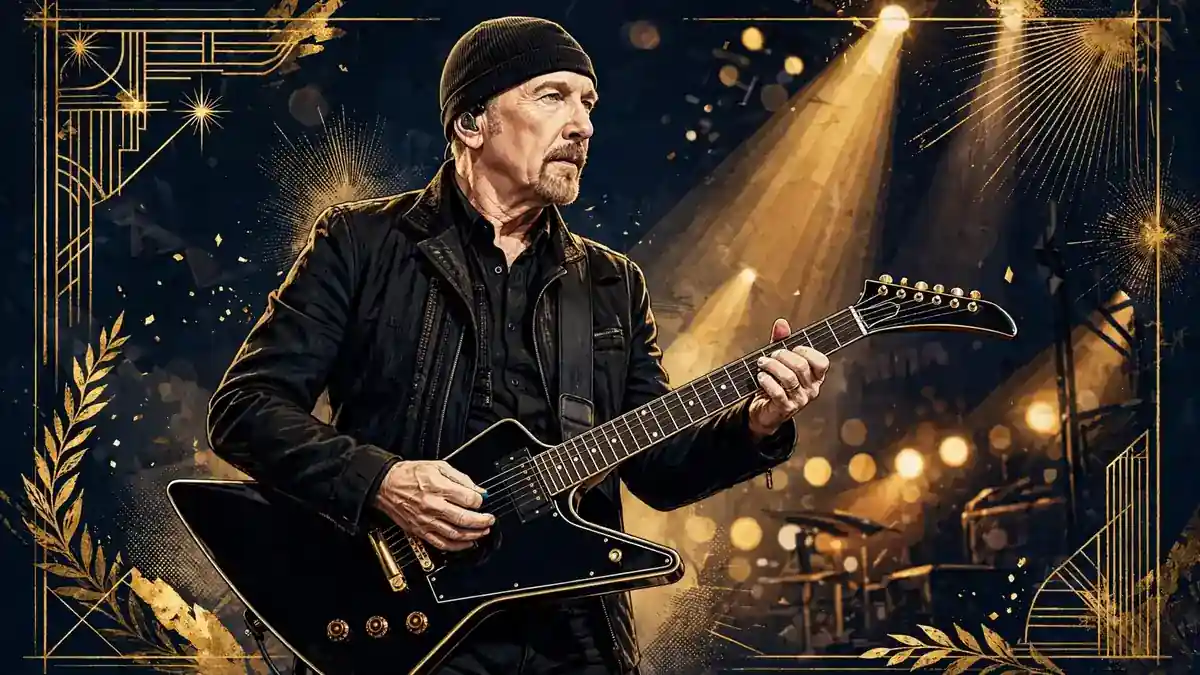
His own description of the approach is the clearest summary of it: “Notes actually do mean something. They have power. I think of notes as expensive. You don’t just throw them around. I find the ones that do the best job and that’s what I use. I suppose I’m a minimalist instinctively.” Led Zeppelin guitarist Jimmy Page called him a “sonic architect”; the critic Neil McCormick called him an “effects maestro.” His instruments have included a Gibson Explorer — his signature guitar — Fender Stratocasters and Telecasters, and Vox AC30 amplifiers, and his use of effects was so influential that a generation of alternative rock guitarists adopted similar approaches to arrangement and tone.
Fame, in the financial sense, arrived with The Joshua Tree and never really left. The album’s 25 million copies, the stadium tours that followed, and the band’s move into the top tier of live earners turned a Dublin school band into a business. U2 has sold an estimated 170 million records worldwide — Celebrity Net Worth puts the figure above 175 million — and the band’s live earnings, tracked by Billboard Boxscore and Pollstar, run into the billions. The Edge’s share of that, as a founding member, principal songwriter and equal partner in the band’s business, is the foundation of the fortune.
Main Sources of Income
The Edge’s income comes from five streams, and the balance between them has shifted over fifty years. Touring is the largest. Record sales and publishing come next. Production, outside collaborations and property have added meaningful sums at different points, and the catalogue itself — the songs — is the asset that ties the rest together.
Touring. U2 is one of the highest-grossing live acts in history. Pollstar ranks the band as the second-highest-grossing live music artist from 1980 to 2022, earning $2.13 billion in that window. The band’s tours are the headline numbers in this article because they are the best-documented figures in the whole fortune — and because The Edge, as a founding member and equal partner, takes a share of the net, not a salary.
Songwriting and publishing. The Edge is a principal songwriter across the catalogue, which means he earns publishing royalties every time a U2 song is played on radio, streamed, licensed to film or television, or covered. The catalogue includes “With or Without You,” “Where the Streets Have No Name,” “One,” “Beautiful Day,” “Sunday Bloody Sunday,” “Pride (In the Name of Love),” “Vertigo” and “I Still Haven’t Found What I’m Looking For.” With more than 170 million records sold, the mechanical royalties alone run deep, and the sync value of those songs — in films, adverts and television — has held up for decades.
Record sales and streaming. Fifteen studio albums with U2, plus the 2023 Songs of Surrender re-recordings and the 2026 EPs, keep generating recorded-music income. The Joshua Tree alone has sold more than 25 million copies. Streaming pays less per play than physical sales ever did, but for a catalogue of this size the volume compensates, and the 2026 releases — two EPs and a sixteenth studio album — put fresh recordings into the stream in the band’s fiftieth year.
Production and outside work. The Edge has produced U2 records — Zooropa in 1993, where he took his first production credit, and Songs of Surrender in 2023, where he was principal producer — and he has been paid for film, television and theatre work outside the band. That includes the score for the film Captive (1986), the theme for the James Bond film GoldenEye (1995), the music for the Broadway musical Spider-Man: Turn Off the Dark, and the theme for the first two seasons of The Batman animated series in 2004 and 2005.
Property. The Clarence Hotel in Dublin was the biggest single business venture of his life outside music, held for more than three decades and sold in 2023. His personal property holdings in Ireland, France and the United States — detailed below — are a substantial part of the fortune, and the Malibu land purchase, for all the trouble it caused, remains a 151-acre asset on the books.
What he does not have is a conventional endorsement portfolio. There is no long list of brand deals, no fashion line, no tequila brand, no venture fund with his name on it. The money is concentrated in the band, the songs and the property — which is also why it has lasted. The fortune is not tied to one hit or one deal, and it does not depend on staying fashionable.
Salary and Earnings
The Edge does not draw a salary. U2 operates as a partnership, and its members are paid from the band’s earnings — tour profits, record royalties and publishing — after costs. That distinction matters, because the gross figures quoted for U2 tours are not what any member takes home. The 360° Tour, for example, cost roughly $750,000 a day to stage, and the tour was barely breaking even through its first two legs despite grossing more than $311 million from its first 44 shows. The profit sits behind the gross, and the band’s four members split it with management, crew and production costs taken out first.
Even with that caveat, the scale of the grosses explains the fortune. The documented tour figures, reported by Billboard Boxscore and Pollstar, are:
| Tour / run | Years | Reported gross | Scale |
|---|---|---|---|
| Vertigo Tour | 2005–2006 | $389 million | The band’s biggest tour to that point |
| U2 360° Tour | 2009–2011 | $736.4 million | 7.27 million tickets, 110 shows, “The Claw” stage |
| Joshua Tree anniversary tours | 2017, 2019 | $391 million combined | Two anniversary runs |
| U2:UV Achtung Baby Live at Sphere | 2023–2024 | $244.5 million | 40 shows, 662,532 tickets, over $6.1 million per show |
Those four runs alone generated more than $1.76 billion in ticket sales. The Sphere residency deserves a closer look, because it changed the maths of touring. Forty shows in one room, with no trucking of staging between cities, grossed $244.5 million — an average of more than $6.1 million per show, still the highest per-show residency average at the Sphere, according to Pollstar comparisons published in 2026. The Eagles have since passed U2’s total gross at the venue, but no residency there has matched the per-night figure. The deal also included a $10 million upfront payment to the band and $4 million per night, according to reporting on the residency’s terms.
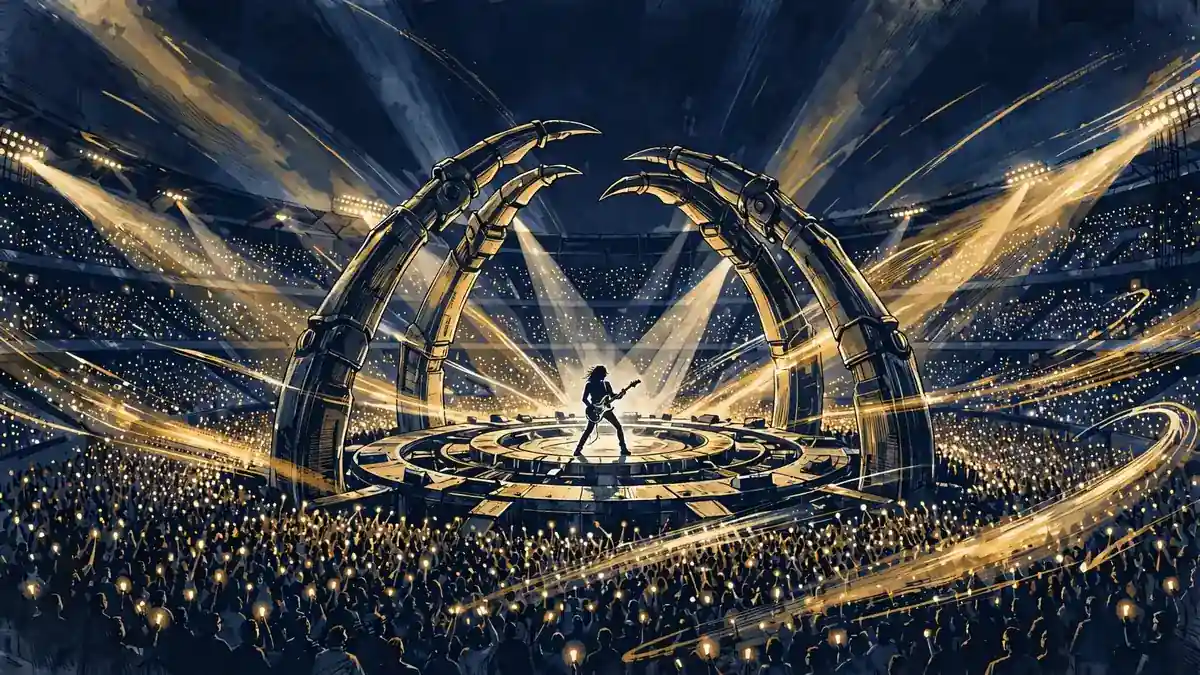
The 360° Tour held the record for the highest-grossing tour in history when it ended in July 2011, at $736.4 million from 7,272,046 tickets. It was also the highest-attended tour ever at the time. Taylor Swift’s Eras Tour has since passed it — a useful comparison, because it shows how the record has moved — but the 360° Tour remains the fifth-highest-grossing tour of all time, and the only one in the top five built around a four-legged circular stage that let the band play in the round and lift stadium capacity by 15 to 20 percent. Our profile of Taylor Swift’s net worth covers the tour that eventually took the record.
Record sales add a second layer. The Joshua Tree sold more than 25 million copies; the band’s total record sales sit at an estimated 170 million, per Wikipedia’s band profile, and above 175 million, per Celebrity Net Worth. Songwriting royalties from a catalogue that deep are the steadiest income a musician can hold: they arrive whether the band tours or not, and they rise whenever a song is licensed, covered or streamed in a new market.
How does The Edge compare with his own bandmates? The published figures disagree more here than anywhere else in this article, so the table below is a range of reported estimates, not a ranking we endorse. Bono is the richest member on every list, with estimates around $700 million, helped by his Elevation Partners investment career and his larger public profile. The Edge sits second on most lists. Adam Clayton and Larry Mullen Jr. are reported anywhere from $150 million to $400 million depending on the source, which tells you how little hard data exists for the two quieter members.
| U2 member | Reported net worth | Main wealth driver |
|---|---|---|
| Bono | Around $700 million | U2 earnings plus Elevation Partners investments |
| The Edge | $340 million to $400 million | Touring, songwriting, property |
| Adam Clayton | $250 million to $400 million (sources disagree) | U2 earnings, real estate, private investments |
| Larry Mullen Jr. | $150 million to $350 million (sources disagree) | U2 earnings, production work |
Two other comparisons put the figure in context. Celebrity Net Worth lists The Edge at $400 million, and LedgerNote’s November 2026 ranking of the richest guitarists also places him fourth at $400 million. Midder Music, by contrast, lists him at $340 million — the low end of our range. Wealthy Persons put him at $280 million in June 2021, which fits a fortune that has grown since through the Sphere residency and the Clarence Hotel sale. The low-end outliers — a handful of content-farm pages quoting $80 million to $200 million — do not reconcile with the tour grosses, the record sales or the property record, and we do not use them.
Businesses and Investments
The Clarence Hotel is the business story of The Edge’s life outside music, and it is also the one most net-worth pages get wrong — usually by skipping the numbers entirely. In 1992, Bono and The Edge bought the Clarence, a tired two-star, 70-room hotel on Wellington Quay in Dublin’s Temple Bar district, along with business partners including property investor Paddy McKillen Sr. They spent a reported $8 million on a renovation and reopened it in 1996 as a luxury boutique hotel with 49 rooms. The rooftop became famous in 2000 when U2 performed “Beautiful Day” there for the BBC’s Top of the Pops.
The exit took place in two steps. In 2019, the owners sold the leasehold interest to the Press Up hospitality group for €3.74 million, while keeping ownership of the building itself. The final exit came in October 2023, when Bono, The Edge and McKillen Sr. sold their remaining interests to the Dean Hotel Group, controlled by Paddy McKillen Jr. and Matt Ryan. Financial disclosures reported afterwards showed the acquiring company paid €18.07 million in cash for the business that owned the Clarence building, with the broader transaction involving additional related entities and bringing total consideration to €28.37 million. Separate reporting put the wider deal value at €42.9 million, backed by a €43 million loan facility from Leumi UK. The sale ended more than three decades of ownership. Because the hotel was held through a partnership structure, the amount The Edge personally received was never disclosed — which is one reason honest estimates of his fortune are ranges, not single numbers.
The Malibu venture is the cautionary half of the property story. In 2005, The Edge bought 151 acres of undeveloped land in the Sweetwater Mesa area of the Santa Monica Mountains, overlooking Malibu, for $9 million. Rather than building a single house, he proposed five luxury homes on separate parcels — a project sometimes called “Leaves in the Wind” — with modern architecture, glass walls, swimming pools and environmentally conscious materials. The projected development cost was $79 million, with other estimates putting the complete undertaking, including access infrastructure, at more than $100 million. One line item alone — an access road — was priced at $24 million.
Environmental groups and local residents objected, arguing the homes would damage fragile habitat and alter views of undeveloped mountains. The Edge’s team revised the proposals repeatedly, shrinking and repositioning the homes, commissioning geological studies and environmental consultants, and offering to dedicate large parts of the property to conservation and public access, including a $1 million commitment toward a public hiking trail. In December 2015, the California Coastal Commission unanimously approved a revised version. Then the Sierra Club challenged the approvals in court. In March 2019, a California appeals court overturned the permits, finding the Coastal Commission no longer had jurisdiction because authority over the area had shifted to Los Angeles County. The Edge sought review from the California Supreme Court; the court declined to hear the appeal in June 2019, effectively ending the project’s approval process. Reviving it would require new applications to Los Angeles County and another round of environmental review. The legal campaign had already consumed millions in lawyers, consultants, lobbying, engineering and redesign — on top of the $9 million land purchase — and the five homes were never built. The land itself, 151 acres above Malibu, remains his.
Beyond the hotel and the land, The Edge has not built a visible investment portfolio. There is no record of a venture fund, no startup portfolio, no public stake in a tech company with his name attached. His wealth is concentrated in three things: the band, the songs and the property. That concentration is also a risk profile — a bad tour or a property fight can dent it — but over fifty years it has compounded rather than unravelled.
Brand Deals and Sponsorships
There is no endorsement empire here, and that is itself a finding. The Edge has never fronted a fashion campaign, a watch brand, a drinks label or a car deal in the way many rock stars of his stature have. His commercial partnerships are musical, not promotional — and the most expensive of them lost money.
The biggest was Spider-Man: Turn Off the Dark. The Edge and Bono wrote the music and lyrics for the Broadway musical, which opened in 2011 after a famously troubled development: delays, injuries, creative disputes and escalating costs. The production budget reached $75 million, making it the most expensive Broadway musical in history. It generated substantial ticket sales, but closed in January 2014 with losses to investors reaching $60 million. The Edge and Bono were composers, not the principal investors, so the loss fell mainly on the backers — but the episode shows the scale of the projects he takes on, and the fact that not every one of them pays.
His other collaborations read like a list of the biggest names in popular music. He and Bono wrote the theme for the 1995 James Bond film GoldenEye, performed by Tina Turner. He composed the score for the film Captive in 1986, featuring vocals by a young Sinéad O’Connor. He has recorded with Johnny Cash, B.B. King, Ronnie Wood, Jah Wobble, Jay-Z and Rihanna — the Jay-Z connection is documented on the rapper’s records and in the pair’s shared sessions, and our profile of Jay-Z’s net worth covers the other side of that collaboration. In 2021, he and Bono worked with Dutch DJ Martin Garrix on “We Are the People,” the official song of the UEFA European Football Championship, and the collaboration continued with the 2026 U2 and Garrix track “Fireflies.”
The guitar world is the one place his name carries commercial weight as a brand. His signature Gibson Explorer, his Vox AC30 amplifiers and his effects rig are studied, copied and sold to players who want his sound. He appeared alongside Jimmy Page and Jack White in the 2008 documentary It Might Get Loud, a film that examined the history of the electric guitar through the three players’ careers. He also wrote the theme for the first two seasons of The Batman animated series, which aired in 2004 and 2005. None of these is a sponsorship deal in the usual sense. Together they form a different kind of brand value: the guitarist other guitarists study, whose equipment choices move product without him ever having to sell it.
Houses, Cars and Other Assets
The Edge owns substantial property in Ireland, France and the United States, and the portfolio is better documented than most celebrity holdings because two of the properties generated public planning records.
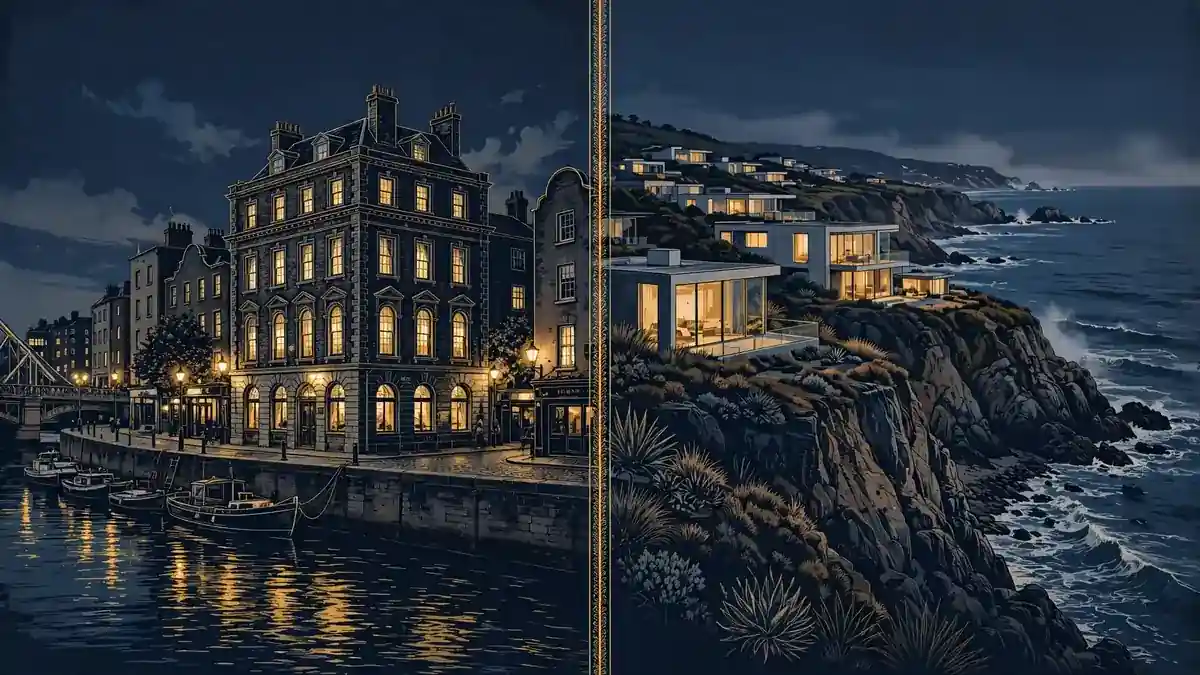
In Dublin, he previously lived in Sorrento Cottage on Vico Road in Dalkey, an affluent coastal neighbourhood south of the city. After planning difficulties expanding that house, he bought another home nearby. In 2002, he acquired Fortlands, a substantial period residence on Killiney Hill Road overlooking Killiney Bay, with landscaped gardens, traditional reception rooms and extensive privacy. Contemporary reports placed the purchase price in the multimillion-euro range. He pursued renovations there, including changes to the driveway, boundary walls and outdoor facilities.
His longest-held foreign property is in France. In 1993, The Edge and Bono acquired Villa Les Roses, a large waterfront property in Èze-sur-Mer, between Nice and Monaco. The residence has around 20 rooms and has served as a private retreat for the musicians and their families, a gathering place for artists and guests on the French Riviera.
In the United States, he shares a home in Malibu, California, with his wife Morleigh Steinberg — the house the Telegraph described in its 2023 profile of the guitarist, noting the couple’s properties in Ireland and on the French Riviera alongside it. The 151 acres of undeveloped Sweetwater Mesa land, bought for $9 million in 2005, sits separately from the family home and remains undeveloped after the planning battle described above.
What about cars? The Edge is not a collector in the public sense. No verified reporting ties him to a fleet of supercars or a headline-grabbing collection, and we do not invent one. His visible spending has gone into guitars and equipment — a rig built over decades, including the Gibson Explorer, Fender Stratocasters and Telecasters, and Vox AC30 amplifiers — and into property. The guitar collection itself has real value: vintage Explorers and the specific instruments used on landmark recordings are sought after, though no public valuation of his collection exists, so we do not put a figure on it.
One more asset is easy to overlook and hard to value: the name. “The Edge” is a stage name with fifty years of recognition behind it, attached to one of the most distinctive guitar sounds in popular music. It is not a balance-sheet item, and it does not appear in any net-worth estimate, but it is the reason the catalogue keeps earning and the reason a 2026 album launch still makes news.
Awards and Achievements
As a member of U2, The Edge has won 22 Grammy Awards — more than any other band in Grammy history — including Album of the Year twice, for The Joshua Tree and for How to Dismantle an Atomic Bomb. The band’s honours also include eight Brit Awards, four Ivor Novello Awards and two Golden Globe Awards. U2 were inducted into the UK Music Hall of Fame in 2004 and the Rock and Roll Hall of Fame in 2005, with Bruce Springsteen delivering the induction speech. In December 2022, The Edge was a Kennedy Center honoree with the rest of the band.
The sales and touring records sit alongside the trophies. The Joshua Tree topped charts in more than 20 countries and became the fastest-selling album in British history at the time of its release. All That You Can’t Leave Behind is the only album in history to have two different singles win the Grammy for Record of the Year. The 360° Tour held the records for the highest-grossing and highest-attended tour in history until 2019. The Sphere residency set the highest per-show residency gross at that venue. Rolling Stone ranked U2 at number 22 on its list of the greatest artists of all time.
Two achievements fall outside the usual award lists and say more about the man. On 29 April 2016, The Edge performed in the Sistine Chapel as part of a conference for the Angiogenesis Foundation, making him the first rock artist to stage a concert at the site. And in 2024, he co-directed V-U2 An Immersive Concert Film with his wife, moving from performer to filmmaker for the document of the band’s Sphere residency.
Net Worth Growth Over the Years
Year-by-year net worth figures for The Edge do not exist in any reliable form before the 2020s, and we do not invent them. What the public record does show is a series of dated estimates from identifiable sources, and they trace a fortune that rose with the band’s touring peak, held through the 2010s, and grew again after the Sphere residency and the Clarence sale.
| Year | Reported estimate | Source and context |
|---|---|---|
| 2021 | $280 million | Wealthy Persons, June 2021 estimate |
| 2023 | £330 million (about $410 million) | Wikipedia, citing 2023 reporting on the guitarist’s wealth |
| 2023–2024 | Growth driver: Sphere residency | $244.5 million gross across 40 shows; Clarence Hotel sold October 2023 |
| 2026 | $340 million | Midder Music ranking of richest rock stars |
| 2026 | $400 million | Celebrity Net Worth (updated October 2026); LedgerNote richest-guitarists ranking, November 2026 |
The spread between the 2026 figures — $340 million at the low end, $400 million at the high end — is the honest answer to the question “how much is The Edge worth?” The $400 million figure is the most cited and the most recently updated, and it is the anchor of our headline. The $340 million figure is the floor set by the most conservative recent ranker. Our $340 million to $400 million range covers both, and the midpoint — around $370 million — is a fair shorthand for the fortune as it stands in November 2026.
Three forces will move the number next. The first is the 2027 world tour announced alongside Carnaval de Luz: a full U2 tour is a nine-figure gross, and the band’s share of it flows straight to the members. The second is the catalogue: fifteen studio albums, plus the 2023 re-recordings and the 2026 releases, keep earning whether the band is on stage or not. The third is property: the Malibu land remains an unresolved asset, and any future sale or development would change the picture materially. None of those is priced into the current range, because none of them has happened yet.
Social Media Presence
The Edge keeps a low profile online, in keeping with a career spent letting the guitar do the talking. He does not run a verified personal social feed in the way many musicians of his generation now do, and he has never built a personal brand around his daily life. News about him travels through U2’s official channels — the band’s website, u2.com, and its official social accounts — and through interviews, most recently a long conversation with Uncut magazine in late 2026 about fifty years of U2, the new album and a collaboration with Dolly Parton that came out of an Irish folk project the band had been working on.
That absence from social media is itself part of the financial story. A large share of modern celebrity wealth comes from sponsored posts, brand partnerships and direct-to-fan sales — income streams The Edge has never chased. His fortune was built the older way: records, tours, songs and property. The trade-off is visible in the numbers: he is worth less than Bono, whose public profile and investment career added hundreds of millions beyond the band, and more than most guitarists who never had a catalogue of this size behind them.
Personal Life
The Edge married his high school sweetheart, Aislinn O’Sullivan, in July 1983. The couple had three daughters — Hollie, Arran and Blue Angel — before separating in 1990. Their divorce was finalised in 1996. In 1993, he began a relationship with American dancer and choreographer Morleigh Steinberg, who had worked with U2 during the Zoo TV Tour and appeared in the band’s live performances, including a belly-dancing sequence in “Mysterious Ways.” The couple married on 18 June 2002 in France and have two children together, Sian and Levi.
The family has faced serious difficulty in private. Their daughter Sian was diagnosed with leukaemia as a child and underwent several years of treatment. During her illness, U2 adjusted parts of its touring schedule so The Edge could spend more time with his family. Sian subsequently recovered. The experience shaped his priorities, and he has spoken since about keeping family relationships intact despite the band’s recording and touring demands.
The couple live between Dublin and Malibu, and Steinberg has become a creative partner as well as a spouse: she co-directed V-U2 An Immersive Concert Film with him in 2024. The Edge’s brother Dik, who played in the earliest version of the band before leaving in 1978, went on to his own career in music. His sister Gillian has stayed out of the public eye.
Outside music, his longest-running commitment is Music Rising, the charity he co-founded with producer Bob Ezrin and other music-industry partners after Hurricane Katrina in 2005. The organisation was set up to replace instruments and equipment lost by musicians in New Orleans and other areas hit by the hurricane, and it has since expanded to schools, churches and community music programmes affected by natural disasters, distributing thousands of instruments and providing millions of dollars in assistance. He has also supported medical research and entrepreneurship initiatives, including the Angiogenesis Foundation and Endeavor Ireland.
Sources & Reporting
Celebrity Net Worth — the $400 million estimate, updated 15 October 2026, plus the full career and property narrative: Clarence Hotel history, the Malibu land purchase and planning fight, tour grosses and personal life. The primary source for the headline figure.
Wikipedia — biographical record for David Howell Evans and for U2: birth and family details, the 1976 formation, the 22 Grammy Awards, 170 million records sold, the 360° Tour gross of $736.4 million, the Sphere residency, the 2026 EPs and Carnaval de Luz, and the £330 million net worth figure reported in 2023. Also the source for the Irish-citizenship date of 23 June 2025.
The Irish Times — Clarence Hotel sale reporting: the October 2023 sale to the Dean Hotel Group, the €18.07 million cash payment for the building’s owning company, the €28.37 million total transaction consideration, and the end of Bono and The Edge’s three-decade ownership.
Billboard — Boxscore tour figures: the Sphere residency gross of $244.5 million from 40 shows and 663,000 tickets, and the venue’s record-breaking 2024 year.
Pollstar — touring records: the 360° Tour’s $736.4 million gross and 7.27 million tickets, U2’s $2.13 billion in live earnings from 1980 to 2022, and the Sphere per-show average of more than $6.1 million.
The Guardian — The Edge becoming an Irish citizen on 23 June 2025 after 62 years in the country, and his comment that Ireland will always be home.
IMDb — height of 5 feet 10 inches (1.78 m) and marriage date to Morleigh Steinberg, 18 June 2002.
LedgerNote — November 2026 ranking of the richest guitarists, placing The Edge fourth at $400 million.
Reporting window: sources consulted in November 2026, covering reporting from 2021 through November 2026. Where sources disagree — most visibly on the net worth figure itself and on the bandmates’ fortunes — this article publishes the range and names who says what, rather than picking one number and hiding the rest.
Frequently Asked Questions
What is The Edge’s net worth in 2026?
The Edge’s net worth is estimated at $340 million to $400 million as of November 2026. Celebrity Net Worth, updated in October 2026, puts him at $400 million, while Midder Music lists $340 million. Wikipedia cites a 2023 figure of £330 million, roughly $410 million at the time. The range reflects genuine disagreement between sources, not a lack of research.
What is The Edge’s real name?
His real name is David Howell Evans. He was born on 8 August 1961 in Barking, Essex, England, to Welsh parents from Llanelli. “The Edge” is a stage name he acquired in the band’s early years; the precise origin is disputed, with the angular shape of his head the most commonly cited explanation.
How did The Edge make his money?
Mostly through U2. The band’s tours have grossed billions — the 360° Tour alone took $736.4 million, and the Sphere residency added $244.5 million — and as a founding member and principal songwriter he shares in tour profits, record sales and publishing royalties from a catalogue of more than 170 million records sold. Property added to it: he co-owned Dublin’s Clarence Hotel for over thirty years before selling in 2023, and he owns homes in Ireland, France and Malibu.
Did The Edge sell the Clarence Hotel?
Yes. He and Bono bought the Clarence in Dublin in 1992 and sold their remaining interests in October 2023 to the Dean Hotel Group, ending more than three decades of ownership. Filings showed the buyer paid €18.07 million in cash for the company that owned the hotel building, with total transaction consideration of €28.37 million. The amount The Edge personally received was never disclosed, because the hotel was held through a partnership.
Did The Edge ever build the Malibu houses?
No. He bought 151 acres above Malibu for $9 million in 2005 and proposed five luxury homes, with a projected cost of $79 million or more. The California Coastal Commission approved a revised plan in December 2015, but the Sierra Club challenged it, and a California appeals court overturned the permits in March 2019 on jurisdiction grounds. The state Supreme Court declined to hear the appeal in June 2019. The land remains undeveloped.
Who is The Edge married to?
He has been married to American dancer and choreographer Morleigh Steinberg since 18 June 2002. They met when she worked with U2 on the Zoo TV Tour and have two children, Sian and Levi. He was previously married to his high school sweetheart Aislinn O’Sullivan from 1983 until their divorce in 1996; they have three daughters, Hollie, Arran and Blue Angel.
How old is The Edge and how tall is he?
The Edge was born on 8 August 1961, making him 65 years old as of November 2026. He is 5 feet 10 inches tall (1.78 m), according to IMDb. He became an Irish citizen on 23 June 2025, after living in Ireland for 62 years.
Is The Edge richer than Bono?
No. Bono is the richest member of U2, with estimates around $700 million, helped by his Elevation Partners investment career alongside his share of the band’s earnings. The Edge, at $340 million to $400 million, is generally ranked second in the band, ahead of Adam Clayton and Larry Mullen Jr., whose reported fortunes vary widely by source.
Final Thoughts
The Edge’s fortune is the quietest fortune in rock. There is no endorsement empire, no fashion line, no venture fund and no social-media brand behind it — just fifty years of the same band, the same guitar sound, and the same partnership, compounded. The $340 million to $400 million range is honest about what the public record can and cannot prove: the tour grosses are documented to the dollar, the record sales are counted in the hundreds of millions, and the Clarence Hotel sale is in the filings — but the split of the partnership’s profits and the personal share of the hotel sale were never published, so a single precise number would be a pretence.
What is certain is the shape of it. The money came from playing — from the 360° Tour’s $736.4 million, from the Sphere’s $6.1 million a night, from songs written in a Dublin school that still pay royalties today. It survived a Broadway musical that lost $60 million and a Malibu planning fight that consumed millions in legal fees and produced nothing at all. And it is still growing: a sixteenth studio album in November 2026, two EPs in the band’s fiftieth year, and a world tour announced for 2027. The guitarist who thought of notes as expensive turns out to have spent his career the same way — carefully, and mostly on things that last.
Published on 2026-11-25. Last reviewed November 2026. Found an error? See our corrections policy.