
Sir Mix-A-Lot‘s net worth is estimated at $20 million–$30 million as of November 2026. The Seattle rapper turned one of the most famous singles in pop history into a fortune that has paid him for more than three decades: “Baby Got Back” grossed over $100 million, his debut album went platinum years before the hit arrived, and the publishing rights he kept have funded everything from a record label to a car collection and a house-flipping television special. He was still headlining major stages in 2024, performing at the NHL Winter Classic in his hometown.
Sir Mix-A-Lot: Quick Facts
| Estimated net worth | $25 million (range: $20 million–$30 million) |
|---|---|
| Profession | Rapper, songwriter, record producer |
| Nationality | American |
| Born | August 12, 1963 (age 63) |
| Height | About 5 ft 10 in (178 cm) — published figures run from 5 ft 8 in to 5 ft 11 in |
| Primary income sources | Music publishing and royalties, record sales, touring and festivals, producing, radio and television work |
| Active years | 1981–present |
| Last reviewed | November 2026 |

- Early Life and Background
- Education
- Career Journey
- Rise to Fame
- Main Sources of Income
- Salary and Earnings
- Businesses and Investments
- Brand Deals and Sponsorships
- Houses, Cars and Other Assets
- Awards and Achievements
- Net Worth Growth Over the Years
- Social Media Presence
- Personal Life
- Sources & Reporting
- Frequently Asked Questions
- Final Thoughts
Early Life and Background
Anthony L. Ray was born on August 12, 1963, in Auburn, Washington, a suburb south of Seattle, and grew up in Seattle’s Central District. His mother worked as a licensed practical nurse at the King County Jail, and the family lived in the Bryant Manor apartments on 19th Avenue and East Yesler Way. Money was tight. Ray has spoken openly about that fact, and about how the city’s school busing program — which ran from 1978 to 1999 — moved him out of his neighbourhood and into better-funded schools in the North End. Some neighbours resented the program. Ray’s own verdict, given to KUOW years later, was blunt: from his side of the city, it was the best thing that could have happened to him, because his family could not afford a home near a good school.
Two early interests shaped the career that followed. The first was music: a teacher at Eckstein Middle School first put the idea of a music career in front of him, and Ray started rapping in the early 1980s. The second was electronics. He was obsessed with CB radio as a teenager — his stage name’s “Prime Minista” handle comes from that world — and one of his first jobs was working at a pinball arcade, servicing machines and fixing keyboards and other musical equipment. That hands-on comfort with gear later set him apart from rappers who only ever held a microphone. He learned how records were actually made, and he kept the habit: electronics remain a hobby decades later.
Seattle in the early 1980s had almost no rap infrastructure. There were no major-label scouts working the city, no established hip-hop radio, and no local blueprint for turning rap into a living. Ray built his own. While still in high school he started DJing parties at local community centres, and by 1983 he was playing weekends at the Rainier Vista Boys and Girls Club in South Seattle. The parties moved to the Rotary Boys and Girls Club in the Central District, and it was there that he met the man who changed his trajectory: ‘Nasty’ Nes Rodriguez, a local radio DJ who hosted Fresh Tracks on Seattle station KKFX (K-Fox), the West Coast’s first rap radio show.
Education
Ray attended Roosevelt High School near the University District and graduated in 1981. His schooling was shaped by Seattle’s 21-year busing experiment, which sent students from the South End and the Central District to predominantly white schools in the North End. The practical payoff for Ray was access: music programs and facilities that his neighbourhood schools did not have. He has credited that access with part of his later success, and his account of it is unusually specific for a celebrity biography — he remembers the resentment from some North End residents, and he remembers deciding that the opportunity mattered more than the friction.
There is no record of Ray attending college. He went straight from Roosevelt into the work that would become his career: DJing, then recording, then running a label. That decision looks, in hindsight, like the first of many times he chose ownership over credentials. While his peers were weighing degrees, he was learning how to press a record, book a room, and keep the money from a door split. The electronics skills from his arcade job — repairing keyboards, wiring gear, understanding signal chains — gave him a producer’s toolkit before he had a producer’s title.
Career Journey
The partnership with Nasty Nes became a business in 1983, when Ray, Rodriguez and local businessman Ed Locke founded Nastymix Records. Owning the label from the start was the single most important financial decision of Ray’s life. Most young rappers of the era signed away their masters and their publishing before they understood what those words meant. Ray, who had spent his teens fixing other people’s equipment and watching how the music business treated artists who did not own their work, started out as an owner.
The first Nastymix song to travel beyond Seattle was “Square Dance Rap” in 1986. Ray had originally planned to rap the whole track slowly, then speed it up and raise its pitch in post-production — the high, cartoonish “Smurf voice” that became the record’s signature. He later told Seattle Refined that he did it because he did not want to rap at all, which is a strange thing to say about a record that launched a rap career, and exactly the kind of sideways thinking that marked his early work. Club DJs across the country picked the record up, and Ray toured Florida, New York and other states on the back of it.
The next hit came from a street sign. While touring in Arizona, Ray noticed a street named Broadway with a restaurant called Dick’s — the same pairing of names he knew from Seattle’s Capitol Hill district. That observation became “Posse on Broadway,” released in 1987. The single cracked the Top 100 and then faded fast, but it never left Seattle: its roll call of local landmarks made it a permanent hometown anthem, and it proved Ray could write a record that was funny, specific and rooted in a real place rather than a generic party.
His debut album, Swass, arrived in 1988 with “Square-Dance Rap” and “Iron Man,” a rap-metal track that sampled Black Sabbath’s song of the same name and was backed by the band Metal Church. The album was certified platinum by the Recording Industry Association of America in 1990 — a remarkable result for an independent Seattle rap record in an era when the city’s music industry barely existed. Seminar followed in 1989, featuring “My Hooptie,” “Beepers,” “Gortex” and “I Got Game,” and was certified gold. By the time the major labels came calling, Ray already had two certified albums, his own label, and a regional touring base. He was not a discovery. He was a going concern.
The 1990s brought the peak and the comedown in quick succession. In 1991 he signed to Def American, which also bought the rights to his first two albums, and released his third album, Mack Daddy, in 1992. After the Mack Daddy wave, his later albums received far less promotion: Chief Boot Knocka (1994) reached No. 69 on the Billboard 200, and Return of the Bumpasaurus (1996) sold poorly after what Ray described as a low label promotion effort. He left Def American. In 1999–2000 he worked closely with The Presidents of the United States of America under the group name Subset, mixing rock and rap, releasing songs online and touring — but nothing was ever officially released. He signed with the independent label Artist Direct for his 2003 album Daddy’s Home, led by the single “Big Johnson,” and released a DVD, Shhhh… Don’t Tell ‘Em That, in 2004. In 2010 he announced a new album, Dun 4got About Mix, and released the single “Carz” on YouTube; by June 2011 the video had passed a million views, but no release date for the album had been set as of 2023.
Rise to Fame
“Baby Got Back” was almost an afterthought. It was the second single from Mack Daddy, one of the last songs recorded for the album, and one of Ray’s least favourite tracks on it. The song spent five weeks at No. 1 on the Billboard Hot 100, sold 2.4 million singles in its first year, and finished 1992 as the year’s second best-selling single, behind only Whitney Houston’s “I Will Always Love You.” It went double platinum and won the 1993 Grammy Award for Best Rap Solo Performance. MTV received so many complaints about the video that it aired the clip only after 9 p.m.
The controversy was part of the engine. The song’s subject — an unapologetic celebration of curves, delivered as a parody of the era’s fashion-magazine beauty standard — drew complaints from broadcasters and praise from listeners who heard the joke underneath the hook. Ray has said the song’s critics had his message backwards, and the record’s longevity backs him up: it became one of the most licensed, sampled and parodied rap songs ever made, which is precisely why it kept paying him long after the chart run ended. Few rap records from 1992 still earn meaningful money in 2026. This one does, because every new use — a film, an advert, a sample — triggers the publishing rights Ray held on to.
The fame that followed was intense and short-lived in chart terms. Chief Boot Knocka produced the single “Put ‘Em On The Glass” and the Grammy-nominated “Just Da Pimpin’ in Me,” which lost Best Rap Solo Performance to Dr. Dre’s “Let Me Ride” in 1994. Ray also crossed into Seattle’s grunge world, collaborating with Mudhoney on “Freak Momma” for the 1993 Judgment Night soundtrack — a pairing that said something about how thoroughly he belonged to his city’s music scene rather than to any single genre. But the major-label machine moved on, and Ray’s chart presence faded. What did not fade was the catalogue. While many of his early-90s peers watched their hits go quiet, Ray’s one giant record kept generating publishing income, and his ownership of it meant the cheques kept coming to him rather than to a label’s back catalogue division.
That durability is the real story of his fame. Queen Latifah, another rapper who broke through in the same era, built a second career in film and television to stay visible. Ray stayed visible a different way: by remaining the man who owned the song everyone still knows. His 2014 performance with the Seattle Symphony, his 2024 Winter Classic appearance, and his steady festival bookings all trade on the same asset — a record that never left the culture.
Main Sources of Income
Ray’s income has always come from several streams at once, and the balance between them has shifted over 40 years. The through-line is publishing. Here is how the money breaks down.
Music publishing and royalties. This is the engine. Ray owns — or shares in — the publishing on “Baby Got Back” and much of his catalogue, and publishing pays every time a song is played on the radio, streamed, licensed to a film or advert, or sampled by another artist. The 2014 Nicki Minaj single “Anaconda,” which samples “Baby Got Back” heavily, created a fresh royalty stream more than two decades after the original. Streaming added another layer: the song’s tens of millions of plays across platforms generate steady, if modest, per-play income that compounds year after year. Ray himself has framed publishing ownership as the whole point of the business, telling interviewers that owning your publishing is what lets you keep earning from a record long after the charts forget it.
Record sales. The early catalogue sold in serious numbers for an independent artist: Swass went platinum, Seminar went gold, and “Baby Got Back” went double platinum as a single, with 2.4 million copies sold in its first year. Those sales paid in the 1980s and 1990s, and they still matter, because catalogue sales and streaming of the back catalogue continue to produce income. TheRichest’s earnings breakdown credits roughly $1 million in estimated earnings each to Swass and Mack Daddy, and about $500,000 to Seminar — figures that should be read as that outlet’s estimates, not audited accounts, but they give a sense of scale.
Touring and live performance. Ray has never stopped performing. The early Nastymix years were built on club dates and regional touring; the modern version is festival slots and special appearances across the country, including his January 1, 2024 performance at the NHL Winter Classic in Seattle, where the Kraken hosted the Vegas Golden Knights. Festival fees for a legacy act with a universally recognised hit are substantial, and Ray’s costs are low — he is a solo performer with a deep catalogue, not a touring production with a large payroll.
Producing and collaborations. Ray produced the album Dream for the urban rock band Ayron Jones and The Way in 2013, opening their album release party at Neumos in Seattle. He collaborated with the Seattle Symphony in June 2014 on a new composition by Gabriel Prokofiev, part of the symphony’s Sonic Evolution series celebrating Seattle music icons. His remix work includes a 2010 track for Puscifer’s All Re-Mixed Up. Producing pays in fees and, where he holds a share, in royalties — and it keeps his name in front of audiences who never bought a rap record.
Radio, television and media work. From 2017 to 2019 Ray hosted a morning radio show on Hot 103.7 FM in Seattle. He hosted the short-lived UPN anthology drama The Watcher in 1995, appeared on The Simpsons in 2006, Robot Chicken in 2008, BoJack Horseman in 2017, and Family Guy in 2025, singing a “Baby Got Back”-style song about big thighs called “Lady Kneecaps.” He narrated Wheedle’s Groove, a 2009 documentary about Seattle’s 1960s and 1970s funk and soul scene. Each of these paid appearance fees and residuals, and together they form a meaningful second income line that most one-hit rappers never develop.
Licensing and sync. “Baby Got Back” is one of the most licensed rap songs in history. Films, television shows, adverts and video games all pay to use it, and the song’s instant recognisability makes it a first-call choice for any scene that needs a 1990s shorthand. That licensing income is lumpy — a big film placement pays far more than a year of radio spins — but over three decades it has added up to a large share of the song’s total earnings.
Salary and Earnings
The honest answer to “how much did Sir Mix-A-Lot make from ‘Baby Got Back’?” has two parts, and most net worth pages only print one of them. The first part is the gross: Ray himself said in a 2014 interview that the song had made over $100 million across publishing, royalties and sales in its first 25 years. That figure is plausible as a gross — the total revenue the song generated for everyone who held a piece of it. The second part is Ray’s personal share, and it is much smaller.
Celebrity Net Worth did the arithmetic in detail. Even if Ray owned the master recording outright and the song generated $100 million in gross revenue, his take would be $23 million at best and around $8 million at worst, before fees to agents, managers, lawyers and marketing. The reason is the split: royalties flow through a chain of rights holders, and the song is built on a sample of “Technicolor” by the band Channel One, who take a generous cut of every royalty. Celebrity Net Worth’s publishing-industry contact added that Ray’s label, Universal Music Group, probably owns the master, which would give UMG the majority of the record’s revenue — and that Ray most likely splits publishing administration 50/50 with UMG. On those assumptions, the outlet concluded he may have made $40 million at most from the one song, and probably considerably less. That careful range — $8 million to $23 million as a personal share of a $100 million-plus gross — is the most useful number in this whole article, because it explains both the size of his fortune and why it is not $100 million.
What does he earn now? No current salary is publicly reported, and Ray has never published his accounts. The shape of the income is clear, though: a catalogue anchored by one of the most durable songs in rap, paying publishing royalties, streaming income, sync fees and sample royalties every year, plus live performance fees. The streaming era changed the mix. A song like “Baby Got Back” now earns a little from millions of streams every month, forever, rather than a lot from a short burst of sales. Drake, whose career was built inside the streaming era from the start, earns at a scale Ray’s generation could not have imagined — but Ray’s song earns in the same system now, with no new recording costs attached. That is the quiet advantage of a catalogue hit: the work is done, the costs are sunk, and the income keeps arriving.
The “Anaconda” sample deserves its own line in the ledger. When Nicki Minaj released “Anaconda” in 2014, built squarely on “Baby Got Back,” Ray publicly praised it as the “new and improved version” of his song — and every stream, sale and radio play of “Anaconda” sent money back to the “Baby Got Back” rights holders. Sample income of that kind is pure upside: Ray recorded nothing new, spent nothing, and gained a second hit’s worth of royalty flow. It is also the reason his net worth estimates rose in the mid-2010s, after years of flat or falling figures.
One more comparison puts the scale in context. Jay-Z turned publishing ownership and catalogue control into a billion-dollar empire by scaling the same idea across dozens of records and businesses. Ray did it with one record and a handful of businesses, which is why his fortune is measured in tens of millions rather than billions — and why it is still remarkable. Most artists with a single giant hit from 1992 ended the decade broke. Ray ended it with his publishing, his label, and a song that would pay him for another thirty years.
Businesses and Investments
Nastymix Records. The label Ray founded in 1983 with Nasty Nes Rodriguez and Ed Locke was his first business and his most important one. It released his early records, gave him control of his masters at a time when young artists routinely signed them away, and established the ownership-first approach that defines his finances. Def American bought the rights to his first two albums when he signed in 1991, which shows the limits of independence — but the label’s existence meant Ray negotiated that deal from a position of strength, as a proven seller with a platinum record, rather than as an unknown.
Publishing ownership. Ray has described owning his publishing as the core of his business thinking, and the numbers support him. Publishing is the asset that kept paying after the chart career ended, after the label deals, and after the touring slowed. Where other rappers of his era sold their publishing for quick cash, Ray kept his, and the “Anaconda” sample in 2014 was the payoff arriving twenty-two years late. This is the least visible part of his wealth and the largest part of it.
A Seattle recording studio. Ray has owned small businesses in Seattle over the years, including a recording studio, according to Plunged in Debt’s profile of him. A studio is a natural extension of a producer’s career: it generates rental and session income, it gives him a base for his own recording, and it is a real asset in a city where commercial property values have climbed sharply since the 1980s.
Real estate. Ray owns multiple residences, including one in Auburn, Washington, and has continued to buy and hold property in the state. Real estate is the hardest part of his portfolio to measure from the outside — no public filing lists his holdings — but the pattern is consistent across profiles: he lives in Washington, owns several homes there, and has treated property as a store of value rather than a display of wealth. The house-flipping television special that DIY Network aired in June 2018, Sir Mix-A-Lot’s House Remix, showed him buying and renovating a Seattle house — a public glimpse of a private habit.
What he has not done. There is no reliable reporting of Ray launching a fashion line, a drinks brand, a tech startup or a restaurant chain — the kinds of ventures that fill out other rappers’ business pages. Several low-quality net worth sites credit him with a “tech startup” and “clothing line,” but none of them names the company, the product or a source, and we found no credible reporting to support those claims. We leave them out rather than repeat them. His business story is narrower and more credible than that: a label, publishing, a studio, property, and a car collection that doubles as an asset class.
Brand Deals and Sponsorships
Ray has never been a heavy endorsement artist, and that is part of his story. He did not build his fortune on sneaker deals or drinks sponsorships. The brand work he has done is selective, local, and usually tied to something he genuinely enjoys.
The most visible was the Washington State Lottery’s Christmas-season campaign in 2013, which featured his music in advertisements running on Spotify and other platforms. It was a natural fit: a Seattle institution hiring a Seattle icon for a holiday push, with the song everyone in the state already knew. He became the spokesperson for Cards Against Humanity’s “Ass Pack” in 2019 — a joke product that was, on reflection, the only brand deal in history that could only have gone to the man who wrote “Baby Got Back.” The humour was the point, and Ray played it straight.
His 2014 collaboration with the Seattle Symphony sits somewhere between a brand deal and an artistic project: a new composition by Gabriel Prokofiev, performed as part of the symphony’s Sonic Evolution series, built around his music. It paid a fee, it sold tickets, and it put his name in front of an audience that does not buy rap records. His morning radio show on Hot 103.7 FM from 2017 to 2019 was a steadier commercial arrangement — a salaried hosting role that traded on his voice, his local fame and his deep knowledge of Seattle music.
The absence of big national endorsement deals is worth noting because it corrects a common assumption. Many net worth pages describe Ray’s wealth as if it came from the same mix of endorsements and ventures as a modern rapper’s. It did not. His money came from records, publishing and property, with brand work as a side line. That is a slower way to get rich, and a sturdier one.
Houses, Cars and Other Assets
Ray lives in Washington state and owns multiple residences there, including one in Auburn, near where he was born. He has kept his property life private — no public listings, no house tours, no social-media walkthroughs — so the exact portfolio cannot be itemised. What is on the record is the pattern: several homes in the state, held over decades, in a market where Seattle-area property values have risen enormously since the 1980s. The 2018 DIY Network special Sir Mix-A-Lot’s House Remix showed the other side of that habit, with Ray buying a Seattle house and renovating it for resale.
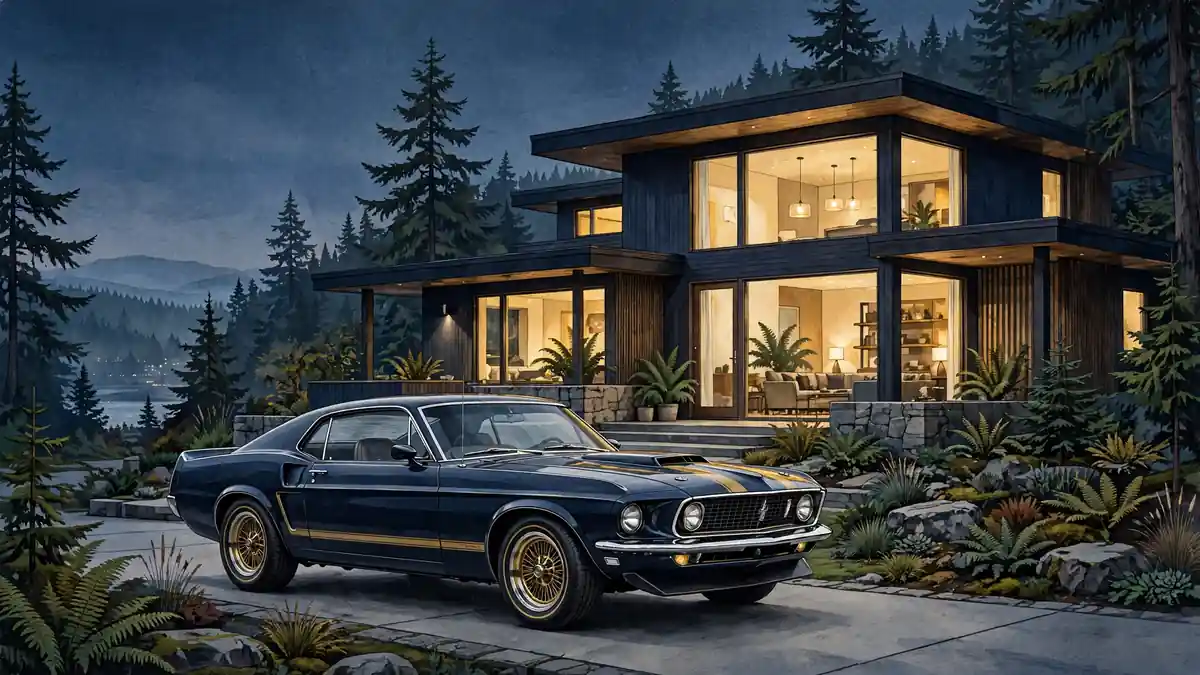
His car collection is better documented, at least in outline. Celebrity Net Worth describes him as a keen car collector with a very impressive collection of luxury and muscle cars, and his 2010 single “Carz” — released on YouTube, where it passed a million views within months — was a love letter to that hobby. He has spoken about cars as a lifelong interest rather than a status purchase, which fits the rest of his spending pattern: the collection is a passion that happens to hold value, not a fleet bought for display.
Beyond property and cars, his assets are the ones that do not photograph well: the publishing rights, the catalogue, and the Nastymix legacy. Those are worth more than the houses and the cars combined, and they are the reason his net worth has held up while other artists from his era saw theirs evaporate. A house can be sold. A song that earns every month cannot be spent in a weekend.
Awards and Achievements
Ray’s trophy shelf is smaller than his cultural footprint, and that gap is itself revealing: “Baby Got Back” won the awards that mattered and then kept earning long after the ceremonies ended. The full record:
- Grammy Award, 1993 — Best Rap Solo Performance for “Baby Got Back” (won).
- Grammy nomination, 1994 — Best Rap Solo Performance for “Just Da Pimpin’ in Me” (lost to Dr. Dre’s “Let Me Ride”).
- Grammy nomination, 1999 — Best Long Form Music Video for Televoid.
- American Music Award, 1993 — Favorite Rap/Hip-Hop Artist (won).
- MTV Video Music Award nominations — Best Rap Video and Best Direction in a Video in 1992, and Best Art Direction in a Video in 1993, all for “Baby Got Back.”
- Soul Train Music Award nomination, 1993 — Best R&B/Soul Single, Male, for “Baby Got Back.”
- RIAA certifications — Swass platinum (1990), Seminar gold, “Baby Got Back” double platinum.
- Chart records — five weeks at No. 1 on the Billboard Hot 100; 2.4 million singles sold in the first year; the second best-selling single of 1992.
The Grammy win in 1993 deserves emphasis. Rap was still fighting for respect inside the Recording Academy, and Best Rap Solo Performance was a young category. Ray’s win put a funny, Seattle-made, independently-rooted record on the same stage as the biggest pop acts of the year. Kendrick Lamar, whose Grammy record in rap categories now runs to double figures, works in a world Ray’s generation helped open — and Ray’s win is part of that history. His later career honours are civic as much as musical: the Seattle Symphony collaboration, the Winter Classic headline slot, and a permanent place in his city’s music story.
Net Worth Growth Over the Years
No audited figures exist for Ray’s wealth at any point in his career, so the table below is an illustrative reconstruction built from the reported milestones — album certifications, the 1992 hit, the 2014 sample windfall — and the published estimates from Celebrity Net Worth, TheRichest and other outlets. Treat the early years as broad estimates and the recent range as the best-supported figure.
| Year | Estimated net worth | What drove it |
|---|---|---|
| 1988 | Under $1 million | Debut album Swass released; independent label income |
| 1990 | About $1 million | Swass certified platinum; Seminar certified gold |
| 1992 | About $5 million | “Baby Got Back” — five weeks at No. 1, 2.4 million singles in year one |
| 1995 | About $10 million | Peak catalogue value; Grammy win; touring and licensing |
| 2003 | About $12 million | Daddy’s Home; steady publishing income; television work |
| 2014 | About $18 million | Nicki Minaj’s “Anaconda” samples “Baby Got Back”; Seattle Symphony collaboration |
| 2020 | About $20 million | Streaming-era catalogue income; radio hosting years |
| 2026 | $20 million–$30 million | Celebrity Net Worth $30 million; TheRichest $20 million; catalogue still earning |
The shape of that curve is the point. There is no sudden spike, no crash, and no reinvention. Ray’s wealth rose with the hit, plateaued through the quiet years, and rose again when a sample revived the song — the profile of an owner, not a spender. Compare that with Vanilla Ice, another early-90s rap star with a single giant hit: his fortune collapsed and had to be rebuilt through television and real estate. Ray’s never collapsed, because the asset that made it — the publishing — was never sold.
Social Media Presence
Ray keeps a lower social-media profile than most artists of his stature, and his accounts reflect a working musician rather than an influencer. His Instagram handle is @therealsirmixalot, where he posts performance clips, Seattle appearances and car content. His official website, sirmixalot.com, remains live as a hub for tour dates and news. He does not run the kind of daily content operation that younger artists use to sell records, and he does not need to: his audience finds him through the song, the festivals and the occasional television appearance.
That low profile is a deliberate choice, and it fits a pattern. Ray’s public life has always been event-driven — a Winter Classic performance, a symphony collaboration, a house-flipping special — rather than feed-driven. The January 2024 Winter Classic appearance, performing in front of a hometown crowd at a major sporting event, generated more attention than a year of posts would have. For a legacy artist, a single well-chosen stage beats a thousand uploads.
Personal Life
Ray has never been married and has no children, according to Celebrity Net Worth and BlackPast, and he keeps his personal life private. Very few of his romantic relationships have ever been published in the press. One dating-history site reports that he was once engaged to Michele L. Jennings, a former MC Hammer dancer, and that the engagement ended before a wedding — a claim we could not verify against a stronger source, so we report it as that site’s account, not as established fact. As of 2026 he is believed to be single.
He lives in Washington state, where he has several residences, and he remains based in the Seattle area that shaped him. His height is reported inconsistently across sources — anywhere from 5 ft 8 in to 5 ft 11 in — so we give the midpoint of about 5 ft 10 in (178 cm) and note the spread rather than pretending to a precision the record does not support. Outside music, his known interests are the ones that run through this whole article: cars, electronics, and Seattle itself. He still works with electronics as a hobby, the same skill that paid his first wages at the pinball arcade.
Sources & Reporting
Celebrity Net Worth — the $30 million net worth figure (updated June 2025) and the detailed $8 million–$23 million analysis of Ray’s personal share of “Baby Got Back” gross revenue, including the Channel One sample and the UMG master-ownership assessment; also the personal-life details (never married, no children, car collection, multiple residences).
Wikipedia — birth date and place (August 12, 1963, Auburn, Washington), Central District upbringing, Roosevelt High School and the busing program, Nastymix founding in 1983, full discography and certifications, Grammy and awards record, television work, the 2014 Seattle Symphony collaboration, and the 2024 Winter Classic performance.
TheRichest — the $20 million net worth estimate and the per-album estimated earnings ($1 million each for Swass and Mack Daddy, $500,000 for Seminar).
Rolling Stone — the history of “Posse on Broadway” and how it put Seattle on the rap map.
KUOW — Ray’s own account of the school busing program and its effect on his education.
BlackPast — biography confirming his Roosevelt High School graduation in 1981, that he has never been married, and that he has no children.
RIAA — Gold & Platinum certifications for Swass, Seminar and “Baby Got Back.”
Billboard — chart history for “Baby Got Back,” including the five-week run at No. 1 on the Hot 100.
Reporting window: sources checked November 2026. Net worth figures are estimates drawn from public reporting, not audited financial statements, and are corrected when new evidence emerges.
Frequently Asked Questions
What is Sir Mix-A-Lot’s net worth in 2026?
Sir Mix-A-Lot’s net worth is estimated at $20 million–$30 million as of November 2026. Celebrity Net Worth puts the figure at $30 million and TheRichest at $20 million, so we publish the range rather than picking one outlet’s number. The fortune is built mainly on the publishing and royalties from “Baby Got Back,” plus record sales, touring, producing and property.
How much money did “Baby Got Back” make?
Ray himself said in a 2014 interview that “Baby Got Back” had generated over $100 million across publishing, royalties and sales in its first 25 years. That is the song’s gross revenue — the total earned by everyone who held a piece of it, including the record label and the owners of the Channel One sample it is built on — not the amount Ray personally received.
How much did Sir Mix-A-Lot personally make from “Baby Got Back”?
Celebrity Net Worth’s analysis puts Ray’s personal share at $8 million–$23 million at best, before fees to agents, managers and lawyers, with $40 million as an absolute upper bound if every assumption broke in his favour. The gap between the $100 million gross and his personal share comes from royalty splits, the Channel One sample, and the fact that Universal Music Group probably owns the master recording.
What is Sir Mix-A-Lot’s real name and how old is he?
His real name is Anthony L. Ray, born August 12, 1963, in Auburn, Washington. He is 63 years old as of November 2026. He grew up in Seattle’s Central District and graduated from Roosevelt High School in 1981.
Is Sir Mix-A-Lot married? Does he have children?
No. According to Celebrity Net Worth and BlackPast, Ray has never been married and has no children, and he keeps his personal life private. One dating-history site reports he was once engaged to former MC Hammer dancer Michele L. Jennings, but that claim could not be verified against a stronger source.
How tall is Sir Mix-A-Lot?
Published figures disagree, ranging from 5 ft 8 in to 5 ft 11 in. The midpoint is about 5 ft 10 in (178 cm), which is the figure we use. No authoritative measurement is on the public record, so the spread itself is the honest answer.
Is Sir Mix-A-Lot still performing in 2026?
Yes. He continues to perform at festivals and special events across the country, most recently headlining the NHL Winter Classic in Seattle on January 1, 2024. He also hosted a morning radio show on Hot 103.7 FM in Seattle from 2017 to 2019 and appeared on Family Guy in 2025.
Did Nicki Minaj’s “Anaconda” make Sir Mix-A-Lot money?
Yes. “Anaconda” (2014) is built on a heavy sample of “Baby Got Back,” so every stream, sale and radio play of Minaj’s hit sends royalty income back to the “Baby Got Back” rights holders, including Ray. He publicly praised the song as the “new and improved version” of his hit, and the sample created a fresh income stream more than two decades after the original was released.
Final Thoughts
Sir Mix-A-Lot’s fortune is a lesson in ownership. He did not have the biggest career of his generation, and he did not chase the endorsement deals or the business empire that other rappers built. He had one giant song, and he owned the rights that mattered. The $20 million–$30 million estimate rests on that single decision, repeated over forty years: keep the publishing, keep the label, keep the property, and let the record keep working. “Baby Got Back” grossed over $100 million, and Ray’s share of it — $8 million to $23 million by the best analysis available — was enough, invested carefully and never sold off, to fund a life of festivals, fast cars, Seattle homes and the occasional symphony stage. Most one-hit wonders from 1992 are a trivia question now. He is still getting paid, still performing, and still the man who owns the song everyone knows.
Published on November 15, 2026. Last reviewed November 2026. Found an error? See our corrections policy.