
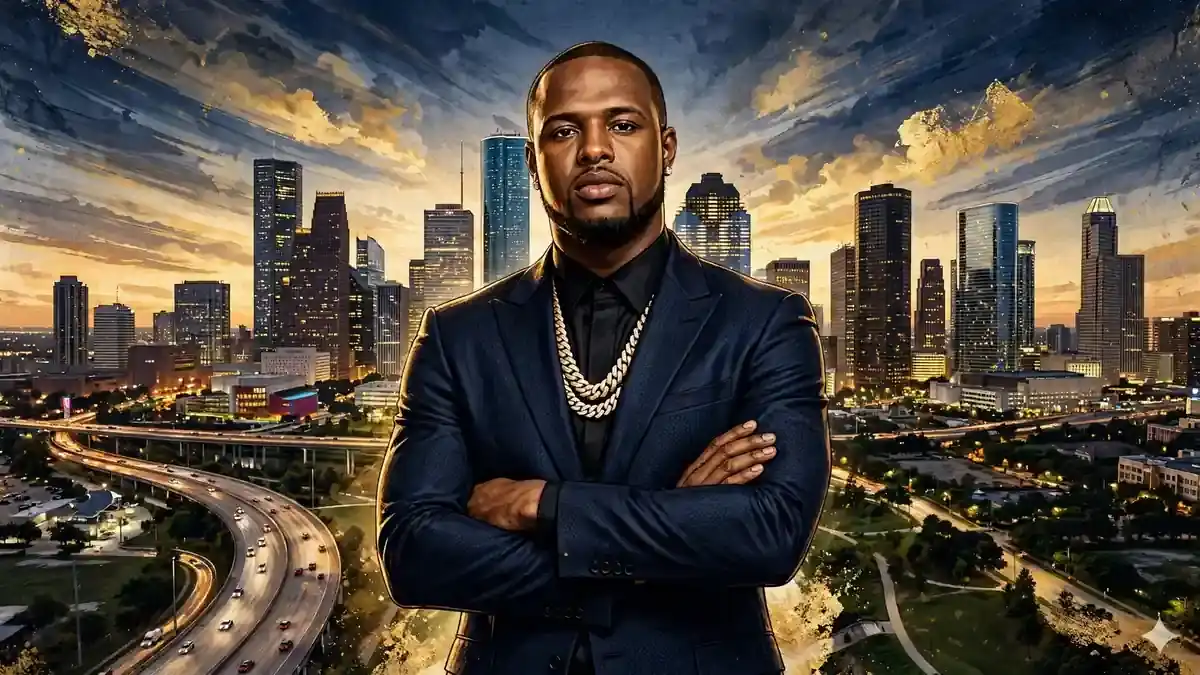
Slim Thug‘s net worth is estimated at $2 million to $4 million as of November 2026. The Houston rapper built that fortune the hard way: selling mixtapes out of the trunk and through his own record stores, scoring a number-two album and a five-week number-one single in 2005 and 2006, then turning the money into a construction company that builds affordable homes on the same blocks where he grew up. Celebrity Net Worth puts him at $4 million, NetWorthSpot at $3 million, and several other estimators at $2 million — the spread says less about Slim Thug than it does about how hard an independent artist’s money is to track from the outside.
Slim Thug: Quick Facts
| Estimated net worth | $3 million (range: $2 million–$4 million) |
|---|---|
| Profession | Rapper, record-label owner, real estate developer |
| Nationality | American |
| Born | September 8, 1980 (age 46) |
| Height | 6 feet 6 inches (198 cm) |
| Primary income sources | Music sales and streaming, touring and features, Boss Hogg Outlawz label, Boss Life Construction real estate |
| Active years | 1998–present |
| Last reviewed | November 2026 |
- Early Life and Background
- Education
- Career Journey
- Rise to Fame
- Main Sources of Income
- Salary and Earnings
- Businesses and Investments
- Brand Deals and Sponsorships
- Houses, Cars and Other Assets
- Awards and Achievements
- Net Worth Growth Over the Years
- Social Media Presence
- Personal Life
- Sources & Reporting
- Frequently Asked Questions
- Final Thoughts
Early Life and Background
Stayve Jerome Thomas was born on September 8, 1980, in Houston, Texas, and grew up first in the city’s Homestead area before moving to Acres Homes in his early teens. Acres Homes is one of Houston’s oldest Black neighborhoods, a sprawling northwest community built on large lots and deep church and family roots — and it matters to this story because Slim Thug never really left it. The houses he builds today through Boss Life Construction stand on streets a few miles from the ones he walked as a teenager.
Music reached him early. As a teenager he was already performing freestyle raps at local high school parties, testing verses in rooms where the crowd would tell him straight away whether a line worked. He has named Tupac Shakur and the Houston rapper Fat Pat among his early influences — Tupac for the directness and the business sense, Fat Pat for proof that a Houston voice could carry a record on its own terms. He has also credited J. Prince, the founder of Rap-A-Lot Records, whose ownership-first approach to the music business shaped how Slim Thug thought about his own career long before he had a record deal.
That ownership instinct showed up before fame did. While most aspiring rappers in late-1990s Houston were chasing a deal, Thomas was studying the economics of the local scene: who pressed the CDs, who moved them, who kept the money. Houston had its own self-contained rap economy in those years — chopped-and-screwed tapes, neighborhood record stores, and artists who sold directly to their own city. Slim Thug learned that economy from the inside, and it became the foundation of everything that followed. He did not wait for the industry to find him. He built a small business around his music first, and the industry came to him later.
The nickname came with the frame. At 6 feet 6 inches, Thomas was tall and slim, and “Slim Thug” stuck as a stage name that sounded like a Houston street character and doubled as a brand. It was a name built for a record sleeve, and it would eventually sit on a construction company, a clothing line, and a record label too.
Education
Slim Thug attended Eisenhower High School in Houston, where the freestyle sessions at school parties doubled as his earliest training ground. There is no public record of him attending college, and he has never claimed a degree. His education, by his own account in interviews, came from the record business itself: pressing CDs, moving units, pricing product, and learning what a wholesale margin meant before he could legally buy a drink.
That gap between formal schooling and business schooling is central to understanding his money. In a 2016 interview with Forbes, he described learning retail the painful way — watching national chains undercut the small record stores he owned. The lesson stuck: whoever controls distribution keeps the margin. It is the same lesson he later applied to real estate, where controlling the land and the build keeps the value in the neighborhood instead of shipping it out.
Career Journey
Slim Thug started rapping in the late 1990s with Swishahouse, the Houston label and collective that defined the city’s chopped-and-screwed sound for a generation. Swishahouse was more than a label; it was a distribution network, a street-level marketing machine, and a finishing school for Houston rappers. Slim Thug absorbed all of it, then left to build his own operation. He formed Boss Hogg Outlawz as both a record label and a rap group, and released his first mixtape, I Represent This, on his own terms.
The independent years were a business education in public. He bought two record stores and worked in real estate while he was still building his name as a rapper. He and other Houston artists packaged CDs themselves, drove them from town to town, and supplied local stores directly. Southwest Wholesale helped distribute projects, including his collaboration with E.S.G., and the system let him release music and collect payment close to home, without waiting on a label’s accounting department.
The economics were simple and he has explained them in plain numbers ever since. In a 2004 interview with AllHipHop, he laid out the math: a release selling 100,000 copies at $7 each brings in $700,000. That was the Houston model — modest per-unit prices, direct sales, and volume across a loyal regional audience. It also explains why he turned down record deals for years. A major label offered reach, but the independent route offered control and a bigger slice of every dollar. Pharrell Williams later said on The Tyra Banks Show that Slim Thug was already a millionaire when the two of them met, and the album they made together was named for exactly that fact.
By 2004, the Houston sound was breaking nationally, and Slim Thug was positioned at the center of it. His guest verse alongside Paul Wall on Mike Jones’s single “Still Tippin'” became the record that carried all three rappers into the mainstream. The track peaked at number 60 on the Billboard Hot 100 and earned a platinum certification from the Recording Industry Association of America (RIAA) — a slow-burning hit that kept paying for years. The same year, he was building the Boss Hogg Outlawz roster rather than folding it into a major-label system, a decision that protected his independence even as the offers arrived.
When the major-label deal finally came, it came on his terms. He signed with Interscope Geffen A&M and Pharrell’s Star Trak Entertainment, but negotiated the right to keep releasing independent music, including chopped-and-screwed versions of his own records. He resisted moving the whole Boss Hogg Outlawz roster into the major-label system at once. Killa Kyleon signed a deal; Slim Thug kept developing the other members independently. It was an unusual arrangement for a debut artist, and it showed how much bargaining power his independent earnings had already given him.
After the major-label chapter, he went back to independence and stayed there. His second album, Boss of All Bosses, arrived in 2009 as an independent release and still debuted at number 15 on the Billboard 200. Tha Thug Show followed in 2010, reaching number 89. Then came Boss Life in 2013, the same year he released his first EP, Welcome to Texas. The Hogg Life series ran through 2015 and 2016 — The Beginning, Still Surviving, Hustler of the Year, and American King — the last of which included “King,” a track built around the voice of the late Pimp C. Welcome 2 Houston and The World Is Yours arrived in 2017, followed by the Boston George collaboration EP Big Bad Boston and the Boss and the album Suga Daddy Slim: On tha Prowl in 2019.
The pace never really slowed. Thug Life came in 2020, the SDS Vibes EP in 2021, BIGslim in 2022, and Midlife Crisis in 2023, alongside the EP Where Dreams Are Made. In 2025 he released Double Cup with Propain and Double Cup, Pt. 2 with Lil’ Keke, continuing a two-decade habit of full-length collaborations with Texas rappers. His catalog also includes collaborative studio albums going back to 2001’s Boss Hogg Outlaws with E.S.G., 2003’s The Big Unit with Lil’ Keke, 2004’s Boyz-n-Blue with Boss Hogg Outlawz, the three Serve & Collect volumes, and two Having Thangs albums with Killa Kyleon. By one 2024 count, his catalog runs to around 15 studio albums, 20 mixtapes, and half a dozen collaborative albums.
That longevity is the point most net-worth pages miss. Slim Thug never had a second platinum album, but he also never stopped releasing, touring, and collecting. A catalog that deep, owned outright through his own label, pays in small amounts across many years — streaming royalties, show fees, features, and licensing — and it compounds in a way a single big year does not.
Rise to Fame
The breakthrough came in two waves, and both arrived within about eighteen months. The first was “Still Tippin’,” the 2004 Mike Jones single that put Houston rap on national radio. Slim Thug’s deep, unhurried delivery on the track became one of the most imitated sounds of the mid-2000s Southern rap wave. The record peaked at number 60 on the Hot 100, but its real impact was cultural: it announced Houston as the center of rap’s gravity for a moment, and Slim Thug as one of its defining voices.
The second wave was bigger. Already Platinum, his debut solo studio album, arrived on July 12, 2005, through Star Trak and Geffen after several delays and heavy bootlegging. It debuted at number two on the Billboard 200, selling 130,000 copies in its first week, and eventually moved about 500,000 copies in the United States — enough for a gold certification from the RIAA, which it received in 2018, thirteen years after release. The title was a statement, not a prediction. As he explained to XXL, it meant his lifestyle was already platinum before a record deal — the money, the cars, the independence — and the album was only the confirmation.
The record’s singles showed his range. “Like a Boss” became a signature track and a catchphrase that followed him for the rest of his career. “I Ain’t Heard of That” paired him with Pharrell and Bun B. “3 Kings” put him on a track with T.I. and Bun B, two of the South’s biggest names at the time. The album’s title track concept — that he was already living the life other rappers were chasing — became the core of his brand.
Then came the feature that made him a household name beyond rap. In 2005, he appeared alongside Bun B on Beyoncé’s single “Check on It.” The song reached number one on the Billboard Hot 100 on February 4, 2006, stayed there for five weeks, and spent 28 weeks on the chart. It earned a 2× Platinum certification from the RIAA and won Best R&B Video at the 2006 MTV Video Music Awards. For Slim Thug, it was his first number-one record — and it arrived on a pop single, not a rap one, which put his voice in front of an audience his own records never could have reached alone. The story behind it is pure Houston: he had been invited to perform his “Still Tippin'” verse at a Destiny’s Child show in the city, and the Beyoncé team sent him the track soon after.
The same year brought a second pop crossover. His appearance on the remix of Gwen Stefani’s “Luxurious” peaked at number 21 on the Hot 100. Two pop features, one number-one single, one gold album, and a platinum guest verse — all within about two years. It was the peak of his commercial visibility, and he has spent the two decades since converting that visibility into ownership: a label, a construction company, and a catalog he controls.
His association with Pharrell began, fittingly, in a Houston restaurant. As he told RapReviews in 2005, people kept approaching both men for autographs, which made Pharrell curious about the local rapper. A recording session with Fam-Lay and further meetings led to the working relationship that produced Already Platinum. It was a partnership built on mutual respect for independence — Pharrell admired that Slim Thug had already made his own money, and Slim Thug admired that Pharrell wanted to build with him rather than buy him out.
Main Sources of Income
Slim Thug’s money comes from four places, and the mix has shifted over time from music toward property. Music still pays — album sales, streaming, touring, and feature verses — but the construction business and the label now do at least as much of the work. Here is how the four streams break down.
Music sales and streaming. His catalog is the foundation. Already Platinum sold roughly 500,000 copies in the United States, and “Check on It” moved more than two million units on its way to a 2× Platinum certification. On streaming, his debut album alone has passed 31 million Spotify streams, according to chart tracker Kworb’s October 2026 data, and it still pulls around 8,000 streams a day more than twenty years after release. That is catalog income: modest per day, but it never stops, and because much of it runs through his own label, he keeps a larger share than an artist on a standard major-label deal.
Touring and live performance. Slim Thug has toured steadily for more than twenty-five years, from club dates in the mixtape era to major stages. In 2022 he joined Bun B’s Houston-focused RodeoHouston show, which he described to the Defender as one of the biggest stages of his career. Legacy acts with a deep catalog and a loyal regional audience can command reliable show fees for decades, and Houston’s 713 Day celebrations and anniversary shows keep him on stage in his home city every year.
Boss Hogg Outlawz. The label he founded in the late 1990s remains his music business. It released his independent albums, his collaborative projects, and records by artists he developed, including Killa Kyleon. Owning the label means owning the masters on much of his catalog — the asset that matters most in the streaming era, when every play pays the rights holder.
Boss Life Construction and real estate. This is the stream that sets him apart from most rappers of his generation, and the one that has grown the most since 2015. The company builds affordable homes in Houston, and it turns the same skills he learned selling CDs — find the customer, control the product, keep the margin — into houses. The details are in the business section below, but the headline is that property, not music, is now the most durable part of his wealth.
A fifth, smaller stream runs alongside the rest: merchandise and clothing through his Boss Life World line, plus the occasional brand appearance. None of it is the main story. The main story is a rapper who used a two-year commercial peak to buy himself twenty years of independence.

Salary and Earnings
Slim Thug has never published a salary, and no public filing lists his annual income, so any yearly figure is an estimate built from the pieces that are public. What the record does show is the shape of his earning life: a sharp peak in 2005 and 2006, a long independent tail, and a second act in real estate that does not depend on the charts at all.
The mixtape years are the most revealing, because he has talked about them in hard numbers. In 2004 he explained that a release moving 100,000 copies at $7 each brought in $700,000 — and that was retail math he controlled, selling through his own stores and wholesale channels rather than splitting the money with a label. In a 2024 interview with The Art of Dialogue, reported by HotNewHipHop, he went further, claiming he had made more money from mixtapes than any artist in history. The claim is impossible to verify — nobody audits mixtape sales from the early 2000s — but the detail he gave is concrete: his wholesale price was $8 a tape, while other sellers in the mixtape scene were giving product away for free. He had figured out, as a teenager, how to move tapes at a profit while his peers were moving them for exposure. Twenty mixtapes at those margins, across a loyal Houston audience, adds up to real money even before a single major-label check arrived.
The major-label years paid differently. Already Platinum sold 130,000 copies in its first week and about 500,000 in total in the United States. At mid-2000s retail prices, that is several million dollars of gross album revenue, of which an artist on a standard major-label deal would typically keep a fraction after the label recouped its advance, marketing, and distribution costs. Slim Thug’s deal was better than standard — he kept his independent releases and his label — but the album’s gold certification did not arrive until 2018, a reminder that his biggest record was a slow earner rather than a windfall. “Check on It” paid better and faster: a five-week number-one single with multi-platinum sales, a hit video, and a feature fee and royalty stream that ran for years.
Today, his music income is catalog income. Streaming pays fractions of a cent per play, but a catalog with a gold album, a platinum single, and a number-one feature generates a steady monthly flow. His debut album’s roughly 8,000 daily Spotify streams, reported by Kworb in October 2026, translate to a modest but permanent revenue line — and because Boss Hogg Outlawz owns much of the catalog, more of each stream reaches him than it would under a traditional deal. Touring adds the bigger checks: legacy rap acts with a recognizable catalog can earn five figures per show, and Slim Thug plays regularly in Houston and across the South.
What he does not have is the kind of public salary figure that comes with a television contract, a sports deal, or a corporate endorsement. No brand has ever paid him a reported eight-figure ambassador fee, and no filing has ever disclosed his income. That is why the estimators disagree by a factor of two: they are all guessing at the same private numbers. Our range — $2 million to $4 million — reflects that uncertainty honestly rather than pretending it does not exist.
One thing the record does make clear is his spending discipline. In interviews he has described himself as frugal — cutting his own hair for years, avoiding the bottle-service spending he watched other artists burn money on, and putting cash into assets that hold value. That discipline is part of the net worth story: a fortune is what you keep, and Slim Thug has kept his by spending less than he made for a very long time.
Businesses and Investments
Boss Hogg Outlawz. The label and group Slim Thug founded after leaving Swishahouse is the oldest of his businesses and still the center of his music operation. It released his independent albums, his collaborative projects, and the records of artists he developed. The label’s value is not in a sale price — it has never been sold — but in the catalog it holds and the control it gives him. In the streaming era, owning your masters is the difference between renting your career and owning it.
Record stores. Before the major-label deal, he bought two record stores in Houston. They were a real business and a real lesson. The stores sold his own music and other artists’ records, and they gave him a direct line to his customers. But the model broke when national chains started selling albums for $9.99 — close to what a small shop paid wholesale. He explained the squeeze to Forbes in 2016: the chains could afford to sell at a loss to drive traffic, and an independent store could not. The stores closed, but the lesson carried into everything after — control the product, control the margin, and never build a business that a bigger competitor can undercut overnight.
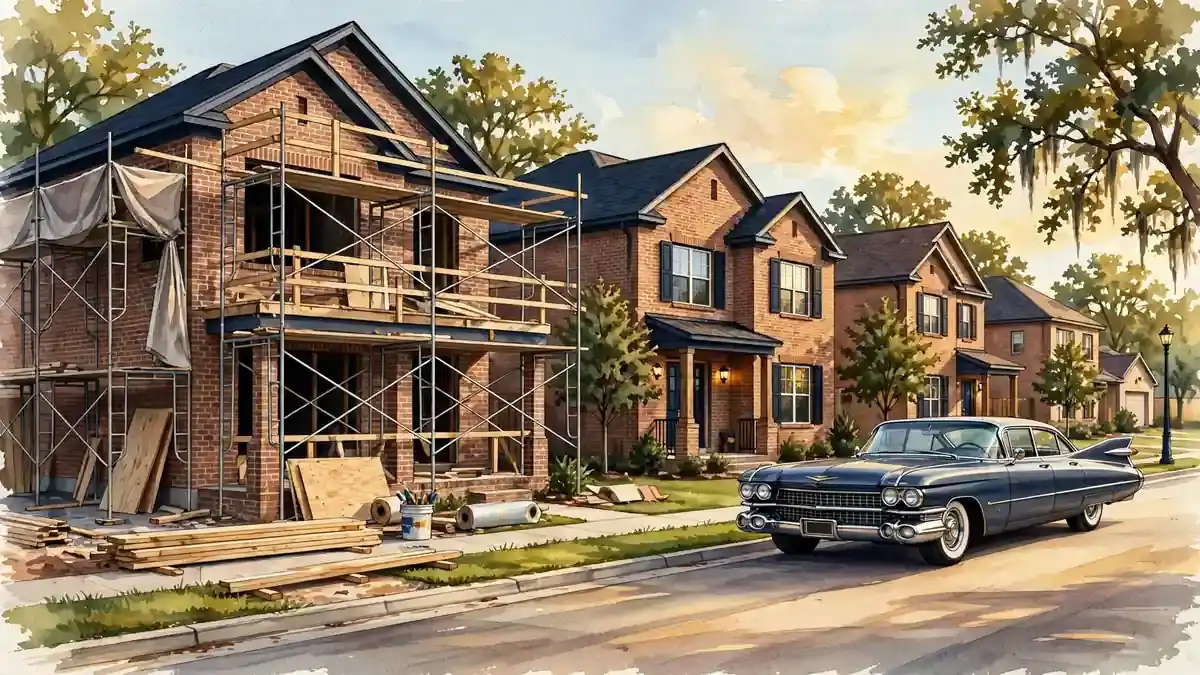
Boss Life Construction. This is the business that defines Slim Thug’s second act. He co-founded the company in 2015 with partners Cory Crawford and Troy Green, with LeSean West also involved in the early partnership, to build affordable homes in Acres Homes — the neighborhood where he grew up. The idea came from a civic honor: when Houston gave him his own day, February 25, 2014, city officials told him about the Land Assemblage Redevelopment Authority, or LARA, a program that lets builders buy city lots for as little as $1 if they build affordable homes on them. Slim Thug saw the opening immediately. Cheap land, real demand, and a neighborhood that outside developers were buying up and pricing out.
The company’s pitch is simple: build good-quality homes that local families and young professionals can actually afford, without cutting corners on construction. It uses low-cost LARA lots and offers down-payment help to buyers who qualify. Its projects have included three-bedroom, two-story homes in a small development called Burns Village, along with duplexes and townhomes across Acres Homes. It has also turned abandoned residential property into local businesses, including Burns Burger Shack. At one point the team built ten new homes on a single block — Conklin Street — in one push, a scale of building that made the “buy back the block” slogan literal.
By 2022, Slim Thug told the Defender that he and his partners had built about 10 homes for low-income buyers and were working on townhouses in Acres Homes with Cory Crawford and partners from Burns Original BBQ. The numbers sound modest next to a big developer’s output, but the model is the point: each home is a family housed, a lot reclaimed, and a small piece of the neighborhood kept in local hands. After Hurricane Harvey devastated Houston in 2017, the company partnered with Radio One Houston to give a new home to a family whose house had been destroyed, along with cash gifts to nine other families.
The construction business also runs a foundation and an annual Boss Life Ball, which recognizes local entrepreneurs. In 2016, Slim Thug joined other Houston rappers at a meeting with city officials organized by activist Deric Muhammad, where the group discussed policing, trade education, and support for young entrepreneurs. Afterward, the participants opened accounts at Unity National Bank, a Black-owned Houston bank — a deliberate choice to keep the money in the community the music came from.
Real estate holdings. Beyond the construction company, Slim Thug has bought and sold Houston property since his early career, starting with the real estate deals he described in a 2004 AllHipHop interview. He has never published a portfolio valuation, and no property record has been tied to a specific dollar figure in reliable reporting — which is why this article does not invent one. What is documented is the pattern: he buys in neighborhoods he knows, develops rather than flips, and holds the work close to home.
Boss Life World. His clothing line, Boss Life World, extends the brand from music and construction into apparel. It is a smaller business than the construction company, but it fits the same pattern: a brand he owns outright, sold to an audience he built himself.
Car lot and other ventures. As early as 2004 he was developing a car-lot business alongside his record stores, and he has described other small ventures over the years. None of them has been valued publicly, and this article does not guess at their worth. The pattern across all of them is consistent: small, local, owned outright, and tied to Houston.
Brand Deals and Sponsorships
Slim Thug has never been a big endorsement artist, and that is a deliberate part of his story rather than a gap in it. His commercial peak came before the era when rappers routinely signed seven-figure deals with fashion houses and drinks brands, and his career since has been built on ownership rather than sponsorship. There is no reported Nike deal, no liquor brand ambassadorship, no fashion collaboration with a published fee attached to his name.
What he has done instead is lend his name to his own businesses and to Houston causes. The Boss Life brand — the label, the construction company, the clothing line, the ball — is the endorsement, and it pays him as an owner rather than as a spokesman. He has appeared in local campaigns and community partnerships, including the Radio One Houston hurricane relief effort and the back-to-school drives he has sponsored for children on Houston’s north side, but those are philanthropy, not paid sponsorship, and this article counts them as such.
The absence of big brand deals is one reason his net worth sits where it does. Compare him with a peer like Chamillionaire, the fellow Houston rapper whose tech investments pushed his fortune far past his music earnings, or with Jay-Z, whose brand partnerships and business empire made him a billionaire. Slim Thug chose a different route: smaller deals, full ownership, and a business that serves his own neighborhood. The trade-off is a smaller number on a net-worth list and a larger stake in the things he actually controls.
Houses, Cars and Other Assets
The Pearland house. Slim Thug’s main home is in Pearland, a fast-growing suburb just south of Houston, which is why many profiles describe it simply as his Houston home. During a 2020 visit by the Houston Chronicle, he showed a reporter around the property and talked through the car collection parked there. He has never publicly shared what he paid for the Pearland house, and no reliable report confirms a purchase price or a current market value. Any figure you see online without a public-record source attached should be treated as a guess, and this article does not repeat one.
The car collection. Cars are the one asset he has valued in public, and the number is striking. During that same 2020 Houston Chronicle visit, he estimated the collection at about $1 million and said he had owned roughly 100 vehicles over the years. At the time he had around a dozen cars at the house, including a 1959 Cadillac Coupe DeVille appraised at $200,000. His first car, acquired at 15, was a 1960 Cadillac hearse — a detail that tells you everything about his taste: big, old, American, and impossible to ignore. The collection is both a hobby and an asset class. Classic Cadillacs in good condition hold their value, and a $200,000 appraisal on a single car is the kind of figure that makes the collection a meaningful slice of a $2 million to $4 million fortune.
Property and the catalog. The rest of his assets are the ones that do not photograph well: the Boss Hogg Outlawz catalog and masters, the construction company’s land and projects, and the Boss Life brand itself. None of them has a published valuation. Together, they are the reason the low end of his net worth range still sits at $2 million even in a year when he has not had a hit record: the assets keep working whether or not he is on the charts.
Awards and Achievements
Slim Thug has never won a Grammy, and his trophy shelf is thinner than his chart record might suggest. The industry’s big prizes mostly passed him by. What he does have is a set of achievements that tell a more honest story about his career.
The biggest is the “Check on It” win: Best R&B Video at the 2006 MTV Video Music Awards, for the Beyoncé single that gave him his first number-one record. A five-week run at the top of the Billboard Hot 100 is the kind of achievement that does not need a trophy to matter — it is a permanent line in the chart’s history, and it is the reason his name appears in every account of Beyoncé’s early solo career.
His album record is the second achievement. Already Platinum debuted at number two on the Billboard 200 in 2005 and earned a gold certification from the RIAA. Boss of All Bosses debuted at number 15 in 2009 as an independent release — a top-20 album with no major label behind it, which is a harder thing to do than a top-20 album with one. “Still Tippin'” earned a platinum certification, and “Check on It” went 2× Platinum.
The civic honors matter as much as the chart ones. Houston gave him his own day — February 25, 2014 — and he used the occasion to start a construction company rather than to throw a party. The Boss Life Ball, his annual event recognizing local entrepreneurs, has become a fixture in Houston’s business community. And in 2022, sharing the RodeoHouston stage with Bun B, he played one of the biggest shows of his career in front of a hometown crowd that has followed him since the mixtape days.
The achievement that sums him up best is not an award at all. It is the fact that he is still here: still releasing music, still building houses, still independent, more than twenty-five years after he started. Most rappers from the 2005 class are gone from the business entirely. Slim Thug owns his label, his catalog, and a construction company, and he did it without ever signing his life away.
Net Worth Growth Over the Years
The table below reconstructs Slim Thug’s wealth from the public record. The early years are estimates based on what he has said about his own earnings — Pharrell’s statement that he was already a millionaire before their 2005 meeting is the anchor — and the later years reflect the published estimates. Nothing here is an audited figure, and the ranges are the point.
| Year | Estimated net worth | What drove it |
|---|---|---|
| 2000 | $500,000–$1 million | Mixtape sales, record stores, early real estate |
| 2005 | $1 million–$2 million | Already Platinum debuts at number two; “Check on It” hits number one |
| 2010 | $2 million–$3 million | Boss of All Bosses goes top 15 independently; catalog and touring income |
| 2015 | $2 million–$3 million | Boss Life Construction founded; Hogg Life series released |
| 2020 | $2 million–$4 million | Car collection valued at about $1 million; Thug Life released |
| 2023 | $2 million–$4 million | Midlife Crisis released; construction work continues in Acres Homes |
| 2026 | $2 million–$4 million | Current published estimates: Celebrity Net Worth $4M, NetWorthSpot $3M, others $2M |
The pattern is a slow climb, a plateau, and no crash. That is unusual for a rapper whose commercial peak lasted two years. The reason is the mix: music income that never stopped, a catalog he owns, and a construction business that grows independently of the charts. The $1 million car collection, valued by Slim Thug himself in 2020, is the single most concrete asset figure in the public record — and a reminder that a large share of his wealth sits in things you can park in a driveway.
Peer comparison puts the number in context. Fellow Houston rapper Chamillionaire is estimated at around $50 million by Celebrity Net Worth, thanks to early tech investments that Slim Thug never made. Bun B sits near $4 million on the same estimator, close to Slim Thug’s top end. The gap between Slim Thug and Chamillionaire is not a gap in talent or work — it is a gap in one investment decision. Slim Thug put his money into Houston houses. Chamillionaire put his into startups. Both men are still standing, which is more than most of their peers can say.
Social Media Presence
Slim Thug is active on social media, but he uses it the way he uses everything else: as a direct line to his audience, not as a brand campaign. His Instagram account, under his stage name, mixes new music announcements, clips from shows, construction updates from Boss Life sites, and community work in Houston. It is a working account, not a curated feed, and that fits the way he has always done business — direct, local, and in his own voice.
He also uses social platforms to talk about money and ownership, subjects he returns to again and again. His 2024 claim about mixtape earnings, made in an interview with The Art of Dialogue, spread across hip-hop media precisely because he said it in his own words on camera. The same directness shows in his posts about Boss Life Construction, where he documents the building work rather than just announcing it.
His following is modest next to the streaming-era stars. A rapper like Drake or Kendrick Lamar counts followers in the tens of millions; Slim Thug’s audience is smaller and older, built over twenty-five years rather than bought in a viral moment. That audience is also more valuable per person than a casual following: it buys tickets, streams the catalog, and shows up in Houston. For a working independent artist, a loyal regional audience beats a large indifferent one.
Personal Life
Slim Thug has kept his private life mostly private, and the public record is thin by design. He was previously in a relationship with singer LeToya Luckett, a former member of Destiny’s Child. In 2022, the two discussed their past relationship publicly on YouTube, including their disagreements about marriage and having children. There is no public record of Slim Thug ever being married.
He has a son, Dreux Mason, with another partner whose identity he has not made public. He has spoken in interviews about parenting and about being frugal with money — lessons he says he wants to pass on, including the habit of putting cash into assets that hold value rather than spending it on things that do not. He has described his approach to money in plain terms: own assets that appreciate, avoid liabilities that drain you, and keep the spending modest enough that the business can survive a slow year.
His health has come up in public only rarely. In 2020 he announced that he had tested positive for COVID-19 despite taking precautions, and used the moment to urge people to take the virus seriously. Beyond that, he has kept the focus on the work: the music, the houses, and the city.
What the public record shows, taken together, is a man who built his life around one place. He was born in Houston, raised in Acres Homes, made his name in Houston, and now builds houses in the neighborhood where he grew up. The personal life and the business life are the same story: stay home, own what you build, and put the money back where it came from.
Sources & Reporting
Celebrity Net Worth — the $4 million estimate (profile updated October 23, 2026) and the detailed career and business history, including the Forbes 2016 interview, the AllHipHop 2004 economics, the Defender 2022 construction update, and the Houston Chronicle 2020 car collection visit. Reporting window: profile published November 2023, updated October 2026.
NetWorthSpot — the $3 million estimate (updated November 1, 2026) and the Boss Life World clothing line detail.
Money Inc — the $2 million estimate and the account of Pharrell’s statement that Slim Thug was already a millionaire before they met.
Forbes — the 2016 interview on the record-store business and the pressure from chain retailers selling albums at $9.99.
HotNewHipHop — the July 2024 report of Slim Thug’s mixtape-earnings claim in his Art of Dialogue interview, including the $8 wholesale price and the 20-mixtape, 15-album catalog count.
AfroTech — the Boss Life Construction history, the February 25, 2014 Slim Thug Day honor, and the LARA $1-lot program with down-payment help for qualifying buyers.
The Hype Magazine — the 2019 Boss Life Construction interview, including the ten homes built on Conklin Street and the Hurricane Harvey relief effort.
Wikipedia — chart positions and certifications: Already Platinum at number two on the Billboard 200 with 130,000 first-week sales and RIAA Gold; “Still Tippin'” at number 60 with RIAA Platinum; “Check on It” at number one for five weeks with 2× Platinum; and the full album and collaboration discography.
Stereogum — the note that Already Platinum did not receive its gold certification until 2018, thirteen years after release.
Billboard — chart history for Already Platinum, Boss of All Bosses, “Still Tippin’,” and “Check on It,” via the chart records cited in the discography.
Reporting window for this article: sources published or updated between 2004 and November 2026, with the net worth estimates current as of November 2026. Where sources conflict — most visibly on the net worth figure itself — this article publishes the range and names the estimators rather than picking one number and hiding the disagreement.
Frequently Asked Questions
What is Slim Thug’s net worth in 2026?
Slim Thug’s net worth is estimated at $2 million to $4 million in 2026, with $3 million as the middle of the range. Celebrity Net Worth puts him at $4 million, NetWorthSpot at $3 million, and MoneyInc, NetWorth202, and Digestley at $2 million. The spread reflects how hard an independent artist’s private finances are to track — his income comes from a catalog he owns, a construction company, and touring, none of which files public earnings.
What is Slim Thug’s real name?
Slim Thug’s real name is Stayve Jerome Thomas. He was born on September 8, 1980, in Houston, Texas, and took the stage name Slim Thug as a teenager — a nod to his tall, slim frame.
How old is Slim Thug?
Slim Thug is 46 years old as of November 2026. He was born on September 8, 1980, and has been active in music since the late 1990s, giving him a career of more than 25 years.
How tall is Slim Thug?
Slim Thug is 6 feet 6 inches tall (198 cm) and weighs around 220 pounds. His height is part of where the “Slim” in his stage name comes from.
What is Slim Thug’s most famous song?
His most famous song is “Check on It,” the 2005 Beyoncé single featuring Slim Thug and Bun B, which spent five weeks at number one on the Billboard Hot 100. His signature rap record is “Still Tippin’,” the 2004 Mike Jones single featuring Slim Thug and Paul Wall, which went platinum and made Houston rap a national sound.
Is Slim Thug married?
There is no public record of Slim Thug ever being married. He was previously in a relationship with singer LeToya Luckett, and he has a son named Dreux Mason with another partner.
Where does Slim Thug live?
Slim Thug lives in Pearland, Texas, a suburb just south of Houston. He grew up in Houston’s Homestead and Acres Homes neighborhoods, and his construction company builds affordable homes in Acres Homes.
What businesses does Slim Thug own?
Slim Thug owns the Boss Hogg Outlawz record label, founded in the late 1990s; Boss Life Construction, the affordable-housing company he co-founded in 2015; and the Boss Life World clothing line. He previously owned two record stores in Houston and has worked in real estate since the start of his career.
Final Thoughts
Slim Thug’s net worth — $2 million to $4 million, with $3 million as the honest middle — is not the biggest number on a rapper’s balance sheet. It is, in its own way, one of the most interesting. It was built without a second hit album, without a major endorsement deal, and without ever selling the catalog or the label. It was built by a teenager who figured out how to sell tapes at $8 wholesale, a rapper who turned a two-year commercial peak into a lifetime of ownership, and a businessman who took the money back to the blocks where he grew up and turned it into houses.
The comparison with his peers makes the point. Chamillionaire turned Houston rap money into a tech fortune. Jay-Z turned it into a business empire. Slim Thug turned it into ten homes on Conklin Street and a construction company that still builds in Acres Homes. The number is smaller. The footprint is easier to walk past and see. If you want to know what Slim Thug is worth, you can listen to a record — or you can drive through the neighborhood and look at the houses.
Published on 2026-11-13. Last reviewed November 2026. Found an error? See our corrections policy.