
Michael Richards‘s net worth is estimated at $30 million to $35 million as of November 2026. The anchor figure is $30 million, the number Celebrity Net Worth and Parade both publish, and the range allows for the quiet growth of residuals, DVD income, and property equity since that estimate was set. Richards earned the bulk of the fortune in nine seasons as Cosmo Kramer on Seinfeld, peaking at $600,000 per episode in the final season, then watched the show’s syndication billions flow mostly to its creators because he and his fellow supporting players never owned a piece of it. A night at the Laugh Factory in 2006 then froze a second act that had barely started, and a 2024 memoir, Entrances and Exits, became his first major public project in years — written, by his own account, with no comeback campaign attached.
Michael Richards: Quick Facts
| Estimated net worth | $30 million (range: $30 million to $35 million) |
|---|---|
| Profession | Actor, comedian, writer, producer |
| Nationality | American |
| Born | July 24, 1949, Culver City, California (age 77) |
| Height | 6 feet 3 inches (1.91 m) |
| Primary income sources | Seinfeld salaries, SAG-AFTRA residuals, DVD participation, film and television roles, memoir sales, live appearances |
| Active years | 1979–present |
| Last reviewed | November 2026 |
- Early Life and Background
- Education
- Career Journey
- Rise to Fame
- Main Sources of Income
- Salary and Earnings
- The Backend Deal That Never Happened
- Businesses and Investments
- Brand Deals and Sponsorships
- Houses, Cars and Other Assets
- The 2006 Laugh Factory Night and Its Cost
- Awards and Achievements
- Peer Comparison: The Seinfeld Cast Ranked
- Net Worth Growth Over the Years
- Social Media Presence
- Personal Life
- Sources & Reporting
- Frequently Asked Questions
- Final Thoughts
Early Life and Background
Michael Anthony Richards was born on July 24, 1949, in Culver City, California, to Phyllis, a medical records librarian, and William Richards, an electrical engineer. He grew up in Southern California and attended Thousand Oaks High School. The household was not a show-business household, and nothing in his early record points to a child performer. Richards has described himself as introspective and quiet in his younger years, a temperament that makes the physical abandon of Kramer — the sliding entrances, the flailing limbs, the face-first commitment to every gag — read less like a natural gift and more like a discipline he built as an adult.
At 21, Richards was drafted into the U.S. Army during the Vietnam War era and served from 1970 to 1972. He trained as a medic and was stationed in West Germany, where he worked as a co-director of the V Corps Training Road Show, staging shows that dealt with race relations and drug abuse for troops. The detail matters for two reasons. First, it gave him stagecraft before he ever set foot in a comedy club: directing, timing, and holding a room of soldiers who had not chosen to be there. Second, it sits in sharp, uncomfortable contrast with the night in 2006 that ended his stand-up career, when a heckling exchange curdled into racial slurs on a Los Angeles stage. Richards returned from Germany, used the G.I. Bill to pay for school, and spent time at a commune in the Santa Clara Mountains before committing to performance in Los Angeles in the late 1970s.
That slow start is part of the money story. Richards was 30 when he got his first national television break and 40 when Seinfeld premiered. He did not arrive in Hollywood with a famous family, a child-star bank account, or a record deal. The fortune he holds now was compressed into roughly a decade of peak television earnings, then preserved — not grown — for nearly three decades after the show ended. Anyone comparing his $30 million with the billion-dollar figure attached to Jerry Seinfeld is really comparing two different contracts signed for the same show.
Education
Richards studied at Los Angeles Valley College, attended the California Institute of the Arts, and earned a Bachelor of Arts in drama from The Evergreen State College in Olympia, Washington, in 1975. The Evergreen degree, completed after his Army service, is the formal credential on his record, but the training that shaped Kramer came from elsewhere: Los Angeles theatre work, including Arthur Miller’s The American Clock and Wild Oats, and the stand-up circuit at the Comedy Store and the Improv, where he began performing in 1979. He also drove a bus during those years, a biographical footnote that keeps showing up in profiles because it captures how late and how ordinary his working life was before television found him.
The education section of a net-worth profile usually reads like filler. Here it explains the performance itself. Richards built Kramer out of theatre training and physical-comedy study — he has cited silent-film performers such as Charlie Chaplin and Buster Keaton as reference points — rather than out of the joke-writing tradition that produced Jerry Seinfeld and Larry David. That division of labour inside Seinfeld later became a division of money: the writers owned the show, and the physical comedian, however essential to its success, was paid as an employee.
Career Journey
Richards got his first national break in 1979, appearing in Billy Crystal’s first cable television special, playing an aged Chevy Chase. Crystal had spotted him in the Los Angeles club scene only months after Richards started doing stand-up, and the special put him in front of casting directors who remembered a tall, loose-limbed comic with a gift for entering a scene as if he had been shot out of a cannon. In 1980 he joined the cast of ABC’s Fridays, a live sketch show built to rival Saturday Night Live. The show ran until 1982 and gave Richards two things that shaped the rest of his life: a working friendship with fellow cast member and writer Larry David, and a notorious live moment in which guest host Andy Kaufman refused to deliver his scripted lines, Richards carried the cue cards onstage, Kaufman threw a drink in his face, and a small on-air riot followed. Richards later said he was in on the joke.
The 1980s after Fridays were a working actor’s decade, not a star’s. Richards took guest spots on Miami Vice and Cheers, appeared in films including Young Doctors in Love (1982), Problem Child (1990), Coneheads (1993), and So I Married an Axe Murderer (1993), and played Stanley Spadowski, the janitor who saves a failing UHF station, in “Weird Al” Yankovic’s cult film UHF (1989). None of those roles paid star money, and none of them is the reason his net worth has a second digit. They matter because they show a performer who stayed employed for a decade on craft and reliability — the exact qualities Larry David remembered when he and Jerry Seinfeld were casting the neighbour across the hall.
After Seinfeld ended in 1998, Richards tried to convert fame into a second vehicle and failed twice in public. The Michael Richards Show, his own NBC sitcom, premiered in 2000 and was cancelled after eight aired episodes. He had one of his few starring film roles in Trial and Error (1997), opposite Jeff Daniels, which earned under $15 million against a reported $25 million budget. Later credits read like a slow fade: a voice role in Bee Movie (2007), a guest spot as himself on Curb Your Enthusiasm (2009), a regular role as Frank in TV Land’s Kirstie (2013–2014) opposite Kirstie Alley and Rhea Perlman, and a part in the romantic comedy Faith, Hope & Love (2019). His last screen credit dates to 2019. The post-Seinfeld career, in money terms, added very little to the fortune. It subtracted something else: the sense, after 2006, that there would be a second act at all.
Rise to Fame
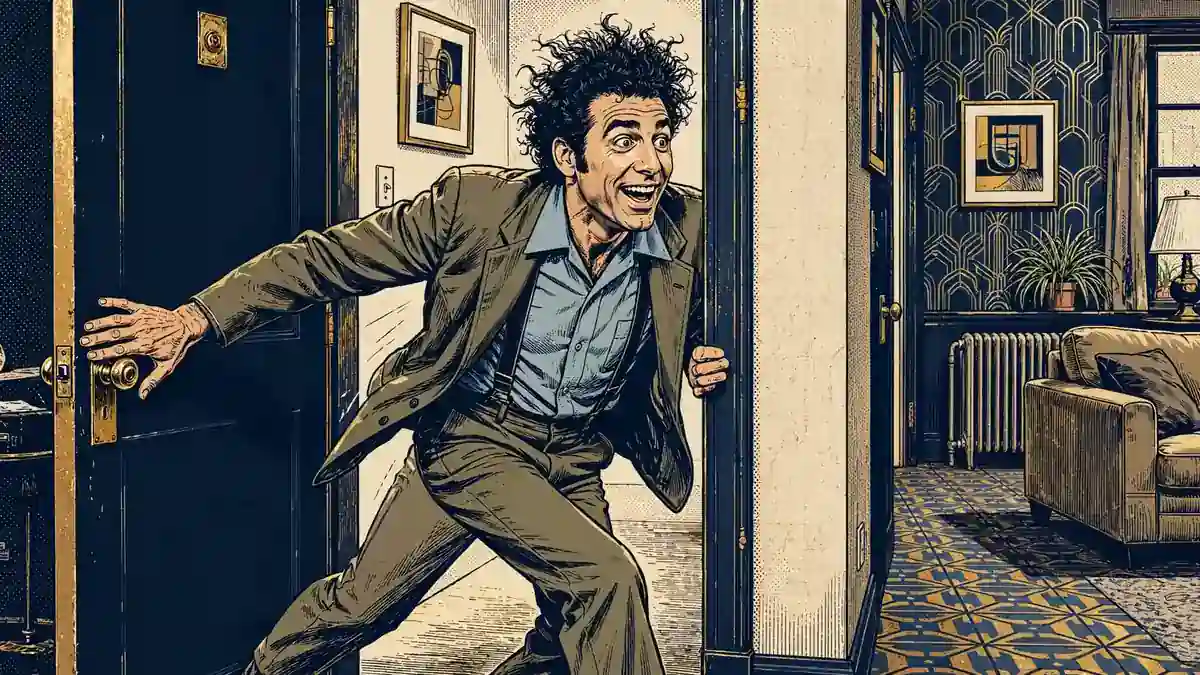
Seinfeld premiered on NBC on July 5, 1989, as The Seinfeld Chronicles, and Richards played Cosmo Kramer from the pilot through the finale on May 14, 1998 — 180 episodes across nine seasons. The character was loosely based on Kenny Kramer, a real neighbour of Larry David’s in Manhattan, and was originally called Kessler in the pilot. Richards rebuilt him from the outside in. He scoured second-hand shops for clothes Kramer might have owned for decades, never anything new or shiny. He decided Kramer moved the way a dog might move — an idea that began when producers rejected his suggestion that Kramer own a dog, so Richards embodied the animal himself. He treated Kramer as a trickster figure living largely in his imagination, a man whose schemes (the Muffin Tops bakery, the Kramerica Industries oil bladder, the coffee-table book about coffee tables) collapsed on contact with reality and never dented his confidence.
The performance earned three Primetime Emmy Awards for Outstanding Supporting Actor in a Comedy Series, in 1993, 1994, and 1997 — more wins in that category than any of his Seinfeld castmates. The finale drew about 76 million viewers in the United States, one of the largest audiences in television history. By the final seasons, Kramer had become the show’s most imitated creation: the entrance, the hair, the sudden reversals of mood. Syndication then did what a single salary could not. Reruns carried Kramer to viewers who were children when the show aired, and streaming carried him further still. Richards has said little in public about the character in recent years, but the 2024 memoir returns to the craft of building him in detail — the auditions, including one in which he performed headstands to show his physical commitment, and the four-episode initial order that gave him room to experiment before the show became a hit.
Fame, for Richards, was narrow and deep. He never became a movie star, never fronted a franchise, and never built a production company. He became one character so completely that the character now pays his bills. That is the whole financial story in one sentence, and it explains both the size of the fortune and its ceiling.
Main Sources of Income
Richards’s income breaks into five streams, and only the first two have ever been large. The first is Seinfeld base salary across nine seasons, which Celebrity Net Worth totals at roughly $45 million before taxes and professional fees for Richards, Julia Louis-Dreyfus, and Jason Alexander each. That gross figure is the foundation of the net worth, and it is also a lesson in how much of a television salary disappears: agent and manager commissions, taxes at California’s top rates, and living costs across the years when the cheques were largest. A $45 million career gross, taxed and fee’d, landing at a $30 million net worth three decades later, with residuals and property appreciation filling the gap, is arithmetic that checks out.
The second stream is residuals. Richards receives standard SAG-AFTRA residuals when Seinfeld airs in reruns, on cable, and on streaming services, plus a share of DVD sales that the supporting cast negotiated in the early 2000s (more on that negotiation below). Celebrity Net Worth and Parade both describe these payments as hundreds of thousands of dollars per year — real money, and the reason the fortune has held steady rather than draining, but nowhere near the tens of millions per year that flow to Jerry Seinfeld and Larry David from ownership. The third stream is film and television work after Seinfeld, which was modest and, after 2006, close to zero. The fourth is the memoir Entrances and Exits (Permuted Press, June 4, 2024), a New York Times bestseller with a foreword by Jerry Seinfeld, which added book advances and royalties but no figure any outlet has published. The fifth is live appearances: Celebrity Net Worth notes that by 2026 Richards had begun returning to the stage for live storytelling and audience question-and-answer events, a low-volume, high-ticket form of income that suits a 77-year-old performer who has said he is not chasing a comeback.
What is missing from the list is as telling as what is on it. Richards has no production company with a sale price attached, no restaurant chain, no tequila brand, no clothing line, and no disclosed venture portfolio. Competitor profiles that credit him with “business ventures” and “brand investments” never name a company, a deal, or a dollar figure, and this article does not repeat those claims as facts. His wealth is a salary fortune, preserved by residuals and property, not a business fortune.

Salary and Earnings
The salary ladder is the best-documented part of Richards’s finances, because the 1997 negotiation was reported at the time by Variety and has been retold by the cast ever since. For the first several seasons, the three supporting players earned what Celebrity Net Worth calls a nominal amount. Before season five in 1993, they negotiated raises to $150,000 per episode, worth roughly $3.8 million for a full season. By the mid-1990s, reporting puts the rate around $200,000 per episode. Then came the holdout of May 1997. Richards, Louis-Dreyfus, and Alexander asked for $1 million per episode and, more importantly, for backend participation in the show’s profits. NBC countered at $200,000, then $400,000. The final deal, reported by Variety in 1997, was $600,000 per episode for the final season — a jump from the roughly $160,000 per episode Parade cites for the prior seasons, a discrepancy that reflects how the trades counted different contract years and should not be smoothed over.
For the final season, that rate produced about $13 million per performer, according to Parade’s account of the Variety reporting. Celebrity Net Worth puts the final-season figure closer to $15 million. The per-episode rate is not in dispute; the season total moves with how many episodes and added payments each source counts. This article reports the range and names both outlets rather than picking the larger number for effect. Across the full run, Celebrity Net Worth’s estimate of roughly $45 million in base salary per supporting player is the most widely cited total, and it is consistent with the ladder: small early cheques, a $150,000 plateau, a $200,000 middle stretch, and a $600,000 finale.
For scale, Jerry Seinfeld’s salary path ran far ahead at every step: $20,000 per episode in the five-episode first season, $40,000 in seasons two and three, $100,000 in seasons four through six, $500,000 in seasons seven and eight, and $1 million per episode in the final season. NBC, desperate for a tenth season, reportedly offered Jerry Seinfeld $110 million to keep going. He declined. The supporting trio’s $600,000 finale rate was, at the time, among the highest salaries on television — and still 40 percent below the star’s rate, with none of the ownership that made the star’s rate a footnote.
One more negotiation belongs in any honest salary history, because most competitor profiles skip it. In 2003, Richards told The New York Times that he and his fellow supporting players initially refused to record new material for the Seinfeld DVD release, after asking, in his words, whether there was any compensation and being told there was not. They eventually negotiated a percentage of DVD sales. That holdout, six years after the finale, is the only backend-style payment the supporting cast ever secured, and it arrived when the DVD market was near its peak — a well-timed bargain that still pays, in smaller amounts, as physical media fades.
The Backend Deal That Never Happened
Jason Alexander has told the story plainly, and Richards has never contradicted it. In a 2004 interview with The Globe and Mail, Alexander said: “Julia, Michael and I, during our big renegotiation for the final year, asked for something that I will go to my grave saying we should have had, and that is back-end participation in the profits for the show. It was categorically denied to us, which forced us to then ask for ungodly salaries.” The denial is the single most expensive sentence in Richards’s financial life.
To see why, follow the money the creators collected. Seinfeld was produced by Castle Rock Entertainment, and distribution sits with Sony Pictures Television. The first off-network syndication cycle in 1995 sold to 224 local stations for more than $500 million. A second cycle around 1998 brought roughly $1.1 billion, including a TBS deal reported at more than $1 million per episode for cable rights. By 2010 the show had earned about $2.7 billion in reruns, according to Warner Bros. chairman Barry Meyer, and the Wall Street Journal later put total syndication above $3 billion. Hulu paid a reported $130 million to $180 million for streaming rights in 2015. Netflix paid more than $500 million for global streaming rights in 2019, the largest sum ever paid for an off-air series at the time, and TheWrap reported that Jerry Seinfeld and Larry David each received nine figures from that deal alone, with one source putting each share at $100 million to $125 million. In August 2026, Sony renewed the Netflix arrangement for five more years in the United States and Canada, while Paramount renewed basic-cable rights for three years; financial terms were not announced, but Nielsen reported nearly 60 million Americans watched Seinfeld in the first half of 2026 alone.
Richards’s share of that river is a residual cheque, not a profit share. Alexander told The Globe and Mail in 2004 that the trio made “very little, standard Screen Actors Guild residuals for the reruns,” estimated by the paper at around $250,000 each that year. Two decades of reruns, cable deals, and streaming have lifted that annual figure into the hundreds of thousands, according to Celebrity Net Worth — a comfortable income, and a rounding error beside the creators’ haul. The often-repeated claim that Richards receives $300,000 per month in royalties, which would total $3.6 million per year, appears on gossip roundup sites citing no primary source, and it flatly contradicts Alexander’s own account and Celebrity Net Worth’s hundreds-of-thousands-per-year framing. This article treats the monthly figure as an unverified rumour, not a fact, and readers should too.
The arithmetic of the missed deal is stark. Had Richards held even a single percentage point of the show’s backend, his fortune would be several times larger. He holds none. That is why a performer from the most profitable sitcom in television history is worth $30 million while its co-creators are worth roughly $750 million each from the show, according to Celebrity Net Worth’s accounting of their salaries, syndication, and streaming shares.
Businesses and Investments
There is no public record of Richards founding, funding, or selling a business. He has no production company of note, no disclosed startup portfolio, and no brand partnership with a sale or valuation attached. Some competitor pages list “business ventures” and “investments” as income sources without naming one, and this article declines to invent the detail. What can be documented is conservative rather than entrepreneurial: a long-held Los Angeles-area property base, a DVD participation deal, and a memoir contract.
The investment story that does hold up is time. Richards was paid at the peak of network television, when a hit sitcom salary could be banked rather than spent on a lifestyle business. He did not, so far as any public record shows, burn the fortune on failed restaurants or vanity projects. The fortune’s stability across thirty years of minimal new earnings is itself evidence of careful management — or, at minimum, of a cost base that never outran the residual cheques. Readers looking for a hidden business empire will not find one here, and the absence is reported rather than papered over.
Brand Deals and Sponsorships
Richards has no documented endorsement portfolio. He did not become a pitchman after Seinfeld, and after 2006 no major brand would have touched the association in any case. His commercial appearances were as an actor — television spots early in his career — rather than as a celebrity endorser lending his name to a product. The memoir’s 2024 press tour, including appearances on Today and The View, was promotional work for a book, not a sponsorship.
This section is short on purpose. Net-worth profiles often pad a “brand deals” heading with generic claims when a subject has none. Richards’s endorsement income, on the public record, is negligible, and saying so plainly is more useful than a paragraph of speculation about deals that never existed.

Houses, Cars and Other Assets
The best-documented property transaction in Richards’s name is a Studio City house he bought in 1992 for $525,000 and sold in 1998 for $810,000, a gain of $285,000 before costs, reported by TheThings and repeated in later roundups. The timing is neat: bought as Seinfeld salaries climbed, sold the year the show ended. The sale price is sometimes misreported in roundups as a current valuation; it is not. It is a 1998 sale, and the house’s value since then belongs to its later owners, not to Richards.
Less solid is the Los Angeles home described in celebrity-gossip coverage: a 6,035-square-foot house purchased in 1996 for $1.75 million, where Richards and his wife Beth Skipp are said to live. That account comes from gossip outlets, not from a property record cited in mainstream reporting, so this article reports it as gossip-outlet reporting, not as a verified holding. No reliable outlet has published a current, sourced valuation of Richards’s primary residence, and no car collection, boat, or other luxury asset has a sourced figure attached. Richards is not known for a public car collection, and profiles that imply one offer no make, model, or price.
What can be said with confidence is that property has been a store of value, not a trading business. One documented flip with a six-figure gain, plus a long-held family home in Los Angeles, fits a performer who banked television money in real estate rather than in equities or startups. It does not support the $8 million to $10 million current valuations that some roundups attach to the old Studio City house as if Richards still owned it.
The 2006 Laugh Factory Night and Its Cost
On November 17, 2006, Richards was performing stand-up at the Laugh Factory in West Hollywood, attempting a return to the club circuit, when audience members heckled him. He responded with a tirade that included repeated racial slurs and a reference to lynching. An audience member filmed the set, TMZ published the video, and within days the footage was worldwide news. Three days later, on November 20, 2006, Richards appeared by satellite on Late Show with David Letterman — Jerry Seinfeld had been scheduled as that night’s guest and suggested the appearance — and apologised, saying he had lost his temper after being heckled, that he was deeply sorry, and that he was not a racist. Seinfeld, on the same broadcast, told the audience to stop laughing, saying the incident was not funny.
The financial cost is measurable in opportunity, not in fines. Richards has said he effectively exiled himself from Hollywood afterward, turning down the machinery of a comeback. In his 2024 memoir and in a Today interview with Hoda Kotb that year, he called the outburst despicable, said anger had a hold of him, and said he cancelled himself out to examine what had happened inside him. He told People magazine in 2024 that he was not looking for a comeback. The roles that might have followed a successful Kirstie-era return or a stand-up tour never materialised at scale, and his screen credits after 2006 amount to a handful of small parts across thirteen years. Had he worked steadily through the 2010s at even a fraction of his Seinfeld fame, his fortune would plausibly be higher. How much higher cannot be estimated honestly, and this article does not put a number on a career that did not happen.
The incident also explains the shape of the 2024 return. Entrances and Exits addresses the Laugh Factory night at length, including the Letterman apology and the crisis managers who urged damage control while Richards, by his account, believed the damage was inside him. The book’s publication, with a foreword by Jerry Seinfeld, functioned as a public reckoning rather than a relaunch: no sitcom deal followed, no tour was announced, and Richards has since appeared only in low-key live storytelling settings. The money story after 2006 is therefore a story of preservation. Residuals kept arriving. The fortune did not grow, and it did not collapse.
Awards and Achievements
Richards won the Primetime Emmy Award for Outstanding Supporting Actor in a Comedy Series three times for Seinfeld, in 1993, 1994, and 1997. No other member of the show’s cast won as many acting Emmys for the series. He also shared in the show’s ensemble honours, including its 1993 Emmy for Outstanding Comedy Series, and the series itself is a fixture of every credible greatest-sitcom list published since. His film and stage work never produced an equivalent honour, and his later career added no major award.
The Emmys matter to the money story in one specific way: they certified, at the time, that Kramer was not a supporting player in the ordinary sense but a co-lead in performance terms. That certification makes the contract gap more striking, not less. The most decorated actor on the show, by Emmy count, was paid as an employee while the writers owned the asset. Awards did not convert into equity, and Richards’s case is now the standard example agents cite when explaining why backend points matter more than salary.
Peer Comparison: The Seinfeld Cast Ranked
Placing Richards beside his castmates shows how a single contract clause reorders a fortune. Jerry Seinfeld, with ownership, is estimated at roughly $950 million to $1.1 billion. Julia Louis-Dreyfus, who had no backend on Seinfeld but built a second fortune on Veep and producing, is estimated at roughly $250 million. Jason Alexander, who shared Richards’s exact Seinfeld contract position, sits in a similar range to Richards, with decades of Broadway, directing, and voice work layered on top. Richards, with the smallest post-show output of the four, sits at the bottom of the core cast at $30 million to $35 million — still a large fortune, and the clearest illustration in the group of what salary alone buys.
The comparison also corrects a common misunderstanding. Fans often assume the four stars split the syndication billions four ways. They did not. Two creators owned the show, one star built a second career, and two supporting players lived on salary plus residuals. Richards’s position at the foot of that table is not a sign of failure. It is the arithmetic of the deal he signed, and of the eighteen years after 2006 in which he chose, by his own account, not to pursue the work that might have closed the gap.
Net Worth Growth Over the Years
No outlet publishes an audited year-by-year balance sheet for Richards, so the table below is a reconstruction from the documented salary ladder and the published estimates, labelled as such. The early years are salary accumulation; the later years are preservation.
| Period | What happened | Estimated position |
|---|---|---|
| 1989–1992 | Early Seinfeld seasons at modest supporting rates; film and guest work | Under $5 million |
| 1993–1996 | Raise to $150,000 per episode, then around $200,000; first property purchase | $5 million to $15 million |
| 1997–1998 | Final season at $600,000 per episode; Studio City sale at $810,000 | $20 million to $30 million |
| 1999–2006 | Failed sitcom, small film roles, DVD participation negotiated in 2003 | Around $30 million |
| 2007–2023 | Near-total retreat after the Laugh Factory incident; residuals sustain the fortune | Around $30 million |
| 2024–2026 | Memoir publication; return to live storytelling appearances | $30 million to $35 million |
The flat line from 1998 onward is the point. Most celebrity fortunes in this series rise, fall, or spike with new projects. Richards’s line goes flat for nearly thirty years because the income that sustains it — residuals — is designed to be flat, and because he stopped adding new income. The $35 million top of the current range is generous: it credits property appreciation and a memoir cycle that no outlet has priced. The $30 million anchor is the figure two independent profiles still publish, and readers should treat it as the safer number.
Social Media Presence
Richards has no verified, active personal social media presence that functions as a business channel. He does not run an Instagram, X, or TikTok account with a public following comparable to his castmates, and he has never monetised a social following with endorsements. Fan accounts and clips of Kramer entrances circulate widely, but they are not his, and they pay him nothing directly. Any account claiming to be Richards selling appearances or merchandise should be treated with scepticism: his public appearances since 2024 have been announced through publishers and venues, not through a personal feed.
The absence is consistent with the rest of the profile. A performer who stepped away from Hollywood for nearly two decades did not build the direct-to-audience business that younger comedians use to replace television income. His audience reaches him through reruns and streaming, and the money reaches him through the residual system, not through a link in a bio.
Personal Life
Richards married Cathleen Lyons in 1974; they divorced in 1992 and have a daughter, Sophia. He met actress Beth Skipp in 2002, when both were working at CBS Radford Studios, and they married in 2010 after an engagement announced in 2007. Their son, Antonio Baz Richards, was born in 2011. The family lives in the Los Angeles area, and Richards has kept his children out of the public eye: no reality appearances, no joint brand work, no public social accounts for his son.
Two personal disclosures from the memoir belong in a net-worth profile because they explain recent career decisions. Richards revealed in Entrances and Exits that he survived stage 1 prostate cancer in 2018, treated by surgical removal of his prostate, and he has said the health scare pushed him to finish the memoir. He is also a Freemason, a detail he has confirmed in interviews. Neither fact changes the fortune, but the cancer disclosure explains the timing of a book that arrived six years after treatment and eighteen years after the incident that ended his first career.
Sources & Reporting
Celebrity Net Worth — the $30 million anchor estimate; the $45 million career salary total; the $150,000, $200,000, and $600,000 per-episode ladder; the hundreds-of-thousands-per-year residual framing; the 2026 live storytelling return. Reporting window: profile updated 2026.
Parade — the 2026 profile confirming $30 million; Variety‘s 1997 reporting of $600,000 per episode and about $13 million for the final season; the 2003 New York Times DVD holdout account. Reporting window: 2026 profile.
Variety — original 1997 reporting of the supporting cast’s final-season salary, as cited by Parade. Reporting window: 1997.
The Globe and Mail — Jason Alexander’s 2004 interview: the denied backend request, the “ungodly salaries” quote, and the roughly $250,000 residual estimate for that year. Reporting window: 2004.
The New York Times — the 2003 DVD compensation interview with Richards, as cited by Parade. Reporting window: 2003.
TheWrap — the 2019 Netflix deal: more than $500 million, with nine-figure shares each for Jerry Seinfeld and Larry David, and the cast’s residual-only position. Reporting window: 2019.
The Wall Street Journal — syndication totals above $3 billion, as cited in later reporting. Reporting window: 2010s.
Los Angeles Times — reporting on the Netflix deal terms, as cited by GameSpot’s 2019 coverage. Reporting window: 2019.
People — Richards’s 2024 statement that he is not looking for a comeback. Reporting window: 2024.
NBC — Today interview with Hoda Kotb, 2024: the self-imposed exile, the prostate cancer disclosure context, and the memoir discussion. Reporting window: 2024.
Associated Press — November 2006 reporting of the Laugh Factory incident and the Letterman satellite apology. Reporting window: 2006.
Biographical records: Richards’s birth date and place, Army service 1970–1972, education, marriage dates, and filmography are drawn from encyclopaedic and biographical records consistent across Wikipedia, TV Insider, and Encyclopedia.com. Where gossip outlets disagreed — notably on the current family home and on the $300,000-per-month royalty rumour — this article names the disagreement instead of adopting the larger figure.
Frequently Asked Questions
What is Michael Richards’s net worth in 2026?
Michael Richards’s net worth is estimated at $30 million, with a range of $30 million to $35 million as of November 2026. Celebrity Net Worth and Parade both publish the $30 million figure. Higher figures of $45 million to $50 million circulate on low-authority roundup sites with no named source and are not adopted here.
How much did Michael Richards make per episode on Seinfeld?
Richards earned $150,000 per episode after the 1993 renegotiation, around $200,000 per episode in the mid-1990s, and $600,000 per episode in the final season, matching Julia Louis-Dreyfus and Jason Alexander. Jerry Seinfeld earned $1 million per episode that season. Across the full run, Celebrity Net Worth estimates about $45 million in base salary per supporting player before taxes and fees.
Does Michael Richards still make money from Seinfeld reruns?
Yes, but far less than fans assume. Richards receives standard SAG-AFTRA residuals for reruns, cable airings, and streaming, plus a share of DVD sales negotiated in 2003. Celebrity Net Worth describes the total as hundreds of thousands of dollars per year. He owns no backend stake in the show, so he does not share in the syndication billions that flow to Jerry Seinfeld and Larry David.
Why is Michael Richards worth so much less than Jerry Seinfeld?
Ownership. Jerry Seinfeld and Larry David created the show and held backend profit participation; the supporting cast were salaried employees. When the trio asked for backend points in the 1997 renegotiation, the request was denied, and they took $600,000-per-episode salaries instead. Netflix paid more than $500 million for streaming rights in 2019, and TheWrap reported nine-figure shares each for the creators — money the supporting cast never touched beyond residuals.
What happened to Michael Richards in 2006?
On November 17, 2006, Richards delivered a racially abusive tirade at hecklers during a stand-up set at the Laugh Factory in West Hollywood. Video of the set spread worldwide. He apologised by satellite on Late Show with David Letterman on November 20, 2006. He then largely withdrew from Hollywood, a self-imposed exile he discussed in his 2024 memoir Entrances and Exits and in a Today interview that year.
Is Michael Richards still acting?
His last screen credit dates to Faith, Hope & Love in 2019. He has said he is not looking for a comeback. Since his June 2024 memoir, he has returned to the stage in a limited way for live storytelling and audience question-and-answer appearances, according to Celebrity Net Worth’s 2026 update.
Who is Michael Richards’s wife?
Richards married actress Beth Skipp in 2010 after meeting in 2002. Their son, Antonio Baz Richards, was born in 2011. Richards was previously married to Cathleen Lyons from 1974 to 1992, and they have a daughter, Sophia.
What is Michael Richards doing now?
As of 2026, Richards lives in the Los Angeles area with his family, promotes his memoir Entrances and Exits (Permuted Press, June 2024), and makes occasional live storytelling appearances. He has no announced television or film project and no active social media business.
Final Thoughts
Michael Richards’s fortune is a clean, almost mathematical story. A gifted physical comedian turned one role into roughly $45 million of career salary, banked it through the peak years of network television, and has lived off the residual tail ever since. The $30 million estimate has barely moved in years because the income behind it barely moves: a few hundred thousand dollars a year from a show that ended in 1998, plus a house, plus a book. The missed backend deal is the hinge on which the whole story turns — denied in 1997, it capped a fortune that the show’s success would otherwise have multiplied many times over. The 2006 incident then removed the second career that might have softened that cap. What remains is secure, modest by sitcom-legend standards, and honestly earned: the money of a man who was paid extremely well for nine seasons of work that people still watch, and who has spent the decades since deciding, deliberately, not to chase more of it.
Published on 2026-11-02. Last reviewed November 2026. Found an error? See our corrections policy.