
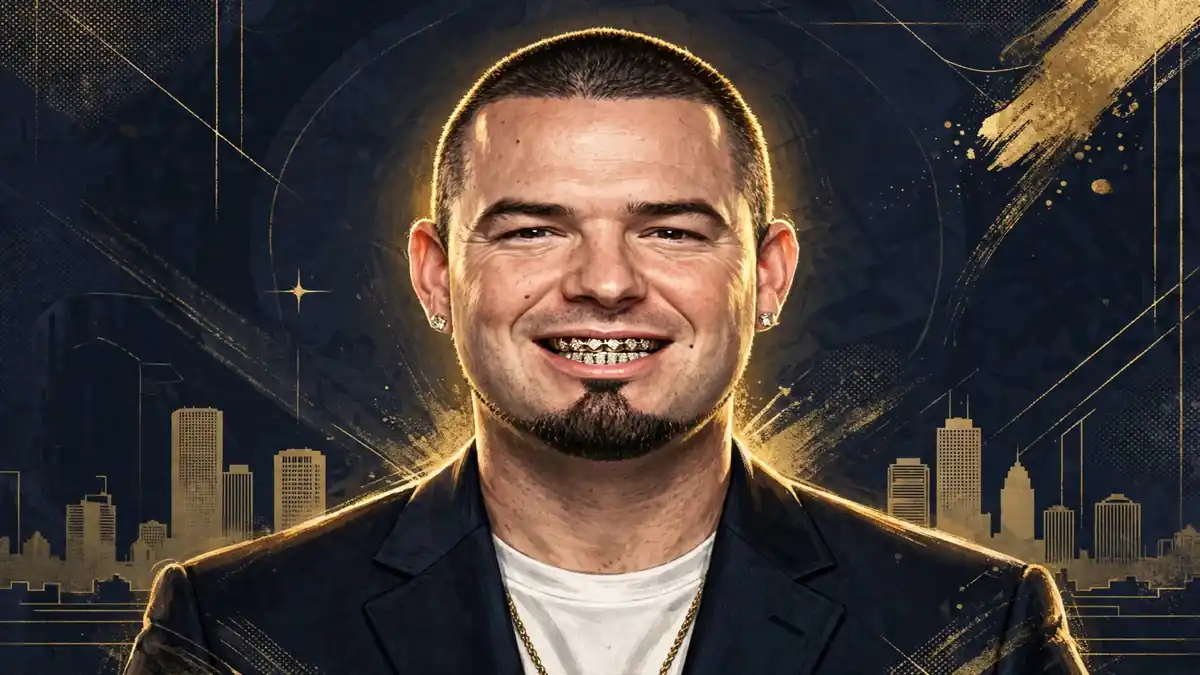
Paul Wall‘s net worth is estimated at $2.5 million to $5 million as of November 2026. The Houston rapper turned a No. 1 album, a No. 1 Nelly single and a diamond grill business into a two-decade career that is still producing new albums and sold-out rooms in 2026 — without ever chasing the pop-star spotlight.
Paul Wall: Quick Facts
| Estimated net worth | $2.5 million – $5 million (range: $2.5 million to $5 million) |
|---|---|
| Profession | Rapper, DJ, entrepreneur |
| Nationality | American |
| Born | March 11, 1981 (age 45) |
| Height | 5 ft 9 in (175 cm) — most commonly listed; IMDb lists 5 ft 11½ in |
| Primary income sources | Music royalties and streaming, touring, custom grillz and jewelry, brand appearances |
| Active years | 1998–present |
| Last reviewed | November 2026 |
- Early Life and Background
- Education
- Career Journey
- Rise to Fame
- Main Sources of Income
- Salary and Earnings
- Businesses and Investments
- Brand Deals and Sponsorships
- Houses, Cars and Other Assets
- Awards and Achievements
- Net Worth Growth Over the Years
- Social Media Presence
- Personal Life
- Sources & Reporting
- Frequently Asked Questions
Early Life and Background
Paul Michael Slayton was born on March 11, 1981, in Georgetown, Texas, and grew up in Houston, where the city’s car culture, chopped-and-screwed mixtapes and neighborhood hustle shaped everything he would later rap about. Most sources, including Wikipedia and IMDb, give March 11, 1981 as his birth date; a small number of older reference entries list March 30, 1980 instead, and we flag the disagreement rather than quietly picking one. What is not disputed is the Houston upbringing. Wall came of age in a city where slab culture — candy-painted cars on chrome rims, trunk-rattling bass, DJ Screw’s slowed-down tapes — was not a costume but a daily language, and he learned to speak it fluently before he ever recorded a verse.
He started early. By his own account, retold in profiles of his career, Wall was working street promotion for Cash Money Records by the age of 14, handing out flyers and pushing mixtapes while still in school. That teenage job taught him two things that would define his money story: how records actually move through a city, and how a rapper’s name becomes a brand before a label ever gets involved. He was freestyling and rapping in high school, and the local scene noticed quickly — not because he sounded like anyone else, but because a white kid from Houston rapping over Screw tapes with total conviction was impossible to ignore.
The early grind mattered financially as well as artistically. Houston’s rap economy in the late 1990s ran on independent releases sold hand to hand, and Wall learned the margins of that world first: pressing costs, trunk sales, radio-show appearances that cost nothing but paid in exposure. When he eventually met Chamillionaire, the two formed the Color Changin’ Click and started building the audience that would carry them both to major-label deals. The partnership began as a friendship and a shared work ethic, and it stayed one of the most productive alliances in Houston rap history.
Education
Wall attended Jersey Village High School in the Houston area, where he was already rapping and promoting music as a teenager. After high school he enrolled at the University of Houston, where he studied for three years before leaving to pursue music full time. The decision was not a rejection of school so much as a calculation: the music was already paying, and the classroom could wait. It was at the University of Houston that he met Crystal Slayton, the woman he would marry in 2005, so the three years there shaped his personal life even more than his career.
The education that actually built his fortune came outside the classroom. Working street teams at 14 taught him promotion; hustling independent records taught him margins; and his years around Swishahouse founder Michael “5000” Watts taught him how a regional label turns local loyalty into national distribution. Wall has never claimed a degree, and the article does not invent one for him. His business education is visible in the record instead: a jewelry company that has outlasted most rap careers, a catalog that still earns, and a touring schedule that still fills rooms more than twenty years after his first release.
Career Journey
Wall’s path into the music business ran through Houston’s Swishahouse label. After working promotions, he talked his way onto the radio show of Swishahouse founder Michael “5000” Watts, alongside his friend Chamillionaire, and the two became early signees of the label in the late 1990s. The Color Changin’ Click became their vehicle: a crew built around car culture, custom paint and the slowed-down sound DJ Screw had made Houston’s signature. Their first album together, Get Ya Mind Correct (2002), sold more than 200,000 copies as an independent release, according to Wikipedia — a remarkable number for a local record with no major-label machine behind it, and the proof of concept that made Atlantic Records pay attention.
The move to Atlantic in 2005 changed the scale of everything. Wall’s major-label debut, The Peoples Champ, arrived in September 2005 and debuted at No. 1 on the Billboard 200, selling 176,000 copies in its first week in the United States, per Encyclopedia.com’s account of the release. The album went platinum, and its singles — “Sittin’ Sidewayz” featuring Big Pokey and “Girl” — became permanent fixtures of mid-2000s rap radio. “Girl” peaked at No. 35 on the Billboard Hot 100, the biggest solo chart hit of his career. The summer of 2005 was, as Houston rap fans still call it, the Summer of Houston: Wall, Mike Jones and Slim Thug put Texas rap on the national charts at the same time, and Wall’s face was on the cover of the movement.
His follow-up, Get Money, Stay True (2007), debuted at No. 1 on Billboard’s Top R&B/Hip-Hop Albums chart and No. 8 on the Billboard 200, confirming that the debut was not a one-off. Fast Life followed in 2009, reaching No. 15 on the Billboard 200. After that, Wall settled into the independent rhythm that has defined the second half of his career: a steady stream of albums, mixtapes and collaborations — including Slab God (2015) — released on his own terms, touring constantly, and building the jewelry business into something bigger than a side project. By the mid-2010s he was releasing music at a pace that would have been impossible inside a major-label system, and the catalog kept growing: dozens of albums, mixtapes and collaborative projects across more than two decades.
The 2026 chapter proves the engine is still running. Wall released Fortune & Glory on June 5, 2026, under his own imprint, a project Okayplayer described as a reflection on legacy, growth and perseverance, balancing slab-culture anthems with more personal records. Two months later, on August 14, 2026, he released Repeat Repeat Repeat, a full collaborative album with Termanology on Perfect Time Music Group, according to KAZI Magazine’s running list of Houston rap releases for 2026. Singles “WAR AND PEACE” (September 7, 2026) and “Converse” (October 30, 2026) followed, and a tour schedule stretching from November 2026 into February 2027 — including the Dial Up Festival in Chandler, Arizona, the King of Cars show in Houston and a Warfield date in San Francisco — keeps him on stage at 45.
Rise to Fame
Wall’s rise had two engines running at once: his own records and his jewelry. The music engine peaked in 2005, when The Peoples Champ topped the Billboard 200 and “Sittin’ Sidewayz” became the anthem of Houston car culture. But the moment that carried him furthest beyond rap audiences came in November 2005, when he appeared on Nelly’s single “Grillz,” alongside Ali & Gipp. The song reached No. 1 on the Billboard Hot 100, and its success did something no album of Wall’s could have done on its own: it turned his side business — custom diamond mouthpieces — into a national pop-culture phenomenon. The track earned a Grammy nomination for Best Rap Performance by a Duo or Group at the 2007 Grammy Awards, the only Grammy nomination of Wall’s career, and it remains his most commercially successful recording.
The same year brought another high-profile placement: a verse on Kanye West’s “Drive Slow,” from West’s second album Late Registration, alongside GLC. Between “Drive Slow,” “Grillz” and his feature on Mike Jones’s hit “Still Tippin'” — a record he cut with Jones and Slim Thug — Wall’s voice was on three of the defining rap records of 2005, and his name was attached to the grillz trend that dominated hip-hop fashion for the next several years. That is the part of his rise most net-worth profiles miss: the fame was never just about record sales. It was about a look — gold and diamonds in the mouth — that he had helped invent as a business before it became a trend, and that let him monetize the fame twice, once as a rapper and once as a jeweler.
The nickname stuck. Houston started calling him “The People’s Champ,” a title that captured both his everyman persona and his standing in the city. Unlike many of his peers, Wall never tried to leave Houston behind or rebrand himself for a coastal audience. He stayed in the slab scene, stayed on the independent circuit, and stayed visible — a choice that limited his chart ceiling but gave him a career with no expiration date. Twenty years after his No. 1 album, he is still headlining festivals and releasing records, while plenty of bigger 2005 stars have vanished from the touring circuit entirely.
Main Sources of Income
Paul Wall’s money comes from four streams that have run in parallel for two decades, and the balance between them is what makes his net worth hard to pin to a single number. Music is the foundation: royalties and streaming income from a catalog anchored by a platinum No. 1 album, two gold singles from that album, and a No. 1 Hot 100 feature on “Grillz.” A catalog with a platinum album and a chart-topping single earns every year, even in years when the artist releases nothing, and Wall’s catalog has been earning since 2005. Streaming has replaced physical sales as the engine, but the principle is the same — the records he made in his twenties are still paying in his forties.
Touring is the second stream, and in recent years it has arguably become the largest. Wall tours constantly, playing festivals, car shows and club dates across the United States, and his 2026–2027 schedule includes the Dial Up Festival in Chandler on November 21, 2026, the King of Cars Custom Car Show & Culture Fest at Reliant Arena in Houston on November 22, 2026, the Warfield in San Francisco on December 4, 2026, the Turnt Up Tour with the Ying Yang Twins, Petey Pablo and Twista in Tulsa on December 18, 2026, and headline dates in Colorado Springs, Denver, Salt Lake City and Cedar Rapids running into February 2027. Ticket prices for his shows typically start in the $26–$43 range, according to ticket listings, and festival and car-show appearances — where he is often billed alongside Slim Thug, Lil’ Keke and Mike Jones — pay appearance fees that reflect twenty years of name recognition rather than a single hot record.
The third stream is the jewelry business, and it is the one that separates Wall from nearly every other rapper of his era. With jeweler Johnny Dang, he built Grills by Paul Wall into the premier custom grillz brand in hip-hop, supplying diamond and gold mouthpieces to artists including Lil Jon, T.I., Diddy and Usher, as well as athletes such as Olympic swimmer Ryan Lochte. The business is private, so no revenue figure is publicly disclosed, and we do not repeat the unverified “$2–3 million a year” claims that circulate on fan-run profile sites. What is documented is the physical asset behind it: the Johnny Dang & Co. store the pair opened on Richmond Avenue in Houston in October 2016, a two-level building reported at the time as a roughly $4.5 million property.
The fourth stream is the smallest but the most consistent: appearances, DJ sets, features and brand work. Wall is a working DJ as well as a rapper, and he takes paid guest verses, festival slots and promotional appearances that trade on his name and his Houston credibility. None of these streams alone would make him wealthy. Together, across twenty years, they produced the multi-million-dollar range this article estimates — and, just as importantly, they produced it without the boom-and-bust pattern of artists who depend on a single hit.

Salary and Earnings
Paul Wall has never had a publicly disclosed salary, because rappers do not draw salaries — they earn in spikes tied to releases, tours and business quarters. The closest thing to a pay stub in his record is the first-week performance of The Peoples Champ: 176,000 copies sold in its first week in the United States, at mid-2000s retail prices, with the album going on to platinum certification. A platinum album on a major label in 2005 generated millions in gross revenue, of which the artist’s share — after the label recouped its advance, marketing and distribution costs — was a fraction, typically in the low-to-mid six figures for a debut artist on a standard deal. We do not have Wall’s contract, so we do not invent a per-album paycheck; the honest statement is that the album made him real money in 2005, and that its singles, “Sittin’ Sidewayz” and “Girl,” added gold-single royalties on top.
The feature economy paid him too. A verse on a No. 1 single like “Grillz” earns performance royalties every time the song plays, and “Grillz” has been played, streamed and licensed for twenty years. Guest appearances on records by Nelly, Kanye West and Mike Jones carried feature fees at the time and royalty streams afterward. None of these figures are public, which is exactly why responsible estimates of Wall’s wealth disagree: the money is real but the paperwork is private. What can be said with confidence is that his peak earning years were 2005–2007, when he had a No. 1 album, a No. 1 feature, a Grammy nomination and a jewelry business all hitting at once, and that his earnings since then have been steadier and more diversified — less spectacular in any single year, but spread across music, touring and jewelry instead of depending on one album cycle.
Touring income is the most visible part of his current earnings. With shows booked from November 2026 through February 2027 and ticket prices starting around $26–$43, a working rapper of Wall’s stature can gross tens of thousands of dollars per headline date before costs, with festival and car-show appearances paying flat fees. Multiply that across a year of dates, add merchandise, and the touring line alone supports a comfortable living — before a single royalty check arrives. That is the financial story of Paul Wall’s second act: not a fortune built on one windfall, but a working income stitched together from a catalog, a stage and a storefront, year after year.
Businesses and Investments
The Johnny Dang partnership is the centerpiece of Wall’s business life and the reason his net worth conversation is different from that of most one-album rappers. Wall and Dang met in the early 2000s, when Wall was buying grillz for himself and his friends and Dang was the Houston jeweler making them. Together they formalized the trade as Grills by Paul Wall, and later as TV Jewelry, turning a street-level craft into a brand that supplied custom gold and diamond mouthpieces to the biggest names in hip-hop. Lil Jon, T.I., Diddy and Usher all wore their work, and the brand became the default answer to the question of where a rapper got his grillz. In October 2016 the partnership went physical in a major way: Wall and Dang opened Johnny Dang & Co., a two-level jewelry and lifestyle store on Richmond Avenue in Houston, in a building reported at the time as a roughly $4.5 million property.
The store matters for the net-worth estimate in two ways. First, it is a tangible asset with a documented value, unlike the private revenue of the grillz business itself. Second, it shows the direction of Wall’s money thinking: he invested in a storefront and a brand rather than spending the 2005 windfall on depreciating luxuries. The business has also proven durable in a way rap careers rarely are — the grillz trend has survived two decades, and the store is still the pair’s flagship. Wall’s role in the business is not ceremonial. He designs, promotes and sells the product, and his name is on the door. That is the difference between an endorsement and an ownership stake, and it is why the jewelry line belongs in the income column of his net worth rather than the lifestyle column.
Beyond jewelry, Wall’s investments are the quiet kind: his music catalog, his touring brand and his Houston real estate footprint. He has never publicized a venture-capital portfolio or a tech investment, and we do not invent one. His 2026 releases came out under his own imprint, which is itself an investment decision — owning the masters and the distribution margin on new work rather than renting them from a label. The catalog is the asset that compounds: every stream of “Sittin’ Sidewayz,” every license of “Grillz,” every new fan who discovers the 2005 records adds to a royalty base that cost him nothing to maintain.
Brand Deals and Sponsorships
Wall’s brand work has always been an extension of his identity rather than a separate lane. The grillz business is itself the brand deal — a product he co-owns, not a logo he rents. Around it, he has taken the kinds of deals that fit a Houston rap veteran: festival billing, car-show appearances, paid features and promotional work tied to the slab and grillz culture he helped popularize. The King of Cars Custom Car Show & Culture Fest in Houston, where he is billed alongside Slim Thug, Lil’ Keke and Mike Jones in November 2026, is a good example of the model: a cultural event that pays him to be exactly who he already is, in front of exactly the audience that already knows him.
He has never been a mainstream endorsement star in the manner of sneaker deals or beverage campaigns, and the article does not pretend otherwise. His commercial value is niche but deep: brands that want Houston, car culture, grillz or Southern rap credibility come to him, and they pay for authenticity that cannot be bought from a bigger name with no connection to the scene. That positioning has kept him working while bigger stars cycled through endorsement deals that expired with their chart runs. The sponsorship income is modest next to the jewelry business and the touring, but it is real, and it is another reason his earnings have stayed steady for twenty years.
Houses, Cars and Other Assets
The most documented asset tied directly to Wall is the Johnny Dang & Co. building on Richmond Avenue in Houston, reported as a roughly $4.5 million two-level property when the store opened in October 2016. It is the one hard number in his asset column, and it anchors the upper end of the net-worth range: a rapper who co-owns a multi-million-dollar commercial property is not a $2.5 million man by accident, even if the lower estimates ignore the building entirely. Beyond the store, Wall’s personal real estate is not a matter of public record, and we do not speculate about addresses or purchase prices that no outlet has reported.
Cars are a different story — in Wall’s world, they are the culture itself, and the car is the canvas. Wall’s identity is inseparable from slab culture: candy-painted cars, chrome rims, trunk bass and the Houston car-show circuit. He has owned and showcased custom slabs throughout his career, and his 2026 schedule includes the King of Cars show in Houston, where the vehicles are the point. A custom slab is both a possession and a marketing tool for a rapper whose brand is car culture, and Wall has treated it that way for twenty years. We do not assign a dollar value to his personal car collection, because no reliable source has, but it is fair to say the cars are a real, if illiquid, part of his holdings — and a visible one at every show he plays.
The rest of his asset base is the catalog. A platinum album, two gold singles, a No. 1 Hot 100 feature and a twenty-year discography of independent releases represent a royalty stream that, while impossible to value precisely from the outside, is the kind of asset that professional catalog buyers pay real money for. Wall has never sold his catalog, as far as the public record shows, and the 2026 releases under his own imprint suggest he intends to keep owning his work. Add the jewelry business, the storefront and the touring brand, and the asset picture is a diversified one — which is precisely why the low-end estimates that treat him as a retired one-hit rapper miss the mark.
Awards and Achievements
Wall’s trophy case is modest by superstar standards, which is part of the point of his story: his career was built on sales, touring and business, not awards-season campaigns. The headline achievement is the Grammy nomination he earned at the 2007 Grammy Awards, for Best Rap Performance by a Duo or Group, for his appearance on Nelly’s “Grillz” alongside Ali & Gipp. A Grammy nomination is the industry’s formal recognition, and it remains the only one of his career — a fact worth stating plainly rather than dressing up.
The commercial achievements are the stronger list. The Peoples Champ debuted at No. 1 on the Billboard 200 and was certified platinum; its singles “Sittin’ Sidewayz” and “Girl” were certified gold, with “Girl” reaching No. 35 on the Hot 100. Get Money, Stay True topped Billboard’s Top R&B/Hip-Hop Albums chart and reached No. 8 on the Billboard 200. Get Ya Mind Correct, his 2002 independent album with Chamillionaire, sold more than 200,000 copies without major-label support. He also won Best Rap Album at the 2006 Ozone Awards for The Peoples Champ, an honor from the Southern rap press that meant a great deal inside the scene he came from. And the achievement that no plaque captures: he turned a No. 1 album into a jewelry empire, a twenty-year touring career and a 2026 release schedule — a conversion rate from fame to fortune that most of his 2005 peers never managed.
Net Worth Growth Over the Years
| Year | Estimated net worth | What drove it |
|---|---|---|
| 2002 | Under $500,000 | Independent sales of Get Ya Mind Correct; street-level promotion income |
| 2005 | $1 million – $2 million | The Peoples Champ debuts at No. 1, goes platinum; “Grillz” tops the Hot 100 |
| 2007 | $2 million – $3 million | Get Money, Stay True hits No. 8; Grammy nomination; grillz business scales |
| 2010 | $2 million – $3 million | Catalog royalties steady; Fast Life era touring; weight-loss comeback keeps him visible |
| 2016 | $2.5 million – $4 million | Johnny Dang & Co. store opens in a roughly $4.5 million Richmond Avenue building |
| 2020 | $2.5 million – $4 million | Streaming-era catalog income; independent releases continue |
| 2024 | $2.5 million – $5 million | Touring rebound; catalog and jewelry business both active |
| 2026 | $2.5 million – $5 million | Fortune & Glory and Repeat Repeat Repeat; tour booked into February 2027 |
The table above is a NetWorthCraft estimate built from the public record, not a set of audited figures. The pattern it shows is the honest one: a sharp rise in 2005–2007, then a long plateau rather than a collapse. That plateau is the story. Most rappers who peak with a No. 1 album see their net worth fall by half within five years as the spotlight moves on. Wall’s did not, because the grillz business and the touring kept earning while the chart positions faded. The range widens in the later years because the private business makes precision impossible — the $2.5 million floor is Celebrity Net Worth’s published figure, and the $5 million ceiling reflects the storefront, the catalog and two decades of touring income that the low-end number does not account for.
Social Media Presence
Wall is active on the platforms where his audience actually lives, and he uses them the way a working independent artist should: to sell tickets, announce records and show the jewelry. His Instagram is the main channel, where he posts tour dates, studio sessions, grillz work and slab-culture content to a following built over two decades rather than bought in a month. He is also present on X and Facebook, and his music is distributed across Spotify, Apple Music and YouTube, where the 2005 hits continue to accumulate plays from listeners who were teenagers when they first charted and from younger fans discovering chopped-and-screwed Houston rap for the first time.
We do not publish follower counts in this article, because they change daily and the figures quoted on fan-run profile sites are routinely stale or invented. What matters for the money story is the function: social media is Wall’s tour poster, his record store and his jewelry showroom in one feed, and it costs him nothing to run. The 2026 album announcements and tour dates all traveled through those channels first, which is how an independent artist with no major-label marketing department fills rooms in seven cities. The audience is not the biggest in rap, but it is loyal, it buys tickets, and it has stayed with him for twenty years — the kind of following that converts to income far more reliably than a viral moment.
Personal Life
Wall married Crystal Slayton on October 22, 2005 — the same year his career exploded — and the marriage has lasted through the entire arc of his fame. The couple met while both were students at the University of Houston, and they have two children together: a son, William Patrick Slayton, and a daughter, Noelle Slayton. His son’s middle name honors the late Houston rapper Fat Pat, whose given name was Patrick Hawkins. Crystal is a fitness coach and entrepreneur in her own right, and the family is a visible part of Wall’s public life rather than a hidden one.
The most personal chapter of his story is the health transformation. In 2010 Wall underwent gastric sleeve surgery and went on an extreme diet, losing more than 100 pounds. He has spoken about the change in interviews since, and it became part of his public identity — the People’s Champ who took control of his health the same way he took control of his career. The weight loss also changed his stage presence and his stamina for touring, which matters for a performer whose income depends on being on the road at 45. He remains based in Houston, still rooted in the city and the scene that made him, and still married to the woman he met in college before any of it happened.
Sources & Reporting
Wikipedia — birth date and place (March 11, 1981, Georgetown, Texas), Swishahouse signing, Get Ya Mind Correct sales of more than 200,000 copies, The Peoples Champ chart debut and platinum status, “Grillz” No. 1 and Grammy nomination, marriage to Crystal in 2005, two children, 2010 gastric sleeve surgery and 100-plus-pound weight loss. Reporting window: profile as accessed November 2026.
Celebrity Net Worth — the $2.5 million net worth figure that anchors the low end of our range and is the most widely repeated estimate in the public record. Reporting window: figure as published and repeated across 2025–2026 coverage.
Encyclopedia.com — The Peoples Champ first-week sales of 176,000 copies and No. 1 Billboard 200 debut; the Grills by Paul Wall partnership with Johnny Dang; University of Houston attendance. Note: this source lists a March 30, 1980 birth date, which conflicts with Wikipedia and IMDb; we report the majority figure and flag the disagreement.
IMDb — birth date March 11, 1981, height 5 ft 11½ in (the higher of the reported heights), marriage date October 22, 2005, two children. Reporting window: profile as accessed November 2026.
Shazam (Apple) — street-team work for Cash Money at age 14, the Swishahouse radio-show break with Chamillionaire, Atlantic signing, platinum album and two gold singles, TV Jewelry and its celebrity clients. Reporting window: artist profile as accessed November 2026.
Zine Weekly — critical reading of the net-worth spread: the $2.5 million Celebrity Net Worth figure versus unsourced $8 million and $12 million claims; the Johnny Dang & Co. store opening in October 2016 and the roughly $4.5 million Richmond Avenue building. Published August 2026, updated September 2026.
KAZI Magazine — 2026 Houston rap releases: Fortune & Glory on June 5, 2026 and Repeat Repeat Repeat with Termanology on August 14, 2026. List last checked October 23, 2026.
Okayplayer — Fortune & Glory as a reflection on legacy, growth and perseverance, mixing slab anthems with personal records. Published June 2026.
Ticketmaster and Vivid Seats — 2026–2027 tour dates, including Chandler (November 21, 2026), Houston King of Cars (November 22, 2026), San Francisco Warfield (December 4, 2026) and headline dates into February 2027. Listings as accessed November 2026.
Where sources conflict — on the birth date, the height and the net worth figure itself — this article publishes the range and names who says what, rather than silently choosing the most flattering number. Figures labeled as NetWorthCraft estimates are our own calculations from the public record, not sourced claims.
Frequently Asked Questions
What is Paul Wall’s net worth in 2026?
Paul Wall’s net worth in 2026 is estimated at $2.5 million to $5 million. Celebrity Net Worth lists him at $2.5 million, the most widely repeated figure, while other outlets publish $2.8 million, $3 million and $5 million. The range reflects a real disagreement: his jewelry business is private, so no public source can give an exact number. The $4.5 million Johnny Dang & Co. storefront and twenty years of touring income support the higher end of the range.
How old is Paul Wall in 2026?
Paul Wall is 45 years old in 2026. He was born Paul Michael Slayton on March 11, 1981, in Georgetown, Texas, and raised in Houston. A small number of older reference entries list March 30, 1980, but Wikipedia, IMDb and most biography sources give March 11, 1981.
How tall is Paul Wall?
Paul Wall’s height is most commonly listed as 5 ft 9 in (175 cm) on biography sites. IMDb lists him at 5 ft 11½ in (1.82 m), and some profile pages claim 6 ft. The 5 ft 9 in figure is the one that appears most often, so we report it with the disagreement noted.
Who is Paul Wall’s wife?
Paul Wall is married to Crystal Slayton, whom he met while both were students at the University of Houston. They married on October 22, 2005, and have two children: a son, William Patrick Slayton, and a daughter, Noelle Slayton. Crystal is a fitness coach and entrepreneur.
How did Paul Wall get famous?
Paul Wall got famous in two stages. First, his 2005 major-label debut The Peoples Champ debuted at No. 1 on the Billboard 200, carried by the singles “Sittin’ Sidewayz” and “Girl.” Second, his appearance on Nelly’s No. 1 single “Grillz” later that year turned his custom grillz business into a national trend and earned him a Grammy nomination. He had already built a Houston following through Swishahouse and his 2002 independent album Get Ya Mind Correct with Chamillionaire.
What is Paul Wall’s most famous song?
Paul Wall’s most famous song is “Sittin’ Sidewayz” featuring Big Pokey, the lead single from The Peoples Champ and the anthem of Houston slab culture. His biggest chart success, though, came as a featured artist on Nelly’s “Grillz,” which reached No. 1 on the Billboard Hot 100. “Girl,” his highest-charting solo single, peaked at No. 35 on the Hot 100.
Does Paul Wall still make music in 2026?
Yes. Paul Wall released the album Fortune & Glory on June 5, 2026, under his own imprint, followed by the collaborative album Repeat Repeat Repeat with Termanology on August 14, 2026, and the singles “WAR AND PEACE” and “Converse” in the fall of 2026. He is also touring from November 2026 into February 2027, with dates in Chandler, Houston, San Francisco, Tulsa, Denver and Salt Lake City.
What is Paul Wall’s grillz business?
Paul Wall co-owns the custom grillz and jewelry business Grills by Paul Wall with Houston jeweler Johnny Dang. Together they opened Johnny Dang & Co., a two-level jewelry store on Richmond Avenue in Houston, in October 2016, in a building reported as a roughly $4.5 million property. Their clients have included Lil Jon, T.I., Diddy, Usher and Olympic swimmer Ryan Lochte. The business is private, so its revenue is not publicly disclosed.
Final Thoughts
Paul Wall’s net worth — $2.5 million to $5 million by our estimate — is not the biggest number in Houston rap, and that is exactly what makes it interesting. He never had a second No. 1 album, never became a pop star, and never chased the endorsement deals that made his peers rich for a season and broke the next. What he did instead was convert one explosive year, 2005, into a twenty-year career: a platinum album that still earns, a jewelry business he co-owns outright, a touring schedule that still fills rooms, and new records in 2026 that prove he has not stopped working. The low-end estimates treat him as a retired rapper with a $2.5 million footnote. The evidence — the storefront, the catalog, the tour dates — says he is a working businessman whose fortune is diversified, durable and still growing. The People’s Champ earned the nickname twice: once for the music, and once for the way he turned it into a living.
Published on November 19, 2026. Last reviewed November 2026. Found an error? See our corrections policy.